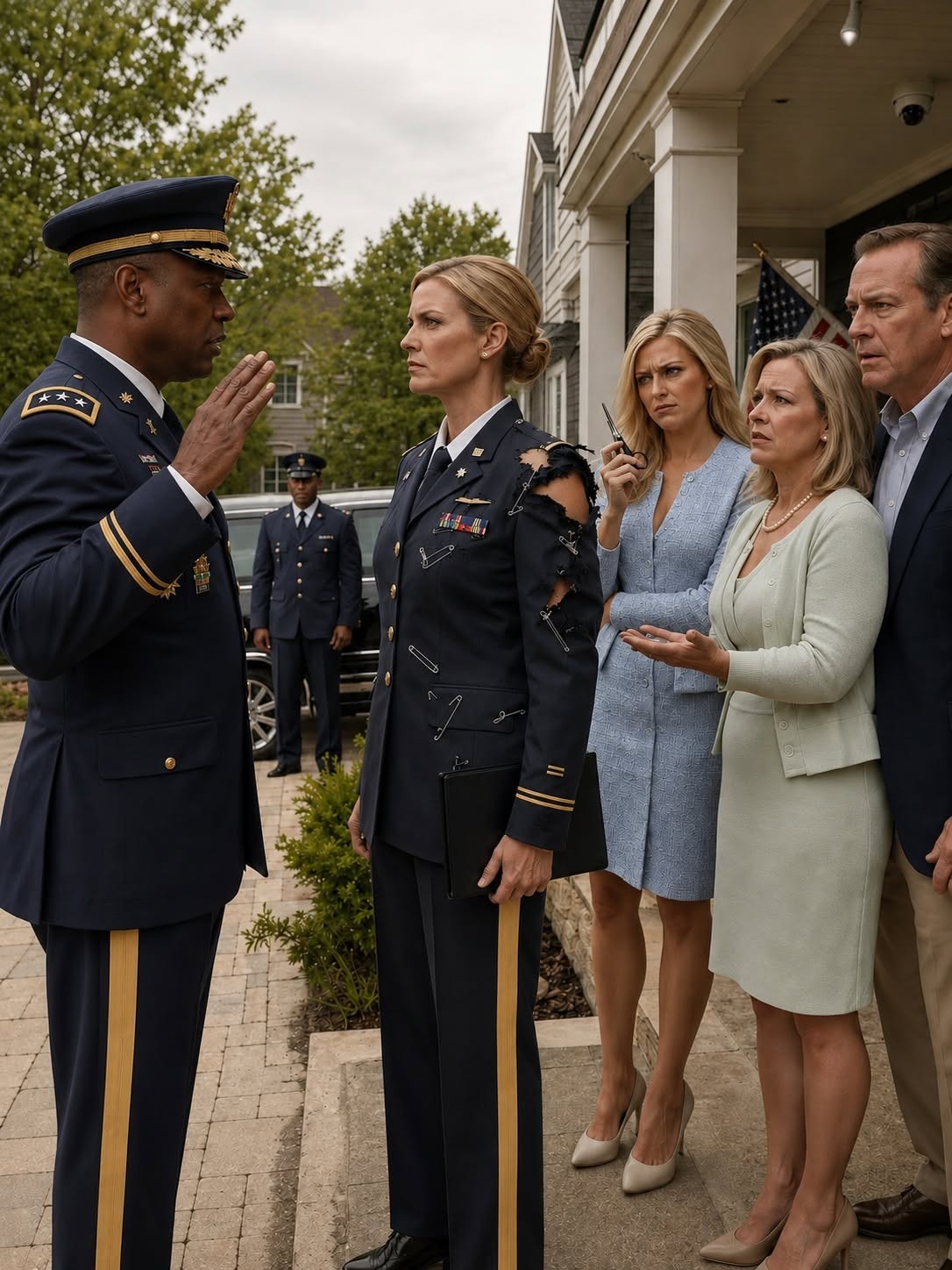

“It’s just a uniform—stop acting like somebody died.” My mother said it while I held my dress-blue jacket in two pieces and my sister sipped coffee, smiling
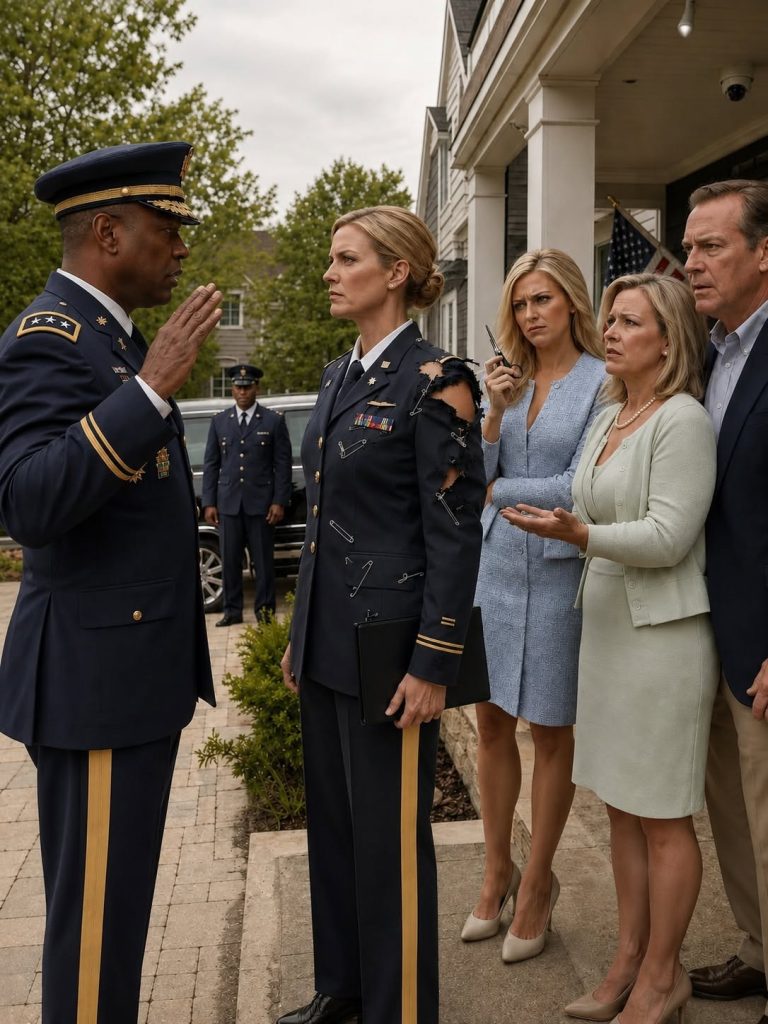
The drive to Arlington was a masterclass in controlled fury.
The heater in my aging sedan rattled against the dashboard, blowing lukewarm air while my hands gripped the steering wheel so tight my knuckles turned translucent. My mind wasn’t on the highway or the crawling morning traffic along Interstate 66. It was replaying every single family dinner, every subtle put-down, and every financial bailout I had quietly funded for people who viewed my sacrifice as a logistical inconvenience for Callie’s wedding calendar.
By 8:45 a.m., I pulled into the Pentagon security checkpoint.
The security guards knew me. They also noticed the state of my service coat. When I unzipped my garment bag in the screening area, the safety pins holding my left shoulder together caught the hard fluorescent lights.
Master Sergeant Hayes, a veteran of two tours in Kandahar who had reviewed security clearances with me three years prior, stopped dead in his tracks.
“Captain Marsh?” he asked, his eyes dropping to the improvised stitches and the frayed edge of the fabric. “What in God’s name happened to your dress blues?”
“Domestic sabotage, Sergeant,” I said, my voice deadpan.
He stared at me for a long second, then his jaw tightened into a hard, rigid line. “You need a replacement? I can pull a spare from logistics inventory downtown, but it won’t be tailored to your frame in fifteen minutes.”
“No time,” I checked my watch. “The panel starts at ten.”
Hayes looked at the envelope in my hand, out of which peeked the edges of eleven years of sliced ribbons—the Legion of Merit, the Bronze Star, the Meritorious Service Medal, all severed down the middle. A cold, quiet anger settled into his eyes.
“Go in there, Elena,” Hayes said, holding the security gate open. “Kill the interview. When you’re done, come back to my desk. We’re going to make a few phone calls.”
Inside the Pentagon Boardroom
The interview room was cold, high-ceilinged, and dominated by a polished mahogany table that reflected the harsh overhead lights.
Four officers sat behind it. In the center was Major General Thomas Vance, a man with silver hair, piercing gray eyes, and a reputation for chewing up intelligence officers who didn’t know their data down to the decimal point. To his left sat Colonel Harris and two senior civilian analysts from the Office of the Under Secretary of Defense.
I walked in, stood at attention, and sat down.
I didn’t offer an excuse for the safety pins holding my jacket together. I didn’t mention my sister, my mother, or the breakfast island in Virginia.
General Vance didn’t ask about the jacket either, not at first. He opened my personnel dossier, flipped through my evaluations, and then looked directly at me.
“Captain Marsh,” Vance began, his voice gravelly and smooth. “Your file is exceptional. You’ve spent eleven years tracking illicit supply chains and encrypted communications across Eastern Europe and the Middle East. But this task force requires absolute focus. Zero distractions. Tell me why you’re the right fit for a joint command when personal affairs can sometimes cloud judgment.”
It was a standard stress question, designed to see how candidates handled pressure.
I looked him straight in the eye.
“Sir, for eleven years, I have maintained top-secret clearance while managing high-stakes intelligence assets under active threat,” I said, my voice ringing clear across the quiet room. “Three hours ago, an attempt was made to compromise my readiness for this exact interview by a family member who believed my military career was a decorative hobby.”
A ripple of surprise crossed Colonel Harris’s face.
Vance leaned forward, resting his forearms on the table. “Explain.”
“My dress uniform was slashed with sewing scissors early this morning in an effort to prevent me from attending this board,” I said calmly, placing the white envelope containing the shredded ribbons onto the polished mahogany. “The perpetrator assumed I would stay home to avoid embarrassment. They miscalculated.”
I slid the envelope forward.
“I don’t break under pressure, General. And I don’t let interference go unaddressed.”
Vance stared at the envelope for a long moment. He slowly pulled out one of the sliced ribbons, turning it over in his calloused fingers. The deliberate, malicious cut through the center of the metal backing was unmistakable.
When Vance looked back up at me, the gray in his eyes looked like winter ice.
“Colonel Harris,” Vance said softly. “Get JAG on the phone. Tampering with an active-duty service member’s uniform and equipment on the eve of a Department of Defense selection board isn’t a family dispute. It’s a federal offense under the Uniform Code of Military Justice, specifically article 134, coupled with civilian obstruction.”
He looked back at me, a faint, grim smile touching the corner of his mouth.
“Welcome to the task force, Captain. Let’s go fix your uniform.”
Friday Afternoon in Virginia
By Friday afternoon, the storm hadn’t just broken over the house in Virginia; it had completely leveled it.
I sat in Master Sergeant Hayes’s office at Fort Myer, the micro-SD card from my grandfather’s hallway camera plugged into a secure terminal. On the monitor, timestamped at 1:13 a.m. on Wednesday, high-definition footage played out with pristine clarity.
There was Callie.
She wore her pink silk pajamas, her hair tied up in a loose bun. She crept down the hallway carrying my mother’s heavy silver sewing scissors, slipped into the guest room, and emerged four minutes later holding my dress-blue jacket by the collar, wearing a look of malicious, spiteful satisfaction.
The audio picked up her muffled humming as she carried the jacket down to the basement craft table to execute her masterpiece.
“Well,” Hayes said, leaning back in his chair with his arms crossed. “That’s airtight. We have the perpetrator, the weapon, the motive expressed at dinner, and clear intent to sabotage a federal security vetting process.”
“What’s the next step, Sergeant?” I asked.
“Federal marshals, a military investigator, and an arrest warrant for property destruction and interference with national security operations,” Hayes replied, picking up his phone. “Shall I make the call?”
“Give me two hours,” I said. “I want to deliver the invitation in person.”
The Final Reckoning
At 6:00 p.m. on Friday, the black government sedan pulled into the gravel driveway of my parents’ house in Virginia.
The house looked peaceful from the outside. Through the front window, I could see fairy lights strung across the porch—preparations for Callie’s engagement party with the Bennett family, scheduled for Saturday night.
I walked up the front steps wearing my newly issued, perfectly tailored dress blues, every ribbon pinned precisely in its rightful place.
I didn’t knock. I opened the front door and walked right in.
My mother was standing in the kitchen arranging white roses in a crystal vase. My father sat at the dining table reviewing guest lists with Mason Bennett and his parents, local royalty who were laughing politely at one of Callie’s stories.
Callie stood by the kitchen island holding a glass of champagne, wearing a designer cream dress.
When she saw me standing in the doorway in full uniform, her champagne glass stopped halfway to her mouth. The room went dead silent.
“Elena?” my father said, standing up, his face flushing a furious crimson. “What are you doing here? And why are you wearing that? I told you on Wednesday to drop the drama.”
“Good evening, Dad,” I said, my voice carrying clearly across the quiet open-plan house. “Mr. and Mrs. Bennett, good evening. I’m Captain Elena Marsh.”
Mason’s father frowned, looking between my father and me. “Gerald, what is this?”
“Nothing,” my mother intervened, hurrying out of the kitchen with a tense, forced smile. “Elena just has a flair for theatricality. She’s upset about a clothing mishap—”
“A federal offense, actually, Mom,” I interrupted, pulling a thick folder from under my arm and tossing it onto the dining table right on top of Callie’s guest list.
Callie dropped her champagne glass. It shattered against the hardwood floor, splashing champagne across her white shoes.
“What is that?” Callie hissed, her voice rising in panic.
“That is the evidence file from the hallway security camera,” I said, stepping closer. “The camera Grandpa installed three years ago that you forgot about. It recorded you sneaking into the guest room at 1:13 a.m. on Wednesday morning with Mom’s sewing scissors.”
Color drained entirely from Callie’s face. She looked at Mason, whose expression hardened instantly.
“That’s a lie,” Callie stammered, backing away toward the kitchen counter. “She’s making it up! She’s jealous because I’m getting married!”
“The footage has already been reviewed by the Department of Defense and military investigators,” I said calmly. “Tampering with a service member’s uniform on the eve of a Pentagon joint task force selection isn’t just family drama, Callie. It’s obstruction of a federal vetting process.”
My father slammed his hands down on the table. “You called the military on your own sister?! Have you lost your damn mind?! We are family!”
“No, Dad,” I said, looking him dead in the eyes for the final time. “For eleven years, I was the ATM, the errand runner, and the family scapegoat. You taught Callie that her actions have no consequences because you and Mom always cleaned up her mess.”
I turned my gaze to Mason’s father, who was staring at Callie with undisguised disgust.
“Mr. Bennett, I thought you should know before the Federal Marshals arrive with the arrest warrant tomorrow morning. Your future daughter-in-law has a rather unique criminal hobby.”
Mason stood up abruptly, looking at Callie as if she were a stranger. “Callie… is this true?”
“Mason, no, wait—!” Callie cried, lunging forward, but he stepped back, holding his hands up.
“We’re done,” Mason said quietly, turning to his parents. “Let’s go.”
As the Bennett family marched out the front door, slamming it behind them, my mother collapsed into a kitchen chair, sobbing hysterically into her hands. My father stood frozen, his political and social standing evaporating in real-time under the weight of his own willful blindness.
I turned toward the door, adjusting the silver buttons on my immaculate jacket.
“Wait!” Callie screamed, tears streaming down her face, her voice cracking with absolute terror. “You can’t do this! You’re ruining my life!”
I stopped at the threshold and looked back over my shoulder one last time.
“It’s just a uniform, Callie,” I said quietly. “Stop acting like somebody died.”
Then I walked out into the evening air, leaving them to finally face the consequences they had spent a lifetime avoiding.
