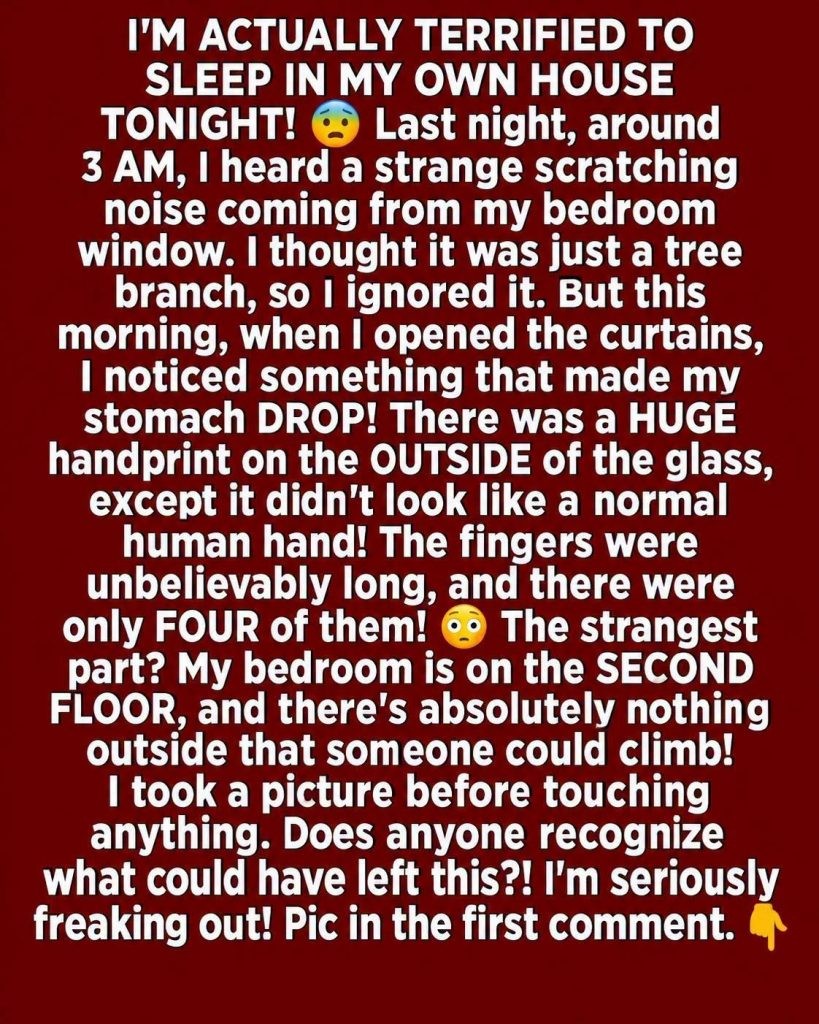

Discovering an unusual hand-shaped mark on an upstairs window can be an unsettling experience. At first glance, an impression resembling a human hand, especially one that appears to have only four fingers, may raise questions about how it got there. However, there may be a much simpler explanation: a nocturnal animal could have visited the outside of the home and left its tracks on the glass.
Why an Unusual Handprint Might Appear on an Upstairs Window
Windows on upper floors are not necessarily beyond the reach of wildlife. Many animals that live near residential neighborhoods are skilled climbers and regularly explore buildings, trees, fences, and rooftops. Although homeowners may rarely see these visitors, their nighttime movements can leave behind clues that become visible the following morning.
Raccoons and opossums are two animals commonly associated with nighttime activity around homes. Both can climb and navigate a variety of outdoor surfaces. Depending on the building’s design and surrounding landscape, an animal may reach an elevated window by climbing a nearby tree, following a drainpipe, moving along a roofline, or using another accessible structure.
A mark left on glass can look surprisingly human when viewed without additional context. Dust, moisture, pollen, and other environmental residue can make an animal’s paw impression more noticeable. The resulting pattern may resemble a handprint even when it was produced by an entirely different kind of visitor.
Raccoons Have Paws That Resemble Human Hands
Raccoons are particularly interesting candidates because their front paws have a distinctive appearance. Their long, flexible toes and sensitive front paws help them explore objects, handle food, and move through their surroundings. Unlike the paws of many other mammals, raccoon forepaws can produce impressions that look remarkably similar to small human hands.
Raccoons generally have five toes on each foot. Their toes are relatively long and separated, creating a recognizable footprint pattern. When an animal presses its paw against a dusty or damp window, the impression can reveal several individual digits and the broader shape of the paw.
Their front paws are also important tools for investigating unfamiliar objects. Raccoons frequently use their paws to examine surfaces, manipulate food, and explore openings. A raccoon moving across an exterior windowsill might briefly place its front paw against the glass for balance or support.
However, not every impression will show all five toes clearly. A paw may make incomplete contact with the surface, or some digits may leave marks too faint to distinguish. The shape of the glass, the animal’s movement, and the condition of the surface can all influence the resulting pattern.
Could an Opossum Be Responsible?
Another possible visitor is the Virginia opossum, a nocturnal marsupial found throughout much of the United States. Opossums are adaptable animals that can live in wooded areas, suburban neighborhoods, and environments where natural spaces overlap with human development.
Opossums are capable climbers, although their climbing abilities and movements differ from those of raccoons. Their feet have five toes, and their hind feet have a distinctive opposable thumb-like digit that helps them grip branches. This feature is particularly useful when navigating trees and other elevated structures.
Because opossums and raccoons both have five digits, an impression that appears to show four fingers does not automatically identify either species. A partial print, an overlapping impression, or an unclear contact pattern may conceal one or more toes.
Consequently, identifying an animal from a single mark on a window is difficult. Additional evidence, such as footprints, scratches, fur, or observations from a wildlife camera, can provide a more reliable indication of which animal may have visited.
How Nocturnal Animals Reach Upper Floors
Many homeowners underestimate how easily certain wild animals can access elevated areas. Trees growing close to houses are one potential route. Branches that extend toward roofs, balconies, and windows may create natural pathways for climbing animals.
Building features can also provide opportunities. Drainpipes, downspouts, rough exterior walls, fences, and adjoining structures may help some animals gain access to higher locations. Roof edges and gutters can offer additional routes once an animal has climbed partway up the building.
Raccoons are particularly adaptable in environments where natural vegetation and residential construction meet. They can investigate attics, sheds, garages, and other sheltered spaces when suitable access is available. Their curiosity and ability to manipulate objects can make them successful explorers of human-made environments.
Opossums also make use of sheltered spaces, including areas beneath decks, sheds, and buildings. Their presence near homes does not necessarily mean that they have entered the property or caused damage. They may simply be moving through the neighborhood while searching for food or shelter.
These behaviors help explain why an animal might leave a mark on a second-story window. An elevated location may appear inaccessible from inside the house, but the exterior environment can provide several routes that are not immediately obvious.
Why Four Fingers May Appear Instead of Five
One of the most unusual details in a mysterious window impression is the apparent absence of a fifth digit. A hand-shaped mark with four visible fingers may seem unusual enough to suggest a human origin. Nevertheless, incomplete animal tracks are common and should not be interpreted as definitive evidence of a particular source.
There are several possible reasons why a five-toed animal might leave an impression that appears to contain only four digits.
- Incomplete contact: One toe may not have touched the glass firmly enough to leave a visible mark.
- Uneven surfaces: Dirt, condensation, and other residue may create inconsistent impressions.
- Movement during contact: An animal that shifts its weight or slides its paw may produce a distorted pattern.
- Overlapping marks: Several impressions can overlap, making individual toes difficult to distinguish.
- Environmental conditions: Wind, rain, cleaning products, and accumulated dust can alter how a print appears over time.
These factors mean that a visible digit count is not always a reliable way to identify an animal. Wildlife tracking generally relies on several characteristics, including the overall shape, size, spacing, and arrangement of tracks, rather than one isolated feature.
How to Investigate a Mysterious Handprint Safely
When an unusual mark appears on an upstairs window, homeowners can begin investigating without disturbing possible wildlife. The most useful approach is to examine the surrounding area and look for several independent clues rather than relying on the appearance of the print alone.
1. Examine the Window and Nearby Surfaces
Start by looking closely at the mark from a safe position. Notice its approximate size, shape, direction, and whether individual digits are visible. Check whether the impression appears to contain several overlapping marks or a single continuous contact pattern.
Nearby surfaces may provide additional information. Dusty windowsills, exterior walls, roof edges, and other accessible areas can sometimes preserve footprints or smudges. Raccoon tracks, for example, can become distorted when animals climb surfaces such as downspouts, making the resulting marks less recognizable.
Taking photographs before cleaning the glass can also be helpful. Images taken from different angles and under different lighting conditions may reveal details that are difficult to see initially.
2. Look for Other Signs of Wildlife Activity
A single hand-shaped impression is not enough to establish which animal produced it. Additional evidence can make an identification more reliable.
- Footprints: Tracks in dirt, mud, or other soft surfaces may help distinguish raccoons from opossums.
- Scratches: Small marks on wooden frames or nearby structures may indicate that an animal has been climbing or exploring.
- Fur: Loose animal hair around an exterior opening may provide another clue, although it is not enough to identify a species by itself.
- Disturbed objects: Moved outdoor containers, overturned trash bins, or displaced items may indicate nighttime activity.
- Tracks on the ground: Prints beneath trees, near fences, or around the foundation can help establish a possible route.
It is important to remember that these signs can have multiple explanations. For example, scratches may result from weathering or ordinary maintenance issues, while disturbed outdoor objects may have been moved by wind or other animals.
3. Inspect Potential Climbing Routes
Look at the relationship between the window and nearby outdoor structures. A tree with branches close to the building may offer a convenient route toward the roof. Downspouts, fences, exterior stairs, and adjoining structures may also provide access points.
Gutters and roof edges deserve particular attention because they can connect different parts of a building’s exterior. However, homeowners should avoid climbing onto roofs or unstable structures to investigate a suspected animal visit.
If there are signs of repeated wildlife activity, a qualified wildlife professional can inspect the property and identify potential access points. This is especially useful when the suspected route leads toward an attic, chimney, or enclosed building space.
4. Consider Using a Wildlife Camera
When mysterious marks continue appearing, a motion-activated wildlife camera may help establish what is happening after dark. Properly positioned outdoor cameras can record animals moving along a yard, fence, or other accessible area.
Video evidence is generally more useful than attempting to identify an animal from one incomplete print. It may reveal the animal’s size, movement, approximate time of activity, and route around the property.
Any camera should be installed safely and positioned to respect neighbors’ privacy. Homeowners should also avoid placing equipment where it could interfere with an animal’s movement or encourage it to approach the house.
What Homeowners Can Do to Prevent Unwanted Wildlife Visits
Finding evidence of wildlife near a window does not necessarily indicate a serious problem. Raccoons and opossums are adaptable animals, and their presence in residential areas is not unusual. Nevertheless, reducing opportunities for animals to enter buildings can help prevent future encounters.
Secure Outdoor Food Sources
Accessible food is one of the reasons wildlife may repeatedly visit residential properties. Unsecured garbage, pet food left outdoors, fallen fruit, and food scraps can attract raccoons and other opportunistic animals.
Homeowners can reduce these attractions by using tightly secured garbage containers, bringing pet food indoors, cleaning outdoor feeding areas, and removing fallen fruit when practical.
Maintain Trees and Vegetation
Branches that touch or extend close to roofs and upper-floor windows may provide convenient access for climbing wildlife. Maintaining trees and vegetation can reduce some potential routes into a building.
Tree maintenance should be carried out carefully, particularly when branches are near electrical lines or elevated structures. Professional assistance is advisable when pruning involves significant height or other safety risks.
Check the Exterior of the Building
Regularly inspecting the roofline, attic vents, soffits, siding, and other exterior features can help homeowners identify gaps that might provide access to sheltered spaces.
Any suspected opening should be checked before it is permanently sealed. Closing an entry point while an animal is inside could trap it in an attic or wall cavity. A qualified wildlife-control professional can help determine whether an animal is present and recommend an appropriate solution.
Avoid Direct Contact With Wild Animals
Even animals that normally avoid people may react defensively if approached, cornered, or handled. Homeowners should observe wildlife from a distance and should not attempt to catch, feed, or relocate an animal themselves.
If an animal appears injured, trapped, unusually disoriented, or unable to leave a building, contacting a local wildlife agency or appropriately licensed professional is a safer option.
Are Raccoons and Opossums Dangerous to Have Around a Home?
Raccoons and opossums are wild animals, so reasonable precautions are important. However, seeing one near a home does not automatically mean that residents are in danger.
Both species generally prefer to avoid direct interactions with people. They may enter residential yards while searching for food, exploring their surroundings, or moving between sheltered areas. Their behavior is influenced by food availability, habitat, weather, and access to suitable shelter.
As with other wildlife, problems can arise when animals become accustomed to human food or gain access to enclosed spaces. Raccoons may damage building materials while investigating possible shelter, while opossums may occupy protected spaces beneath decks or outbuildings.
There are also general health considerations associated with wild mammals. Homeowners should avoid handling unfamiliar animals, their droppings, or contaminated materials without appropriate precautions. If an animal has entered an occupied space, professional advice can help determine the safest response.
Responsible wildlife management focuses on preventing unnecessary contact, removing attractive food sources, maintaining buildings, and allowing wild animals to remain in their natural environment whenever possible.
Why Understanding Animal Tracks Matters
Learning to recognize animal tracks can provide a better understanding of the wildlife living around residential neighborhoods. A footprint is more than an unusual pattern on a surface. Its size, shape, toe arrangement, and position relative to other prints can reveal information about the animal that produced it.
For example, the United States Fish and Wildlife Service explains that raccoon tracks have five long, finger-like toes connected to a C-shaped palm pad. Their characteristic walking pattern can also help distinguish them from other mammals.
Mississippi State University Extension Service similarly highlights differences between raccoon and opossum footprints. Although both species have five toes, an opossum’s hind footprint has a distinctive separated, thumb-like digit. These details are useful when examining clear impressions in mud or soil.
Wildlife identification is most accurate when several characteristics are considered together. Experienced observers look beyond individual footprints and examine track patterns, surrounding habitat, and other evidence of animal activity.
This approach is particularly important when investigating unusual marks on glass. A distorted impression may look different from a textbook footprint because the animal was moving, balancing, or touching the surface at an unusual angle.
When Should You Contact a Wildlife Professional?
Most isolated animal marks do not require an emergency response. Nevertheless, repeated activity around an upper-floor window may justify a closer inspection, particularly if there are indications that wildlife is entering the building.
Consider contacting a qualified wildlife professional if you notice repeated scratching near an attic opening, persistent animal noises inside walls or ceilings, visible damage to roof structures, or an animal that appears trapped inside an enclosed area.
Local wildlife agencies can also provide guidance about protected species, appropriate prevention methods, and applicable regulations. Wildlife management requirements differ by location, so homeowners should avoid assuming that the same removal methods are appropriate everywhere.
The goal should be to address the source of the problem without unnecessarily harming wildlife or creating additional risks for residents.
The Natural Explanation Behind a Mysterious Four-Fingered Mark
A hand-shaped impression on an upstairs window may initially appear mysterious, especially when it seems to contain only four fingers. However, ordinary wildlife activity offers a reasonable explanation worth investigating before reaching more alarming conclusions.
Raccoons have long, flexible toes that create hand-like footprints, while opossums have distinctive feet adapted for climbing and gripping branches. Both animals are capable of navigating elevated outdoor environments, and their nighttime activities can go unnoticed by homeowners.
An incomplete impression does not necessarily mean that an animal has fewer than five toes. Surface conditions, partial contact, movement, and overlapping marks can all affect the appearance of a footprint.
Examining nearby surfaces, identifying possible climbing routes, and looking for additional evidence can help homeowners understand what happened. When necessary, wildlife cameras and professional inspections can provide further information.
Ultimately, an unusual mark on an upstairs window does not automatically indicate human activity or an unusual event. It may simply be a small reminder that wildlife shares many residential environments with people. With careful observation, practical prevention measures, and a basic understanding of animal behavior, an unsettling discovery can become an interesting opportunity to learn more about the natural world.
Sources
- U.S. Fish and Wildlife Service – Snow Tracks
- Mississippi State University Extension Service – How to Identify Raccoon and Opossum Tracks
- North Carolina Wildlife Resources Commission – Virginia Opossum
- Smithsonian’s National Zoo – Virginia Opossum
- Internet Center for Wildlife Damage Management – Raccoons
- University of California Agriculture and Natural Resources – Opossum
- Massachusetts Division of Fisheries and Wildlife – Get to Know Animal Tracks
Disclaimer: This content is intended for entertainment purposes only and is not based on real events.