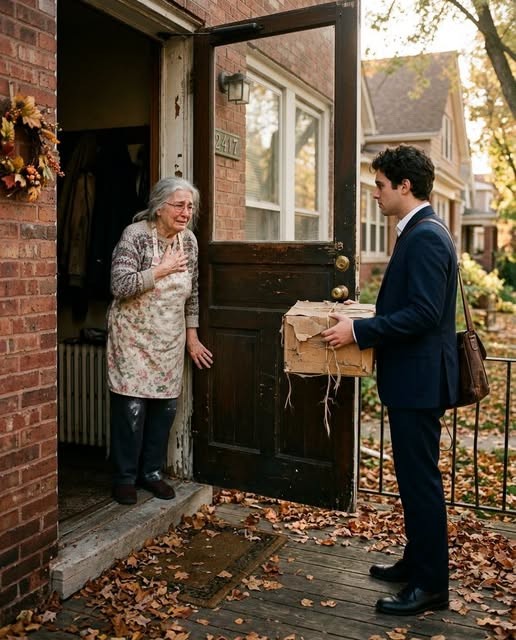

I stared at the young man standing on my porch.
“Are you Mrs. Anderson?” he asked politely.
“Yes. Can I help you?”
He adjusted the cardboard box in his arms.
“My name is Daniel. I’m an attorney representing the estate of Mr. Henry Mitchell.”
For a moment, I forgot how to speak.
Henry.
I hadn’t heard that name spoken aloud in years. Not since Robert had been alive, and even then, I rarely mentioned the man who had once left me standing alone in a wedding dress.
I tightened my grip on the door.
“Is Henry all right?”
The young attorney lowered his eyes.
“I’m afraid Mr. Mitchell passed away three weeks ago. Before his death, he left specific instructions concerning this box. He asked me to deliver it to you personally, on the fiftieth anniversary of your wedding.”
I felt a strange chill.
“Why would he want to contact me after all these years?”
Daniel looked at the box.
“Because he wanted you to know what really happened that morning.”
I stepped aside and invited him in.
We sat in the living room, where photographs of Robert, our children, and our grandchildren covered the shelves.
Daniel placed the box on the coffee table.
“Mr. Mitchell spoke about you frequently during the final years of his life. He also left a letter that I believe you should read before opening anything else.”
He handed me a cream-colored envelope.
My name was written across it.
Not Mrs. Anderson.
Not my married name.
Just my first name, in handwriting I recognized immediately.
Henry’s handwriting.
My fingers began trembling.
I opened the envelope.
Dear Margaret,
If this letter has reached you, then I have finally run out of time to make excuses.
I know you probably stopped wondering about me a long time ago. I hope you did. You deserved a happy life, and I hope someone gave you the happiness I once promised.
But there is something I have carried for fifty years, something you should have known before you walked away from that church.
I didn’t run because I stopped loving you.
I stopped reading.
My vision blurred.
For fifty years, I had imagined dozens of explanations for Henry’s behavior.
Perhaps he had fallen in love with someone else. Perhaps he had become frightened of marriage. Perhaps he had discovered something about me that made him change his mind.
But never, not once, had I imagined that he might still have loved me.
I looked at the attorney.
“What does this mean?”
Daniel folded his hands.
“Mr. Mitchell asked me to explain the circumstances surrounding your wedding. He wanted you to hear everything, including the parts he found difficult to discuss.”
I looked back at the letter.
Then I continued reading.
That morning, I received a telephone call from your aunt, Eleanor.
My heart stopped.
My aunt Eleanor.
She had been the one who helped organize our wedding. She had also been among the first people to suggest that I must have done something to make Henry abandon me.
Henry’s letter continued.
She told me something about your family. Something she said would destroy your future if I married you.
I lowered the letter.
“What did my aunt tell him?”
Daniel opened the cardboard box.
Inside were several old photographs, newspaper clippings, handwritten documents, and a small wooden jewelry case.
He removed a photograph and handed it to me.
It showed my mother standing beside a young woman I didn’t recognize.
On the back, someone had written a date.
March 1948.
Daniel explained that Henry had discovered some old family records shortly before the wedding.
Your aunt had told him that you were not your parents’ biological daughter.
I stared at him.
“What?”
He nodded.
“According to the documents, your mother had adopted you as a baby.”
I felt my hands go cold.
I had never heard anything about an adoption.
My mother had died when I was eighteen, and my father had passed away several years later. They had always been my parents. I had never questioned it.
“Why would my aunt hide something like that?”
Daniel opened another folder.
“Your aunt had a particular reason for wanting you to believe your family history was different. She had been involved in a disagreement over an inheritance, and she feared that certain documents would change who was entitled to a property.”
I stared at him.
“Was Henry told that I had been adopted?”
“Yes. But your aunt went much further. She claimed that your biological mother had been involved in a scandal and that marrying you would bring embarrassment to his family.”
I felt a wave of anger.
“That was none of her business!”
“I agree,” Daniel said quietly.
He explained that Henry had initially refused to believe her. He had planned to speak with my parents directly.
But my aunt showed him a document bearing what appeared to be my father’s signature.
It stated that my adoption had been arranged under circumstances that could supposedly create legal difficulties for Henry if he married me.
The document was misleading.
More importantly, it had been presented without the rest of the adoption records.
Henry was twenty-four, frightened, and completely unprepared for what he was being told.
But that still didn’t explain why he had run from the church.
I looked at Daniel.
“Why didn’t he simply ask me?”
The attorney hesitated.
“Because your aunt told him something else.”
He removed a folded piece of paper from the box.
It was a letter addressed to Henry.
The handwriting belonged to my aunt.
Henry,
I know you love Margaret, but you must understand that marrying her will create consequences you cannot imagine.
Her biological mother has been searching for her for years. She has a history that could destroy the reputation of anyone connected to her.
If you go through with this marriage, I will make sure Margaret learns everything about the circumstances surrounding her birth.
You have one opportunity to walk away before both your lives are ruined.
I felt sick.
“She threatened him?”
Daniel nodded.
“Mr. Mitchell believed that your aunt was prepared to expose you to something deeply painful. He thought that leaving the wedding would prevent her from using the information against you.”
I shook my head.
“That makes no sense. He could have told me.”
“Yes. And that was the greatest regret of his life.”
I returned to the letter.
I convinced myself that I was protecting you. I thought that if I disappeared, your aunt would have no reason to hurt you.
I didn’t understand that my silence would become its own kind of cruelty.
I wanted to come back that evening. I drove past your house three times. I sat outside the church until darkness fell.
But I was ashamed.
I had humiliated the woman I loved in front of everyone who mattered to her.
I thought you would never forgive me.
I stopped reading.
I remembered that evening.
I remembered sitting on the church steps long after everyone had gone.
I remembered looking down the road every time headlights appeared.
Henry had been nearby?
I pressed my fingers against my lips.
“Was he really outside the church that night?”
Daniel nodded.
“He told me he watched you leave. He wanted to approach you, but he couldn’t bring himself to explain what had happened.”
I looked at the photographs scattered across the table.
Fifty years.
Half a century of believing that I hadn’t been worth choosing.
And now I was learning that the truth had been more complicated.
But there was still one thing I needed to understand.
“Who was my biological mother?”
Daniel glanced at the final envelope.
“That is why Mr. Mitchell included the adoption records.”
He handed them to me.
I unfolded the first document.
My biological mother’s name was written at the top.
Helen Carter.
I had never heard the name before.
According to the records, Helen had been a young woman who had become pregnant at nineteen. Her family had pressured her to place the baby for adoption because they believed an unmarried mother would face terrible judgment in their community.
My adoptive parents, who had been unable to have children, had adopted me shortly after my birth.
The documents showed that the adoption had been legally completed.
There was no scandal.
No crime.
No hidden family disgrace.
My parents had simply wanted a child, and Helen had wanted her baby to have a secure home.
I began crying.
“My mother never told me.”
Daniel spoke gently.
“Your adoptive parents may have believed they were protecting you. The records suggest that your mother intended to explain everything when you were older, but she became ill before that conversation happened.”
I looked at the photograph again.
The young woman beside my mother was Helen.
She was smiling.
She looked so young.
“Did Henry ever find her?”
Daniel nodded.
“Eventually.”
I stared at him.
“When?”
“About fifteen years after your wedding.”
My heart began racing.
“Did he meet her?”
“Yes. He located her through the adoption records and discovered that she had been living in another state. She had married, had two children, and built a peaceful life.”
I felt relieved.
At least she had found happiness.
“Did he tell her about me?”
“He did. But she already knew that you had been adopted by a loving family. She had never wanted to disrupt your life.”
I looked down.
“What happened after that?”
Daniel reached into the box and removed a small jewelry case.
“Mr. Mitchell received this from Helen.”
I opened it.
Inside was a delicate silver locket.
My hands began shaking again.
It was the same locket I remembered seeing in my mother’s jewelry drawer when I was a child.
She had told me it was a family heirloom.
I turned it over.
On the back were two initials.
M.H.
My initials.
Inside was a tiny photograph of a baby.
On the other side was a handwritten message.
To my little girl. May you always know you were loved.
I began sobbing.
For fifty years, I had thought I knew everything about my family.
But there had been a woman somewhere in the world who had given birth to me and spent her life wondering whether I was happy.
And another woman who had raised me as her own.
I had been loved by both.
Daniel waited patiently.
Then he told me that Henry had received a letter from Helen shortly before his death.
She had passed away several years earlier, but her daughter had found some old correspondence while clearing out her belongings.
The letter had been written shortly after Helen learned that Henry had contacted her.
It contained a message she wanted me to receive.
I opened it.
Dear Margaret,
I don’t know whether you will ever read this.
I have thought about you every birthday since the day you were born.
I hope your parents gave you the childhood I couldn’t provide. I hope you were loved, protected, and encouraged to become whatever you wanted to be.
I never stopped loving you.
I never stopped wondering whether you had found someone who made you happy.
If you are reading this, please know that giving you up was not the same as abandoning you. I was young, frightened, and unable to give you the life you deserved.
I hope one day you will understand.
Your birth mother, Helen.
I held the letter against my chest.
I thought about my adoptive mother.
The woman who had stayed awake when I had a fever, taught me how to sew, and held my hand when I was afraid of the dark.
She was my mother.
Helen was also my mother.
There was no need to choose between the two.
Both women had loved me in different ways.
But what about Henry?
I looked at Daniel.
“Did he ever marry?”
The attorney nodded.
“Yes. He married a woman named Susan several years after your wedding. They had two children and eventually four grandchildren.”
I felt an unexpected sadness.
“Was he happy?”
“According to his family, yes. But he never stopped remembering you.”
I looked toward the photographs again.
“Did his wife know about me?”
“She did. Mr. Mitchell told her the truth before they married. She understood that you had been an important part of his past.”
I nodded slowly.
At least he hadn’t built another life on another lie.
Daniel then handed me one final document.
It was Henry’s last request.
He had asked that I receive the box, the letters, and the silver locket.
He had also left instructions that I be offered a small collection of photographs and a personal journal.
I opened the journal.
The first entry was dated the morning of our wedding.
I have never loved anyone as much as I love Margaret. I hope I am brave enough to explain everything before the ceremony.
The next entry was written three days later.
I saw her today. She looked exhausted. I wanted to tell her the truth, but I couldn’t.
Another entry, dated twenty years later, read:
Today I heard she married Robert. I hope he treats her well. I hope he makes her laugh.
I stopped.
Henry had known about Robert.
I turned the page.
I have no right to interfere. She has built a beautiful life. I am grateful she found someone who gave her what I failed to give her.
The final entry was written just weeks before his death.
Fifty years have passed. I wonder whether she still remembers that morning.
If she does, I hope this box helps her understand that she was never the reason I ran.
I closed the journal.
For a long time, I sat without speaking.
Then Daniel asked whether I wanted him to arrange a meeting with Henry’s children.
I thought about Robert.
I thought about the life we had shared, the children we had raised, and the grandchildren who filled my home with laughter.
I had no desire to reopen old wounds or pretend that the past could be rewritten.
But I also didn’t want to reject the people who had been part of Henry’s life.
“Yes,” I finally answered. “I would like to meet them.”
Three weeks later, I met Henry’s daughter, Catherine, at a small café.
She was in her late forties and had her father’s eyes.
When she saw me, she stood up immediately.
“Mrs. Anderson?”
“Please, call me Margaret.”
She smiled nervously.
“My father talked about you.”
I looked down at my coffee.
“What did he say?”
She reached into her handbag and removed a photograph.
It showed Henry standing outside the old church.
He was holding a small bouquet of flowers.
I recognized the building immediately.
“Where did he get this?”
“He took it the morning of your wedding. He told us that he had planned to give you those flowers after the ceremony.”
My throat tightened.
Catherine continued.
“He said he made the worst decision of his life that day. He spent years wishing he had been brave enough to tell you the truth.”
I looked at the photograph.
For a moment, I could almost see the young man I had loved standing outside the church, waiting for a courage that never came.
Catherine reached across the table.
“I know I can’t change what happened. But I wanted you to know that my father never blamed you.”
I gently squeezed her hand.
“Thank you.”
Then I told her about Robert.
About our three children.
About the grandchildren who loved baking cookies with me.
Catherine listened and smiled.
“I’m glad you had a happy life,” she said.
“So am I.”
That evening, I placed Henry’s photograph beside the silver locket.
I didn’t feel the same heartbreak I had carried for fifty years.
I felt something closer to peace.
For decades, I had believed that the young man who left me at the altar had rejected me.
Now I understood that fear, family pressure, and one person’s deliberate lies had changed the course of two lives.
But I also understood something else.
Henry’s decision had been his own.
He could have trusted me. He could have told me the truth. He could have taken my hand and faced whatever came next together.
He hadn’t.
And although I could understand his fear, I couldn’t pretend that his choice hadn’t hurt me.
The next Sunday, my grandchildren came over.
One of them noticed the silver locket on the table.
“Grandma, whose is this?”
I smiled.
“It belonged to a woman who loved me before I was old enough to know her.”
“Was she your grandmother?”
I laughed softly.
“No, sweetheart. She was my birth mother.”
They gathered around as I showed them the photograph inside.
Then I told them a little about the two women who had shaped my life.
Later that afternoon, while we were decorating cookies, I looked at the old wedding photograph I had kept tucked away in a drawer.
I was twenty-two again, standing in a handmade white dress, waiting for a man who never returned.
I no longer hated that young woman.
She had been hopeful.
She had been innocent.
And she had survived something she never deserved.
I placed the photograph back in the drawer.
Then I returned to the kitchen, where my grandchildren were laughing.
Because fifty years ago, I thought my life had ended at an altar.
But it hadn’t.
It had simply taken a different road.
And if there is one thing I wish I could tell the twenty-two-year-old girl who stood alone in that church, it would be this:
Someone else’s inability to choose you does not determine your worth. You are still deserving of love, even when the person you expected to give it walks away.
I never got the wedding day I dreamed of with Henry.
But I got a life with Robert that was filled with the kind of love I had once thought was impossible.
And after fifty years, that is the truth I choose to keep.