
An Unexpected Visitor After Her Mother’s Funeral
Losing a parent often leaves behind more than grief. It can bring unanswered questions, forgotten memories, and discoveries that completely change how someone understands the person they loved.
For one daughter, that discovery began shortly after her 75-year-old mother, Frances, passed away.
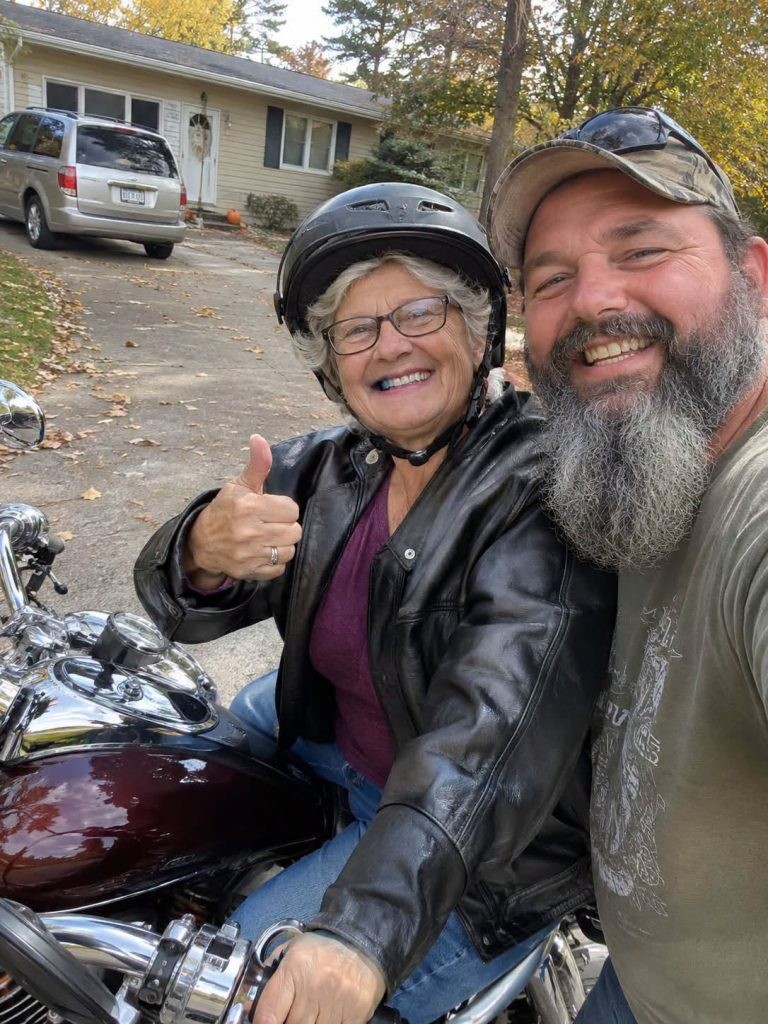
As she was returning from the funeral, a large motorcyclist named Connor approached her. He was someone she had never met, and his unexpected appearance immediately caught her attention.
He introduced himself and explained that, for the previous six months, he had spent every Saturday taking Frances on motorcycle rides.
The daughter was stunned. She had never known her mother to ride motorcycles, let alone spend entire weekends traveling with a stranger.
But Connor explained that their journeys had a much deeper purpose.
His grandmother, Diane, had once been Frances’s closest friend. The two women had known each other since high school, but a painful history involving love, jealousy, and family conflict had separated them for decades.
During those final six months, Frances had been visiting Diane every Saturday.
The daughter struggled to understand what she was hearing. She had always remembered Frances as a gentle, thoughtful mother who valued kindness and family. How could someone she loved so deeply have kept such a significant part of her life hidden?
Connor’s explanation was only the beginning of a family story that had remained buried for years.
The Friendship Destroyed by Jealousy
According to Connor, Frances and Diane had been inseparable when they were young.
Their friendship began to unravel when both women became emotionally connected to the same young man, Sam.
Diane had fallen in love with Sam, while Frances had secretly loved him herself. The disappointment left Frances with feelings she never fully confronted.
Life moved forward, but the emotional wound remained.
Years later, after Sam had died, Diane eventually found happiness with Mike, Frances’s brother.
Their relationship offered Diane an opportunity to build a new life. But Frances struggled to accept it. Instead of seeing her brother’s relationship as a chance for happiness, she viewed it through the lens of her unresolved jealousy.
She gave Mike an impossible choice: remain close to his family or continue his relationship with Diane.
Mike chose Diane.
The consequences were devastating. He left town, and the family connection deteriorated. Years passed without the reconciliation that might have brought them back together.
For Frances, the decision became a burden that followed her into old age.
The daughter found it difficult to believe that her mother had played such a significant role in separating people who had once been close.
Yet the story also raised an important question: how many relationships are damaged not by one moment of anger, but by years of refusing to acknowledge the feelings behind it?
Time can change people’s circumstances, but it does not automatically heal resentment.
The Wooden Box That Changed Everything
After Connor’s visit, the daughter returned to her mother’s bedroom.
She needed to understand what had happened, and she hoped that Frances might have left behind something that explained the story.
While searching through her belongings, she discovered an old wooden box.
Inside were photographs, personal letters, and small objects that seemed to preserve memories from a different lifetime.
One photograph immediately caught her attention.
It showed Uncle Mike standing beside Diane and her young son, Connor.
The image revealed a connection she had never fully understood. These people had once been part of the same family circle, before jealousy and unresolved conflict pushed them apart.
At the bottom of the box, she found a letter addressed specifically to her.
Unlike the photographs, which showed what had happened, the letter explained what Frances had eventually come to understand.
Her mother admitted that jealousy had influenced her decisions and damaged relationships. She acknowledged that she had hurt people she loved and that her actions had cost them years they could never recover.
Frances did not try to excuse herself.
She did not claim that she had been misunderstood or that the past had somehow been unavoidable.
Instead, she accepted responsibility.
One sentence stood out more than the rest:
“Please don’t make me better than I was just because you miss me.”
The daughter read those words repeatedly.
Her mother was asking her not to turn grief into an excuse for forgetting the truth. She wanted to be remembered as a real person, with loving qualities as well as serious mistakes.
It was a difficult request, but perhaps the most honest gift Frances could leave behind.
Why Frances Returned to Diane in Her Final Months
The letter finally explained the Saturday motorcycle rides.
For six months, Frances had been visiting Diane regularly. She brought homemade lemon cake, sat with her old friend, and apologized for the pain she had caused.
These visits were not simply opportunities to remember their younger years.
They were attempts to repair a friendship that had been broken for decades.
Frances could have chosen to remain silent. She could have allowed the past to remain buried, especially when the people involved had grown older and their lives had taken different directions.
Instead, she decided to face what she had done.
Her repeated visits were important because an apology is not always enough to rebuild trust. A person may express regret, but meaningful change also requires patience, consistency, and a willingness to listen.
Frances could not demand forgiveness from Diane. She could only acknowledge the damage and offer a sincere attempt at reconciliation.
Perhaps she had finally realized that protecting her pride had never brought her the peace she wanted.
Her motorcycle journeys with Connor became part of a quiet effort to make things right.
Every Saturday, she traveled toward a friendship she had once helped destroy.
Forgiveness Does Not Mean Forgetting
After reading the letter, the daughter decided to visit Diane.
She wanted to hear the story from someone who had experienced it firsthand.
Their meeting helped her understand that forgiveness was more complicated than simply accepting an apology.
Diane had not forgotten what happened. She remembered the friendship they once shared, the conflict involving Sam, and the painful consequences of Frances’s decision about Mike.
Those memories had not disappeared.
But Diane had eventually chosen to forgive Frances.
That did not mean the past had suddenly become harmless. It did not restore the years they had spent apart or bring Mike back.
Instead, forgiveness allowed Diane to stop letting an old conflict control the rest of her life.
This distinction is important.
Forgiving someone does not require pretending that their actions were acceptable. It does not mean denying the pain they caused or immediately restoring the relationship to what it once was.
Sometimes, forgiveness simply means choosing not to carry resentment forever.
For Diane, accepting Frances’s apologies was a way to acknowledge their shared history without allowing its most painful chapter to define everything.
The daughter also began to understand that her mother could be both loving and deeply flawed.
Frances had made decisions that caused real suffering. She had also recognized her mistakes and tried to make amends.
Both things could be true.
Bringing a Hidden Family History Into the Open
As the daughter learned more, she realized that the truth deserved to be shared with the rest of the family.
She invited Diane and Connor into the family home and explained what had happened between Frances, Mike, and Diane.
The conversation was difficult, but it offered something the family had lacked for years: a clearer understanding of its own history.
Family secrets can influence relationships long after the original events have passed. When important experiences remain unexplained, later generations may inherit confusion and misunderstandings without knowing where they began.
The daughter no longer saw Diane and Connor as strangers connected to an unusual motorcycle story.
They were people who had once belonged to an important part of her family’s past.
More importantly, she realized that accepting the truth about her mother did not mean loving her any less.
In fact, understanding Frances’s imperfections made her memories more meaningful.
She could remember the mother who cared for her while also acknowledging the woman who had allowed jealousy to damage relationships.
Love did not require her to rewrite history.
Visiting Uncle Mike’s Grave
Months later, the family visited Uncle Mike’s grave.
The visit brought the story back to the person whose life had been deeply affected by Frances’s decision.
Diane carried an old baseball and gently placed it on Mike’s headstone.
It was a simple gesture, but it carried years of personal meaning. The baseball reminded her of the little boy he had helped raise and the memories they had shared.
Standing beside the grave, the family was reminded that some losses cannot be repaired through apologies.
Mike’s life could not be brought back. The years he had spent away from his family could not be recovered.
There would be no opportunity to recreate the conversations that never happened or the moments that had been lost.
Yet remembering him together mattered.
The visit allowed the family to acknowledge his place in their lives and recognize the consequences of the choices that had separated them.
Sometimes, reconciliation comes too late to restore what was lost. All that remains is the opportunity to understand, remember, and make different choices moving forward.
A Motorcycle Ride Becomes a New Beginning
After the cemetery visit, Connor approached the daughter and offered her something unexpected.
He handed her her mother’s motorcycle helmet.
He wanted to know whether she would like to take a ride.
The daughter hesitated. She had never imagined herself climbing onto a motorcycle, and the thought made her nervous.
Still, she accepted.
She climbed onto the back of Connor’s bike, held tightly to his waist, and prepared for the journey.
At first, she was terrified. The unfamiliar movement and sound of the motorcycle made it difficult to relax.
But gradually, her fear gave way to laughter.
As they traveled along the country roads, she began to understand something she had previously known only through Connor’s words.
For six months, Frances had traveled these same roads every Saturday. She had made the journey not for excitement alone, but because she wanted to reconnect with someone she had once loved as a friend.
The motorcycle had become part of her effort to face the past.
For the daughter, the ride was more than an unusual experience. It was a chance to feel connected to a part of her mother’s life that had remained hidden.
She finally understood that Frances had not spent her final Saturdays running away from the reality of getting older.
She had been trying to make peace with her past.
The Lessons Behind Frances’s Final Journey
Frances’s story offers several important reflections on family relationships, accountability, and forgiveness.
First, unresolved emotional conflicts can have consequences far beyond the original disagreement. Feelings of jealousy and resentment may seem temporary, but when left unaddressed, they can influence decisions for decades.
Second, genuine apologies require responsibility. Frances did not simply say she was sorry and expect everything to return to normal. She continued visiting Diane, acknowledged the harm she had caused, and accepted that forgiveness was not something she could demand.
Third, forgiveness does not erase history. Diane could forgive Frances while still remembering the years of pain and separation.
Finally, it is never too late to begin making different choices, even when it is impossible to repair everything.
Frances could not restore her relationship with Mike or recover the time she had lost with Diane. But she could use the time she had left to approach her old friend with honesty and compassion.
Her actions did not erase her mistakes. They showed that she was willing to face them.
The Long Way Home: A Daughter Learns to Remember Her Mother Honestly
After losing a parent, it is natural to focus on the memories that bring comfort.
People remember familiar voices, family traditions, small acts of kindness, and moments that once seemed ordinary.
But Frances left her daughter something more complicated.
Her final letter asked her not to confuse love with perfection.
It was a reminder that people are rarely defined by only their best or worst decisions. Someone can be loving and selfish, generous and jealous, thoughtful and mistaken.
Their lives are shaped by choices, and those choices sometimes create consequences that last much longer than expected.
The daughter could not change what had happened between Frances, Diane, and Mike. But she could choose what to do with the truth.
By welcoming Diane and Connor into the family, remembering Mike, and finally taking the motorcycle ride, she found a way to honor her mother’s final efforts without overlooking the past.
Perhaps that was the greatest lesson Frances left behind.
Making peace does not require rewriting history. It requires facing history honestly.
Sometimes, the road toward forgiveness is long and uncomfortable. It may involve memories we would rather avoid and conversations we wish had happened years earlier.
But even a difficult journey can lead somewhere meaningful.
And sometimes, the most important journey is not about escaping the past.
It is about finding the courage to take the long way home.