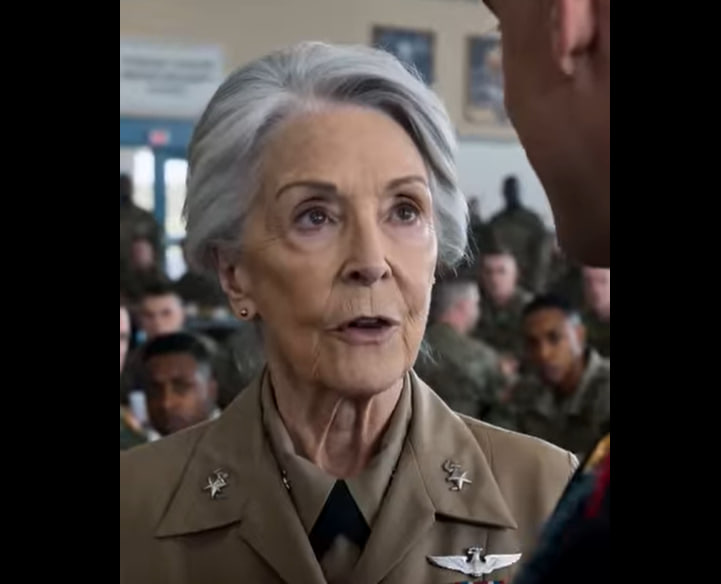

The Lieutenant Thought He Had Humiliated a Helpless Woman Until the Senior Chief Recognized Who Had Been Watching Him
The hallway leading to the junior officers’ quarters at Fort Redstone was so quiet that the rhythmic thud of combat boots against the polished linoleum floor echoed with every step. Senior Chief Daniel Brooks walked with a thoughtful expression. In his mind, the final words of that older woman still lingered: “You hesitated because you were trying to guess who I was, instead of focusing on what was happening to an ordinary human being right in front of you.”
It was a hard lesson. In the military, people are taught to instantly recognize rank, seniority, and authority with a single glance so they can respond according to regulations. But sometimes, that reflexive obedience to hierarchy overshadows the most basic essence of human respect.
When Brooks reached the shared office and lounge of the junior officers, the door was ajar. Muffled, tense voices drifted from inside.
“Who the hell do you think she was, Chris?”
It was Lieutenant Tyler Mercer’s voice. Gone was the arrogant defiance, the swagger, and the mocking laughter from the cafeteria just hours earlier; instead, his tone carried the raw bewilderment and bitterness of a man whose protective shield had just been shattered.
Chris—the junior officer who had earlier admitted to following along with Mercer’s cruel amusement—replied in an exhausted tone, “I don’t know, Tyler. But the way Senior Chief Brooks and the entire base reacted afterward… we just stepped on a massive landmine.”
“She was just wearing an out-of-regulation old uniform! Completely out ofregs!” Mercer hissed, his voice tight with lingering fury. “Why didn’t anyone warn me? How can an old woman with no visible rank turn an entire lunchroom upside down with just a few cold sentences?”
“Because the problem isn’t her, Tyler,” Chris snapped back, offering no coddling this time. “The problem is you. You built that trap for yourself through the way you’ve treated everyone around you for the past six months. And I’m just as guilty. We all went along with your arrogance because we thought you were the star player around here.”
Outside the door, Daniel Brooks paused. He didn’t immediately push the door open. He wanted to see whether this heavy fall from grace would actually awaken the young officer, or if it would simply turn him into a bitter, vengeful antagonist waiting for a chance to strike back.
The room fell dead silent for a few seconds. The only sound was the faint hiss of the air conditioning unit through the doorframe.
Finally, Mercer’s voice returned, dropping into a much quieter, gravelly register: “She forced me to pick up every single piece of dropped chicken… in front of everyone I command. The feeling in that room… it was absolute humiliation, Chris.”
“And how do you think that woman felt when you kicked her lunch tray off the table in front of over eighty people?” Chris countered relentlessly. “Do you want people to respect you because of your actual competence, or just because you wear a special operations patch?”
Silence stretched, suffocating and complete.
At that moment, Daniel Brooks raised his hand and gave three firm raps against the wooden door. Tap, tap, tap.
The room jolted. The door was pulled fully open by Chris. Seeing the tall, stern figure of the Senior Chief standing in the corridor, all three junior officers snapped to attention by sheer reflex.
“Senior Chief,” Chris stammered.
Brooks stepped into the room, his sharp gaze sweeping over each of them, lingering longest on Tyler Mercer. Mercer’s uniform had been replaced by a fresh, clean set, but dark circles shadowed his eyes, and a faint smudge of dirt from the cafeteria floor still stained his knee, unnoticed.
“What kind of parade rest is this, gentlemen? At ease,” Brooks said, his voice measured but carrying enough weight to suppress any panic. “I didn’t come here to hand down formal disciplinary action this exact minute. That’s up to the senior command chain, and it will go through official channels.”
Mercer swallowed hard, lifting his chin to meet Brooks’s eyes, anxiety written across every muscle in his face. “Then… why are you here, Senior Chief?”
“I wanted to see whether you’re just wallowing in self-pity, or if you’re actually reflecting on what happened,” Brooks said calmly, walking over to Mercer’s cluttered tactical desk. He flipped through a tactical training logbook before setting it back down.
“I’ve been in this uniform for over twenty years, Lieutenant Mercer,” Brooks continued slowly. “I’ve seen the most brilliant officers—men with flawless marksmanship scores and record-breaking physical fitness test results—completely crumble the moment they faced their very first test of character.”
Mercer pressed his lips into a tight line. “Do you think I lack character, Senior Chief?”
“I think you lack basic empathy,” Brooks turned to look him straight in the eyes, unblinking. “You think strength means overpowering everyone else. You think grinding down the dignity of someone who can’t fight back somehow enhances your authority. That isn’t the mark of an elite operator. That’s just insecurity disguised as aggression.”
Brooks’s words cut like a scalpel, piercing straight through Mercer’s remaining armor. The junior officers standing nearby held their breath. They knew that at Fort Redstone, a direct critique from a veteran Senior Chief like Brooks carried more weight than any formal reprimand or restriction.
“Who was she?” Mercer asked quietly, curiosity finally overriding his fear. “That woman… you called her a former superior. Does she really hold that much power?”
“Her greatest power isn’t her title or her rank,” Brooks answered, his gaze drifting toward the bright patch of sunlight outside the window. “Her power is that she can see right through a man’s soul without needing a name tag or a chest full of ribbons. She spent her career building generations of warriors who protect others, not men who use their comrades as stepping stones for personal glory.”
Brooks paused, stepping forward to give Mercer a firm, grounding pat on the shoulder—a gesture of mentorship rather than punishment.
“The report goes up to the commanding officer’s desk tomorrow morning. Disciplinary action is coming, and you have to own it, Tyler. Don’t look for loopholes, don’t ask anyone to pull strings for you, and for God’s sake, don’t hold a grudge.” Brooks looked deep into the young officer’s eyes. “Because if you survive this lesson like a man, you might actually become a real leader. If you don’t, the uniform you’re wearing will never be anything more than a cheap costume.”
With that, Daniel Brooks turned and walked out of the room, leaving the three young officers buried under the heavy weight of self-reflection.
The following morning, the large conference room at Fort Redstone was bathed in golden morning light. The atmosphere inside was solemn and rigid. Colonel Vance sat at the head of the table, flanked by Lieutenant Colonel Mercer, with the comprehensive leadership-culture evaluation report signed by the retired female special operations auditor placed neatly in the center.
Tyler Mercer entered the room upon being summoned. He had stripped away his field utility gear; instead, he wore his polished dress uniform, crisp and immaculate. His stride was firm as he walked up to the command table. He knew full well that the next few minutes would dictate the entire trajectory of his military career.
“Lieutenant Tyler Mercer,” Colonel Vance spoke in a deep, commanding voice, flipping open the pages of the report. “Command has received the findings from the special evaluation board. The details outlined here… are deeply troubling.”
Mercer stood tall, keeping his eyes locked on the Colonel. “Sir, I take full responsibility for my misconduct in the mess hall yesterday. I offer no excuses whatsoever.”
Colonel Vance blinked in mild surprise, glancing sideways at Lieutenant Colonel Mercer. It seemed this direct, unevasive admission of guilt caught them off guard. Most young officers facing disciplinary boards scrambled to find loopholes or mitigate their blame; Mercer was choosing to face the music head-on.
“Do you understand that your actions severely violated the core ethical standards expected of a commissioned officer?” Vance asked.
“Yes, sir.”
“The board initially weighed severe penalties: a six-month suspension from active tactical duties, reassignment to an isolated logistics depot, and a permanent negative mark on your service record,” Vance read aloud.
The room fell into an oppressive silence. A punishment like that effectively meant the end of Mercer’s career trajectory, shattering any dream of commanding elite units.
However, Colonel Vance turned to the very last page of the report—where a handwritten note had been appended by the female auditor herself. The colonel skimmed the brief note, a subtle, appreciative smile briefly touching the corner of his mouth.
“However,” Vance continued, shifting tone, “the report also notes that immediately following the incident, you voluntarily returned to clean up the mess area, owned up to your failure in front of subordinates without making excuses, and most importantly—you’ve shown a willingness to pause and listen instead of just shouting commands.”
Mercer looked up, stunned.
“Command has modified the disciplinary action,” Vance announced crisply. “You will receive a formal official reprimand and be stripped of direct command authority for the next three months. During that time, you are reassigned as a base safety operations assistant, under the direct mentorship of Senior Chief Daniel Brooks. Furthermore, you will complete an intensive professional reading and seminar course on leadership psychology and military culture.”
Three months of probation. No exile to a remote outpost, no total destruction of his career, but under a microscope of intense supervision.
“Thank you… thank you, Colonel,” Mercer said, his voice thick with emotion as he executed the sharpest, most precise salute of his career. “I won’t let the command down.”
“Don’t thank me, Lieutenant,” Vance waved a hand, dismissing him. “Thank the person who wrote that report. She believed you were still worth salvaging—if you’re willing to grind away your ego.”
When Tyler Mercer walked out of the conference room, the morning sunlight streamed through the grand hallway, catching the bright ribbons and insignia on his chest. He stopped for a second, taking a deep, steady breath. The dirt on his knee from yesterday had been washed away, but the lesson in humility was permanently etched into his mind.
In a quiet corner near the main gates of Fort Redstone, a sleek black sedan rolled smoothly away from the installation. In the back seat, the woman with short silver hair looked out the tinted window, watching the compound gradually fade into the distance.
She didn’t require a thank-you note or a formal farewell ceremony. Her life’s work was ensuring that the men and women entrusted with defending the nation retained their humanity and clarity at their very core.
And right here at Fort Redstone today, the seeds of genuine, lasting change had officially taken root.
