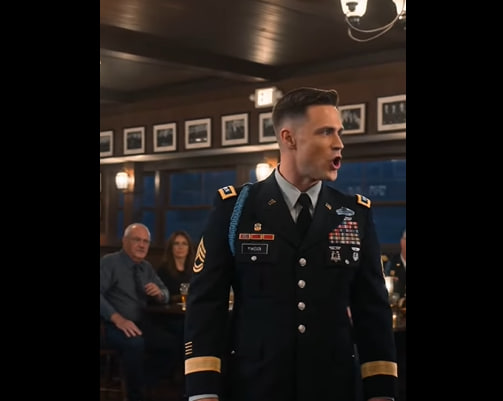

THEY HUMILIATED HER IN FRONT OF EVERYONE… THEN ONE PHOTOGRAPH MADE THE ENTIRE ROOM GO SILENT.
The transition from a ghost to a guardian did not happen overnight, but within two months, Evelyn Mercer had breathed an entirely new life into the old veterans’ hall.
She treated the building the way she had once treated her forward operating bases: with meticulous attention to detail, a quiet demand for order, and an unwavering loyalty to the people inside it. The scent of stale beer and dust was replaced by the aroma of fresh coffee, pine polish, and hot meals. The cracked leather of the bar stools was repaired. The flickering neon sign in the window, which had buzzed erratically for a decade, finally glowed with a steady, welcoming warmth.
And then there was Travis Cole.
The man who had once mocked her uniform had become her most fiercely loyal shadow. He showed up at five in the morning every day, sweeping the floors, unloading delivery trucks, and fixing the ancient plumbing in the basement. He never asked for a paycheck. He never asked for forgiveness, either. He simply put his head down and worked, his silent labor an ongoing apology for the day he had questioned her honor. Evelyn, understanding the complex, unspoken language of soldiers seeking redemption, allowed him to do it. She didn’t thank him, and he didn’t expect her to. They had formed a quiet alliance built on the mutual understanding of duty.
The heavy, leather-bound ledger Arthur had left behind remained the heart of the hall. Evelyn had built a custom glass-topped display case for it near the entrance, right beneath the faded photograph of her in uniform. Every day, she turned exactly one page. The patrons—men and women bearing the invisible scars of various conflicts—would often pause by the door just to read the names of the people who were alive because of the woman pouring their coffee. It became a shrine not to war, but to the preservation of life.
But peace, Evelyn knew all too well, was usually just a temporary pause between battles.
The disruption arrived on a torrential Tuesday afternoon in late October. The rain was lashing against the front windows, blurring the streetlights into glowing smears of amber. The hall was comfortably full, filled with the low hum of conversation and the clatter of silverware, when the deep, synchronized rumble of heavy engines cut through the sound of the storm.
Travis, who was wiping down the far end of the mahogany bar, stopped. He looked out the front window, his jaw tightening. “Commander,” he said, his voice low but sharp enough to slice through the ambient noise.
Evelyn set down the glass she was drying and followed his gaze. Three black government-issue SUVs had pulled up onto the curb, their heavy tires splashing through the flooded gutters. The doors opened in unison. Six men in tailored dark suits stepped out into the pouring rain, forming a protective perimeter around the middle vehicle.
The rear door of the center SUV opened, and a man stepped out. He didn’t rush through the rain. He walked with the arrogant, unhurried stride of a man who believed the weather should yield to him. He wore a perfectly pressed, immaculately tailored dress uniform, the silver stars on his epaulets catching the dull light from the streetlamps.
Evelyn felt a familiar, icy calm settle over her. She knew that stride. She knew the sharp, hawkish profile beneath the military cap.
Lieutenant General Thomas Sterling.
The man who had ordered the disastrous strike eight years ago. The man who had ignored her warnings about the failing reactor. The man who had quietly orchestrated her dishonorable discharge to cover up his own catastrophic tactical failure.
The heavy oak doors of the hall swung open, letting in a gust of freezing wind and rain. The six men in suits entered first, their eyes scanning the room, their hands resting noticeably near their waistbands. General Sterling walked in behind them, stopping just inside the threshold. He slowly removed his leather gloves, his eyes sweeping over the worn floorboards, the mismatched chairs, and finally, settling on Evelyn standing behind the bar.
The hall went dead silent. The veterans in the room didn’t need to know the General’s name to recognize a threat. Posture shifted. Chairs scraped subtly backward. Shoulders squared.
“Evelyn,” Sterling said. His voice was smooth, cultured, and dripping with condescension. “I must say, when the Pentagon flagged an estate transfer putting a piece of commercial real estate in your name, I assumed it was a clerical error. I never imagined you’d end up playing barkeep in a dilapidated dive.”
Evelyn didn’t move. She rested her hands flat on the polished wood of the bar. “You’re a long way from Washington, Thomas. And you’re tracking mud on my floor.”
Sterling offered a cold, thin smile. He walked slowly toward the bar, his suited men fanning out behind him, silently intimidating the patrons. Walter Hayes stood up from his booth, his hands balling into fists, but Evelyn caught his eye and gave a nearly imperceptible shake of her head. Stand down.
“I’m not here to reminisce about your tragic fall from grace, Evelyn,” Sterling said, stopping a few feet from the bar. He glanced at the brass taps, looking thoroughly unimpressed. “I am here about Arthur Pendelton.”
“Arthur is dead,” Evelyn said flatly.
“I am aware. But before the old man’s heart gave out, he spent years making an absolute nuisance of himself. Filing Freedom of Information Act requests. Bribing defense contractors. Harassing my staff for classified operational logs from eight years ago.” Sterling leaned forward, dropping the polite facade, his voice dropping to a dangerous hiss. “He was compiling a dossier. And my intelligence officers believe that when he died, he left that highly classified, stolen material in your possession.”
Evelyn’s face remained an unreadable mask. “Arthur left me a bar, Thomas. And a ledger of names.”
“Don’t play games with me, Mercer,” Sterling snapped, his patience fraying. “Pendelton was a paranoid relic, but he was thorough. He stole digital logs. He stole operational blueprints. If that material goes public, it compromises current national security protocols. And, more importantly, it is federal property.” Sterling gestured to his men. “I have a warrant signed by a federal judge to seize any and all documents, hard drives, and personal effects left behind by Arthur Pendelton. We can do this quietly, or my men can tear this pathetic little clubhouse down to the foundation.”
Travis took a step forward, a heavy iron wrench suddenly appearing in his grip from beneath the bar, his knuckles white. Before he could raise it, Evelyn’s hand shot out, gripping Travis’s wrist with startling strength. She didn’t look at him, keeping her eyes locked on Sterling, but her grip was an absolute command. Travis swallowed hard and lowered the wrench.
“You’re afraid,” Evelyn said quietly, the realization blooming in her chest.
Sterling scoffed. “Excuse me?”
“You’re not here for national security protocols,” Evelyn said, her voice carrying effortlessly across the silent room. “You’re here because you’re up for a seat on the Joint Chiefs next month. And whatever Arthur found, it proves what really happened in that valley. It proves you abandoned those battalions, and it proves you forged the official report to make me the scapegoat.”
Sterling’s eyes narrowed into dark, hateful slits. “You have no rank. You have no pension. You are a disgraced civilian pouring cheap beer for has-beens. Hand over Pendelton’s files, Evelyn. Because if you don’t, I will have you arrested for the possession of stolen state secrets. I will drag you through a federal court, and I will ensure you spend the rest of your natural life in a military prison.”
He stared at her, waiting for the fear. Waiting for her to break.
Evelyn held his gaze for a long, agonizing moment. Then, she let go of Travis’s wrist, turned her back on the General, and walked calmly out from behind the bar.
She walked over to the glass display case near the entrance. She lifted the glass lid and carefully pulled out the heavy leather ledger. She carried it back to the bar and set it down with a heavy thud right in front of Sterling.
“Here,” Evelyn said. “Arthur’s life’s work. The only thing he left in the lockbox besides the deed to this building.”
Sterling looked at the book, then at his men. He sneered, reaching out and flipping the cover open. He expected blueprints. He expected satellite imagery.
Instead, he saw the handwritten names. Sarah Jenkins. Marcus Thorne. The Al-Farsi Family.
He flipped through a dozen pages, his frustration mounting as he saw nothing but thousands of signatures, dates, and messages of gratitude. “What the hell is this?” Sterling demanded, slamming his hand against the parchment. “This is a guestbook! Where are the tactical logs?”
“You never did understand Arthur,” Evelyn said softly. “You only understand power. You don’t understand loyalty.”
Evelyn reached across the bar. She ran her fingers down the thick, reinforced spine of the leather book. “Arthur told me he spent eight years building a ledger to balance my soul,” she said, her voice dropping to a whisper meant only for Sterling. “But Arthur was a sapper in Vietnam, Thomas. He never built anything without putting a failsafe in the foundation.”
She pressed her thumb hard against a small, decorative brass stud at the very bottom of the ledger’s binding.
There was a faint mechanical click.
Sterling stepped back in surprise as the thick leather spine of the book suddenly popped open, revealing a hollowed-out cavity hidden entirely within the binding.
Inside the cavity rested a small, black, encrypted solid-state drive.
Evelyn didn’t touch it. She just looked at Sterling, watching the color drain completely from his face.
“Do you know what the beautiful thing about modern technology is, General?” Evelyn asked, her voice echoing in the dead quiet of the room. “Arthur didn’t just leave that drive for me. He linked it to the legal transfer of the deed. The moment this building legally became mine last month, a dead-man’s switch activated on Arthur’s private server.”
Sterling’s breath caught in his throat. “You’re lying.”
“Am I?” Evelyn tilted her head. “Check your phone, Thomas. Check the news. Because as of 8:00 AM this morning, unredacted copies of the original strike orders—bearing your digital signature and proving you ordered the abandonment of two battalions—were emailed to the investigative desks of the Washington Post, the New York Times, and the Inspector General of the Armed Forces.”
One of the men in suits suddenly reached into his pocket. His phone was vibrating wildly. He pulled it out, looked at the screen, and his face went pale. He stepped forward and whispered frantically into Sterling’s ear.
Sterling looked as though he had been struck by lightning. His immaculate posture collapsed. He stared at Evelyn, his mouth opening and closing silently.
“This isn’t your jurisdiction anymore, General,” Evelyn said, her voice ringing with the absolute, unquestionable authority of a true commander. “This is my house. And you are trespassing.”
Evelyn didn’t raise her voice. She didn’t have to.
Behind Sterling, the sound of movement broke the silence. The General turned around.
Every single veteran in the hall had quietly stood up. Dozens of men and women, standing shoulder to shoulder, blocking the exit. Travis Cole stepped out from behind the bar, holding a heavy wooden baseball bat casually resting against his shoulder. Walter Hayes stood at the front of the crowd, his arms crossed over his chest.
They weren’t an army. They were old, they were tired, and they were broken. But looking at the wall of uncompromising, unified defiance, the six federal agents instinctively took their hands away from their weapons and took a step back.
“Leave the drive,” Evelyn ordered. “Take your men. Walk out that door. And prepare your resignation.”
Sterling looked at the black drive, then at the wall of veterans, and finally, back at Evelyn. The arrogance was completely gone, replaced by the terrifying realization that his entire career had just been entirely dismantled by a ghost. Without another word, he turned on his heel and walked swiftly toward the door. The veterans parted just enough to let him and his men through, their silence louder than any shout.
The heavy oak doors slammed shut behind them. A moment later, the rumble of the SUVs faded into the pouring rain.
The tension in the room shattered. A massive, collective exhale swept through the hall. Someone in the back let out a ragged cheer. Walter leaned against a booth, wiping a sudden sweat from his brow, while Travis slowly lowered the baseball bat, staring at Evelyn with a look of absolute, unshakeable reverence.
Evelyn looked down at the open ledger. She gently closed the hidden compartment, pressing the leather spine back into place until it clicked. She smoothed her hand over the cover, feeling the phantom warmth of Arthur’s final, brilliant maneuver.
“Alright,” Evelyn said softly, looking up at the room full of people who had just stood between her and the United States government. She reached for a fresh rag and turned back to the brass taps. “Who needs a refill?”
