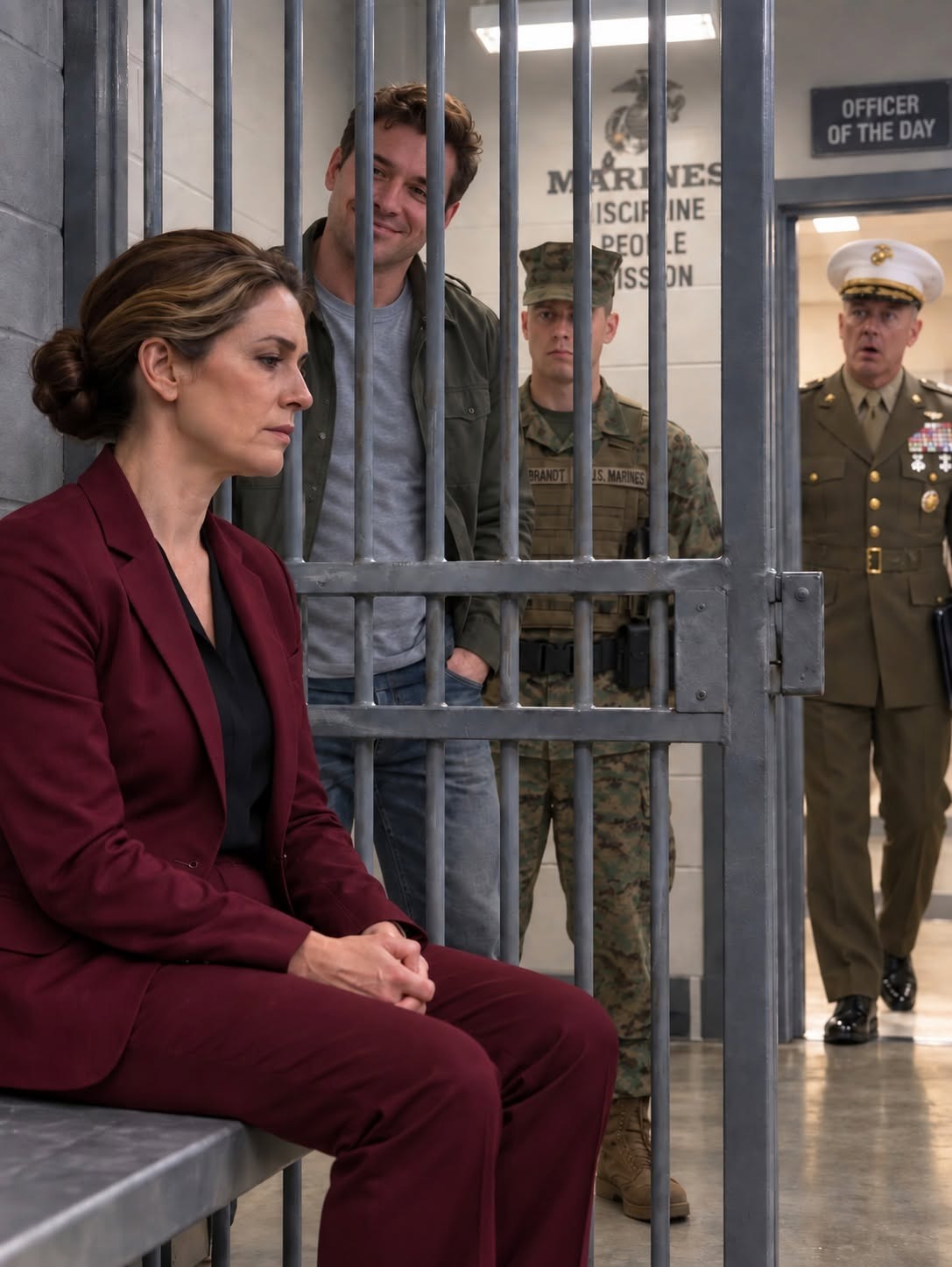

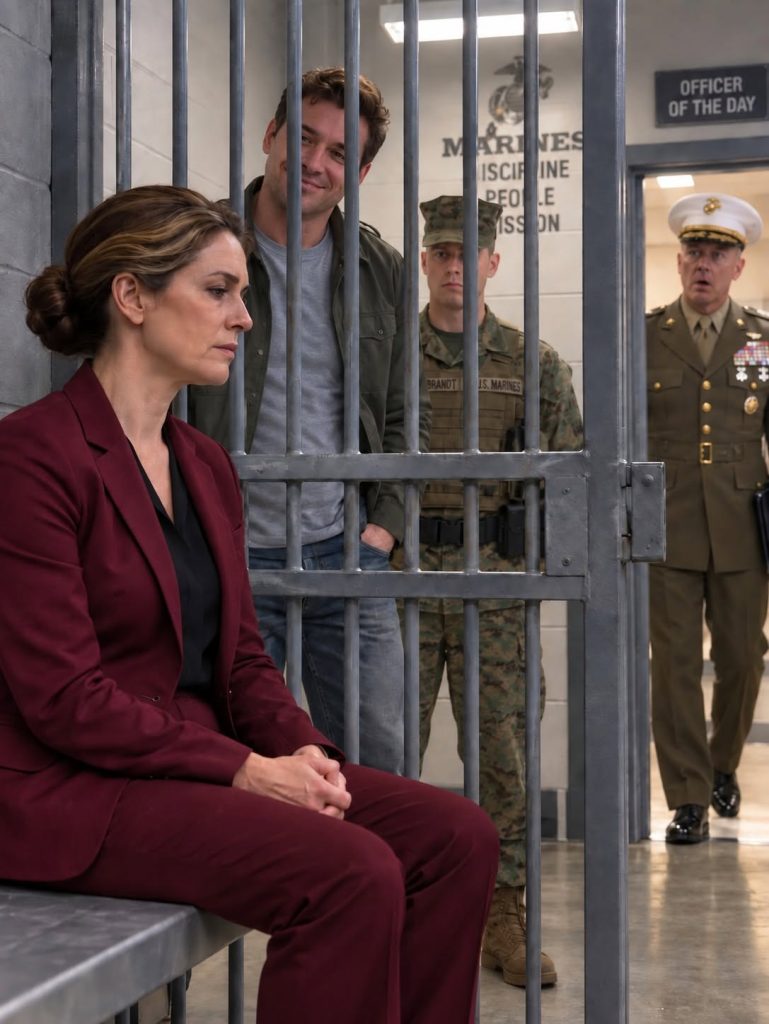
"A corporal locked me inside a holding cell on the Marine base I was about to command, and my brother smiled at me through the bars
The rhythmic hum of a military installation at twilight is entirely distinct from any other sound in the world. It is a layered symphony of distant jet engines throttling down, boots marching in synchronized cadence across the tarmac, the low rumble of tactical vehicles returning from the motor pool, and the crisp, ceremonial snap of the American flag being lowered for the evening.
Months had passed since Glenn’s visit to my office. The battered cardboard box of childhood relics now sat neatly on a shelf in my quarters—not as a shrine to the past, but as a quiet reminder of how far the road had stretched.
Command is an all-consuming endeavor. When you hold the rank of brigadier general and oversee a major Marine installation, your life ceases to be measured in hours or weekends. It is measured in readiness reports, budget allocations, personnel decisions, safety audits, and the endless, invisible labor of leadership. You are the anchor for thousands of service members, responsible not only for their tactical proficiency but for their well-being, their morale, and their futures.
Yet, amidst the relentless whirlwind of staff meetings and operational briefings, a profound sense of internal calm had settled over me. The ghosts of old family dynamics—the persistent, phantom need to prove my worth to people who refused to look past their own biases—had finally been laid to rest. I no longer walked into rooms bracing for skepticism, nor did I measure my achievements by whether someone else chose to applaud them.
One crisp morning in late autumn, my deputy, Colonel Maria Torres, stepped into my office with a thick manila folder tucked under her arm and a knowing glint in her eye.
“General,” Torres said, setting the folder down on the corner of my desk. “You have an incoming directive from the Commandant’s office regarding the upcoming joint Pacific readiness exercises.”
I looked up from a personnel commendation I was signing, raising an eyebrow. “That early? We weren’t expecting the finalized deployment parameters until next month.”
“They moved the timeline up,” Torres replied, pulling up a digital tablet. “And there’s a secondary memo attached to the package. A personal request from the Director of Marine Corps Personnel.”
I paused, leaning back in my command chair. “Spit it out, Maria. What is it?”
“They want you to keynote the annual senior leadership symposium in Quantico next month,” Torres said, offering a faint, encouraging smile. “Specifically to address modern command culture, accountability, and the psychological framework of institutional resilience.”
I stared at the tablet screen for a moment. A keynote address at Quantico, speaking to hundreds of incoming battalion commanders, generals, and senior enlisted leaders across the Corps. The old reflex—the instinct to deflect attention, to hide behind the quiet anonymity of administrative excellence—tugged faintly at the back of my mind.
For decades, I had treated visibility as a hazard. I had believed that keeping my head down and working twice as hard was the only way to survive an institution that often questioned the presence of women in its senior ranks, let alone women carrying the weight of command. But standing where I was now, looking back at the holding cell, the security gates, the decades of quiet endurance, and the hard-won peace with my family, I realized something fundamental.
Silence is a tool for survival when you are fighting for a foothold. But once you reach the summit, silence is a missed opportunity to build a handrail for everyone climbing behind you.
“Tell them yes, Colonel,” I said, my voice steady and clear.
Torres’s smile widened into something genuinely proud. “Understood, General. I’ll have the logistics team lock down your travel arrangements.”
Two weeks later, I stood backstage in the grand auditorium at Quantico. The air in the wings smelled of old wool uniforms, nervous anticipation, and floor wax. Through the thick velvet curtains, I could hear the low, rolling murmur of hundreds of military leaders filling the massive hall—a sea of alphas, strategists, combat veterans, and future commanders of the Marine Corps.
My dress uniform was impeccably pressed, the service ribbons aligned with geometric precision, and the single silver star on each collar catching the stage lights.
When the master of ceremonies introduced my name, the applause rolled over the auditorium like a physical wave—respectful, sustained, and heavy with institutional weight.
I stepped out from behind the velvet curtains, walked steadily to the center of the stage, and adjusted the microphone. I didn’t reach for a stack of index cards or a polished, bloodless speech written by a public affairs officer. I had written these words in my head over the course of a thirty-year career, forged in command posts, operations tents, and quiet moments of reflection.
“When we talk about military leadership,” I began, my voice carrying cleanly across the vast auditorium, “we spend a great deal of time discussing tactics, logistics, strategic foresight, and operational readiness. We study campaigns, analyze intelligence failures, and test our readiness against every conceivable adversary on the globe.”
I paused, letting my gaze sweep slowly across the rows of attentive faces.
“Those things are vital. They keep us alive, they keep our nation secure, and they ensure that when the call comes, the Marine Corps executes the mission with absolute precision. But there is another kind of readiness—one that rarely appears on a PowerPoint slide or a doctrinal manual. It is the readiness of the internal command.”
In the front rows, senior officers sat a little straighter.
“For the first twenty years of my career,” I continued, pacing slowly across the stage, “I believed that leadership meant becoming unassailable. I believed that if I absorbed enough pressure, worked through enough exhaustion, and wore a thick enough layer of professional armor, nothing could ever touch me. I thought strength meant never showing a crack, never asking for grace, and enduring institutional or personal disrespect in absolute silence because ‘that’s just the culture.’”
I stopped walking and looked directly into the audience.
“I was wrong. Strength isn’t about being made of stone. True leadership—effective, transformative leadership—begins with the courage to look at reality without flinching. It requires us to understand the difference between authority and worth.”
I shared the story of Corporal Brandt at the gate—not to publicly shame a young Marine who had made a mistake, but to illustrate a deeper truth about institutional blindness. I talked about how easy it is for an organization to rely on assumptions, to mistake visibility for capability, and to let bias dictate how we evaluate the people standing right in front of us.
“You will encounter young Marines under your command who don’t fit the mold you expected,” I told the room. “You will deal with officers whose backgrounds, communication styles, or paths to leadership look entirely different from your own. And in those moments, your uniform will offer you a dangerous temptation: the temptation to decide who someone is before you bother to verify the facts.”
The auditorium was so quiet you could hear the faint hum of the overhead ventilation system.
“When you are challenged—whether by an external adversary, an administrative failure, or a junior service member whose perspective makes you uncomfortable—do not turn uncertainty into contempt. Do not confuse a person’s quietness with weakness. And above all, never make the mistake of measuring a Marine’s value by how easy they are to dismiss.”
I spoke for nearly thirty minutes about accountability, about the necessity of owning our mistakes without crumbling under them, about breaking the generational cycles of professional and personal validation, and about building an environment where excellence doesn’t have to constantly audition for permission to exist.
When I finally delivered my closing remarks and stepped back from the podium, the auditorium erupted.
It wasn’t just polite applause. Hundreds of officers rose to their feet as one, the sound crashing against the walls in a sustained, thunderous ovation that rattled the glass in the back of the hall. I stood at the edge of the stage, offering a crisp, formal salute to the formation before stepping back behind the velvet curtain.
Backstage, Colonel Torres was waiting with a bottle of water and a look of absolute triumph in her eyes.
“Well, General,” Torres said, handing me the water. “I think it’s safe to say you made your point.”
I took a sip, letting out a long, slow breath. “I just told the truth, Maria. Sometimes that’s the most disruptive thing you can do in a uniform.”
The flight back to the installation was smooth, the twin-engine aircraft cruising high above a blanket of unbroken white clouds illuminated by the golden glow of the setting sun.
When I stepped off the tarmac and drove back through the security gates, the night shift was already on duty. As my sedan approached the primary checkpoint, the sentry stepped out to verify my credentials.
I rolled down the window, handing my ID card across.
The young corporal took it, scanned it into the terminal, and watched the green light flash on his handheld reader. He looked down at the credentials, then glanced through the window to verify the face against the card.
A flash of recognition crossed his eyes. He snapped to attention, saluting sharply.
“Good evening, General. Welcome back to the installation, ma’am.”
I returned the salute, my movements precise and deliberate. “Good evening, Corporal. Carry on.”
“Yes, ma’am!”
The barrier arm lifted smoothly, and I pressed my foot gently against the accelerator, rolling forward into the heart of the base.
Later that evening, after clearing the last of my paperwork and signing off on the morning operational briefs, I walked out onto the private balcony of my quarters. The night air was cool and crisp, carrying the distant, steady rumble of the base and the sharp, clean scent of the ocean.
I pulled the tiny, rusted toy padlock from my uniform pocket, holding it in the palm of my hand under the pale moonlight. It felt impossibly small—a relic of a frightened child who had tried to lock away her secrets in a five-cent diary because she believed nobody would ever listen to her story.
I smiled, tossed the little lock gently into the air, caught it again in my fist, and slipped it back into my pocket.
The door was unlocked. The mission was accomplished. And for the first time in my life, the ground beneath my boots was entirely my own.
