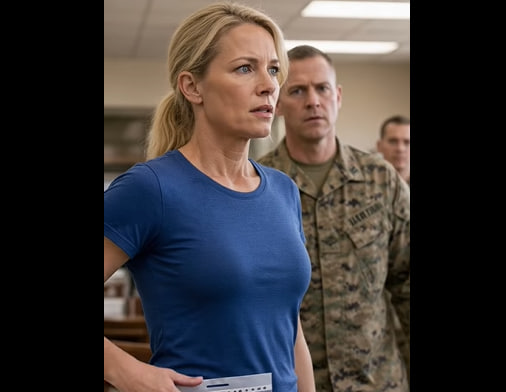

HE THOUGHT SHE WAS JUST AN ORDINARY VISITOR… UNTIL SHE ASKED FOR HIS NAME.
The cardboard box sitting in the center of Cole Rourke’s sprawling mahogany desk looked absurdly small. For eight years, this corner office with its floor-to-ceiling windows had been his undisputed kingdom. It was the high altar from which he handed down ultimatums, crushed dissenting opinions, and built a reputation as the facility’s most untouchable executive. Now, his entire legacy was being reduced to a handful of framed photographs, a metallic desk toy, and a leather-bound planner.
Standing just inside the glass door was Marcus, a senior security officer. Cole distinctly remembered screaming at Marcus six months ago over a minor delay at the parking gate, threatening to have the man fired for sheer incompetence. Today, Marcus stood with his hands resting casually on his utility belt, his expression a portrait of absolute, unbothered professionalism. He didn’t gloat. He didn’t smirk. He simply watched the clock, ensuring the terminated executive vacated the premises within the allotted thirty-minute window.
That professional indifference hurt Cole more than an insult ever could. It confirmed what Evelyn Hart had laid bare in the boardroom: Cole wasn’t respected. He was merely tolerated. And the moment his artificial power was stripped away, he was entirely irrelevant.
“Time is up, Mr. Rourke,” Marcus said, his voice calm and firm. “Leave the company laptop on the desk. Your access card and corporate phone go in the plastic bin by the door.”
Cole’s hands trembled slightly as he unclipped his security badge. He dropped it into the bin. The plastic clatter echoed loudly in the silent office. He picked up his cardboard box, his knuckles turning white, and walked past Marcus into the main corridor of the logistics division.
This was the walk he had forced so many others to take. Over the years, Cole had taken a perverse pleasure in watching terminated employees march through the bullpen, believing it served as a brutal, necessary motivation for those who remained.
As he stepped onto the open floor, the sprawling network of cubicles and whiteboards was eerily quiet. Dozens of analysts, coordinators, and supply chain managers were at their desks. But as Cole walked past, not a single person looked up. There were no sympathetic nods. There were no quiet murmurs of support. There was only the furious, deliberate clicking of keyboards and the scratching of pens. They were actively, intentionally erasing him from their reality before he had even reached the elevator.
Cole stepped into the elevator car, the polished metal doors sliding shut, severing him from the empire he thought he owned. As the car descended to the ground floor, the crushing weight of his new reality settled over him. He had banked his entire identity on the belief that ruthlessness was the only valid currency in the corporate world. But Evelyn Hart hadn’t defeated him with ruthlessness. She had dismantled him with observation, empathy for the workforce, and an uncompromising demand for decency. He walked out into the glaring sunlight of the parking lot, realizing for the first time that he had spent eight years building a fortress on top of a sinkhole.
Back on the top floor, the atmosphere inside the executive boardroom was undergoing a seismic shift.
Evelyn Hart had not paused to celebrate Cole’s departure. The moment the door had closed behind him, she had immediately pivoted to the sprawling, complex mess he had left behind. For the next four hours, she and Daniel Reeves tore through the logistics protocols, mapping out the deep, systemic fractures hidden beneath Cole’s falsified efficiency metrics.
“It’s worse than I thought,” Daniel admitted, rubbing his temples as he looked at a projected heat map of their supply chain. “Cole was forcing the maintenance crews to bypass mandatory diagnostic checks on the transport fleet just to shave twelve hours off the delivery cycles. We aren’t just facing a turnover crisis, Evelyn. We are facing a catastrophic equipment failure waiting to happen. If one of those transport rigs goes down on the highway…”
“Then we stop the rigs,” Evelyn said without hesitation.
Daniel looked up, his eyes wide. “Stop them? Evelyn, if we ground the fleet for diagnostics, we will miss our regional quotas for the first time in five years. The board will demand a blood sacrifice. Our stock will take a hit.”
“Let it take a hit,” Evelyn commanded softly. She closed her tablet and leaned forward, resting her forearms on the table. “Daniel, you have been surviving in a survivalist culture for so long that you’ve forgotten how to actually build. You are the Interim Director now. Your job is not to artificially inflate the numbers to keep corporate happy. Your job is to ensure this facility has a foundation that will survive the next decade. Ground the fleet. Order the diagnostic checks. I will personally brief the board and absorb the blast radius regarding the quarterly numbers.”
Daniel stared at her, a profound sense of relief washing over him. It was the first time in a year that an executive had offered him top cover instead of throwing him under the bus.
“We have to send a message to the floor,” Evelyn continued, her gaze sharpening. “Cole’s shadow is still hanging over this building. The staff needs to know that the knife has been permanently removed from their throats. I want you to draft an all-hands memo. Full transparency. Explain the temporary halt in logistics, explain the renewed focus on safety, and formally invite all department heads to submit the innovation proposals Cole previously blocked.”
Daniel nodded, pulling his keyboard closer. “It’s going to take time for them to trust us. They are used to everything being a trap.”
“I know,” Evelyn said softly. “Trust is earned in drops and lost in buckets. Let’s start collecting drops.”
The real test of that new philosophy did not happen in the boardroom. It happened three days later, exactly where the entire chain of events had begun: the ground-floor cafeteria.
It was 7:30 in the morning. The cafeteria was bustling with the early shift, a low, cautious murmur filling the space. The employees were still adjusting to the sudden, shocking vacuum left by Cole’s termination. Evelyn walked through the double doors, dressed in a simple, elegant navy sweater and slacks, carrying her leather notebook.
As she joined the back of the coffee line, the atmosphere instantly shifted. People noticed her. The woman who had quietly executed the most terrifying executive in the building was standing among them. A young logistics coordinator named Sarah, who happened to be standing directly in front of Evelyn, stiffened. She nervously clutched her thermos, her eyes darting toward the floor, terrified of violating some unspoken rule of executive proximity.
Evelyn noticed the fear. It was the exact same fear she had seen on the faces of the department heads.
“Good morning,” Evelyn said. Her voice was warm, lacking the icy edge it carried in the boardroom.
Sarah jumped slightly, turning around. “G-good morning, Ms. Hart.”
“Just Evelyn, please,” she replied, offering a gentle, disarming smile. She glanced at the badge clipped to Sarah’s lanyard. “Logistics, right? You’re on Daniel’s team now.”
“Yes, Ma’am. I mean, yes, Evelyn. I handle the inbound routing schedules.”
“That’s a highly complex desk,” Evelyn noted, her interest genuine. “I saw the new routing protocol you submitted to Daniel yesterday. The overlapping grid system. It’s brilliant. Why hasn’t the facility been using that for the last six months?”
Sarah swallowed hard, her fingers nervously twisting the strap of her bag. “I… I tried to pitch it a few months ago. But Mr. Rourke said it was a waste of time to reinvent the wheel. He threw the file away.”
Evelyn’s expression softened with a deep, empathetic understanding. She took a step closer, ensuring she held the young woman’s gaze.
“No one is ever going to throw your ideas away in this building again, Sarah,” Evelyn said quietly, but with absolute certainty. “Your mind is the most valuable asset this company has. Daniel is pushing your grid system into live testing on Monday. Be proud of it. You earned it.”
Sarah’s eyes widened. A sudden, unexpected sheen of tears built in her eyes, born from months of suppressed anxiety finally evaporating into the air. For the first time since she had been hired, she wasn’t just a cog in a machine; she was a valued, respected architect of the company’s future. “Thank you. Thank you so much.”
Evelyn simply nodded, stepping up to the counter to order her coffee. The interaction had taken less than two minutes, but in a cafeteria full of people quietly watching, it was louder than a siren. The regional director wasn’t a corporate executioner sent to terrorize them. She was a gardener, meticulously pulling out the weeds so the rest of the facility could finally breathe and grow.
Over the next four weeks, the transformation of the facility was nothing short of miraculous.
The initial shock of grounding the transport fleet had indeed caused a temporary dip in their quarterly output, but the diagnostic checks had caught three severe engine faults that would have resulted in catastrophic highway accidents. By averting the crisis, the engineering and maintenance teams were suddenly working in absolute harmony with logistics. The fear-based bottlenecks dissolved. Without Cole’s constant, looming threat of public humiliation, the mid-level managers began to collaborate, share resources, and actually solve problems rather than hiding them.
And then, the impossible happened.
One rainy Tuesday afternoon, Evelyn was sitting in the corner of Daniel’s office, reviewing the final cultural audit report. There was a knock on the door. Daniel looked up from his desk to see a man standing in the doorway. It was Marcus Vance, one of the senior supply chain analysts who had quit eight months prior, citing Cole’s toxic abuse in his exit interview.
“Daniel,” Marcus said hesitantly, holding a visitor’s badge. “HR called me last week. They said the culture had changed. They asked if I would consider coming back.”
Daniel stood up, a broad, genuine smile breaking across his face. He walked around the desk and extended his hand. “Welcome back, Marcus. We’ve kept your desk warm.”
Evelyn watched the reunion from her chair, a quiet satisfaction settling deep into her bones. She closed her leather notebook, slipping it into her bag. Her work here was finished. The infection had been excised, the wounds had been cleaned, and the immune system of the facility was stronger than it had ever been.
She stood up, drawing Daniel’s attention.
“I have a flight to catch,” Evelyn announced, smoothing the front of her jacket.
Daniel looked at her, his expression a mixture of profound gratitude and a lingering sense of awe. “Are you heading back to corporate, Evelyn?”
“No,” Evelyn replied, slinging her bag over her shoulder. “There is a manufacturing plant in Seattle reporting a massive spike in quality control errors and an executive team that refuses to answer their phones. I believe they require a comprehensive structural review.”
Daniel chuckled, shaking his head. “God help them.”
“I don’t think God is on their schedule,” Evelyn said with a faint, knowing smirk. “But I certainly am.”
She walked out of the office, moving through the bustling, energized bullpen of the logistics division. The air was light, filled with the sounds of genuine collaboration, quiet laughter, and focused, productive energy. As she stepped into the elevator, she didn’t look back. She didn’t need to. She had arrived as a stranger in a cafeteria line, armed with nothing but a notebook and an uncompromising standard for human dignity. She left behind a facility that had finally remembered how to lead.
