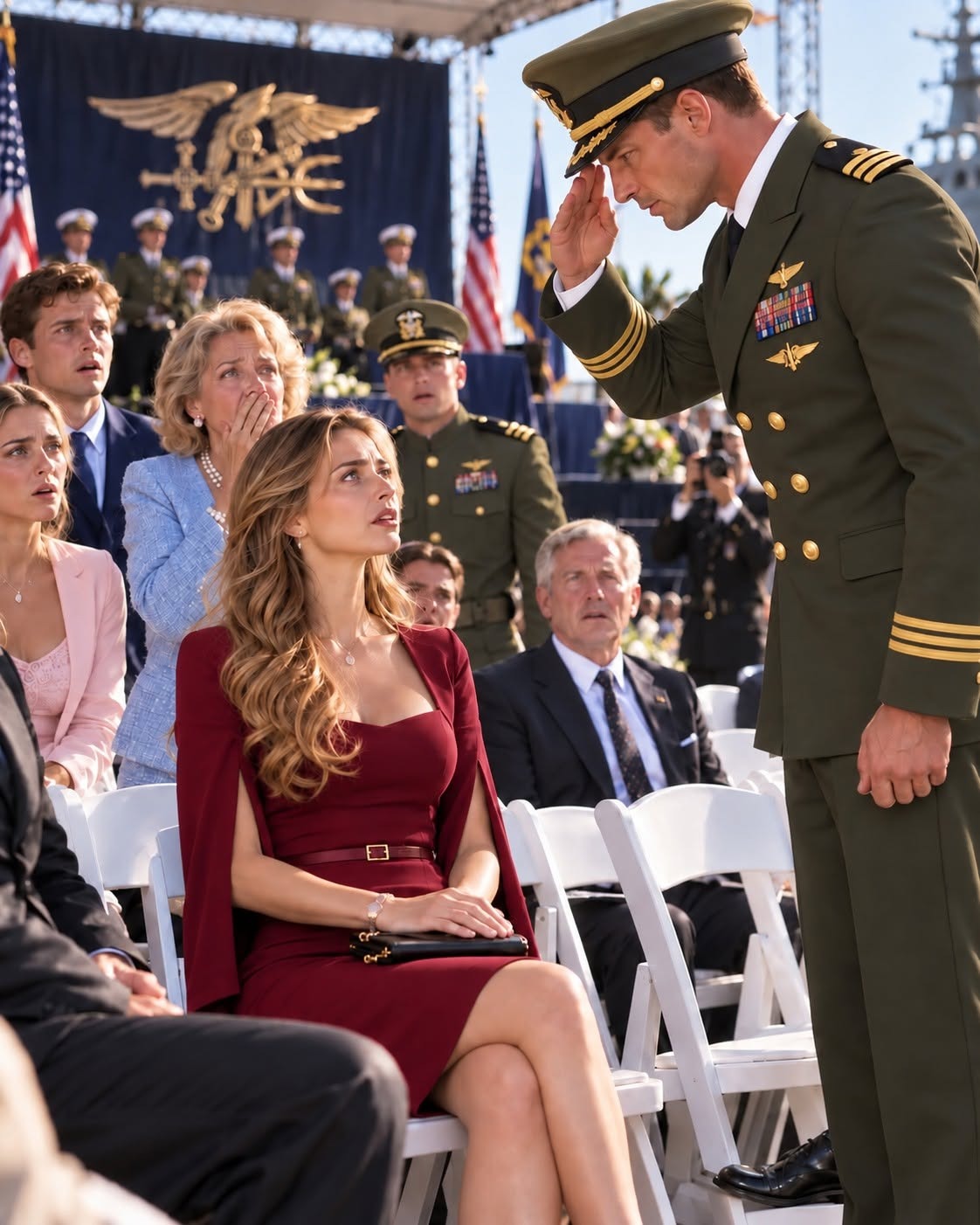

THEY CALLED HER THE “DISAPPOINTING SISTER”… THEN THE COMMANDER WALKED STRAIGHT TOWARD HER.
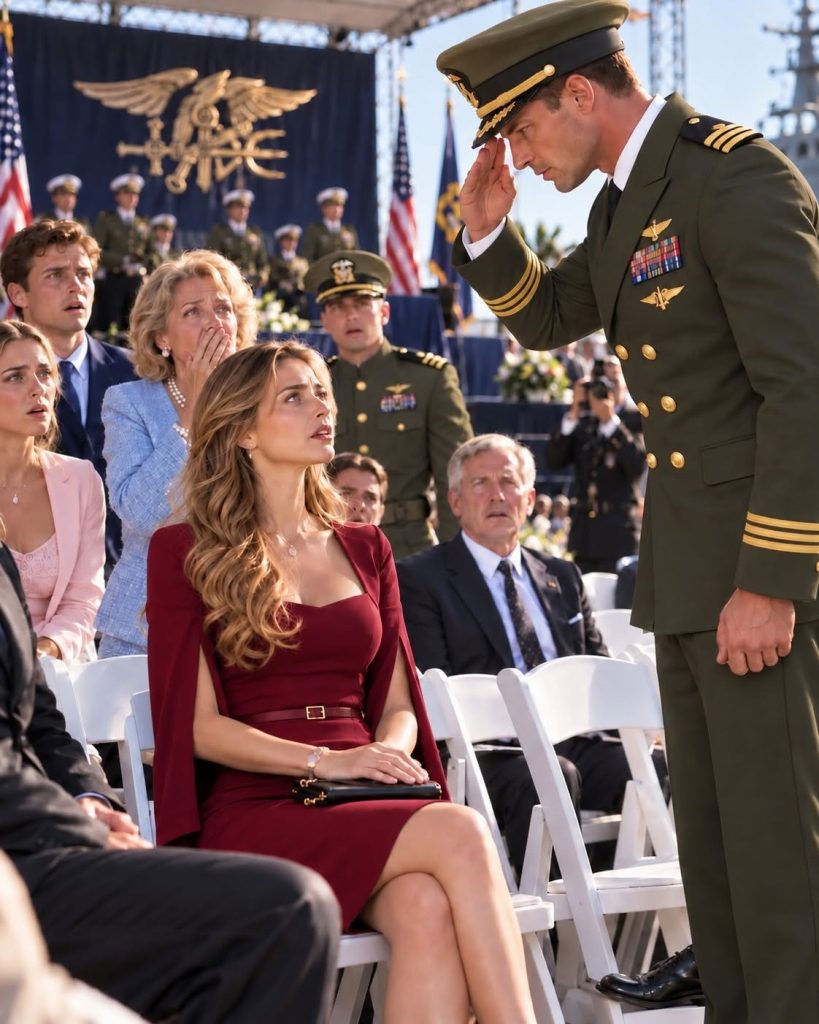
The black government SUV merged seamlessly onto the interstate, leaving the sunlit, celebratory grounds of the military academy far behind. Inside the heavily armored vehicle, the thick, soundproof glass muted the roar of the highway into a dull, rhythmic hum.
Major Emily Vance sat in the back seat, staring out the window at the passing tree line. The adrenaline from the morning’s confrontation had faded, replaced by the familiar, heavy shroud of operational detachment. She reached into her clutch purse, her fingers brushing against the gold-embossed VIP invitation she had left on the cocktail table, only to have Commander Hayes’s aide discreetly return it to her before she departed. Emily looked at the heavy cardstock for a long moment. Then, she opened a classified burn-bag sitting on the floorboard and dropped the invitation inside.
That part of her life—the desperate need to be seen, to be validated by a family that only valued the superficial—was over.
“ETA to Andrews Air Force Base is twenty minutes, Major,” the driver said, his voice completely devoid of the awe that had paralyzed her family. To him, she wasn’t a prodigal daughter; she was a senior intelligence operative running late for a war.
“Thank you, Sergeant,” Emily replied smoothly.
Three hours later, Emily was standing inside a windowless Sensitive Compartmented Information Facility (SCIF) at Joint Special Operations Command. The air was frigid, smelling faintly of ozone and stale coffee. A massive digital map illuminated the darkened room, tracking a highly classified grid square in a hostile, unnamed territory. Four high-ranking generals, two intelligence directors, and a team of Tier 1 operators were staring at her, waiting for her assessment.
“The hostage is being moved at zero-three-hundred local time,” Emily stated, her voice sharp and authoritative, pointing a laser at a clustered compound on the satellite feed. “If we hit the transport vehicle here, in this chokepoint, we minimize civilian casualties. But we only have a four-minute window before enemy quick-reaction forces arrive. I am authorizing the green light for Team Alpha. No one goes in until the drone feed confirms the target’s presence.”
“It’s a tight window, Emily,” a three-star general murmured, crossing his arms. “If your intelligence on their response time is off by even sixty seconds, we lose the extraction team.”
“My intelligence is not off, General,” Emily said, her tone absolute. “I’ll stake my commission on it. Bring them home.”
As the operation commenced, plunging the room into tense, excruciating silence broken only by the crackle of encrypted radio traffic, Emily felt the familiar, crushing weight settle onto her shoulders. This was the “desk job” her mother had lamented. This was where she had been during Thanksgiving dinners and Christmas mornings—standing in the dark, holding the lives of dozens of men in her hands, bearing a psychological burden she could never, ever explain to the people she loved.
Eight months later, Second Lieutenant Ryan Vance stood knee-deep in the suffocating, powdery dust of a forward operating base in the Middle East.
The pristine, tailored uniform he had worn on his graduation day was gone, replaced by sweat-stained, sand-crusted combat fatigues. His face was leaner, his eyes hollowed out by lack of sleep and the relentless, grinding anxiety of commanding an infantry platoon in a hostile theater. The romanticized vision of military leadership that he had nurtured at the academy had been burned away by the blistering desert sun.
Ryan sat on a crate of ammunition inside his sweltering command tent, staring at a crumpled letter from his mother. It had arrived on the morning supply convoy.
…and your cousin got a promotion at the bank! We are all doing so well. We are so proud of you, Ryan, our brave boy. I still haven’t heard a word from Emily. You’d think after that dramatic stunt she pulled at your graduation, she would at least try to call her own mother. She always has to make everything about herself, doesn’t she? Stay safe, honey.
Ryan crushed the letter in his fist, a wave of profound disgust washing over him. Eight months ago, he would have agreed with every word. He would have basked in his mother’s praise and eagerly joined in the casual dismissal of his sister.
But eight months in the dirt had fundamentally changed him. He had spent the last two hundred and forty days learning exactly how heavy the brass on his collar truly was. He was responsible for thirty-two human beings. He had to write letters to their wives when they were injured. He had to stay awake while they slept. He had learned, through brutal exhaustion, exactly what Emily had meant.
The flap of the tent was violently yanked open. Captain Miller, Ryan’s Company Commander, ducked inside. Miller was a career-climber, a man who viewed the deployment not as a tactical responsibility, but as a resume builder for his inevitable promotion to Major.
“Vance,” Miller barked, unrolling a map on a folding table. “Change of plans for tomorrow’s patrol. Battalion wants a show of force. The local governor is visiting the district center, and command wants a heavy American presence in the market sector. I want your platoon to route through Route Violet.”
Ryan felt his stomach drop. He stepped up to the table, looking at the red line drawn through a tightly packed, urban bottleneck.
“Sir, Route Violet is a death trap,” Ryan said, keeping his voice steady. “It’s a narrow corridor flanked by multi-story buildings with zero overwatch. My squad leaders reported increased spotter activity in that sector just yesterday. If we take a convoy through there, we’re sitting ducks for an IED or an ambush.”
“It’s the most direct route to the market, Lieutenant,” Miller snapped, his eyes narrowing. “It puts us front and center for the governor’s cameras. It shows we aren’t afraid to secure the sector.”
“With all due respect, Sir, we can secure the sector by taking the northern bypass,” Ryan countered. “It adds forty minutes to the patrol, but it keeps my men out of a fatal funnel.”
Captain Miller stood up straight, his face flushing with anger. He stepped into Ryan’s personal space, jabbing a finger against Ryan’s chest. “I am not asking for your tactical opinion, Lieutenant. I am giving you a direct order. You will take Route Violet. Or are you too scared to execute a standard patrol? Because I can easily find a Platoon Leader who isn’t afraid of his own shadow, and I will gladly tank your evaluation report to do it.”
The threat hung in the stifling air. A bad evaluation report from a Company Commander could permanently cripple a young officer’s career. It was the exact kind of threat that the old Ryan—the boy who desperately craved gold stars and public approval—would have buckled under instantly.
Ryan looked down at the map. He thought of his mother’s letter. He thought of his own vanity on graduation day.
And then, he saw Emily. He saw her standing at the podium, the Silver Star gleaming on her chest, her voice echoing across the silent courtyard.
Real leadership happens in the dark. It requires the willingness to be misunderstood… Do not seek validation from the crowd. Seek validation from your conscience.
Ryan looked up, meeting Captain Miller’s furious gaze with absolute, unshakeable calm.
“No, Sir,” Ryan said.
Miller blinked, taken aback. “Excuse me?”
“I said no, Sir,” Ryan repeated, his voice resolute. “Route Violet is tactically compromised. I will not put thirty-two of my men into a fatal chokepoint just so Battalion can get a good photograph. I will take the northern bypass. If you want to relieve me of my command and write a negative evaluation, you are entirely within your right to do so. But as long as I am the Platoon Leader, my men are not going down that street.”
For ten excruciating seconds, the two officers stared at each other. Miller’s jaw worked furiously, his face purple with rage. But when he looked into Ryan’s eyes, he found no hesitation. He found a leader who had finally accepted the cost of his rank.
“You just ended your career, Vance,” Miller spat. He turned on his heel and stormed out of the tent.
Ryan let out a long, shaky breath. His hands were trembling slightly, and he knew his promotion to First Lieutenant was likely gone. But as he looked out the tent flap, he saw his Platoon Sergeant, a hardened, twenty-year veteran with combat tours in Iraq and Afghanistan, standing just outside. The older man had heard everything.
The Sergeant didn’t say a word. He simply caught Ryan’s eye, gave a single, slow nod of profound respect, and went back to checking his rifle.
It was the quietest, most invisible form of validation Ryan had ever received. And it meant more than a thousand standing ovations.
Two weeks later, halfway across the world, Emily sat in her dimly lit office at the Pentagon. It was past midnight. The rest of the corridor was empty, but her desk was covered in classified briefs.
The encrypted red phone on the corner of her desk rang.
Emily picked it up. “Vance.”
“Hey, Major,” a voice crackled through the secure satellite connection, distorted by static and distance.
Emily froze, her pen stopping mid-sentence. “Ryan?”
“Yeah. It’s me.”
He sounded different. The arrogant, boastful cadence of the academy cadet was completely gone. His voice was tired, deep, and laced with the undeniable grit of the desert.
“Are you okay?” Emily asked, her posture instantly shifting from military officer to protective sister. “Are you injured? Where are you?”
“I’m fine, Em. I’m safe,” Ryan said quickly. There was a long pause on the line. The static hummed like a living thing between them. “I just… I needed to use my monthly secure-line minute. I didn’t want to call Mom.”
Emily leaned back in her chair, staring at the ceiling. “Why not?”
“Because she asked if I was getting an award for a patrol we did last week,” Ryan said, a dry, humorless chuckle escaping him. “She wanted to know if I was going to be in the base newsletter.”
He went quiet for a moment. When he spoke again, the vulnerability in his voice was absolute.
“I lost my Platoon Leader slot, Em. Captain Miller moved me to the logistics tent. He wrote me up for insubordination.”
Emily’s grip on the phone tightened. “Tell me what happened.”
Ryan told her. He told her about Route Violet, the visiting governor, the pressure from his commander, and the terrifying realization that doing the right thing meant throwing his career under the bus. He didn’t dress the story up. He didn’t try to sound heroic. He just sounded exhausted.
“I was so scared, Emily,” Ryan whispered. “I stood there, and I knew I was throwing away everything I worked for at the academy. But I looked at the map, and I remembered what you said. About leadership happening in the dark. Nobody but my Sergeant knows what I did. I’m going to go home with a terrible evaluation, and Mom is going to be so disappointed in me.”
Emily closed her eyes. A single, silent tear slipped down her cheek, not out of sadness, but out of an overwhelming, profound pride. The boy she had watched grow up was gone. A man had finally taken his place.
“She won’t understand, Ryan,” Emily said softly. “She’s never going to understand. And that’s going to hurt.”
“I know,” Ryan replied.
“But I understand,” Emily said, her voice fierce and unwavering. “You kept your men alive. You stood in the breach, and you took the hit for them. You earned your bars, Lieutenant. You earned them in a way most officers never will.”
Through the static of the satellite feed, Emily could hear her brother let out a breath he sounded like he had been holding for eight months.
“It’s so heavy, Em,” Ryan admitted quietly.
“I know,” Emily smiled sadly, looking at the rows of classified operations folders on her desk. “But you’re strong enough to carry it now. And you don’t have to carry it alone anymore. I’m here.”
“Thanks, Major,” Ryan said, the respect in his voice genuine and unforced.
“Keep your head down, Lieutenant,” Emily replied. “Call me next week.”
When the line clicked dead, Emily gently set the receiver back on its cradle. The silence of her office returned, heavy and familiar. But for the first time in a decade, it didn’t feel lonely. She picked up her pen, pulled the next operational briefing toward her, and went back to work in the dark.
