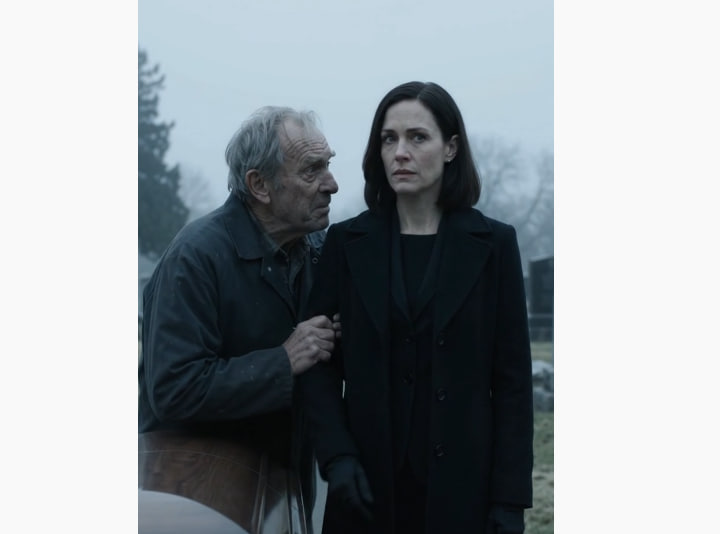

At her father’s funeral, the gravedigger pulled her aside and whispered something that made her blood run cold
The rhythmic, high-pitched electronic beeping from behind the corrugated metal door of Unit 17 cut through the cold New Jersey wind like a razor. It wasn’t a standard mechanical alarm; it was a rhythmic, pulsing cadence—a binary sequence that my military training instantly recognized.
Dot-dot-dash. Dot-dot-dash.
SOS. Played on an encrypted loop.
My fingers tightened around the cold brass key in my palm, the number 17 biting into my skin. For over two decades, I had prided myself on my ability to read a tactical situation in seconds, to anticipate enemy movements, and to keep a level head when bullets flew overhead. But standing outside a row of dreary, rain-swept storage lockers with a senior FBI agent who seemingly knew my name before I arrived, I felt like a raw recruit standing in the middle of a minefield blindfolded.
My phone continued to vibrate in my coat pocket. The screen flashed a bright, mocking illumination against the gathering gloom: Mom.
The FBI agent—a woman whose sharp, unblinking eyes suggested she had seen far too many classified files and solved far too many impossible cases—kept her gaze locked on my device.
“She’s watching the perimeter, Colonel,” the agent said, her voice barely a whisper above the whistling wind. “Or someone who looks like her is. If you answer that call, or if you turn your SUV around and drive back to that house, you won’t just be walking into a trap. You’ll be executing a death sentence your father spent twenty years trying to prevent.”
I swallowed hard, forcing my breathing to remain steady. “You haven’t told me your name. And you haven’t explained how you knew I’d be holding a brass key with a number seventeen stamped on it.”
The woman reached slowly into the inside pocket of her heavy black overcoat, her movements deliberate and transparent, and flipped open a weathered leather identification folder.
“Special Agent Diana Vance, Federal Bureau of Investigation, Counter-Intelligence Division,” she said, her voice dropping lower as she exposed the badge. “And to answer your second question, Colonel Mercer: I didn’t just know you’d be here. Your father and I drafted this protocol twenty-two years ago, back when you were still a cadet at West Point dreaming of a career in the Judge Advocate General’s corps.”
My eyes widened. “My father was an accountant for a regional manufacturing firm. He spent his life staring at ledgers and balancing tax sheets. He never worked for the government. He never even left the state of New Jersey, except for our annual family trips to the Poconos!”
Diana Vance gave a thin, humorless smile. “That’s what the tax forms said. That’s what his retirement plaque from the county transit authority claimed. Raymond Mercer was a master of misdirection, Natalie. The man you called ‘Dad’ was the architect behind some of the most sensitive deep-cover intelligence conduits operated by the Department of Defense during the height of the Cold War. And when he retired from active service, the threats didn’t retire with him.”
Before I could process the staggering weight of her words, the electronic beeping inside Unit 17 abruptly stopped.
A heavy, mechanical clack echoed from the heavy steel door. The magnetic locks had disengaged.
Inside the Vault
“We don’t have much time,” Diana said, stepping past me and inserting the brass key into the master cylinder. She turned it with a smooth, practiced motion. “The men who killed your father’s decoy—the poor soul buried in that empty coffin this morning—are monitoring local cell tower pings. The moment your phone connected to this sector’s relay tower, our clock started ticking.”
With a sharp heave, Diana lifted the corrugated metal door. It rattled upward, releasing a plume of stale, dusty air mixed with the sharp, clinical scent of ozone and archival paper.
Inside, the unit didn’t look like a typical storage locker filled with old furniture or Christmas decorations. It was a fully retrofitted, climate-controlled sub-station. Rows of steel shelving units lined the walls, stacked high with manila folders, reel-to-reel magnetic tapes, labeled cassette drives, and secure military communication terminals that hummed with a low, steady voltage. In the center of the room sat a heavy oak desk—the exact twin of the one that had sat in my father’s home study.
And resting on top of that desk was an open laptop computer, its screen glowing with a single blinking text cursor.
I stepped across the threshold, my boots crunching faintly on the concrete floor. Every instinct screamed that I was walking deeper into a conspiracy from which there was no return. Yet, the memory of the gravedigger’s words—“Your father paid me to bury an empty coffin”—pushed me forward.
“Go ahead, Colonel,” Diana urged gently, standing guard by the open doorway while scanning the empty, rain-slicked lane of the storage facility. “Look at the primary log. It was encrypted using your West Point cadet identification number as a private key. This whole archive was built for you.”
I walked slowly to the desk and leaned over the laptop. My hands hovered over the mechanical keyboard for a fraction of a second before I typed a twelve-digit alphanumeric sequence: my old plebe year cadet serial number.
The screen flashed. A massive, hierarchical database unlocked instantly, displaying a cascading wall of classified documents, surveillance photographs, and bank routing numbers spanning over three decades.
At the very top of the directory was an unencrypted video file labeled simply: PLAY_FIRST_NATALIE.MP4.
My breath caught in my throat. I clicked the mouse.
The screen flickered, blacking out for a brief second before the grainy, high-definition image of a familiar face filled the display. It was my father. But he looked younger, his hair still touched with dark brown rather than the stark silver I had known in recent years. He was wearing a civilian jacket, sitting in what appeared to be a safe house or a makeshift recording studio. He looked directly into the camera lens, his expression heavy with a profound, sorrowful gravity.
“Natalie,” my father’s voice echoed softly through the small speakers of the laptop, rich and steady. “If you are watching this, it means I am legally dead, the funeral is over, and Diana has handed you the key to Route 9.
I am sorry for the lies. I am sorry for every birthday I missed while staring at a ledger, and every time I couldn’t tell you the truth about where I was going when the phone rang in the middle of the night. But you needed to be kept safe. For twenty-two years, a faction within our own government—a syndicate known only inside high-level clearance circles as ‘The Oversight Group’—has been systematically eliminating deep-cover analysts who refused to participate in illegal domestic surveillance operations.
They came for my unit in 2004. They forced us underground. To keep you and your mother safe, I had to cut all ties, fake my death, and let the world believe Raymond Mercer was nothing more than a quiet, boring accountant.
But three days ago, they found me. They didn’t use a heart attack, Natalie. They poisoned my study. And I knew that if I didn’t stage my own funeral and disappear into the wind, they would come for you next to extract the encryption keys hidden in my old network.
You are an officer in the United States Army now. You wear the uniform with honor. But the battle I spent my life fighting has just been handed down to you. Open folder seventeen-beta. The truth is inside.”
The video file ended with a soft click, leaving only the steady hum of the server farm in the background.
I stood frozen, the blood roaring in my ears. All the grief I had felt over the past three days—the agonizing sorrow of losing my father to a sudden heart attack—evaporated instantly, replaced by a cold, searing fury. He hadn’t died of natural causes. He had been murdered. And his funeral had indeed been the opening salvo in a war I didn’t even know I was fighting.
The Shadow at the Door
“Did you find it?” Special Agent Vance asked quietly, her eyes darting toward the end of the storage corridor.
“I found it,” I said, my voice dangerously calm as I clicked on folder 17-beta.
The screen instantly populated with a list of active government officials, high-ranking military commanders, and corporate executives whose names read like a “who’s who” of the national security establishment. Beside each name was a detailed dossier outlining illegal surveillance programs, multi-million-dollar offshore accounts, and classified assassination orders signed off by individuals who currently sat in positions of immense political power.
This wasn’t just a collection of family secrets. It was a ticking bomb capable of destroying the upper echelons of the federal government.
Suddenly, Diana Vance stiffened. She pulled a compact tactical radio from her belt, listening intently to a burst of static-laced chatter coming through her earpiece. Her face drained of all color.
“Colonel,” she hissed sharply, stepping back into the unit and slamming the metal door halfway down before locking it into an intermediate position. “We’ve been compromised. Two unmarked black SUVs just turned into the facility entrance. They bypassed the facility security gate using override codes. They aren’t local police, and they aren’t standard federal agents. They’re Directorate cleanup units.”
“How?” I demanded, drawing my service sidearm—a standard-issue M9 pistol—from its concealed shoulder holster with practiced, fluid precision. “We scrambled our digital signatures before we left the cemetery!”
“They didn’t track our signal,” Diana said grimly, unholstering her own weapon and checking the magazine slide with a sharp metallic clack. “They tracked the access ping from your father’s legacy server the moment you entered your West Point cadet number. The moment you unlocked the primary directory, you tripped a silent tripwire embedded in the mainframe.”
Outside, the heavy, rhythmic thrum of high-displacement diesel engines echoed loudly down the paved lane between the storage lockers. The headlights of two heavy vehicles cut sharp, blinding beams through the corrugated slats of neighboring units, sweeping back and forth across our hiding spot.
“Step away from Unit Seventeen! Federal security mandate! Surrender immediately or face lethal neutralization!” a amplified, distorted voice bellowed through a loudspeaker outside.
I looked down at the glowing laptop screen, then at the stacks of classified files lining the walls, and finally at the brass key still clutched in my left hand. My father had spent twenty years hiding in the shadows so I could live in the light. He had traded his life, his name, and his dignity to ensure I could wear an Army uniform with pride.
I looked at Agent Vance, a grim, determined smile touching the corners of my mouth.
“My father spent twenty years running from these bastards,” I said, racking the slide of my pistol. “I think it’s time we stopped running.”
Diana nodded, her eyes flashing with answering resolve. “What’s the play, Colonel?”
“We don’t surrender,” I replied, stepping into the tactical defensive stance I had drilled into hundreds of soldiers under my command. “We take the files, we burn their network to the ground, and we show them what happens when you mess with a Mercer.”
Outside, heavy boots hit the pavement, sprinting toward our door.
