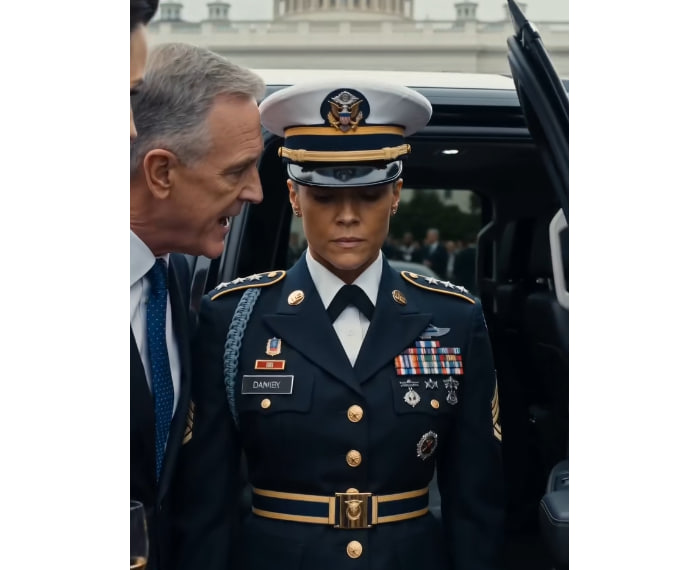

Her family begged her not to wear her Army uniform.
The murmurs rippled across the opulent ballroom like a sudden gust of wind through dry leaves. Crystal chandeliers cast a brilliant, glittering light over silk-draped tables, expensive evening gowns, and sharply tailored tuxedos. Yet, in an instant, all eyes shifted away from the stage and turned backward, craning necks to find the quiet corner near the heavy mahogany doors.
Arthur Parker stood frozen near the front table, his glass of vintage champagne trembling ever so slightly in his manicured hand. His face, usually flushed with the smug satisfaction of a wealthy patriarch hosting high society elites, had turned a pasty, sickly white.
Beside him, Daniel adjusted his silk tie, his confident, self-assured smirk completely wiped away, replaced by an expression of dumbfounded shock. He stared back toward the entrance as if he were seeing a ghost.
Maya remained seated at her table near the back. For a quiet moment, she didn’t move. She simply smoothed down the fabric of her Class A Army service uniform, adjusting the lapel pins with the calm, practiced precision of a soldier who had faced enemy fire and walked away unfazed. Then, with measured grace, she stood up.
The General’s Call
General Marcus Vance, a legend of the United States Army whose chest bore a staggering array of campaign ribbons and decorations, stood tall and unyielding at the center mahogany podium. His gaze remained locked on Maya, cutting through the sea of wealthy socialites and powerful executives like a laser beam.
“Staff Sergeant Maya Parker,” General Vance repeated, his deep, resonant voice echoing flawlessly through the state-of-the-art sound system. “Report to the stage.”
The silence in the ballroom was absolute. You could hear the faint hum of the air conditioning and the soft, nervous swallow of a politician sitting in the third row.
Maya stepped out from behind the rear table. The heavy combat boots she wore made a sharp, rhythmic clack-clack-clack against the imported Italian marble floor. It was a sound entirely foreign to this room—a sound of raw grit, sacrifice, and earth, cutting straight through a sanctuary of inherited wealth and hollow prestige.
As she walked down the central aisle, the guests involuntarily parted for her, leaning back in their chairs. Some looked at her with curiosity; others watched with sudden, cautious awe. But no one dared whisper.
Arthur Parker felt his throat constrict. Only minutes ago, he had cornered her near the coat check, whispering harsh, dismissive venom into her ear: “We don’t need you drawing attention… Being a career soldier isn’t exactly impressive anymore.”
Now, every single general, politician, and billionaire CEO in this room was watching his daughter walk toward the stage with bated breath.
Unveiling the Truth
Maya mounted the steps to the stage, stopping two paces away from General Vance. She came to a crisp, flawless position of attention, snapping a hand up to her brow in a sharp military salute.
General Vance returned the salute, a rare, proud smile breaking across his weathered face. He reached out, his strong, calloused hand gripping Maya’s forearm firmly before turning to face the packed audience once again.
“Ladies and gentlemen,” General Vance began, his voice commanding the absolute attention of every person in the room. “Most of you gathered here tonight know this grand hall as a celebration of business titans, political influence, and generational legacies. But true legacy isn’t measured by stock portfolios, real estate holdings, or fancy titles.”
He turned slightly, gesturing toward Maya.
“True legacy is forged in the dark. It is forged in places where men and women lay down their comfort, their safety, and sometimes their lives so that the rest of the world can sleep peacefully in rooms like this.”
Arthur Parker swallowed hard, his hands gripping the edge of the white tablecloth so tightly his knuckles turned chalk-white. He stared at his daughter, realizing with a sickening jolt of dread that he had never truly known who she was.
“Six months ago,” General Vance continued, his eyes sweeping across the elite crowd, “in one of the most hostile, volatile sectors of the Horn of Africa, an elite long-range reconnaissance unit was ambushed by a heavily armed insurgent cell. Their communications array was crippled. Their perimeter was overrun. They had sixty seconds before they were completely wiped out.”
A collective intake of breath rippled through the audience.
“At that exact moment,” Vance said, his voice rising with fierce pride, “Staff Sergeant Maya Parker was operating a remote tactical intelligence relay four hundred miles away from the hot zone. Recognizing the encrypted distress signature before anyone else in command, she bypassed three layers of bureaucratic protocol, locked onto their encrypted frequency, and directed a precision drone strike and emergency extraction corridor that saved twenty-four American lives.”
The ballroom erupted into a sudden, stunned wave of murmurs. Daniel Parker’s jaw dropped. He had spent the last five years boasting about closing corporate mergers and venture capital deals over golf course lunches, while his sister had literally been calling in air strikes to save lives on the other side of the planet.
The Highest Honor
General Vance reached into a velvet-lined mahogany box resting on the podium. He lifted a heavy, gleaming medal suspended from a blue-and-white ribbon.
“For conspicuous gallantry, extraordinary heroism, and unwavering devotion to duty under enemy fire,” Vance announced, the room hanging on his every word, “the President of the United States, upon the recommendation of the Joint Chiefs of Staff, has awarded the Silver Star—along with the Meritorious Service Medal—to Staff Sergeant Maya Parker.”
The general stepped forward, gently lifting the heavy silver medallion over Maya’s head and resting it squarely over the heart of her uniform jacket. It joined her other ribbons—a modest, brilliant constellation of honor that far outweighed any superficial accolades in the room.
For a second, Maya blinked back a sudden rush of emotion. She thought of the sleepless nights, the endless hours in command bunkers, the dirt, the blood, and the fallen friends she carried with her every single day. She hadn’t sought this spotlight. She had only wanted to honor her grandfather—a World War II veteran who had taught her that service was not a stepping stone for status, but a sacred duty.
Then, General Vance turned back to the audience.
“Please rise,” the general commanded.
It wasn’t a request. It was an order from a four-star general.
And in an instant, every single person in the grand ballroom stood up.
Generals, politicians, corporate executives, wealthy socialites, and dignitaries—hundreds of people rose to their feet in a synchronized wave of deep, profound respect. The applause didn’t start softly; it exploded into a roaring, thunderous ovation that rattled the crystal chandeliers overhead.
People were clapping, cheering, and wiping away tears. Men who had looked down their noses at her plain uniform moments before were now staring up at her with unadulterated reverence.
The Reckoning
In the front row, Arthur Parker slowly pushed himself to his feet. His legs felt like lead. He looked up at the stage, watching his daughter stand tall beneath the blinding stage lights, radiating a quiet, unbreakable strength that he had spent years dismissing.
Daniel stood beside him, completely silent, looking down at the floor in a daze of absolute humiliation. He finally understood the vast, unbridgeable chasm between his comfortable, ego-driven corporate life and the actual, heavy reality of the uniform Maya wore.
Maya didn’t look at her father or her brother as the applause washed over her. She kept her eyes fixed forward, scanning the crowd until she spotted a framed photograph of her late grandfather resting on a memorial table near the edge of the stage.
She offered a subtle, knowing smile toward the photograph, silently whispering: “This one’s for you, Grandpa.”
As the applause slowly subsided into a respectful, reverent hush, General Vance stepped back to the microphone.
“Staff Sergeant Parker,” Vance said quietly, a warm smile touching his lips. “Do you have anything you’d like to say to this distinguished room?”
Maya stepped up to the microphone. She adjusted her posture, her dark eyes sweeping across the sea of powerful people who had just stood to honor her—and finally resting on her pale, trembling father in the front row.
Her voice, calm, clear, and utterly unshakeable, echoed through the grand hall:
“Thank you, General,” Maya said softly. “My grandfather always taught me that true strength isn’t about the uniform you wear to impress a room. It’s about what you do when the lights go out, the noise stops, and everything is on the line. I am proud to wear this uniform. And I wear it for those who never made it back to tell their story.”
She stepped back, saluted one final time, and the ballroom erupted into an even louder, more passionate wave of applause.
Arthur Parker lowered his head, finally realizing that no amount of wealth or social standing in this room could ever buy the kind of honor his daughter had earned with her own two hands.
