
Chapter 1: The Hollow Look
The video ended, and the silence that followed was worse than any sound. I stood there with the tablet still glowing in my hands, my reflection staring back at me like a stranger. Rosa’s final words echoed through my skull: Someone inside your own command gave them access to her background, her medical history, and your deployment schedule.
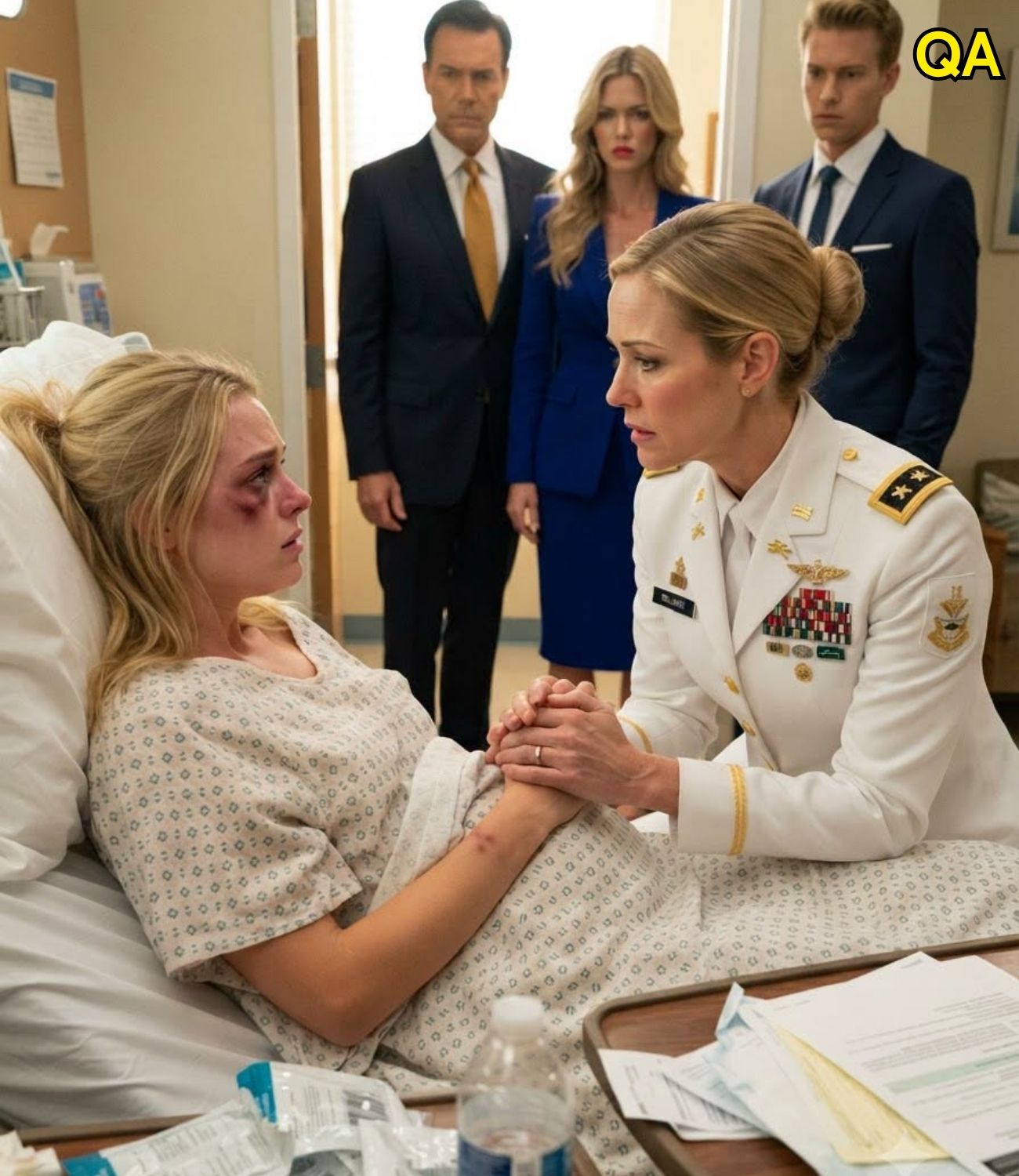
I felt Abigail’s hand slip from mine. When I turned, she had pulled her knees to her chest and was staring at the wall with an expression I had never seen on her face before—not fear, but the hollow look of someone realizing their entire life had been a carefully constructed lie.
“Mom,” she whispered. “They knew you. They knew everything about you.” “I know,” I said, crossing the room to sit on the edge of her bed. “Someone you trusted helped them choose me.”
Her voice cracked on the word choose, and I felt something inside my chest splinter. I had spent my career trusting the people beside me with my life, believing the Army was my family, my fortress, the one place where loyalty meant something. And now my daughter was telling me that same institution had handed her to predators.
Detective Ruiz cleared her throat from the doorway. “Colonel Gardner, I need to ask you something.”
I looked up. “Go ahead.”
“Did anyone in your unit ever ask about Abigail’s personal life? Her whereabouts? Her relationships?”
The question hit me like a physical blow because the answer was yes. A man had asked—a man I had served beside for over a decade, Major Thomas Whitfield. He had approached me at a unit function two years before Abigail met Nicholas, mentioning how difficult it must be raising a daughter while deployed. I had thought nothing of it. We were soldiers; we looked out for one another. But now, replaying those conversations, I remembered something else: Whitfield had introduced Abigail to the Fergusons through his wife, Eleanor, a distant cousin of Patricia’s who had invited Abigail to a charity luncheon and praised Nicholas as a successful businessman.
Abigail had met him there, and I had been grateful to Whitfield, buying him a drink and considering him a brother.
“Mama?” Abigail’s voice sounded far away. “Mama, you know something.” “I need to make a phone call,” I forced myself to breathe. Special Agent Mercer stepped forward. “Who are you calling?” “Someone who may have betrayed me before I ever met the Fergusons.” Mercer’s eyes narrowed. “Give me the name.” “Not until I confirm it myself.” “Colonel, this is a federal investigation. Withholding information—” “Is my daughter safe right now?” Mercer paused. “Not entirely.” “Then I’m not withholding information. I’m protecting my family until I know who I can trust.”
Chapter 2: The House by the Lake
I pulled out my phone and dialed a number I had not called in months. It rang three times before Sergeant First Class Marcus Hale, my right hand for over a decade before he retired, answered.
“Gardner? Is that you?” “Marcus, I need your help.” “Anything. What’s going on?” “Do you remember Major Whitfield?” A pause. “What about him?” “Did he ever ask you about Abigail?”
The silence that followed lasted too long.
“Marcus.” “I don’t like where this is going.” “Answer the question.” “Whitfield asked me about your daughter once. About four years ago. Wanted to know if she was seeing anyone.” My grip tightened on the phone. “Who did you tell him?” “I said she was single. Said you were worried about her being alone while deployed. Why? What the hell is happening?” “Someone used that information to set my daughter up with a family that nearly killed her.”
The line went quiet for a moment before Marcus’s voice came through, low and dangerous.
“Whitfield retired eight months ago. He moved to Virginia.” “How do you know that?” “Because I ran into his wife at the commissary. She said they were leaving the state, selling the house, and that Whitfield had ‘made some investments’ that were finally paying off.” My blood ran cold. “He bought a house and then moved within months of retirement?” “That’s what she said. Mentioned a lake house. Said they’d paid cash.”
I felt the pieces clicking together. Whitfield had been bought—not with loyalty, but with money.
“Marcus, do you still have contacts in military intelligence?” “I know some people.” “I need you to find out everything you can about Major Whitfield’s financial records. Quietly.” “You think he was paid off?” “I think someone inside the Army sold my daughter to a criminal family, and I need to know who else was involved.” Marcus let out a slow breath. “Give me 24 hours.” “I don’t have 24 hours.” “Give me what you can.”
I ended the call and turned back to the room. Mercer was watching me with an unreadable expression.
“Was I right?” he asked. “Major Whitfield introduced Abigail to the Fergusons through his wife two years ago. He retired eight months later and bought a house with cash.”
Abigail let out a small, broken sound.
“He was at the wedding.”
I looked at her sharply.
“What?” “Whitfield and his wife were at the wedding. They sat in the front row. Nicholas introduced them as ‘dear family friends.’”
I felt my hands begin to shake. I had been there, standing at that wedding, smiling, proud of my daughter, grateful to the people who had helped her find happiness, while watching the snake smile back at me.
“Did you meet anyone else from his side?” Mercer asked. Abigail’s brow furrowed. “What do you mean?” “Other men in uniform. People Whitfield introduced you to.” She was quiet for a moment before her face changed. “There was a dinner about six months before the wedding. Whitfield brought me to a restaurant in D.C. He said he wanted to introduce me to some important people.” “Who was there?” “An older woman. She didn’t give her name. She asked me questions about my background, my mother’s career, and whether I felt lonely when she was deployed.”
Every warning bell in my body began ringing.
“What did she look like?” “Blonde. Short hair. A scar on her jaw.”
I felt the air leave my lungs because I knew exactly who she was.
“Mom?” Abigail’s voice was frightened. “Mom, who is she?” Special Agent Mercer spoke before I could answer. “Someone we’ve been hunting for ten years.”
The room went completely still. Abigail looked between us.
“Who?” Mercer’s jaw tightened. “A woman who coordinates trafficking networks along the East Coast. We don’t know her real name. We only know her as ‘The Broker.’”
The word trafficking hung in the air like poison. My daughter had been evaluated—not as a victim, but as merchandise.
“She was interviewing me,” Abigail’s voice was barely audible. “She was making sure I was suitable.”
I crossed the room and pulled my daughter into my arms. For a long moment, she shook against my chest; then her hands balled into fists.
“I want to find her.”
I pulled back and looked at her face. The fear had not disappeared, but something harder had taken root beneath it—something that reminded me of the little girl who had refused to cry when she fell off her bike, who had gotten back up and demanded to try again.
“Finding her won’t be safe,” I said. “Nothing about my life has been safe for years.” “You could go into protective custody—” “No.” “Abigail—” “Mom, she looked me in the eyes and decided I was disposable. I want to watch you show her what happens to people who are disposable.”
Chapter 3: Beneath the Gilded Mansion
Mercer stepped forward.
“If you want to help, there are things you can do.” Abigail turned toward him. “Tell me.” “You said you heard crying beneath the floor.” Her face paled. “Yes.” “Can you describe where exactly? Which room? Which part of the guest house?”
She closed her eyes, forcing herself to remember.
“The closet, in the bedroom. There was a loose panel at the back. Nicholas told me a pipe ran beneath it, but the sound wasn’t water. It was someone weeping.”
Mercer typed something into his phone.
“Our forensic team will need access to the tunnel system.” “The estate is burning,” Abigail said. “Part of it,” Mercer corrected. “The main house and guest house are damaged, but the underground structures may have survived. Fire doesn’t always reach below ground.”
I looked at my daughter, seeing the same determination flickering in her eyes that had carried her through those brutal months in the Ferguson household.
“Take me there,” she said. Mercer shook his head. “Out of the question.” “I know the layout.” “We have floor plans and thermal imaging.” “The tunnel wasn’t on any blueprint. Nicholas took me through it once when I was too drugged to know where I was going. I remembered the turns anyway.”
Mercer stared at her.
“Why would he take you through the tunnel?” “Because he wanted to show me that I was trapped. That even if I escaped the house, I couldn’t escape him.”
The admission cost her something, but she straightened again.
“If I can identify the entrance, your people can dig faster.”
Mercer studied her for a long moment, then looked at me.
“Colonel?”
I understood what he was asking: Was my daughter strong enough? Was I willing to let her face the place where she had been broken?
“If she goes, I go.”
Mercer nodded slowly.
“Then get dressed. We move in twenty minutes.”
The doctor stepped forward, protesting, “She’s not stable enough—” but Mercer interrupted, “She’s the only one who knows the hidden entrance. We’ll have medics on standby.”
Abigail swung her legs over the side of the bed, and as the hospital gown rode up, I saw fresh, angry, dark purple bruises covering her thighs. I clenched my jaw. The Fergusons were still in the building, being questioned in another room, with Patricia demanding her lawyer, Nicholas threatening to sue, and Gregory silent and calculating. They had no idea what was waiting for them.
Mercer handed Abigail a pair of tactical pants and a jacket from an evidence bag.
“These are clean. You’ll ride with me.”
Abigail took them and retreated to the small bathroom to change. I turned to Mercer.
“Tell me the truth. How bad is it?” He was quiet for a moment. “You saw the bruises. You heard her story. But the tunnel suggests this has been going on for years. Decades maybe.” “And Rosa?” “The video suggests she anticipated not surviving.” My stomach twisted. “She gave the drive to Abigail. She knew what would happen.” “She’s been working as a housekeeper for the Fergusons for eleven years. She had access to everything. She collected evidence for years.” “But she needed someone to carry it out.” “Someone whose disappearance wouldn’t be blamed on her.”
I understood. Rosa had used Abigail as a courier—not cruelly, but desperately—seeing a woman being destroyed by the same family and handing her a weapon.
“Do you think Rosa is still alive?” Mercer looked toward the window. “I don’t know. But if she is, she did what she did knowing the risk. She wanted the truth to get out more than she wanted to survive.”
The bathroom door opened, and Abigail emerged in the tactical clothing, her bruised face pale but determined.
“Let’s go.”
Chapter 4: The Prison Beneath the House
We moved through the hospital in a small convoy of two paramedics, four federal agents, Mercer, Abigail, and me. As we passed the waiting room, I caught a glimpse of Nicholas standing beside his attorney. His eyes met mine, and for the first time since I had walked into that hospital room, he looked afraid.
I held his gaze with no words and no threats—just the silent promise that he would never see the world from outside a prison cell again. Abigail walked past him without looking, though as she passed, her footsteps slowed. She didn’t turn her head, but she simply whispered two words that I barely caught: “Rosa found me.”
Nicholas’s face went white, and Abigail kept walking.
We exited through the emergency bay and climbed into two black SUVs. The night air was cool against my skin, and for the first time in hours, I realized I was still wearing my dress uniform. The ribbons on my chest felt heavier than usual, representing years of service, sacrifice, honor, and now something else: the proof that a family had infiltrated the very institution I had devoted my life to.
The SUVs rolled through the darkened streets of Charlotte until the GPS indicated we were approaching the Ferguson estate. Through the windshield, I saw it: smoke rising into the night sky in thick gray columns, curling like something alive, with fire trucks surrounding the property and casting glittering arcs of water into the flames.
Our convoy pulled to a stop near a line of police vehicles. Mercer stepped out first, scanning the scene with careful eyes as a female agent in tactical gear jogged toward us.
“Agent Mercer, we’ve secured the perimeter. Fire crews are containing the blaze to the main structures.” “What about the tunnel entrance?” “We found a hatch near the carriage building, but it’s locked. Thermals show a stairwell leading down, but the readings are unclear.”
Abigail emerged from the SUV behind me, looking at the place where she had been imprisoned.
“It’s really burning,” she whispered. “It doesn’t matter,” I said. “The truth is underground.”
She nodded and turned toward the carriage building, walking across the wet lawn, stepping over hoses and past firefighters. The carriage building was a stone structure that had once housed horses, now standing dark and silent with windows reflecting the orange glow of the fire. Two agents stood guard at a heavy wooden door.
“Status?” Mercer flashed his badge. “Engineered lock on the floor panel. We’ve been waiting for the breaching kit.”
The agent pointed to a black case at his feet, but Abigail stepped forward. “Let me look.” The agent glanced at Mercer, who nodded. Abigail knelt slowly, her injuries making every movement painful, pressing her fingers along the edges of the panel.
“The lock isn’t a key,” she said quietly. “It’s pressure-activated. Nicholas bragged about it once.”
She pressed a stone tile near the corner, tried the one beside it, and then the third. A low grinding sound echoed from beneath the floor, and the panel shifted slightly.
“There’s a switch inside. It resets automatically after thirty seconds.” Mercer knelt and examined the panel. “It’s built like a panic room. No external handle. No hinges visible.” “Nicholas called it his ‘quiet place,’” Abigail’s voice was flat. “He said it was designed to keep what mattered most hidden from the world.”
One of the agents used a crowbar to pry the panel open, and cold, underground, damp, and stale air rushed out. A narrow stairwell descended into darkness with stone steps, old brick walls, a low ceiling, and a smell I knew from overseas—the smell of confined spaces where people had been held against their will, mixed with sweat, fear, urine, and desperation.
Abigail’s face went pale. “I remember this. The stairs. The cold.”
“Are you certain you want to do this?” Mercer asked. She looked at him with haunted eyes. “No. But I’m going anyway.”
She stepped onto the first stair, and I followed immediately behind her. The descent was slow down uneven, worn stairs where water dripped from somewhere ahead. Our flashlight beams cut through the darkness, revealing a narrow corridor that opened into a larger space.
The agents’ flashlights swept the room, and I heard Abigail’s breath catch. There were doors—six heavy steel doors with small sliding panels at eye level, the kind of doors you saw in prisons, not houses.
“They look like cell doors,” one of the agents said.
My daughter had been living in a house built on top of a prison. Abigail approached the nearest door slowly, paused, and slid back the panel. Inside, the flashlight revealed a small room with a concrete floor, a rusted bed frame, a thin mattress, and words scratched into the brick on the wall: They never found me.
Abigail stepped back with her hand covering her mouth. I moved closer and peered through the panel to see old scratches—years old, consisting of names, pleas, and dates.
“How long have these been here?” The agent beside me checked the wall with his light. “Hard to say. The dust patterns suggest years. Maybe a decade or more.”
I turned to Abigail, who was staring at the inner wall as if she could see through it. “Nicholas told me the guest house was built from an older structure. He said it used to be a plantation.”
The word hit me in the chest: Plantation. This was not just a hidden dungeon; this was history—a family that had been imprisoning people on this land for generations.
“Over here,” another agent said sharply.
We moved toward the far end of the corridor, where he was shining his light through a different panel. This room was larger, featuring a chair in the center with metal restraints on the arms and legs, and in the corner, a small bunk with a newer folded blanket.
Abigail’s legs seemed to give out, and I caught her before she fell. She grabbed my arm, her fingers digging in.
“Rosa,” she breathed. “They used to bring them here.” “Who?” “Women. Girls. They’d bring them through the tunnel at night, keep them down here until they could be moved.” “How do you know?” She looked up at me with tears running down her face. “Because I saw them once. Patricia showed me. She said this was what happened to women who didn’t follow the rules.”
My blood turned to ice. Patricia—the elegant, pearl-wearing, silver-haired matriarch—had shown my daughter her private dungeon.
“Abigail,” I said carefully, “why would she show you this?” “Because she wanted me to know what I would become if I ever tried to leave.”
Chapter 5: The Ledger and the Photograph
The words fell between us like stones, and I wrapped my arms around her while she buried her face in my shoulder. The agents continued searching the rest of the rooms, and one of them discovered a leather-bound, handwritten ledger hidden in a false wall containing records of transactions, names, dates, and amounts—proving the Ferguson family had been selling people for decades.
But the final room held something even worse: an rusted old freezer buried beneath a trapdoor. Inside were hundreds of photographs of young women—some tied up, some crying, others with the hollow, empty look of those who had given up. And in the back of the freezer, beneath the photographs, was a woman’s wallet containing Rosa’s driver’s license and a picture of Rosa holding a little girl with bright, laughing eyes.
Abigail picked up the photograph with trembling hands.
“She was going to get her daughter,” she whispered. “She was going to come back for her.” I looked at Mercer. “I need to find out where her daughter is.” Mercer was already on the radio. “All units. I need an urgent search for a child connected to Rosa Alvarez. Check every shelter, every school, every relative’s home.” Static crackled back. “Sir, we have something.” “What?” “School records show Rosa’s daughter was marked absent this morning. They tried to contact Rosa multiple times. The number was unavailable.” “Where was the child supposed to be?” “A public school in Charlotte. But here’s the thing—the school listed a different emergency contact.” “Who?” The agent paused. “A woman named Eleanor Whitfield.”
The name hit me like a bullet: Eleanor Whitfield, Major Whitfield’s wife. The woman who had introduced Abigail to Nicholas had been listed as an emergency contact for Rosa’s daughter.
Abigail’s face drained of color. “Whitfield is here. In Charlotte. He was at the wedding. He was at the estate.”
“Not anymore,” I said. “He retired. He moved to Virginia.” Mercer spoke sharply. “We’re checking his residence now. But if he’s involved, he knows we’re coming. He may have already disappeared.”
I looked at the picture of Rosa and her daughter, then toward the estate where the men who had owned this place were still sitting in a hospital consultation room, protected by lawyers and privilege. Not for long.
“Where are the Fergusons right now?” I turned to Mercer. “Still at the hospital. Their lawyers are fighting the detention.” “They haven’t been told about the tunnel?” “No. We’re holding that information.” “Good.”
I looked at my daughter, who was still holding the photograph. Her face had changed; the fear was still there, but something else with fire in it was rising beneath it.
“Mom,” she said quietly. “I want to see Nicholas.” “Abigail—” “Not to confront him. To tell him a story.” I frowned. “What story?” She set down the photograph carefully. “About the little girl I used to be. The one who sat at the window waiting for you to come home. The one who thought if she was brave enough, she’d never have to be afraid again. Nicholas took that girl. He locked her up. He made her feel powerless.” Her voice hardened. “लेकिन I’m going to walk into that hospital room and tell him what I want written on the wall of the cell where he’s going to spend the rest of his life.” Mercer raised an eyebrow. “Any particular message?”
Abigail’s lips curved into a cold, thin smile. “I was never lost. I was buried.”
The moment stretched before Mercer nodded slowly. “We still need to process this scene, but I’ll authorize a supervised visit. It’ll be brief.”
“Brief is all I need.”
She started climbing the stairs without waiting for assistance. I stayed at the bottom for a moment, looking at the walls scratched with the names of the forgotten, then followed her up.
The cold moonlight hit my face as we emerged from the carriage building. The fire was still burning, but the flames were lower now as firefighters mopped up hotspots, revealing a moonlit sky. Abigail stood near the SUV, looking back at the estate—the home of the Ferguson family, a mansion with a prison beneath it, a family with judges and politicians and reporters in their pocket. But they had made one mistake: they had chosen the daughter of a woman trained to finish every battle she started.
I climbed into the passenger seat as Mercer drove us back toward the hospital. Abigail sat in the back, silent, with no tears and no trembling—quiet the way I had learned to be quiet in combat, in the stillness before a final blow.
When we reached the hospital, the Fergusons had been moved to a secured conference room on the second floor, guarded by two armed marshals. Mercer walked ahead, spoke briefly to one of them, and then turned to Abigail.
“You have five minutes. No physical contact. No threatening statements. Do you understand?” “Yes.”
He opened the door. Nicholas sat at a long table with two attorneys on either side, Patricia beside him, and Gregory standing against the far wall. They looked up when we entered, and Nicholas’s eyes locked onto Abigail, then onto me. The defiance was still there, but it was cracking around the edges.
“Your evidence means nothing,” his lawyer said. “We have witnesses who will testify—” “I’m not here to talk about evidence,” Abigail said quietly, the lawyer stopping as she stepped forward slowly and stopped at the foot of the table. “I’m here to tell Nicholas about a secret I’ve been keeping.”
Nicholas’s eyes flickered with hope or suspicion, and she leaned in slightly, lowering her voice.
“You thought everything was hidden—the tunnel, the cells, the recordings. You thought you had covered every trace of what you did underneath all those polished floors. But I found something you missed.”
Nicholas gripped the table. “What are you talking about?”
“When Nicholas locked me in the guest house, I heard someone breathing beneath the floorboards,” Abigail said slowly.
Patricia’s impassive mask cracked, and Gregory straightened. “You didn’t tell me that,” Patricia said.
Abigail turned her gaze toward her mother-in-law. “I’m telling you now.”
The room fell silent. Mercer looked at me, and I gave a small nod.
“I heard breathing,” Abigail repeated. “And when I pressed my ear to the floor, I heard a voice. A small voice. A child’s voice.” Patricia’s hand went to her pearls, and Nicholas looked at his mother. “It’s a lie,” Gregory snapped. “She’s trying to provoke us.” “Am I?” Abigail tilted her head. “Then explain this. When Rosa stole that flash drive and hid it in her room, she also left something else behind. A photograph of herself with a little girl.”
The color drained from Patricia’s face.
“Do you know where that child is right now?” Abigail asked. Patricia’s mouth opened, but nothing came out. “I didn’t think she did,” Abigail said, stepping closer to Nicholas and lowering her voice. “Your mother thought she taught you how to bury your mistakes. But she forgot to teach you how to survive when the hole gets too deep.”
Nicholas’s hands trembled against the table. Abigail turned and looked at Patricia one final time.
“I hope you understand what’s about to happen. Because your family is about to learn what it feels like to be forgotten.”
Chapter 6: The Lake House Secret
She walked out without looking back, and I followed her into the hallway. Her face was pale and her pulse was racing, but she was standing, which was all that mattered. Mercer joined us with his phone pressed to his ear, listening intently before lowering it slowly.
“Report from Virginia,” he said. “And?” “We raided Major Whitfield’s lake house.” “Did you find him?” “He was already gone. But we found Eleanor Whitfield.” “Is she alive?” “She’s alive,” Mercer said carefully. “लेकिन?” He looked at Abigail. “She’s asking to speak with you. She says she has information about Rosa’s daughter. But she’ll only give it to you.”
Abigail stared at him. “Me?”
“Apparently she’s been waiting. She said you would know what she meant.”
No one spoke for a long moment until Abigail said, “Let’s go,” walking toward the elevator.
I looked at Mercer. “Virginia is a five-hour drive.”
“Then we better not waste time.”
We moved through the hospital doors into the night as another black SUV waited. Abigail climbed in without hesitation, Mercer gave orders to his team, and I sat beside my daughter as the vehicle pulled away, city lights fading behind us. Ahead lay Virginia, a lake house, a woman with secrets, and a missing child who might be the key to everything.
I reached over and took Abigail’s hand, and she squeezed back. No tears this time—we were going to find that little girl, and God help anyone who tried to stop us.
