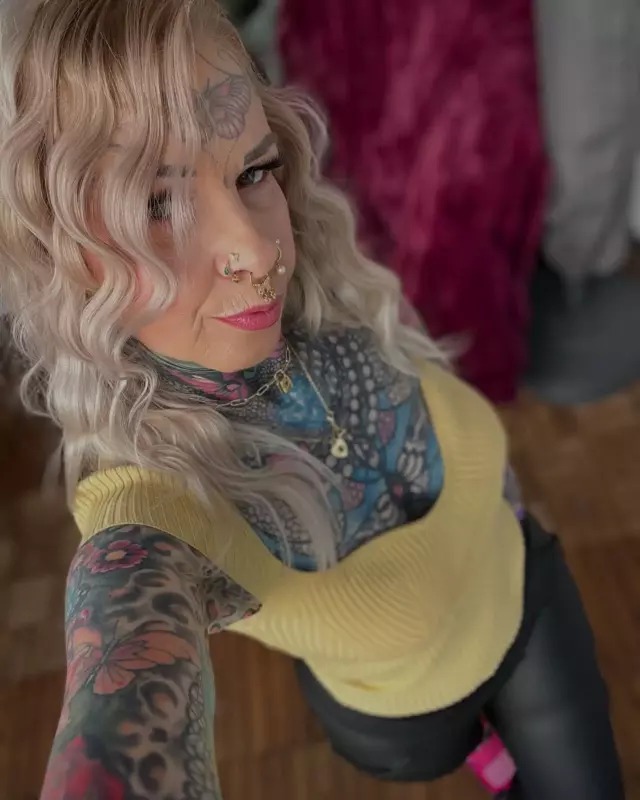

When most people imagine making a major change to their appearance, they often picture someone in their twenties or thirties.
For Kerstin Tristan, however, a remarkable transformation began later in life.
She had once viewed tattoos as something far removed from her own lifestyle. Then, in her fifties, curiosity led her to enter a tattoo studio and try one for herself.
What began as a single experiment eventually became a long-term journey of artistic self-expression. Over the years, Tristan added increasingly elaborate designs across her body, eventually creating the colorful appearance that has made her recognizable online.
Her transformation has attracted considerable attention because it challenges a familiar assumption about getting older: that people eventually stop changing their appearance or exploring new interests.
Tristan’s story suggests something different.
Personal style does not necessarily have an expiration date.

Who Is Kerstin Tristan?
Kerstin Tristan is a German tattoo enthusiast and social media personality whose extensive body art has attracted a large international audience.
Her story became particularly interesting because tattoos were reportedly not always part of her identity.
According to profiles about her journey, Tristan began exploring tattoo art when she was in her fifties. What started as a relatively small change gradually developed into a much larger personal project.
Her tattoos now include colorful floral imagery, animal designs, and detailed artwork covering significant areas of her body.
Rather than treating the tattoos simply as decoration, Tristan has described the transformation as an important form of personal expression.
That perspective helps explain why her story has resonated with people beyond the tattoo community.
It is not simply a story about body art.
It is also a story about changing one’s mind.
From Skeptic to Tattoo Enthusiast
One of the most interesting parts of Tristan’s story is the contrast between her earlier attitude toward tattoos and her later appearance.
Many people assume that major personal preferences remain stable throughout adulthood.
But people can change their opinions at almost any age.
A new experience, a conversation, a trip, an artistic discovery, or simple curiosity can cause someone to reconsider something they once dismissed.
For Tristan, the first tattoo appears to have been that turning point.
Instead of remaining a one-time experiment, the experience encouraged her to explore tattoo art further.
The transformation then developed gradually.
This is perhaps more significant than the final appearance itself.
A person does not necessarily need to know exactly who they want to become before making a change. Sometimes an unexpected first step reveals an interest that had previously remained hidden.

A Body Covered in Colorful Artwork
Today, Tristan’s appearance is dramatically different from the way she looked before beginning her tattoo journey.
Her designs are known for bright colors and detailed imagery.
Flowers are an especially prominent part of her tattoo collection. Other artwork includes animal imagery and portraits, creating a visual style that resembles a collection of separate artworks brought together across one canvas.
The result is highly distinctive.
Instead of choosing one simple design and stopping there, Tristan gradually developed an overall aesthetic.
Each additional tattoo became part of a larger visual composition.
This is one reason before-and-after photographs have become such an important part of her online presence. They allow viewers to see not only the tattoos themselves but also the scale of the transformation.
Why Floral Tattoos Can Have Special Meaning
Flowers have been used in art and symbolism for centuries.
Different cultures have associated flowers with ideas such as beauty, renewal, growth, memory, affection, and the passing of time.
Their meanings can vary considerably depending on the flower, color, culture, and personal interpretation.
For someone building a large tattoo collection, floral imagery can also provide an aesthetic connection between different pieces.
Instead of appearing as isolated designs, flowers can create continuity across the body.
Tristan has reportedly used floral imagery extensively, contributing to the colorful and garden-like appearance of her tattoos.
Whether viewers interpret those designs symbolically or simply appreciate them as artwork is ultimately a matter of personal perspective.

Tattoos as a Form of Self-Expression
Body art has a long history across many societies.
Tattooing has existed in numerous cultures for centuries, sometimes serving social, cultural, spiritual, decorative, or personal purposes.
Modern tattoo culture has expanded those possibilities even further.
People may choose tattoos to commemorate important experiences, celebrate relationships, express artistic preferences, represent personal beliefs, or simply enjoy a particular visual style.
There is no single reason why people get tattoos.
That is particularly relevant to Tristan’s story.
Her transformation demonstrates that tattooing does not necessarily have to be connected with rebellion or a desire to shock others. For some people, it can simply be another form of artistic expression.
Why Her Age Makes the Story Especially Interesting
The timing of Tristan’s transformation is one of the reasons her story has received so much attention.
Popular culture often places enormous emphasis on youth.
Fashion, beauty, and personal reinvention are frequently presented as activities primarily associated with younger generations.
Older adults, meanwhile, can sometimes feel pressure to maintain a familiar appearance.
Tristan’s story challenges that expectation.
Beginning a new creative interest later in life demonstrates that personal experimentation does not necessarily disappear with age.
People can discover new hobbies, change their style, learn new skills, and explore unfamiliar interests throughout adulthood.
In that sense, her story is about much more than tattoos.
It is about permission to change.

The Psychology of Reinventing Your Appearance
Changing one’s appearance can sometimes influence how a person thinks about themselves.
Psychologists have studied the relationship between appearance, identity, self-perception, and confidence. Clothing, hairstyles, cosmetics, and other forms of personal presentation can all contribute to the way people express identity.
Tattoos can occupy a particularly interesting position because they are generally intended to be long-term forms of body art.
Choosing a tattoo therefore involves more consideration than selecting a temporary fashion accessory.
For someone who decides to undergo a major transformation, the process can become part of a broader story about identity.
Tristan’s experience illustrates that possibility.
Her appearance changed, but the transformation also appears to have become part of how she presents herself to the world.
Becoming a Social Media Personality
The internet gave Tristan another opportunity to share her transformation.
Before social media became central to modern culture, a person with an unusual appearance might have remained known primarily within their local community.
Today, photographs and videos can reach audiences around the world within minutes.
Tristan has built an online following by sharing images of her tattoos and her evolving appearance.
Before-and-after photographs are particularly effective social media content because they immediately communicate change.
Viewers can see the contrast between an earlier photograph and a more recent image without needing a lengthy explanation.
This visual storytelling has helped introduce Tristan’s journey to people who might otherwise never have encountered her story.
Why Before-and-After Stories Are So Popular
There is a psychological reason transformation stories attract attention.
Humans naturally notice change.
A before-and-after image presents two different points in time and invites the viewer to compare them.
This format appears everywhere online: home renovations, hairstyles, fashion makeovers, artistic projects, fitness journeys, and creative transformations.
Tristan’s tattoo story fits naturally into that format.
The contrast is particularly striking because the change occurred over many years rather than overnight.
The final appearance is therefore not the result of a single decision.
It represents a long sequence of individual choices.
The Importance of Personal Choice
Not everyone will have the same opinion about extensive tattoos.
Some people appreciate body art as a form of creativity. Others prefer a more natural appearance. Some may enjoy small tattoos while having no interest in covering large areas of the body.
All of these perspectives can coexist.
The significance of Tristan’s story is not that everyone should follow her example.
Instead, it demonstrates the importance of personal choice.
A person’s appearance can be deeply connected to identity, culture, taste, and individual comfort.
What feels meaningful to one person may seem unnecessary to another.
That difference is part of what makes personal style so interesting.
Tattoos, Aging, and Changing Social Attitudes
Attitudes toward tattoos have changed considerably in many parts of the world.
Once strongly associated with particular subcultures, tattoos have become increasingly common across different professions, generations, and social groups.
People with tattoos can be found in almost every part of modern society.
Stories such as Tristan’s contribute to that changing cultural conversation because they challenge assumptions about who gets tattoos.
Her transformation does not fit the stereotype of a young person experimenting with rebellious fashion.
Instead, it presents tattooing as something discovered and embraced later in adulthood.
That may be one reason her story has attracted such a broad audience.
What Her Story Can Teach Us About Reinvention
Perhaps the most memorable lesson is that reinvention does not have to happen at a specific age.
There is no universal schedule for discovering a new passion.
Someone can learn an instrument at fifty. They can travel somewhere new at sixty. They can begin painting at seventy. They can change their personal style at any stage of adulthood.
Tristan happened to discover tattoo art.
For someone else, the turning point might be completely different.
The underlying idea remains the same.
Curiosity can open doors that people never expected to walk through.
Final Reflection: Is It Ever Too Late to Change?
Kerstin Tristan’s transformation is visually striking, but the deeper story is surprisingly universal.
At one point, tattoos were apparently something she had little interest in. Later, curiosity encouraged her to try one. That first experience developed into years of artistic exploration and eventually became a defining part of her public image.
Whether someone personally likes extensive tattoos is beside the point.
Her story raises a more interesting question: how much of ourselves are we willing to reconsider?
Age often comes with expectations. We are told what people at different stages of life are supposed to wear, enjoy, or look like.
But individuality does not necessarily follow those rules.
Tristan’s journey is a reminder that personal identity can continue evolving long after people assume it has been settled.
A new chapter can begin unexpectedly.
Sometimes it begins with a small decision, a little curiosity, and the willingness to discover something different.
And perhaps that is why transformation stories continue to fascinate us. We are not only looking at how another person changed.
We are also imagining the possibilities for ourselves.
Sources
Smithsonian Magazine — Historical and cultural perspectives on tattooing and body art.
Smithsonian Magazine
Encyclopaedia Britannica — Background information on tattooing and its cultural history.
Encyclopaedia Britannica
National Geographic — Cultural and historical coverage of tattoo traditions around the world.
National Geographic
Source article provided for context: Very Interesting, “This grandma reveals what she looked like before covering her entire body in tattoos.” Specific personal details and social-media figures mentioned in the supplied article should be treated as reported claims unless independently verified.
