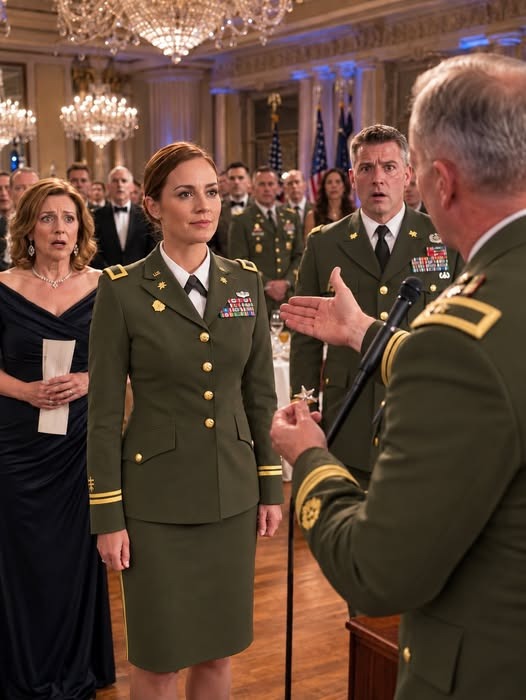

"THE LIEUTENANT COLONEL SLOWED, STARED AT MY RIBBONS, AND WALKED AWAY WITHOUT A WORD
The applause eventually faded, replaced by the polite, low hum of silverware clinking against china and the murmur of polite conversation. Around the ballroom, clusters of guests returned to their wine glasses and weekend plans, eager to smooth over the sudden fracture in their assumptions. But the air in the room had fundamentally shifted.
For thirty years, my family had operated on a quiet, unwritten blueprint. Daniel was the sun; the rest of us simply orbited, absorbing whatever warmth or attention was left over. My career in the military was treated like an eccentric hobby—something to be politely acknowledged at Thanksgiving and quickly dismissed before turning the conversation back to Daniel’s latest promotion, his latest investment, or his impeccably planned future.
Now, sitting at a table near the back of the ballroom with Rebecca, I watched my mother from a distance. She was still holding her crushed dinner program, staring across the room toward the main family table where Daniel sat alone, flanked by empty chairs. The golden-child narrative hadn’t necessarily shattered, but it had cracked wide open, revealing a reality they had actively chosen not to see.
“Penny for your thoughts, Colonel,” Rebecca murmured, nudging my shoulder with her own. “Or are you calculating the trajectory of your mother’s next emotional pivot?”
I smiled, shaking my head. “Just realizing how heavy silence can be when you finally stop filling it.”
Rebecca took a slow sip of her sparkling water. “You spent decades letting them believe whatever made them comfortable, Emily. You can’t be surprised that the bill finally came due with interest.”
She wasn’t wrong. For the longest time, silence had been my armor. In the field, silence meant survival—withholding unnecessary chatter, observing before reacting, never giving an adversary more data than they required. I had brought that exact tactical mindset home, treating my family like a theater of operations where emotional self-defense was paramount. I didn’t correct their assumptions because correcting them felt like begging for validation. And I had learned, very early on, that asking for validation from people who had already decided your value was a losing deployment.
Across the room, my mother excused herself from her seat and began weaving through the tables toward us. Her gait was hesitant, entirely devoid of the practiced confidence she usually wore at these social gatherings.
Rebecca caught sight of her first. “Reinforcements inbound. Do you want me to intercept?”
“No,” I said quietly, straightening my posture. “Let’s see what she has to say.”
Mom stopped at the edge of our table, her fingers nervously pleating the fabric of her silk dress. She looked down at me, and for a fleeting second, she didn’t look like the matriarch who commanded family holidays with an iron fist. She looked old, tired, and profoundly confused.
“May I?” she asked, gesturing to the empty chair opposite us.
“Of course, Mom,” I replied.
She sat down, her eyes darting briefly to Rebecca before settling back on me. “The general… General Hayes mentioned joint assignments. Strategic planning. Decades of service.” She swallowed hard. “Emily, when you told me you were stationed overseas—when you said you couldn’t come home for Christmas that year because of ‘logistics’—what were you actually doing?”
It was a simple question, asked without the usual defensive edge. But the answer belonged to a world she had deliberately locked herself out of.
“Logistics, Mom,” I said evenly. “Moving personnel and equipment through contested regions where supply lines were actively targeted. Sometimes coordinating medical evacuations. Sometimes sitting in a command tent for forty-eight hours straight without sleep, trying to make sure nobody’s child came home in a flag-draped box.”
Mom flinched, her hand flying up to cover her mouth. “Good God, Emily. You never said…”
“You never asked,” I reminded her, keeping my voice entirely neutral. “Whenever I called, before I could even finish telling you I’d landed safely, you were already telling me about Daniel’s new mortgage or his promotion to major. Whenever I tried to talk about the weight of what I was carrying, you changed the subject to something comfortable.”
“I thought… I thought you were just doing paperwork!” she protested, her voice cracking slightly. “You always looked so calm. You never complained!”
“Complaining doesn’t accomplish the mission,” I said. “The military teaches you to absorb pressure, not distribute it to the people around you. Unfortunately, I applied that same rule to you.”
Rebecca shifted slightly, offering a subtle, supportive nod. She knew better than anyone what my operational record looked like—the sleepless nights in austere command posts, the agonizing decisions made when intelligence reports were contradictory, and the quiet grief of losing soldiers under my authority.
Mom stared at her hands, tears welling in her eyes. “I was a bad mother to you, wasn’t I?”
It was the question every parent asks when they finally realize their child has lived an entire, rich life completely independent of their approval. It was a plea for absolution, wrapped in self-deprecation.
“You weren’t a bad mother, Mom,” I said softly, surprising even myself. “You were just a mother who built a system that only had room for one success story at a time. Daniel was cast as the star of the family production, and I was cast as the background extra who didn’t need lines.”
“And you just… accepted that?” she whispered.
“No,” I replied. “I walked off the stage and built my own theater.”
By the time the gala drew to a close, the ballroom had emptied out significantly. The glittering chandeliers were dimmed, and the lingering scent of expensive perfume and floral centerpieces gave way to the quiet, antiseptic chill of the late evening.
Daniel found me near the grand exit, standing by the coat check while Rebecca retrieved our jackets. He looked drained, his tuxedo jacket unbuttoned, his tie slightly crooked.
“Leaving already?” he asked, shoving his hands into his trouser pockets.
“It’s late, Daniel. And I have an early flight back to base tomorrow.”
He nodded slowly, kicking the toe of his polished shoe against the marble floor. “About earlier… on the terrace. I meant what I said. I was a jerk.”
“You were self-absorbed,” I corrected gently. “There’s a difference, but they often look identical in our family.”
He let out a short, dry laugh. “Mom is a wreck, by the way. She spent the last twenty minutes crying in the ladies’ room because she realized she didn’t know a single thing about your career.”
“She has a phone,” I said. “She knows how to use it.”
Rebecca walked up, handing me my dark wool coat. She gave Daniel a crisp, professional nod—the kind of nod an experienced NCO gives an officer who is finally learning how to command without shouting—and stepped toward the exit doors.
“I’ll wait by the car, Colonel,” Rebecca said.
“I’ll be right there.”
I turned back to my brother. He looked smaller under the cavernous arches of the hotel lobby than he did behind a boardroom desk or at the head of a family dinner table. The illusion of his absolute centrality had vanished, leaving behind just a man realizing he had a sister he never truly bothered to know.
“Are we going to be okay?” Daniel asked, his voice uncharacteristically small.
“That depends entirely on you, Daniel,” I said, slipping my arms into my coat sleeves. “If you want a relationship built on mutual respect, where we actually talk to each other as peers, I’m right here. But if you expect me to sit quietly in the background while you hold court, you’re going to be disappointed.”
He looked away, processing my words, then nodded once. “Fair enough.”
“Goodnight, Daniel.”
“Goodnight… Emily.”
It was the first time in years he had used my first name without a patronizing sigh or a sarcastic edge. It wasn’t a complete redemption, and it certainly didn’t erase decades of systemic favoritism, but it was a start.
As I pushed open the heavy glass doors and stepped out into the cool night air, the streetlights cast long, sharp shadows across the pavement. Rebecca was waiting by the curb, her breath pluming softly in the autumn chill.
I looked up at the quiet, starlit sky above the city. There were no cameras here, no glittering chandeliers, no generals waiting to pin medals or evaluate performance. There was just the steady, rhythmic pulse of the night, the quiet crunch of gravel under our boots, and the profound, unshakable peace of a life earned entirely on my own terms.
I didn’t need my family’s permission to be extraordinary. I never had.
And as I slid into the passenger seat of Rebecca’s car, pulling my jacket tight against the chill, I knew one thing with absolute certainty:
The mission was complete. And for the first time in my life, I was exactly where I belonged.
