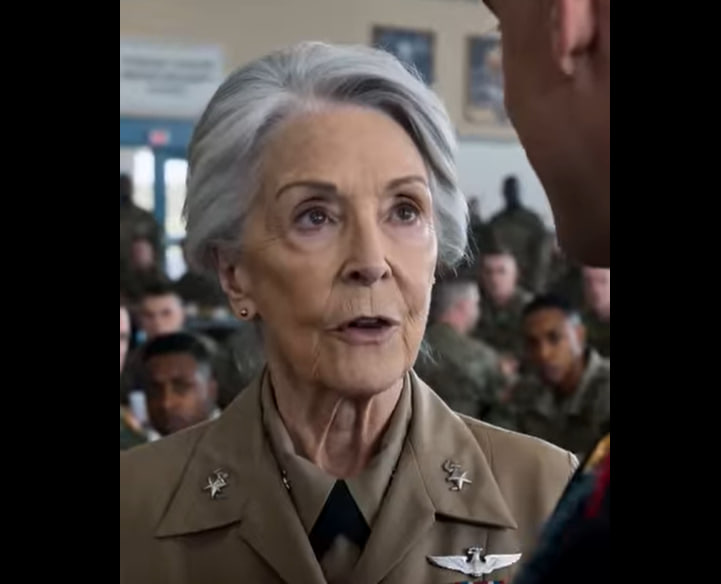

The Lieutenant Thought He Had Humiliated a Helpless Woman Until the Senior Chief Recognized Who Had Been Watching Him
The midday sun beat down hard against the reinforced concrete walls of the Fort Redstone logistics wing, casting a glaring white light across the parking apron. Inside, however, the air was heavily conditioned, humming with the steady drone of large ceiling vents and the low-frequency vibration of server racks housed deeper within the facility.
Senior Chief Daniel Brooks walked slowly down the long corridor, his boots clicking rhythmically against the polished terrazzo. He still felt the phantom echo of the cafeteria floor beneath his feet. The confrontation with Lieutenant Tyler Mercer had ended without violence, but it had left an indelible mark on the atmosphere of the entire base.
Word travels through a military installation faster than classified data. By the time Brooks reached the perimeter security desk, the story of the silver-haired woman and the fallen lunch tray had already morphed into half a dozen exaggerated versions across three different group chats.
“Senior Chief,” the guard at the console greeted him sharply, standing up from his swivel chair.
“At ease, son,” Brooks muttered, leaning against the wooden counter. He looked out the glass doors toward the sun-drenched courtyard. A black sedan was idling near the curb, its tinted windows rolled up against the heat.
The woman in the faded, unbadged utility uniform was standing beside the rear passenger door. She wasn’t looking at the base architecture or checking a watch. She was watching two junior enlisted sailors struggle to load heavy supply crates onto the back of a flatbed truck. One of the sailors was rushing, his form sloppy, nearly dropping a corner of the heavy wooden crate.
The older woman didn’t shout instructions. She didn’t intervene. She simply paused, observing how the senior of the two sailors corrected his partner without losing his temper—a direct, subtle echo of the shift that had just occurred inside the cafeteria.
Brooks pushed off the counter and walked through the sliding glass doors, stepping out into the dry Alabama heat. The asphalt shimmered with heat mirages.
“You’re leaving before you get a proper meal,” Brooks said, stopping a few feet away from her.
She turned her head, her weathered face framed by the short silver hair that caught the bright daylight. Her eyes, pale and impossibly clear, settled on him with an intensity that made time feel elastic.
“The cafeteria offered plenty of drama,” she replied, her voice smooth and even. “The food was secondary.”
Brooks offered a dry, self-deprecating smile. “You left a lot of wreckage in your wake today, ma’am.”
“I didn’t break anything, Daniel. I just removed the varnish.”
Hearing his first name on her lips—used not with casual familiarity, but with the weight of an instructor who had watched him fail, sweat, and slowly learn fifteen years ago—hit Brooks with a strange sense of grounding. He looked down at his own hands, then back at her.
“Mercer is going to be ruined professionally,” Brooks said quietly, keeping his voice masked from the nearby truck drivers. “Even if the report handles him fairly, the rumor mill will chew him up. The other lieutenants won’t look at him the same way.”
“Good,” she said without hesitation.
Brooks blinked, slightly taken aback by the lack of tactical softening. “You don’t think it’s a bit harsh? He’s an Annapolis graduate. Top ten percent of his class. Physically gifted. He genuinely wants to be an operator.”
“Wanting to wear the uniform is not the same as understanding what it costs,” she said, her gaze drifting back toward the two sailors by the truck. They had successfully secured the crate now, and the older one was patting the younger on the shoulder, offering a word of encouragement. “Tyler Mercer loves the idea of power because it makes him feel invisible to his own inadequacies. He treats authority like a shield instead of a trust.”
“And the report?” Brooks asked, stepping closer. “What will it say about the rest of us? About the room staying silent while he kicked that tray?”
“It will say precisely what happened,” she answered evenly. “It will note that a lieutenant weaponized his rank against a perceived civilian. It will note that a room full of trained professionals chose comfort over intervention. And it will note that it took a retired senior officer—wearing no insignia and offering no immediate threat—to force a public reckoning.”
She turned fully toward him, her expression softening by a fraction.
“It will also note that you crossed the room, Daniel. And that three junior officers chose to clean up a mess they didn’t make, rather than pretend it didn’t exist.”
Brooks exhaled a breath he felt he’d been holding since the moment his boots hit the cafeteria tiles. “We shouldn’t have needed a test to do the right thing.”
“No,” she agreed. “You shouldn’t have. But human beings are remarkably good at sleepwalking through their own worst habits until someone wakes them up.”
A sharp rap sounded against the tinted window of the sedan. The driver, a young master chief petty officer with ribbons spanning his chest, unlocked the doors from the inside.
The woman reached out and placed a hand on Brooks’s forearm. Her grip was dry, firm, and steady—the hand of someone who had pulled panicked medics out of burning vehicles and steadied compasses in freezing rain.
“Keep an eye on that lieutenant,” she instructed quietly.
“You think he can be salvaged?” Brooks asked, genuinely curious.
“I think humiliation is a terrible teacher, but it is often the only one that works on the proud,” she said, stepping toward the open door of the car. “Whether he learns from it or simply grows bitter depends entirely on whether his peers let him hide behind excuses again.”
“They won’t,” Brooks said. “I’ll make sure of that.”
She paused with her hand on the car frame, looking back at him one last time. “Make sure you include yourself in that supervision, Senior Chief. You hesitated because you were trying to calculate who I was instead of focusing on what was happening to an ordinary person on your floor.”
Brooks felt the flush rise up his neck, humbling him just as thoroughly as Mercer had been humbled an hour earlier. He dipped his head in a slow, respectful nod.
“Yes, ma’am. Message received.”
She slipped into the back seat of the sedan. The door closed with a heavy, solid thud—the sound of high-grade engineering and absolute finality. Within seconds, the vehicle rolled forward, accelerating smoothly down the access road toward the main gate, leaving behind only the shimmering heat waves rising off the blacktop.
Brooks stood alone for a long moment, listening to the cicadas buzzing in the dry grass beside the fence.
When he finally turned around to walk back inside, he didn’t head straight for his office. Instead, he took the long route through the administrative block, past the rows of quiet desks, toward the junior officers’ quarters.
It was time to see if Lieutenant Tyler Mercer was ready to pick up a broom, or if he was still waiting for someone else to clean up his mess.
