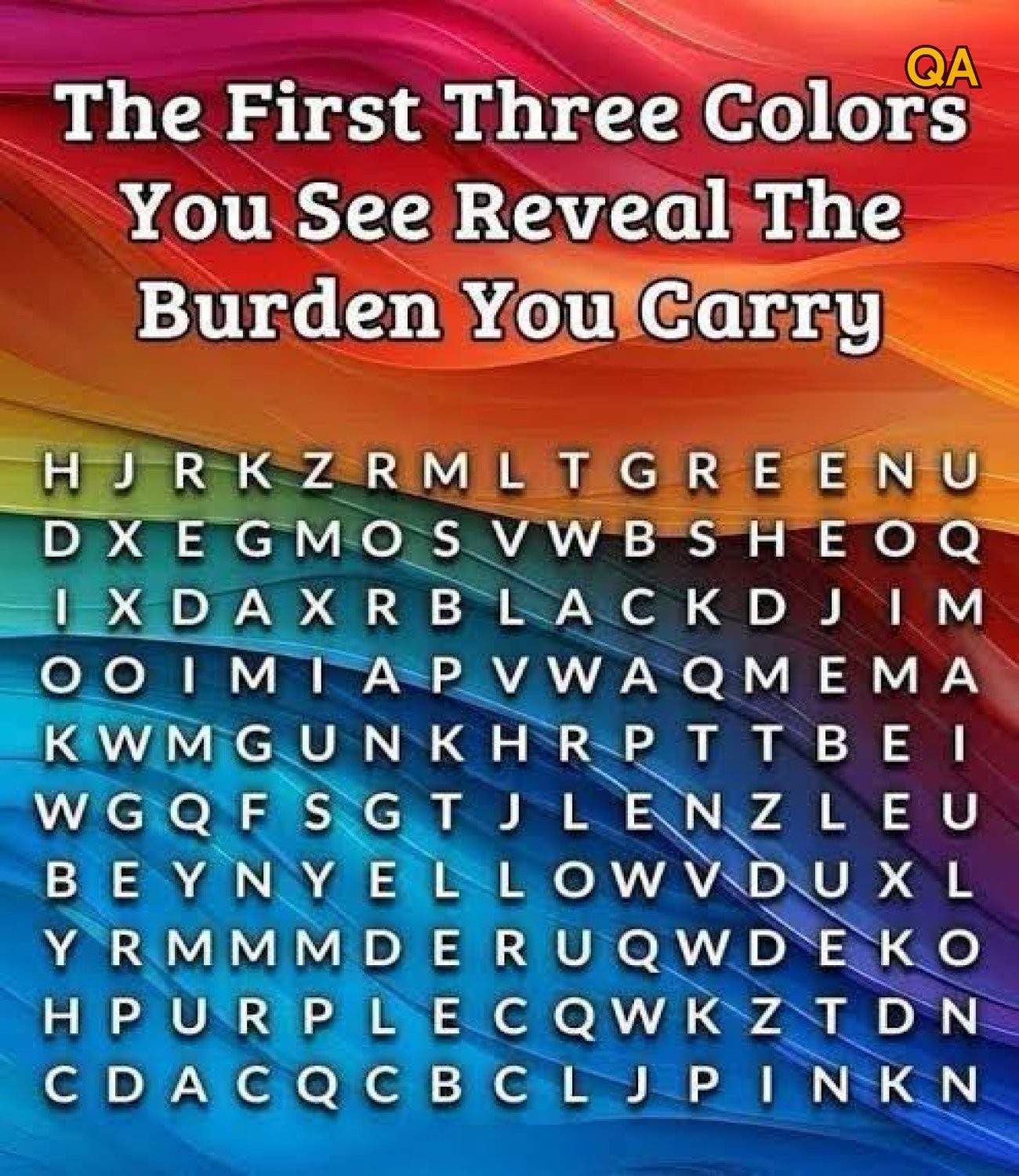

The First 3 Colors You See May Reveal How You Intimidate Others
Have you ever entered a room and noticed that people seemed quieter, more careful with their words, or slightly nervous around you? It can be tempting to wonder whether you appear intimidating. In everyday life, however, intimidation does not necessarily mean someone is unfriendly, harsh, or trying to dominate others. People may feel uncertain around someone who appears confident, highly focused, calm under pressure, direct in conversation, or simply difficult to read.
This is why color-word puzzles and personality quizzes remain popular online. They offer a quick, playful prompt for self-reflection: look at a grid, notice the first three color names that stand out, and consider what the results might say about the impression you make on others.
It is important to be clear about what these puzzles can and cannot do. A color search image cannot scientifically measure personality, diagnose behavior, or determine whether someone intimidates other people. The order in which a person notices words can be influenced by visual layout, letter placement, attention, familiarity, screen quality, expectations, and simple chance. Still, these quizzes can be an enjoyable way to think about communication style, first impressions, and qualities that others may interpret in different ways.
How the Color Puzzle Works
The basic challenge is simple: scan a group of letters and identify the first three color names you notice. The activity relies on selective attention, a normal mental process that helps people focus on some information while filtering out other details. When searching a busy image, the brain does not process every letter with equal depth at the same time. Instead, attention may be drawn to familiar words, visually distinct patterns, or terms a person expects to find.
Popular versions of this trend often assign symbolic meanings to colors. For example, red may be associated with intensity, blue with calmness, and purple with individuality. These associations are common in culture, branding, art, and everyday language. Yet they are not universal rules. Colors can carry different meanings across countries, communities, historical periods, and personal experiences.
Rather than treating the first three colors as a verdict about your character, it may be more useful to treat them as conversation starters. If a description feels relatable, ask why. Perhaps it reflects a quality you value, a way others have described you, or a social situation you have recently experienced. If it does not fit, that can also be informative: it may highlight the limits of broad personality labels.
Why People May Perceive Others as Intimidating
Feeling intimidated is often about perception rather than intent. One person may interpret quietness as confidence, while another may see it as distance. A highly organized colleague may appear reassuring to some people and demanding to others. A direct communicator may be viewed as refreshingly honest by one friend and overly blunt by another.
Psychological research on first impressions suggests that people form quick judgments from limited information, including facial expressions, posture, tone of voice, clothing, and social context. These initial judgments are not always accurate. They can also change substantially as people gain experience with one another.
Someone may seem intimidating because they:
- Speak with certainty or communicate clearly.
- Remain composed in a stressful situation.
- Set firm boundaries and do not easily change their position.
- Have visible expertise, authority, or leadership responsibilities.
- Are private or reserved, making their reactions harder to predict.
- Bring high energy and enthusiasm into social situations.
- Express original views without seeking approval.
None of these qualities is inherently negative. In many settings, they are valuable strengths. The key question is not whether a person seems intimidating in every circumstance, but whether their communication helps others feel respected, heard, and able to participate.
Red: Passion, Drive, and a Strong Presence
In many popular color-symbolism traditions, red is connected with energy, urgency, action, and determination. If red is among the first color names you notice, a quiz may suggest that others see you as passionate, bold, competitive, or highly motivated.
In real-world social settings, strong drive can sometimes make others feel that they need to keep up. A person who speaks quickly, sets ambitious goals, or responds decisively may be perceived as powerful. This impression can be especially noticeable in workplaces, classrooms, sports teams, or group projects where performance and leadership are visible.
At its best, this kind of intensity can inspire others. A driven person may help a group stay focused and move from discussion to action. However, people with a forceful communication style can create more comfortable interactions by leaving space for questions, inviting quieter voices into the conversation, and recognizing that not everyone processes decisions at the same speed.
Blue: Calmness, Thoughtfulness, and Emotional Control
Blue is often used in popular culture to represent calm, reliability, reflection, and trust. In a lighthearted personality puzzle, noticing blue first may be linked to being level-headed, analytical, or difficult to rattle.
Composure can be reassuring during uncertainty. In a demanding meeting or a challenging family discussion, a person who pauses before responding may appear steady and capable. Yet emotional restraint can also be misunderstood. If someone does not reveal much through facial expression or tone, others may wonder what they are thinking.
Being calm does not mean being detached. People who are naturally reserved can make their intentions clearer through simple signals: acknowledging another person’s concerns, explaining their reasoning, or using warm and direct language. These habits can help others recognize that quiet confidence is not the same as disapproval.
Green: Stability, Patience, and Resilience
Green is frequently associated with balance, growth, nature, and steadiness. A typical color quiz may describe people who notice green as grounded, patient, dependable, and emotionally resilient.
In everyday relationships, stability can be a major source of trust. Friends, family members, and colleagues often value people who follow through on commitments, listen carefully, and do not react impulsively. However, someone who seems consistently self-controlled may appear hard to influence or difficult to read, particularly to people who are accustomed to more emotionally expressive communication.
Resilience is not the absence of emotion. It is the ability to adapt, recover, and continue functioning through challenges. Healthy resilience can include asking for help, setting limits, and being honest about stress. Showing this more human side may help a highly dependable person feel more approachable without giving up their sense of calm.
Yellow: Enthusiasm, Optimism, and Social Energy
Yellow is commonly connected with brightness, attention, energy, and optimism. In personality-style content, it is often linked with people who bring enthusiasm to conversations and naturally draw attention in a group.
A lively personality can make gatherings more engaging. Enthusiastic people may help others feel included, introduce new ideas, and create momentum when a group is uncertain. At the same time, high energy can feel overwhelming to people who prefer quiet environments, need time to think, or are dealing with fatigue and stress.
Social awareness helps enthusiasm land well. Asking others how they prefer to communicate, allowing pauses, and noticing when someone wants to contribute can make positive energy feel welcoming rather than overpowering. Personality differences do not need to become conflicts; they can be balanced through consideration and flexibility.
Black: Privacy, Independence, and Authority
Black is often associated in design and popular symbolism with formality, authority, independence, and mystery. A quiz result involving black may suggest that others see you as self-assured or hard to read.
People sometimes interpret privacy as confidence because a private person may not seek frequent validation or reveal every thought. In professional settings, concise communication and a serious demeanor can also be associated with authority. But these impressions are shaped by context. Someone who is quiet may simply be listening, concentrating, tired, or unfamiliar with the group.
If you are naturally reserved, small acts of openness can reduce misunderstandings. Introducing yourself warmly, explaining when you need time to think, or offering a brief positive response can reassure others without requiring you to become more extroverted than you are.
White: Clarity, Directness, and Authenticity
White is often linked in popular symbolism with clarity, simplicity, openness, and honesty. If white stands out in the puzzle, the playful interpretation may be that your directness or strong standards make an impression on people.
Clear communication is useful in almost every setting. It can prevent confusion, make expectations fairer, and help people address problems early. However, directness is most effective when paired with respect. A message can be honest without being dismissive, and a boundary can be firm without being hostile.
People who value transparency may be perceived as intimidating when others fear criticism or avoid difficult conversations. The solution is not necessarily to become less honest. Instead, it can help to frame feedback around specific behavior, listen to the other person’s perspective, and make room for a collaborative response.
Purple: Creativity, Original Thinking, and Individuality
Purple is often connected with imagination, creativity, individuality, and unconventional ideas. In a color quiz, noticing purple may be interpreted as a sign that you stand out because you are comfortable expressing your own perspective.
Original thinking can be valuable in creative work, problem-solving, entrepreneurship, and community life. People who challenge routine assumptions may help groups see alternatives they would otherwise miss. Yet being different can sometimes make others uncertain, especially when they are more comfortable with familiar methods or social norms.
Creativity becomes easier for others to embrace when it is communicated clearly. Sharing the reasoning behind an idea, connecting it to a group’s goals, and being open to feedback can help individuality feel collaborative rather than isolating.
Grey or Silver: Discipline, Strategy, and Self-Control
Grey and silver are often described as symbols of maturity, balance, neutrality, and careful judgment. A playful interpretation may portray people who notice these colors as strategic, disciplined, and difficult to pressure into quick decisions.
Self-control can be a meaningful strength. In uncertain situations, people often rely on those who can assess information, consider consequences, and avoid unnecessary impulsiveness. Still, a highly measured style may lead others to assume a person is emotionally distant or overly critical.
Thoughtful decision-makers can maintain their strengths while building connection by explaining their process. Statements such as “I would like to consider this carefully” or “I see why this matters to you” can make a cautious response feel more supportive and less intimidating.
Why Personality Puzzles Can Feel Surprisingly Accurate
Many personality quizzes use broad descriptions that can apply to a wide range of people. This is sometimes called the Barnum effect, or Forer effect: people may find a general statement personally meaningful when it includes desirable traits, relatable challenges, or flexible language.
For example, a description that says someone is independent but also values close relationships may resonate with many readers. That does not mean the quiz has discovered a hidden fact. It may simply reflect common human experiences.
Confirmation bias can also play a role. People tend to remember details that fit their self-image and overlook details that do not. This does not make the activity worthless; it simply means the results should be approached with curiosity rather than certainty.
Evidence-based personality assessment is more complex than identifying colors in a word grid. Psychologists generally use validated questionnaires, careful interpretation, and research methods designed to test consistency and accuracy. No quick visual puzzle should be used to make important decisions about mental health, relationships, employment, or personal worth.
How to Make a Better Impression Without Changing Who You Are
If you worry that people find you intimidating, consider asking trusted friends, colleagues, or family members for constructive feedback. Their perspective may reveal whether your presence is being interpreted differently than you intend.
Practical ways to appear more approachable include:
- Use open body language, such as relaxed posture and natural eye contact.
- Ask questions and allow others time to answer.
- Explain your intentions when your communication style may seem brief or serious.
- Offer specific appreciation when someone contributes an idea.
- Be clear about boundaries while remaining respectful.
- Remember that confidence and kindness can exist together.
The goal is not to make yourself smaller or hide your strengths. Confidence, creativity, calmness, honesty, and discipline can all be positive qualities. The most constructive approach is to combine those traits with empathy and an awareness that different people may respond to the same behavior in different ways.
What Did the First Three Colors Mean to You?
Whether you noticed red, blue, green, yellow, black, white, purple, grey, silver, or another color first, the puzzle is best understood as entertainment and a prompt for reflection. It cannot reveal a fixed truth about your personality or how everyone sees you.
Still, the question behind the trend is worthwhile: what kind of energy do you bring into a room? The answer is likely more nuanced than any color list. It depends on the setting, your relationships, your communication habits, and the perceptions of the people around you.
Traits that others initially find intimidating may also be the traits they later come to admire: your focus, integrity, imagination, composure, or ability to lead. With clear communication and mutual respect, a strong presence can become a source of trust rather than uncertainty.
Sources
Disclaimer: This content is intended for entertainment purposes only and is not based on real events.