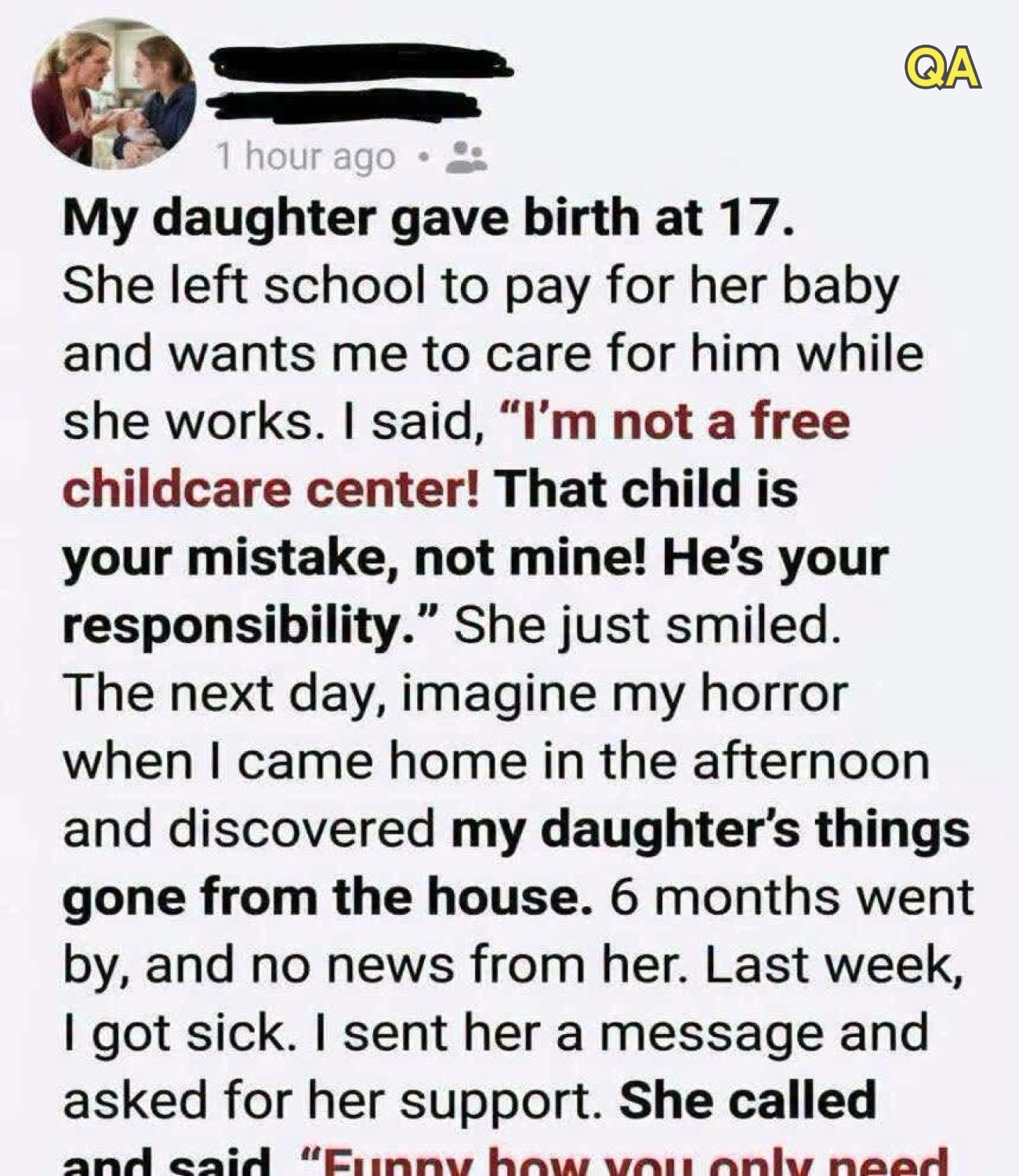

Note: The following article examines the family themes raised by the original personal story. The specific events described in the story cannot be independently verified, so they are discussed as a relationship scenario rather than as confirmed reporting.
Family conflicts often become most painful when they happen during periods of major change. A young person becoming a parent, a grandparent facing unexpected responsibilities, and a family trying to manage financial or emotional pressure can all create difficult questions. Who is responsible? What does healthy support look like? Where should personal boundaries be drawn?
In the scenario behind this story, a mother refused to provide childcare for her teenage daughter’s baby. She believed that becoming a parent required accepting full responsibility and that stepping in too often would prevent her daughter from becoming independent. Her daughter, however, experienced that refusal as abandonment at a vulnerable time. Years later, when the mother faced serious health challenges and asked her daughter for care, the daughter responded by recalling the earlier lack of support.
The emotional impact of this kind of story comes from a difficult but familiar truth: family relationships are shaped not only by love and shared history, but also by whether people feel supported when they need it most.
Teen Parenthood Can Create Complex Family Pressures
Teen pregnancy and young parenthood can affect every member of a family. The teenager may be adjusting to pregnancy, childbirth, education, employment, housing, finances, and a new caregiving role at the same time. Parents and grandparents may feel worried about the young person’s future, uncertain about their own role, or concerned that they will be expected to take on long-term childcare duties.
Public health organizations have long noted that adolescent parents may face practical barriers that older parents are often better equipped to manage. These can include interrupted education, limited income, reduced access to childcare, transportation difficulties, and social isolation. The challenges vary widely by country, community, and individual circumstances, but reliable support systems can make an important difference.
Support does not have to mean that grandparents assume full responsibility for raising a child. It can include listening without judgment, helping identify community services, providing occasional childcare when possible, assisting with transportation to appointments, helping a young parent continue education, or simply offering reassurance during a stressful period.
At the same time, grandparents and other relatives are entitled to have limits. Many are working, managing their own health needs, caring for other relatives, or living on fixed incomes. Healthy family support is not the same as unlimited availability. The central issue is often not whether someone can say no, but how the conversation happens and whether the young parent is left with realistic alternatives.
Independence and Support Are Not Opposites
A common belief in family disagreements is that helping someone will make them dependent. In some situations, this concern may be understandable. Parents often want their children to develop practical skills, make informed decisions, and take responsibility for their own lives.
However, independence rarely develops through isolation. Research and guidance on child and adolescent development consistently emphasize the value of stable, supportive relationships. People generally build confidence when they know they have someone to turn to during setbacks. A parent can encourage responsibility while also showing compassion.
For example, a grandmother might say, “I cannot provide childcare every day, but I can help you explore local childcare programs and watch the baby for two hours while you attend an appointment.” This kind of response preserves a boundary while communicating care. It also shifts the conversation from blame to problem-solving.
In contrast, language that focuses only on failure, disappointment, or punishment can deepen shame. Shame may lead people to withdraw from relatives, hide struggles, or avoid asking for help until a problem becomes more severe. For a young parent who is already under pressure, feeling rejected by close family can have lasting emotional consequences.
Why Communication Matters During Family Conflict
The story’s turning point is not simply a disagreement about babysitting. It is the emotional message that each person may have heard. The older parent may have intended to say, “You need to take responsibility.” The daughter may have heard, “You are alone, and your needs do not matter.”
These different interpretations are common in emotionally charged family disputes. A practical issue such as money, housing, childcare, or transportation can quickly become connected to deeper questions: “Do you respect me?” “Do you care about my future?” “Can I rely on you?” “Will you be there when I am struggling?”
Clear communication can reduce the risk of such misunderstandings. Family therapists often encourage people to use “I” statements rather than accusations. Instead of saying, “You expect me to do everything,” a parent might say, “I feel overwhelmed by the idea of daily childcare, and I need us to make a plan that I can realistically manage.”
Similarly, a young parent might say, “I understand that you cannot raise my child for me, but I need help finding a way to attend school or work. Can we discuss what support is possible?” This approach does not guarantee agreement, but it makes room for empathy and negotiation.
The Long-Term Effects of Feeling Unsupported
When a family member feels rejected during a major life event, the memory may remain powerful for years. The person may come to believe that asking for help is unsafe or that family care is conditional. This can change the relationship permanently, especially if the conflict is never acknowledged or repaired.
In the scenario described, the daughter chooses distance after feeling unsupported. From her perspective, the decision may be a form of self-protection rather than revenge. Setting limits with relatives can be difficult, but boundaries sometimes help people avoid repeating painful patterns.
It is also important to recognize that estrangement is rarely caused by one conversation alone. Family distance often develops over time through unresolved disappointments, misunderstandings, criticism, broken promises, or unequal expectations. A major conflict may become the moment when someone decides they can no longer continue the relationship in the same way.
This does not mean reconciliation is impossible. It means that rebuilding trust usually requires more than a single apology or a request for immediate forgiveness. Trust is restored through accountability, consistency, and respect for the other person’s choices.
Illness, Caregiving, and the Risk of Reversed Expectations
Serious illness can change a person’s perspective quickly. A diagnosis may bring uncertainty, fear, grief, and practical concerns about treatment, mobility, finances, and future care. It is understandable that someone facing illness might reach out to family members for comfort or assistance.
However, adult children are not automatically able to become caregivers. They may have their own children, jobs, health needs, financial pressures, or unresolved emotional wounds. Caregiving is demanding work, whether it involves emotional support, transportation, household tasks, medication coordination, or hands-on assistance.
The U.S. Centers for Disease Control and Prevention and other health organizations have highlighted the pressures caregivers can face, including stress, fatigue, and the challenge of balancing caregiving with other responsibilities. Care should be planned thoughtfully whenever possible, with consideration for the caregiver’s capacity and consent.
When a parent requests care after years of conflict, the adult child may feel torn between compassion and self-protection. There is no universal answer that fits every family. Some people may choose to help while maintaining clear boundaries. Others may prefer limited contact, professional care arrangements, or no contact at all. These decisions can be emotionally difficult, but they deserve to be made without coercion.
Accountability Is Different From Guilt
The central lesson in this story is not that parents or grandparents must always say yes. Nor is it that adult children are obligated to forgive every past hurt. Instead, it is that choices within families have consequences, especially when one person is vulnerable.
Accountability begins with acknowledging harm without immediately defending the original decision. A meaningful apology is specific. It might include statements such as: “I understand that you felt abandoned when you needed support. I focused on teaching responsibility and failed to see how frightened and overwhelmed you were. I am sorry for the pain I caused.”
An apology should not be used as a transaction. Saying sorry does not entitle someone to contact, care, or forgiveness. The person who was hurt may need time, may ask for space, or may decide that a relationship cannot return to what it was. Respecting that response is part of taking responsibility.
Guilt, by contrast, can sometimes center the person who caused harm rather than the person who experienced it. Statements such as “After everything I did for you” or “You owe me because I am your parent” can make reconciliation harder. They may turn a conversation about past pain into a demand for repayment.
How Families Can Rebuild Trust After Conflict
Repairing a damaged relationship is possible in some circumstances, but it usually takes patience. A person hoping to reconnect can begin by listening. Rather than arguing about intentions, it may be more helpful to ask, “What was that period like for you?” and then allow the other person to answer honestly.
Other constructive steps may include:
- Recognizing the other person’s experience without minimizing it.
- Offering an apology that does not include excuses or demands.
- Respecting requests for time, distance, or limited contact.
- Demonstrating change through consistent and dependable behavior.
- Discussing practical boundaries openly, including childcare, money, visits, and caregiving expectations.
- Considering family counseling when all participants are willing and it is safe to do so.
For families affected by teen parenthood, practical support may also be available through schools, health clinics, social services, parenting programs, and local nonprofit organizations. A young parent should not have to navigate every challenge alone, and grandparents who cannot provide direct care may still be able to help identify trusted resources.
A Broader Lesson About Family Care
The story of a mother, a teenage daughter, and a grandchild reflects a broader reality: love is not only a feeling. In healthy relationships, it is also expressed through attention, honesty, compassion, and respect for boundaries.
Families do not need to be perfect to be supportive. People can make mistakes, feel overwhelmed, and disagree about what help should look like. What matters is the willingness to see another person’s humanity, particularly during moments of uncertainty and transition.
When someone asks for help, the answer may not always be yes. But a caring response can still communicate, “I see that you are struggling. I cannot do everything, but I want to help you find a safer path forward.” For many families, that message can make the difference between a difficult season and a lasting rupture.
Sources
Disclaimer: This content is intended for entertainment purposes only and is not based on real events.