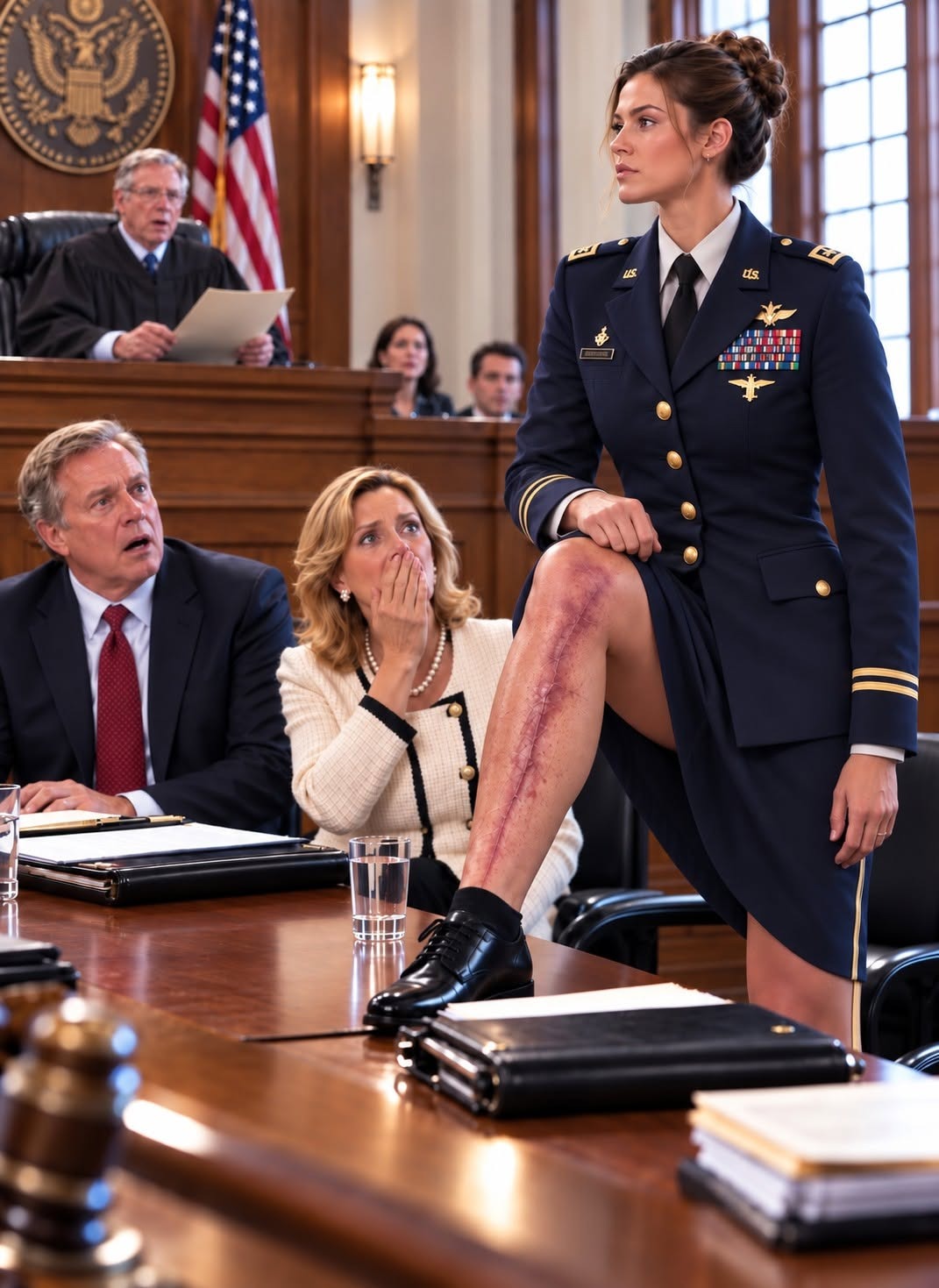

Walking into a Virginia courtroom in the Navy uniform my parents had once treated like a family disgrace silenced the entire room
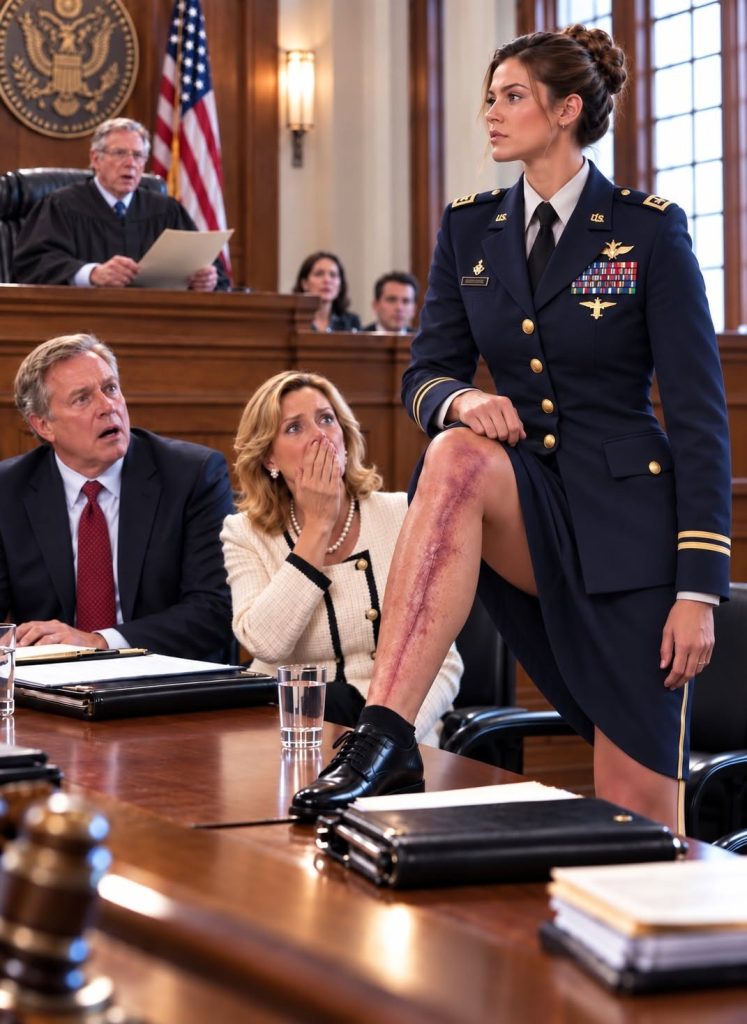
The heavy oak door of the Virginia courtroom clicked shut behind us with a definitive, hollow sound, sealing the dusty stillness of the judiciary chamber.
Judge Simmons remained seated at the elevated mahogany bench, carefully holding the aged piece of parchment by its precise outer edges. His bifocals slipped slightly down the bridge of his nose as he scanned the yellowed lines of text.
Beside me, my father, Robert Carter, stared at the paper as if it were a tactical explosive device primed to detonate. I knew that distinct handwriting intimately. Grandpa Walter had formed his capital letters with an eccentric, backward slant—the permanent physiological result of a severe industrial press injury to his right hand when he was a teenager.
There was zero mistaking the signature inscribed at the bottom.
Walter James Carter.
My grandfather.
Judge Simmons raised his gaze, looking directly across the well of the court toward my father. “Mr. Carter, have you ever laid eyes on this specific document prior to today?”
Dad swallowed hard, his throat working convulsively. “I… I honestly don’t know what that instrument is.”
The judge studied him in absolute, uncomfortable silence for several extended seconds. “It is a recorded deed. A legally binding deed concerning the rural Virginia acreage and farmhouse that serves as the entire subject of your family’s civil complaint.”
My mother’s manicured fingers abruptly stopped their anxious, rhythmic tapping against her pearl necklace.
Dad leaned forward, bracing his palms against the edge of his table. “That… that legally cannot be accurate.”
Judge Simmons arched a single, sharp eyebrow. “Which precise element, Mr. Carter? The legality or the accuracy?”
“My father explicitly told us that property would permanently remain in the family!” Dad sputtered, his face flushing a mottled crimson.
I had to actively restrain myself from releasing a bitter, hollow laugh. Instead, I stood frozen, my posture rigidly fixed in the dark blue Class A service dress uniform of a United States Navy Commander.
Judge Simmons delivered the verdict with chilling administrative precision: “Mr. Carter, whether a piece of real estate remains ‘in the family’ is an entirely distinct legal question from who holds the unencumbered title.”
That single, flat sentence landed in the room with more kinetic force than anything I could have articulated.
Dad whipped his arm around, pointing a trembling finger directly at my chest. “She abandoned the property! She walked away!”
Judge Simmons glanced down at his bench files. “We will address that operational timeline shortly, Mr. Carter.”
“She willfully deserted the place!”
“We will address that, as well.”
“We have personally maintained, taxed, and cared for those acres for over a decade!”
The judge’s facial expression remained completely neutral. “That is a significant legal assertion you will shortly be given the procedural opportunity to substantiate with actual evidence.”
Dad slumped back heavily into his wooden chair. For the very first time since I had marched into the courtroom with the polished silver oak leaves gleaming on my shoulders, he looked genuinely, profoundly uncertain.
The Paper Trail
Judge Simmons shifted his attention across the room, his eyes locking onto mine. “Commander Carter.”
“Yes, Your Honor.”
“Do you possess your own certified copy of this historical deed?”
“Yes, Your Honor.”
“Where is it currently located?”
“Safely stored at my primary residence, Your Honor.”
“Did you bring it with you into these proceedings today?”
“Yes, Your Honor.”
I reached down and unzipped the plain, black canvas folder I had clutched to my side throughout the morning. Dad stared at the movement as though I were pulling an active rifle magazine from a deployment pack.
I extracted a pristine, county-sealed copy of the deed and handed it to the court bailiff, who carried it up to the bench.
Judge Simmons methodically cross-referenced the registration numbers against the copy held by my parents’ counsel. Identical instrument number. Identical county recording stamps. Identical property boundaries. Identical signature.
He looked back up at me, his gaze analytical. “At what chronological point did you first become aware that your maternal grandfather had legally conveyed this property to you?”
“Several months prior to his passing, Your Honor.”
“Did you willingly accept the transfer of interest?”
“Yes, Your Honor.”
“Have you ever legally transferred, signed away, or encumbered your equitable interest in the property at any time afterward?”
“No, Your Honor.”
“Have you ever executed a deed conveying it over to your parents?”
“No, Your Honor.”
“Have you ever given them verbal or written authorization to sell, lease, or mortgage the land?”
“No, Your Honor.”
“Have you ever affirmatively told them that the property legally belonged to them?”
“No, Your Honor.”
Dad let out a sharp, incredulous bark of laughter, breaking courtroom decorum. The sound surprised everyone in the gallery. “You weren’t even physically present in the state!”
I turned my head to look him dead in the eye. “You don’t have to stand inside a county tax assessor’s office to electronically execute an annual property tax payment, Dad.”
A few spectators in the rear benches shifted uncomfortably at the familial friction.
Judge Simmons raised a calm, arresting hand. “Address your remarks exclusively to the bench, Commander.”
“Yes, Your Honor.”
I unzipped the secondary internal compartment of my folder. “May I enter these financial and administrative records into the formal court record?”
The bailiff collected the stack. Electronic payment receipts spanning twelve straight years. County tax assessments paid in full. Comprehensive property insurance policies. Invoices for targeted, contracted maintenance—roof repairs, timber evaluations, and structural bracing—that I had privately arranged and funded through local contractors.
Not every single piece of paper conclusively proved absolute legal ownership. That critical nuance mattered in property law. Simply paying property taxes does not magically manufacture unassailable title out of thin air.
However, Dad had alleged a very specific narrative: that he and my mother had been forced to carry the entire financial burden because I had heinously abandoned the homestead. The documentary records were designed to thoroughly test that sworn allegation.
Judge Simmons silently reviewed the financial exhibits page by page.
My father grew visibly restless, shifting his weight and whispering frantic commands to his attorney.
Mom leaned across the mahogany barrier, her voice dropping into a panicky hiss. “Robert… what on earth did you actually tell our attorney when we filed this?”
“Not now, Margaret,” Dad snapped beneath his breath.
“No, I want to know! What did you tell him about the taxes?”
Dad’s jaw tightened into a rigid, white-knuckled line.
Judge Simmons looked up from the tax ledgers, his eyes sharp. “Mr. Carter, in your initial civil complaint, you explicitly swore under oath that you and your wife personally absorbed all of the property’s tax obligations and maintenance liabilities after your daughter purportedly abandoned the acreage.”
“Yes, Your Honor, we did,” Dad insisted, his confidence surging back.
“Do you possess physical, verifiable documentation substantiating those specific financial claims?”
Dad hastily unzipped his own bulging leather briefcase, producing a sheaf of crumpled receipts and hardware store invoices.
The judge methodically reviewed them. Some receipts were entirely legitimate. I instantly recognized the faded branding of the small lumber and hardware yard located three miles down the rural highway from Grandpa’s place. Roof patching materials, dimensional framing lumber, exterior paint, and emergency plumbing supplies. My parents genuinely had spent money out-of-pocket on minor upkeep. I had never disputed that reality.
Dad looked practically triumphant, shooting a smug glance in my direction. “There, Your Honor. Proof. We maintained the homestead.”
Judge Simmons offered a slow, measured nod. “It certainly appears from these receipts that you personally funded some minor property maintenance over the years.”
“Exactly,” Dad interjected.
“However,” the judge continued, his voice dropping an octave, “your filed civil complaint makes a far broader allegation than mere maintenance.”
Dad’s triumphant expression faltered.
Judge Simmons held up one of my tax payment confirmations. “These specific tax payments—dating back unbroken for over a decade—appear to have been electronically disbursed from private banking accounts directly associated with Commander Carter.”
Dad whipped his head around, staring at me as if I had conjured magic. “That… that doesn’t legally prove anything!”
Judge Simmons did not react to the outburst. “Perhaps not in isolation.” He reached down and selected another document from my stack. “And what about these?”
Dad stared blankly. He had no counter-exhibit.
Mom finally broke her silence, her voice trembling in the quiet courtroom. “Wait… Robert explicitly told me he was handling the annual property taxes out of our joint account.”
Every single head in the courtroom—including the judge and the court stenographer—slowly turned to look at my mother.
Dad’s face turned the color of a bruised plum. “Margaret, shut up.”
“No, Robert! What did you do with the money I gave you for the land taxes?”
“I told you, I handled it!”
Judge Simmons leaned forward over the bench, resting his forearms on the wood. “Mrs. Carter, did you personally verify with county officials that your husband was paying the property taxes every year?”
Mom looked physically terrified now, trapped under the blinding spotlight of truth. “No, Your Honor.”
“Did you personally see the cancelled checks?”
“No, Your Honor.”
“Then please learn to strictly distinguish what you personally know as absolute fact from what someone else conveniently told you in the comfort of your own home.”
“Yes, Your Honor,” she whispered, shrinking back into her seat.
That single, simple judicial instruction felt monumental. For the entirety of my formative childhood and young adulthood, my father’s absolute, unshakeable certainty had functioned as the undisputed law of gravity inside our suburban home. If Robert Carter made a declarative statement, the rest of the household—Mom, my younger brother, and for far too many years, myself—automatically adjusted our personal perception of reality to accommodate his ego.
Mom adjusted. My brother adjusted. I had spent years bending myself into knots trying to fit inside his version of the world.
Civil courtrooms, however, proved aggressively less accommodating to unchecked domestic mythology.
The Midday Recess
The morning session broke for a mandatory ninety-minute legal recess.
I stood up, smoothing the front of my Navy service dress uniform, and walked slowly out into the wide, sunlit marble corridor of the courthouse. My right knee—reconstructed with titanium pins and artificial tendons following an ugly, high-velocity operational extraction overseas—throtted with a dull, persistent ache. I found an empty wooden bench near a tall arched window and sat down, letting my leg stretch out at a comfortable angle.
A few minutes later, Judge Simmons’s administrative clerk briskly walked down the hallway, carrying a stack of case files. She paused as she drew level with my bench, her eyes briefly dropping to the ribbons pinned proudly over my left breast pocket, then rising to meet my eyes.
“Commander?” she asked politely.
“Yes?”
“May I ask you a personal question? If it’s completely out of line, please just tell me to keep walking.”
“Ask away. Provided it doesn’t violate judicial ethics.”
She smiled warmly. “Fair boundary.” She pointed a subtle, respectful finger toward one of my campaign ribbons. “Is that what I intuitively think it is?”
I glanced down at the dark blue and gold device. “Yes.”
She nodded, a shadow of quiet reverence crossing her features. “My husband served two tours in the Persian Gulf. I know what those represent.”
“Please extend my personal gratitude and respect to him for his service.”
“I certainly will, Commander.”
She offered a crisp, professional nod and continued down the corridor.
That was the entirety of the interaction. No dramatic movie-style salutes from strangers. No thunderous crowds gathering to applaud. No cinematic revelation where it suddenly turns out I secretly command half the operational forces of the United States Navy.
I had served my country. I had sustained significant physical injuries in the line of duty. I had been formally recognized for aspects of that operational service through standardized military decorations.
Those biographical facts were profoundly meaningful to the architecture of my private life.
However, none of those professional accolades granted me a single extra square inch of legal entitlement to Grandpa Walter’s farmhouse over anyone else.
The recorded deed—scrawled in messy ink by a machinist with a mangled right hand—was the sole instrument that did that heavy lifting.
Mom found me ten minutes later, tracking me down by the tall arched window. She stood awkwardly several feet away, clutching her leather handbag to her chest as if she were standing near a hostile foreign entity.
“You thoroughly embarrassed us in there today,” she said, her voice tight with defensive pride.
I almost laughed out loud, though there was zero humor in my chest. “Today, Mom? You think today was the embarrassing part?”
“Don’t use that tone with me.”
“I’m asking an honest question.”
She looked aggressively down at my uniform. “All of this… this entire production.”
“What production, exactly?”
“You know precisely what I mean.”
“No, humor me. Spell it out.”
“You deliberately marched into a local civil courthouse dressed like that solely to make some dramatic, theatrical point against your own father.”
I thought about denying her accusation to keep the peace. Then I decided she had finally earned the unvarnished truth.
“Partly, yes,” I admitted without flinching.
Her eyes widened in genuine shock, as if she had expected me to fold immediately under her maternal guilt-trip. “At least you’re honest about your spite.”
“Mom, for twenty consecutive years, you and Dad collaborated to actively describe my military career to our extended family, neighbors, and friends as though it were a shameful, embarrassing amateur hobby,” I said, my voice dropping into a quiet, razor-sharp register. “You brought me into a public courtroom under oath, legally swearing to a judge that I was a deadbeat daughter who cynically walked away from my foundational familial responsibilities.”
I met her gaze unflinchingly. “So, yes. Today, I deliberately wore my uniform. I wanted you to finally, physically see me—not as the docile, obedient child you spent decades trying to erase, but as the adult I actually became while you weren’t paying attention.”
Her mouth tightened into a hard, brittle line. “Finally dropped the polite act, did you?”
She stared down at my ribbons again, her brow furrowing deeply. “What on earth are all of those colorful little bars even for?”
That seemingly casual question hit me with a sudden, unexpected physical wave of grief that I was entirely unprepared to process.
It wasn’t painful because she failed to instantly recognize the specific awards—the vast majority of American civilians cannot decode military ribbon precedence, and expecting them to do so is absurd.
It hurt because after all those decades of shared life, my own mother had never once bothered to ask.
“They are simply milestones and components of my professional service,” I said quietly.
“Well, what did you actually do in the Navy?” she demanded, her voice rising defensively.
I looked straight through her. “Mom.”
She flinched slightly. “What?”
“You don’t get to demand a comprehensive, twenty-year operational briefing during a five-minute courthouse hallway recess.”
She looked down at the marble floor, chastised. That marked the absolute first time in my entire living memory that I had ever witnessed my mother appear visibly ashamed of something other than my own existence.
Then she muttered defensively, “Your father always assured me that you simply worked quietly behind a traditional desk somewhere safe.”
“I did.”
Her head snapped back up, genuine surprise flashing across her features.
I almost laughed again. “Well… I worked behind a desk sometimes.”
“There’s nothing inherently shameful about administrative desk work,” she fired back, rallying her defenses.
“You’re entirely right. There isn’t,” I continued evenly. “People sitting behind desks make monumental strategic decisions. They coordinate global logistics. They plan complex operational maneuvers. They manage critical intelligence streams. They actively keep other human beings alive in hostile environments. Sometimes my assignments required me to operate behind a secure desk. And sometimes, they absolutely did not.”
Her eyes drifted slowly down toward my right knee, tracking the subtle, stiff mechanics of how I stood. “You told us your severe knee injury was merely a routine athletic training mishap during a physical fitness test.”
“No, I never told you that.”
“Robert explicitly said—”
“I know precisely what Dad claimed.”
She stared at me, paralyzed by uncertainty. “What actually happened to your leg?”
I turned my head, gazing out the towering courthouse window toward the bustling street below. Commuter cars streamed past in an endless, monotonous blur. A commercial delivery truck idled at the corner traffic light. Ordinary civilian life, functioning smoothly without interruption.
“I was severely injured during an operational deployment overseas,” I told her plainly.
Her face drained of color, her eyes widening in genuine alarm. “How… how badly were you hurt?”
“Badly enough to rewrite my medical records permanently.”
“Why on earth didn’t you ever call and tell us?”
That specific question pushed me right to the razor’s edge of anger. “I did call you, Mom.”
“No, you most certainly did not.”
“I called this exact house from an overseas military medical facility immediately following my initial surgeries.”
She went completely, terrifyingly still. “You called?”
“I did.”
Her lips parted in a soundless O.
“You actually remember that phone call?” I asked.
I certainly did. The heavy haze of medical-grade morphine. The blinding white acoustic ceiling tiles of the intensive care ward. My leg rigidly immobilized in an external fixator rig. A compassionate civilian staff nurse kindly asking if there was any immediate family member I wished to notify back in the States.
I had dialed our home number directly. Dad had answered on the second ring.
I painstakingly explained to him that I had sustained a severe operational combat injury overseas.
He had listened in dead silence for ten seconds, then curtly asked whether the wound was actually serious enough to compromise my operational status.
When I honestly answered yes, he sighed heavily and asked if I was finally ready to abandon my childish stubbornness, resign my commission, and come home to stop playing soldier.
I quietly severed the connection without saying another word.
And my mother had never once bothered to pick up the phone and dial me back.
“You spoke directly to your father,” she whispered, her voice cracking.
“Yes, I did.”
“He… he told me it was just a minor, insignificant training scratch.”
I offered no verbal response.
Her face slowly, agonizingly collapsed. For my entire adult life, I had secretly operated under the comforting emotional illusion that Mom fundamentally knew the unvarnished truth about my life and simply chose to look the other way out of cowardly habit.
The harsh reality was far more tragic: she had simply uncritically consumed whatever distorted version of reality my father chose to feed her.
That devastating realization did not magically absolve her of personal moral responsibility. She was a grown woman with a functioning telephone; she possessed the autonomous capacity to pick up the receiver, dial my direct extension, and ask me herself.
She had consciously chosen not to.
Yet, as the legal maxim dictates: Truth exactly as far as the evidence carries it. No farther. She was guilty of willful emotional negligence, not active malice.
Litigation and Reality
The legal proceedings resumed promptly at 1:30 p.m.
My parents’ high-priced corporate defense attorney formally requested a thirty-day operational continuance to adequately review, audit, and address the sudden emergence of my financial tax records and historical deeds.
Judge Simmons granted the standard procedural request, holding strictly to the methodical timeline required by Virginia civil jurisprudence.
That bureaucratic delay deeply frustrated the impatient, dramatic part of my psyche that desperately craved a cinematic gavel-slam and immediate, sweeping justice served before afternoon tea.
Real-world civil litigation, however, aggressively refuses to respect Hollywood dramatic pacing.
Over the subsequent weeks, the paper blizzard intensified exponentially. There were secondary legal filings, forensic accounting audits, sworn depositions, comprehensive title searches, and endless depositions regarding historical property expenses.
My parents had undoubtedly spent genuine money over the years patching roofs and clearing brush on the acreage. That created legitimate legal complications that required careful, adult untangling.
However, their minor financial maintenance outlays did not magically vaporize my recorded deed or automatically transfer grandfather Walter’s unencumbered title into their hands.
Likewise, my unbroken record of paying the annual county property taxes supported core pillars of my legal standing, but it did not grant me a blank check to assert wild, unverified financial damages against them.
We systematically isolated and dissected each individual question: Who held clear legal ownership? Who possessed lawful possession? What expenses were legitimately incurred? What verbal representations were actually made versus legally enforceable?
Each specific legal question demanded its own distinct evidentiary burden of proof.
Recognizing that I was severely outmatched in civil procedure, I finally retained private legal counsel.
Her name was Claire Donovan.
She was fifty-two years old, possessed a terrifying, militaristic level of administrative organization, and was entirely, wonderfully unimpressed by my Navy uniform, my rank insignia, or my operational campaign ribbons.
I liked her instantly.
During our very first formal conference in her downtown office, she slid my meticulously color-coded exhibit binders across the desk and said flatly, “Commander, I need you to immediately stop trying to actively command and micromanage your own civil lawsuit.”
“I was merely organizing the exhibits logically,” I defended myself.
“You completely rearranged my proprietary legal exhibit index.”
“Your previous indexing methodology was wildly inefficient for cross-referencing.”
She stared at me with an unblinking, predatory squint. I stared right back at her across the oak table, refusing to blink.
Then she calmly reached out, picked up my binders, and locked them away inside her filing cabinet. “We are done discussing document indexing, Commander.”
Claire proved her operational worth almost immediately.
Through aggressive discovery, her firm unearthed a critical paper trail my parents had desperately tried to bury: Dad had held confidential, preliminary meetings with a commercial real estate developer nearly six months before initiating the lawsuit against me.
No binding land sale had officially closed. No illicit property transfer had been executed. But there had been extensive, highly lucrative exploratory discussions regarding what the raw acreage could potentially fetch on the commercial market if consolidated with adjacent municipal parcels.
That explosive discovery fundamentally reframed the entire psychological context of the litigation.
It wasn’t a nostalgic, sentimental crusade to keep Grandpa Walter’s humble homestead safely “in the family.”
It was a calculated financial maneuver driven by the surging wave of suburban real estate development. The old farmhouse itself was modest, structurally obsolete, and virtually worthless.
The land, however, had suddenly become extremely valuable.
Suburban expansion had aggressively marched outward from the city limits. Grandpa Walter’s isolated acreage now sat directly adjacent to a major commercial zoning corridor that was attracting intense, multi-million-dollar developer interest.
Suddenly, my father’s sudden, rabid legal urgency made horrifying, crystal-clear sense.
Confrontation
I confronted my father only once outside of the courtroom environment.
It occurred during a mandatory court-ordered settlement conference held in a neutral conference room under the watchful eyes of both legal counsels.
“Did you initiate this entire fraudulent lawsuit simply because you wanted to seize and sell the land to a developer?” I asked him directly, my voice devoid of emotion.
Dad refused to meet my eyes, staring stubbornly at a yellow legal pad. “I wanted the property kept securely within the family infrastructure.”
“I am the family, Dad.”
He snapped his head up, his face contorting with bitter resentment. “No. You walked away.”
“I served my country in uniform.”
“You deliberately chose the Navy,” he snarled, slamming his fist against the table. “You actively chose a military career over your own flesh and blood.”
“No, Dad,” I corrected him, leaning forward until our faces were separated by only a few feet of polished wood. “You are the one who forced me to choose between serving my country and being accepted as a respected member of this family.”
He stood up so violently his chair crashed backward onto the carpet. “You publicly humiliated me in front of my peers!”
“How, exactly?”
“My business associates and close friends constantly asked what your life path was leading to, and I had to invent stories!”
“And what, precisely, were you supposed to tell them?”
He let out a harsh, mocking laugh. “The unvarnished truth, I suppose! That my brilliant daughter desperately wanted to play frontline commando?”
I sat back in my chair, staring at him. Even now—standing in a legal conference room, facing the undeniable reality of a recorded deed, after learning about my near-fatal operational injuries—he still desperately needed to frame my entire adult existence as a ridiculous, unserious joke.
Something deep inside my chest—something that had spent thirty agonizing years perpetually bleeding out while begging for his paternal approval—finally, permanently snapped and went cold.
“You know what the absolute saddest part of this entire miserable dynamic is, Dad?” I asked softly.
He glared down at me. “What?”
“You honestly believe my military rank and operational history are the core revelations here.”
He frowned, thrown off balance. “Aren’t they?”
“No.”
I leaned forward, locking my eyes onto his. “You were fundamentally wrong about me when I was eighteen years old. Before I ever enlisted. Before I earned a single qualification. Before BUD/S selection. Before naval rank. Before dangerous overseas deployments. Before anyone ever pinned a single ribbon on my chest.”
His expression faltered, a flicker of genuine confusion crossing his features.
“You didn’t have to be blindly impressed with my personal career choices,” I continued, my voice steady and unyielding. “You didn’t have to understand tactical logistics or naval operations. You were entirely entitled to worry about my safety. You were fully permitted to respectfully disagree with my lifestyle trajectory. But I was your daughter long before I ever proved to you that I could survive anything.”
Dad said nothing. He turned around, grabbed his briefcase, and walked out of the conference room without uttering another word.
That marked our final substantive conversation for nearly three agonizing years.
The Farmhouse Restored
The property litigation eventually wound its way to a definitive conclusion based strictly on documentary evidence and statutory law.
The recorded deed executed by Grandpa Walter remained the unassailable legal anchor of the case. The county tax records systematically dismantled major pillars of my parents’ manufactured narrative. Their documented out-of-pocket material expenses were legally addressed and settled through an independent financial offset rather than magically converting into structural ownership title.
The preliminary developer discussions explained the underlying financial catalyst for my father’s aggressive legal actions, though they didn’t legally grant me the right to psychoanalyze his darkest motives in a property dispute.
No civil court judge stood up and formally declared me the morally superior Carter. No grand punitive damages were assessed against my parents merely because they deeply resented my career path.
The narrow legal questions addressed by the court were vastly smaller than the sprawling, generational family wound.
They almost always are.
At the end of the legal process, the rural Virginia farmhouse and acreage remained legally mine.
I did not throw a celebratory party. I drove out to the rural property entirely alone, with only my aging German shepherd, Knox, riding shotgun in the passenger seat.
Knox was noticeably older now, his muzzle frosted completely white with distinguished age. He hopped stiffly out of the truck bed and slowly ambled ahead of me toward the weathered wooden porch steps.
The massive historic oak tree standing near the southern boundary line was, tragically, beyond structural salvation. A certified arborist who surveyed the property confirmed it was dying from an aggressive internal fungal rot.
I sat on the porch steps and cried harder over the impending loss of that old tree than I had throughout the entire grueling civil lawsuit.
Grandpa Walter had securely lashed an old tractor tire swing to its thickest lower branch when I was a small child of seven. Dad used to stand beneath its canopy and push me higher and higher until my terrified screams dissolved into helpless fits of giggles.
That cherished memory remained historically true.
It delivered yet another deeply difficult, foundational life lesson: People who deeply injure or fail you later in life do not retroactively transform into mustache-twirling villains in every single photograph from your past.
My father had once pushed me joyfully on a tire swing until I screamed with absolute delight.
He had also spent years systematically minimizing, mocking, and undermining the capable adult I eventually became.
Both incompatible realities belonged to the unvarnished history of my life.
I invested my own capital into systematically restoring the homestead. I replaced the rotting porch timbers, scraped and repainted the peeling white siding, and installed a modern metal roof to permanently stop the persistent leaks.
I did not execute these repairs to transform Grandpa’s rustic place into a pristine historical monument. I did it because neglected, abandoned buildings inevitably deteriorate into structural hazards.
Furthermore, I steadfastly refused to sell the acreage to the commercial real estate developer.
Not out of stubborn spite. And equally, I refused to bind myself to a permanent oath swearing I would never sell it in the future.
That dirt belonged to me. Keeping it purely out of trapped emotional guilt would have simply been yet another sophisticated mechanism of allowing dead and living relatives to dictate the boundaries of my personal choices.
So, I retained ownership simply because I genuinely wanted to. At least for the foreseeable future.
Rebuilding the Bridge
Mom arrived unannounced at the farm one sunny Tuesday afternoon.
No designer pearls. No high-priced corporate attorney trailing behind her. She simply stepped out of her sedan, holding a heavy glass casserole dish wrapped in a quilted kitchen towel.
I almost laughed out loud at the visual cliché. It appeared human families routinely conducted complex geopolitical peace negotiations entirely through the medium of baked pasta dishes.
“May I come inside for a few minutes?” she asked tentatively, standing at the base of the newly rebuilt porch stairs.
I studied her posture, looking for hidden traps. “Did Dad send you out here as an emissary?”
“No.”
“Does he even know you drove out here?”
“Yes.”
“Is he furious?”
“Furious,” she admitted with a tired sigh.
“Good enough.”
I stepped back and swung the heavy front door wide open.
She walked slowly through Grandpa Walter’s house, her fingers gently trailing over the familiar wooden doorframes and living room surfaces. In the kitchen, she paused, pressing her palm softly against the Formica countertop.
“He truly loved this old place,” she whispered.
“Yes, he did.”
“And he genuinely loved you, Evelyn.”
“I know he did, Mom.”
She spun around, genuine surprise flashing across her eyes. “You actually know that?”
“Yes. Grandpa loving me was never the central question in dispute.”
She pulled out a wooden chair at the kitchen table and sat down heavily. For a long, unbroken stretch of time, neither of us spoke a single word.
Then, she confessed quietly, “I was deeply ashamed of you.”
“I am well aware.”
“I genuinely believed that women serving in the military forces were…” She paused, struggling for the socially acceptable phrasing.
“Go ahead and finish the sentence, Mom. Say it.”
“I thought it was unfeminine.”
I waited, letting her sit in the discomfort of her own prejudice.
“I honestly believed that people in our social circles would judge our entire family harshly for it.”
“They probably did. People judge everyone for everything.”
She looked up, startled by my casual acceptance. “That doesn’t bother you at all?”
“People judge everyone, Mom. If you structure your entire existence around avoiding the speculative judgment of strangers, you never actually live.”
She offered a weak, melancholic smile, which rapidly faded into sorrow. “I should have dialed your phone number immediately after you were injured overseas.”
“Yes, you should have.”
“I blindly believed your father’s version of events.”
“You still could have picked up the phone and asked me directly.”
“I know I could have.”
Precise culpability. Zero cowardly excuses.
That was a massive operational improvement.
“I am profoundly sorry, Evelyn.”
I turned my head to look out the kitchen window. The fresh wooden stump of the ancient oak tree was starkly visible near the perimeter pasture fence.
“For which part, specifically?”
She understood the core requirement of a genuine apology. “For treating your professional career like some bizarre, embarrassing rebellion against our household. For letting your father unilaterally dictate what information about your life I was permitted to believe without ever checking the facts. For not attending your commissioning graduation. For abandoning you when you were medically vulnerable in a hospital bed.”
Her voice finally cracked, spilling over into ragged sobs. “And for walking into that public courtroom operating under the breathtaking arrogance that the most embarrassing element of our entire family was your uniform.”
I looked back down at her. “And what is your perspective now?”
She wiped her wet cheeks with a tissue. “That I was profoundly, inexcusably wrong.”
I didn’t sprint across the kitchen to throw my arms around her in a cinematic embrace. Real life does not automatically reward a correct, belated apology with instant emotional fairy tales.
Instead, I simply walked over to the counter, pulled down two ceramic mugs, and poured fresh coffee.
She remained seated at the table for two solid hours.
That was more than sufficient progress for day one.
The Long Arc
My father proved to be a vastly more formidable challenge. Healing a fractured relationship with him required years of grinding, unglamorous persistence.
In fact, Knox—my faithful old German shepherd—passed away of old age before Dad and I ever truly managed to clear the air.
I buried Knox’s ashes deep in the rich soil beneath a flowering dogwood tree planted near the farmhouse boundary line.
Dad somehow caught wind of the dog’s passing through Mom. Roughly a week later, his sedan pulled up through the open front gate.
He had visibly aged. Deep canyons etched his forehead, and his hair had gone completely silver. But aging spares none of us; parents inevitably remain perpetually frozen at forty-five in their children’s idealized memories until reality forces a harsh revision.
He walked slowly across the grass toward the dogwood tree, his hands shoved deep into his coat pockets.
“That the dog?” he asked gruffly.
“Yes, Dad. That’s Knox.”
“He looked like a genuinely good animal.”
“He was an exceptional dog. Better company than half the people I’ve met.”
“Fair assessment,” Dad muttered.
We stood together in silence, looking down at the freshly turned earth.
Then Dad cleared his throat. “I… I read about your service record recently.”
I turned my head to look him squarely in the eye. “Where did you access that?”
“Publicly available service milestones. Citations. Command histories.”
Good. There were extensive tiers of my classified operational service history that he would never, ever access or comprehend. That wasn’t designed as a petty punishment; it was simply the immutable baseline reality of my profession.
“I didn’t know the half of it,” he admitted, staring at the ground.
“I know you didn’t.”
“I… I genuinely wish I had.”
I shook my head, keeping my voice calm. “Dad, don’t.”
“Don’t what?”
“Don’t attempt to make this about how impressively long my official résumé eventually turned out to be.”
His face tightened defensively. “I thought you would be pleased that I finally read it.”
“No.”
“Why on earth not? Every child wants their father to recognize their achievements!”
“Because the exact moment you make my achievements the baseline condition for your respect, we are immediately thrown right back to where we started.”
He frowned, thoroughly baffled. “Explain that.”
“If I had washed out during grueling training selection, would I have deserved your respect?”
He looked startled, hesitating.
“If I had spent twenty unglamorous years as a quiet administrative supply officer pushing paper in a warehouse, would I have deserved your respect?”
“Evelyn, that’s not a fair comparison—”
“If I had never earned a single military decoration?”
“Stop it.”
“If I had come home broken after my very first enlistment contract and left the service forever?”
“Stop!” he shouted, his voice breaking.
I stopped.
He looked away from me toward the rustic farmhouse, then back down at the dogwood tree, his chest heaving under his heavy winter coat.
Finally, in a voice barely louder than the rustling autumn wind, he whispered: “Yes. You still would have.”
I felt a sudden, hot prickle of tears behind my eyelids.
He swallowed hard. “You were my daughter long before any of that happened.”
“Are your daughter,” I corrected gently.
His face crumpled into an ugly, authentic grief. “Are my daughter.”
That conversation marked the true starting point of our rebuilding process. Not the miraculous conclusion.
Epilogue
Years later, I officially retired from active naval service.
The military retirement ceremony was intentionally small, understated, and private.
By my explicit personal choice. No grand officers’ ballroom gala. No rigid, theatrical formal formations. Just close personal friends, trusted operators I had bled alongside, and junior sailors I had mentored through the pipeline.
Mom attended. Dad attended, as well.
Right before the private ceremony commenced, Dad tracked me down in the quiet staging room while I was methodically adjusting the alignment of my service ribbons.
For a fleeting second, I caught his reflection in the heavy wall mirror.
The exact same man who had once laughed openly at the mere concept of his daughter wearing a military uniform.
He looked down at the array of ribbons pinned over my chest, tracing the rows with his eyes. Then, deliberately, he lifted his gaze away from the medals and looked straight into my eyes in the mirror.
“You feeling nervous at all?” he asked quietly.
“A little bit, yeah.”
He offered a warm, self-aware smile. “Good.”
“Why on earth is being nervous good?”
“Because it proves you’re still thoroughly human.”
I let out a genuine laugh. “Careful, Dad. You’re dangerously close to sounding wise in your old age.”
“Probably arriving too late to make any practical difference.”
“Probably.”
Then, he said the exact words I had spent the majority of my adult life starving to hear:
“I am simply profoundly glad that you are my daughter.”
That statement was infinitely better than any medal the Department of Defense could ever issue.
Following my military retirement, I permanently relocated to Grandpa Walter’s rural Virginia farmhouse.
Over time, I converted the sprawling old wooden barn into a fully equipped woodworking and mechanical workshop. Furthermore, I dedicated a significant portion of the surrounding acreage to establishing a private, temporary retreat space operated through a registered non-profit foundation dedicated to serving combat veterans and their immediate families.
I didn’t build the retreat out of some messiah complex, as if veterans were intrinsically more morally deserving of peace than any other human being.
I did it because that was a distinct cultural community I intimately understood, and the rustic land possessed the quiet capacity to heal.
I kept only one specific framed photograph hanging prominently in the farmhouse’s main hallway.
It wasn’t my formal official command portrait in pristine service whites.
It was a faded, candid snapshot of Grandpa Walter, my father, and me.
I was seven years old, grinning wildly while sitting squarely on the wooden tractor tire swing hanging from the dying oak tree. Dad was standing directly behind me, pushing me higher into the air with both hands. Grandpa Walter was captured mid-laugh, leaning against the fence post.
Nobody in that photograph knew anything about BUD/S selection pipelines. Nobody knew about classified overseas combat deployments. Nobody knew about reconstructed knees, civil courtrooms, property deeds, or campaign ribbons.
I was simply Evelyn.
And, as I finally understood, I had already been completely enough.
That fundamental realization became the ultimate moral of the story that casual observers invariably missed.
When I strode into that Virginia civil courtroom wearing my Navy uniform, the entire room had instantly pivoted. Judge Simmons recognized my operational rank. My parents laid eyes on decorations they possessed zero capacity to decode. For a few brief minutes, the uniform coercively forced them to rapidly recalibrate the dismissive narrative they had constructed about my capabilities.
However, let us be entirely clear: The uniform did not win the property lawsuit.
The recorded deed mattered immensely. The tax payment ledgers mattered. The verifiable documentary facts mattered.
And equally, the uniform did not create my intrinsic human worth.
That profound internal realization required years of grueling, painful emotional labor to fully integrate.
For a long, toxic stretch of my life, I had secretly yearned for my parents to accidentally discover that the dismissed daughter they routinely marginalized had somehow transformed into someone extraordinary.
I wanted my hard-earned ribbons to act as retroactive punishment against them. I wanted my operational rank to conclusively prove they had backed the wrong sibling. I wanted elite professional achievement to make their parental rejection look objectively foolish to the world.
Yet, if I had required three decades of high-risk military service just to finally merit my own parents’ baseline respect, I would have implicitly accepted the most toxic premise of all: that human worth must be continuously purchased through exceptional, high-stress performance.
It does not.
I had possessed intrinsic worth when I was eighteen years old, standing uncertain at life’s crossroads.
Worthy before physical selection. Worthy before operational qualification. Worthy when working behind a quiet, dusty desk. Worthy when operating downrange in the dirt. Worthy when physically injured. Worthy when decorated. Worthy upon retirement.
And if I had utterly failed at every single ambitious professional endeavor I ever attempted in this lifetime, I still would have been a daughter whose parents should have possessed the emotional maturity to disagree with her choices without treating her basic existence as a source of family humiliation.
The rural farmhouse taught me that exact same monumental life lesson written in a completely different language.
Dad had stubbornly convinced himself that years of physical absence equated to malicious abandonment.
However, physical absence and legal ownership are distinct concepts.
Just as familial disappointment and human worth are not synonymous.
Just as paying for minor roof repairs and holding unencumbered title deeds are entirely separate legal realities.
Families inevitably slide into deep crisis when unexamined emotional feelings attempt to impersonate objective facts.
That is precisely why verifiable paperwork matters so deeply in this life.
Paperwork retains an unblinking memory.
A recorded deed remembers who legally held property rights when loud family mythology aggressively attempts to rewrite history.
Tax ledgers remember who paid the bills when someone confidently testifies to the contrary in a court of law.
And occasionally, a weathered, candid photograph remembers a fierce, unconditional love that raw human anger later tries desperately to erase.
Years subsequent to the conclusion of the civil lawsuit, I happened across the original, cream-colored court summons while cleaning out a neglected bottom desk drawer.
Carter versus Carter.
Plaintiffs: Robert and Margaret Carter.
Defendant: Evelyn Carter.
I stared down at the crisp legal typography for a long time.
Then, I deliberately placed it directly beside Grandpa Walter’s original deed inside the folder.
One single document represented what my parents desperately claimed they were entitled to.
The other legally documented what my grandfather had actually executed.
That vast chasm once threatened to permanently sever our family tree.
I closed the manila folder and slid it back into the dark drawer.
Outside, the flowering dogwood tree planted above Knox’s final resting place was bursting into full spring bloom.
Dad was currently standing out on the newly repaired wooden porch, aggressively arguing with Mom about whether he had, once again, disastrously overwatered her delicate potted hydrangeas.
He had, quite clearly, overwatered them.
And Mom was actively losing her temper.
I pushed open the screen door and stepped out into the warm afternoon sunshine.
Dad caught sight of me and immediately pointed an accusing finger. “Tell your mother right now that these delicate plants required deep root hydration!”
“They are her plants, Dad. Fight your own battles.”
“Absolute coward,” he grumbled under his breath.
Mom pointed a warning spoon in his direction. “Don’t you dare drag Evelyn into your landscaping incompetence.”
Evelyn.
Not Commander Carter. Not the family disappointment. Not the active-duty soldier. Not the civil defendant.
Simply Evelyn.
It had taken us an absurdly, heartbreakingly long time to finally arrive at this quiet destination.
But, against all odds, we had finally made it home.
And standing firmly on the rich Virginia soil that my grandfather had gifted me long before anyone in the world knew what I would eventually become, I finally grasped a fundamental truth no military campaign ribbon had ever been capable of teaching me:
Public recognition feels undeniably validating. Professional achievement matters for operational execution. Military service can grant an individual life profound structural purpose.
However, none of those things manufacture human worth.
The civil courtroom had fallen into stunned silence when it laid eyes on my Navy uniform. The recorded deed had legally settled the permanent status of the rural farmhouse.
Yet, neither of those milestones made me inherently valuable as a human being.
I had been fully valuable long before I ever earned a single thing they could visibly measure.
