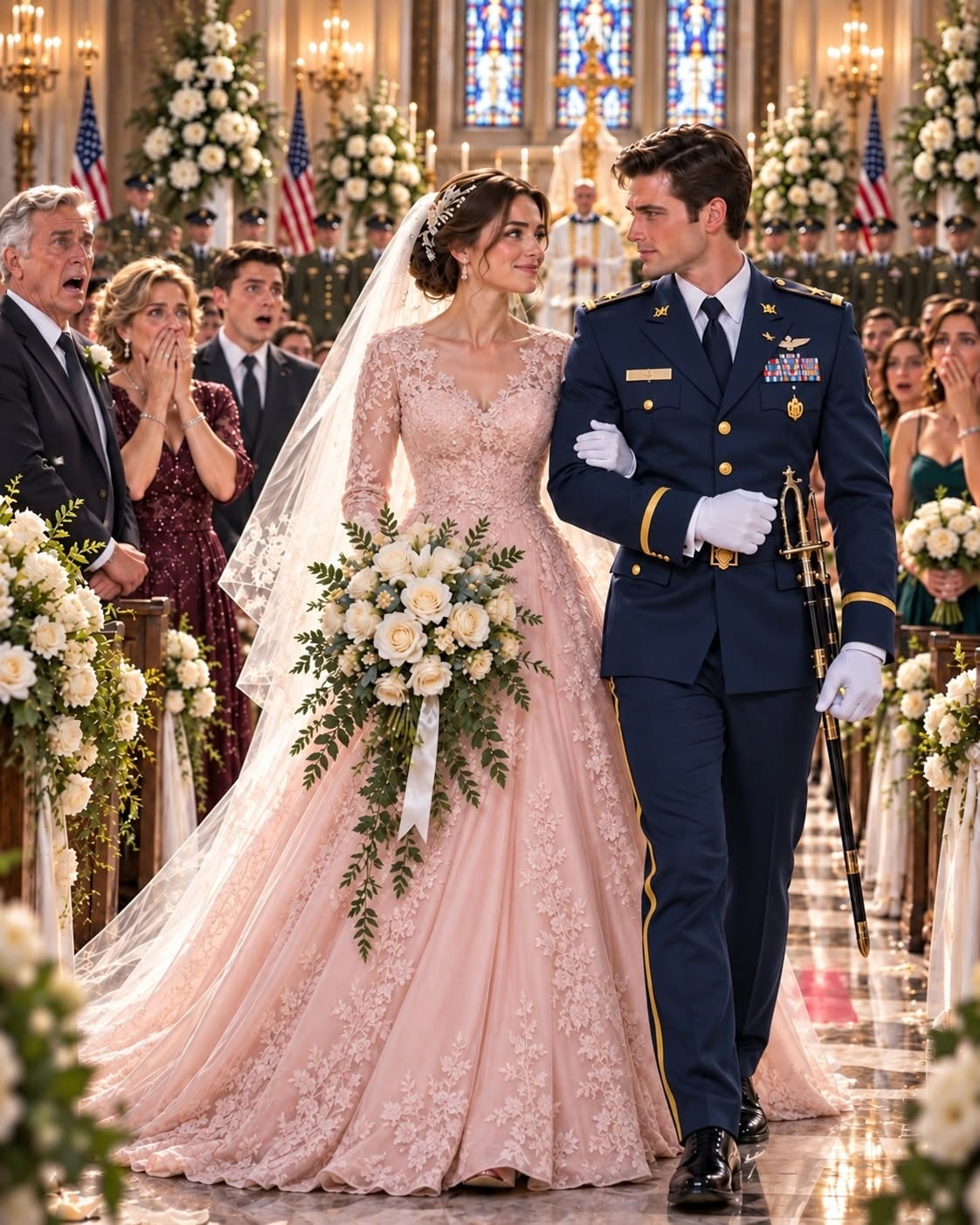

Two nights before my wedding, my father stood over the shredded remains of every bridal gown I owned and smiled
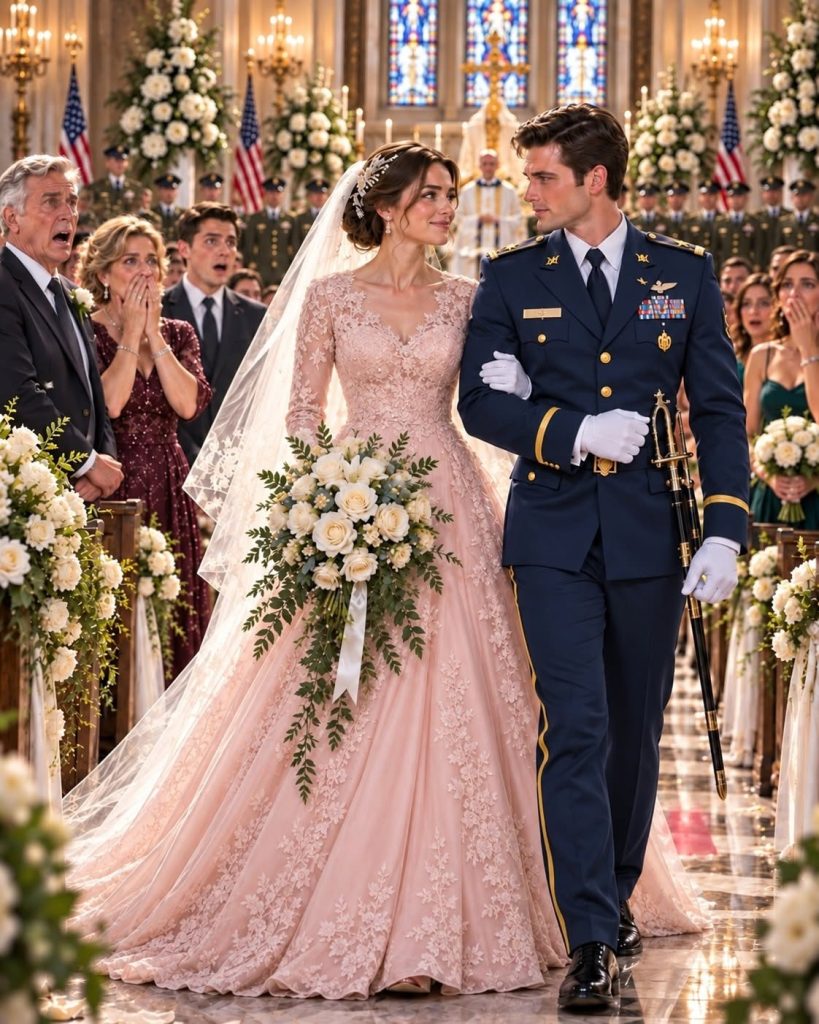
The humid air inside the vestry carried the faint, familiar scent of old beeswax, damp hymnals, and sudden panic. Outside, the church bells were beginning their fifteen-minute warning chime, vibrating through the stone walls and rattling the loose panes of the stained-glass windows.
My mother stood in the corner of the small room, her hands clamped over her mouth as if she were trying to physically swallow a scream. Tyler was pacing a frantic semicircle near the coat rack, muttering under his breath, occasionally casting terrified glances toward the heavy oak door that led out to the nave.
“You can’t go out there like that,” Tyler blurted out, stopping his pacing to gesture wildly at my uniform. “Claire, it’s insane. It’s a wedding. People are wearing silk and tulle. You look like you’re about to brief a strike package.”
“It’s my authorized dress uniform, Tyler,” I said, my voice remarkably steady as I adjusted the silver lapel insignia. “And since your father thoughtfully reduced all four of my custom-tailored bridal options to confetti at two in the morning, it is also the only clean outfit I own that hasn’t been shredded by kitchen shears.”
“He was just trying to teach you a lesson about submission,” Mom whispered, her voice trembling behind her fingers. “You’ve been so… so defiant lately, Claire. The military changed you. It made you hard.”
I turned slowly to look at her. “No, Mom. The military taught me how to read a logistics manifest and maintain composure when a payload goes sideways. Dad taught me that the people who are supposed to keep you safe are sometimes the ones holding the blade.”
Before she could invent another excuse for him, the vestry door clicked open.
Ethan stepped inside. He had ditched his tuxedo jacket, his white shirt sleeves rolled up to his forearms, looking every bit as stressed as a man standing at Ground Zero. When his eyes landed on me, standing tall in my dark blue Air Force service dress with its quiet cascade of ribbons, he stopped cold.
The frantic worry in his eyes melted into something soft, warm, and entirely steady.
“You look…” Ethan swallowed, shaking his head with a faint, incredulous smile. “You look magnificent.”
“I look like an officer who just survived a localized hostile engagement,” I dryly corrected, though a small knot of tension in my chest finally loosened.
“Major General Lawson is out there,” Ethan added, stepping closer and gently tracing the edge of my service ribbon with his thumb. “She took her seat three rows back, right behind your parents. Half the congregation thinks she’s a visiting dignitary. The other half thinks you’re about to declare martial law.”
“She’s a friend, Ethan. And she has impeccable timing.”
Ethan looked down at my polished black oxfords, then back up into my eyes. “Are you ready to break some civilian traditions?”
I took a deep, steady breath, feeling the crisp wool of my uniform adjust to my posture. I thought of the shredded silk lying in piles across my parents’ living room floor. I thought of my father’s smug smile in the dark. And then I thought of the man standing in front of me, who loved me not in spite of my strength, but because of it.
“Let’s go ruin my father’s afternoon,” I said.
The Unbroken Line
The heavy oak doors of the chapel swung open with a slow, dramatic creak.
The organist, who had been gamely hammering out a cheerful prelude, hit a sharp, discordant minor chord and froze, her fingers hovering in mid-air over the keys like trapped insects. The collective intake of breath from the pews sounded like a sudden, sharp gust of autumn wind.
I didn’t blink. I didn’t slouch.
I stepped across the threshold and began walking down the central aisle alone.
Every head in the church snapped backward. High-society aunts adjusted their bifocals in absolute horror; corporate colleagues of my father dropped their programs; family friends stared as if I were an alien spacecraft touching down on the altar.
My father was halfway out of his front-row pew, his mouth half-open to voice some theatrical public objection, before his eyes locked onto the woman sitting three rows behind him.
Major General Rebecca Lawson.
Rebecca didn’t snap to attention. She didn’t salute. She simply crossed her legs, rested one arm casually on the mahogany pew, and offered Frank Bennett a long, slow, razor-sharp stare that communicated more raw, unadulterated menace than a squadron of F-35s.
Dad’s jaw clicked shut. He slowly lowered himself back onto the cushioned pew bench, the crimson flush creeping up his neck turning a bruised, panicked purple.
I kept my eyes fixed forward, locking onto Ethan at the altar. He was grinning like an idiot, whispering something to his best man that I could lip-read easily enough: That’s my wife.
When I reached the front, Ethan didn’t reach out to steady me as if I were a fragile porcelain doll requiring rescue. He stepped forward, offered his arm with mock formality, and whispered, “Nice hardware, Captain. Remind me never to argue about who takes out the trash.”
“You’d lose,” I whispered back, stepping up to the altar beside him.
The minister, looking like a man who had accidentally stepped into the middle of a geopolitical standoff, cleared his throat frantically and turned to page one of the liturgy.
There were no lightning bolts. No dramatic interruptions. No sudden heart attacks or cinematic plot twists. Just two people standing in front of a room full of uncomfortable witnesses, promising to navigate the rest of their lives without trying to control each other.
When the minister pronounced us husband and wife, the applause was hesitant, scattered, and utterly dominated by Major General Lawson’s sharp, rhythmic clapping from the third row.
The Aftermath
The courtyard outside the historic stone church was bathed in golden afternoon sunlight, ringing with the chatter of three hundred bewildered guests trying to process a wedding where the bride wore ribbons instead of Chantilly lace.
I was standing near the stone fountain, trying to explain to our photographer that no, we didn’t need a staged shot of me saluting a stained-glass window, when a heavy hand clamped down onto my shoulder.
“Claire.”
I turned around. My father stood there, his face tight, his chest heaving with suppressed fury. My mother hovered nervously two steps behind him, while Tyler stood off to the side, wearing a smirk that begged for a tactical intervention.
“Dad,” I said mildly.
“You did that on purpose,” he hissed, keeping his voice low enough to avoid drawing the attention of the surrounding guests, but sharp enough to cut glass. “You deliberately humiliated your mother and me in front of the entire community. Turning your own wedding into a military inspection!”
“I didn’t turn anything into an inspection, Dad,” I replied, crossing my arms. “You destroyed four custom bridal gowns at two in the morning. I merely adapted to changing logistical conditions. It’s called resourcefulness. You should try it sometime.”
“Those dresses cost thousands of dollars!” Tyler chimed in, stepping closer with a righteous sneer. “You’re just throwing a temper tantrum because Dad wouldn’t let you throw a ridiculous, over-budget party.”
I looked at my brother, letting a cold, humorless smile touch my lips. “Tyler, the only person here throwing a tantrum is the fifty-year-old man who sneaked into his daughter’s bedroom with sewing shears like a panicked toddler.”
Dad’s face turned the color of a bruised plum. “I am your father! I demand respect!”
“Respect isn’t something you command by destroying other people’s private property,” a calm, authoritative voice cut cleanly through the tension.
We all turned.
Major General Rebecca Lawson had drifted over from the reception line, holding a flute of sparkling cider. She didn’t raise her voice. She didn’t puff out her chest. She simply stood there with the effortless, crushing gravity of someone who commanded thousands of airmen and millions of dollars of hardware before breakfast.
Dad blinked, instantly recognizing the insignia on her collar. His knees practically buckled. “M-Major General…”
Rebecca looked him up and down once—the exact same clinical evaluation a squadron commander gives a chronically underperforming junior officer.
“Frank Bennett, correct?” she asked smoothly.
Dad swallowed hard, his voice pitching an octave higher. “Yes, ma’am. I’m Claire’s—”
“I know whose father you are,” Rebecca interrupted, her tone dropping into a cool, surgical register. “Captain Bennett is one of the sharpest, most competent tactical minds I have ever had the privilege of serving alongside. For years, she has operated in high-stress environments where failure costs lives, and she has done so with absolute grace and unwavering integrity.”
She took a slow sip of her cider, her eyes never leaving my father’s terrified face.
“It is profoundly unfortunate,” Rebecca continued, her voice echoing in the sudden silence of the courtyard, “that her own family lacks the basic emotional discipline to match her standards. If one of my airmen treated government property the way you treated her wardrobe, they’d be standing before a court-martial by sundown.”
Tyler opened his mouth to say something stupid, took one look at Rebecca’s unblinking stare, and abruptly swallowed his tongue, taking two steps backward into the hydrangea bushes.
Mom began to cry softly, dabbing at her mascara with a lace handkerchief. “We only wanted what was best for her…”
“No, Margaret,” I said softly, stepping up beside my commanding officer. “You wanted obedience. There is a massive, unbridgeable chasm between the two.”
Dad stared at me—really stared at me—for the first time in my entire life. He didn’t see a rebellious teenager. He didn’t see an ungrateful daughter. For a terrifying, fleeting second, he looked like a small, broken man who realized the walls he had built to keep his world secure had finally locked him out entirely.
“You’re really going to take legal action over the dresses, aren’t you?” Dad whispered, the fight completely draining out of him.
“My attorney will be in touch with an itemized invoice on Monday morning,” I said evenly. “We can handle it quietly through civilian channels, or we can let a judge sort it out in open court. The choice of venue is entirely yours.”
He didn’t answer. He couldn’t.
Rebecca gave me a crisp, subtle nod of approval, turned on her heel, and walked back toward the gathering crowd of guests, leaving my family stranded in the afternoon sun like relics of a past I had finally outgrown.
The Long Game
Two years slipped by with the quiet, relentless speed of a well-oiled machine.
Ethan and I settled into an ordinary, beautiful, maddeningly mundane life. We bought a small, slightly drafty craftsman house with a sprawling backyard, adopted an aggressively affectionate golden retriever named Maverick who treated military posture as a personal insult, and spent our weekends arguing over whether to paint the kitchen cabinets sage green or slate gray.
My career continued its upward trajectory. I pinned on my major’s leaves during a quiet, sunlit ceremony at the base theater, with Ethan sitting in the front row holding a camera that clicked furiously every three seconds, terrified he’d miss a single frame.
My relationship with my family underwent a seismic, permanent tectonic shift.
Dad paid for the shredded dresses—every single penny of the itemized invoice my attorney mailed him, delivered via a cashier’s check with zero accompanying notes. It was his version of a white flag.
We didn’t speak for eighteen months after the wedding. No holidays, no phone calls, no forced Sunday dinners.
Then came the slow, agonizing thaw.
Mom called first, six months after checking herself into private counseling. She didn’t make excuses. She didn’t blame the wedding stress or Dad’s explosive temper. She simply apologized for watching a crime happen in real-time and electing to stay silent because she was terrified of the man she had married.
We started meeting for coffee on neutral ground—a quiet downtown diner halfway between our houses. No dad. No Tyler. Just two women slowly learning how to speak to each other without walking on eggshells.
Dad broke his silence two years to the day after the ceremony.
He didn’t call shouting, and he didn’t demand an audience. A simple, heavy envelope arrived in my mailbox, containing a single photograph: me at age seven, standing proudly beside a cardboard airplane I had built in the garage, holding a wrench.
On the back, written in his shaky, aging handwriting: I was wrong. I’m trying to learn how to be proud of you without needing to control you. Whenever you’re ready, I’m here.
It wasn’t a magic wand. It didn’t erase thirty years of emotional conditioning, conditional affection, and shredded bridal gowns.
Some broken things can never be glued back together quite right; the cracks remain visible, permanent reminders of the impact.
But recovery isn’t about erasing the scar tissue. It’s about building a life so strong, so secure, and so full of genuine love that the scars lose their power to hurt you.
Epilogue
Last autumn, Ethan and I hosted a small, backyard barbecue for our fifth wedding anniversary.
There were no three hundred elite guests. No string quartet. No high-society catering companies. Just twenty close friends, half a dozen Air Force colleagues, Maverick the golden retriever sprinting frantically through the sprinkler system, and a smoking charcoal grill run by a very happy husband who still burned the burgers if he got distracted talking about aviation history.
My parents attended. They sat together on the patio furniture, conversing politely with Ethan’s parents, aging into the background of a family dynamic they no longer ruled with an iron fist.
Tyler dropped by for an hour, ate three hot dogs, apologized awkwardly for being a jerk during our twenties, and rushed off to a youth soccer game.
And my father?
He stood near the edge of the lawn, watching me pull a tray of fresh lemonade out of the kitchen.
When I walked out onto the wooden deck, he caught my eye. He didn’t demand my attention. He didn’t bark an order or offer unsolicited criticism about my career trajectory.
He simply raised his plastic cup in a quiet, respectful toast.
I paused, standing in the warm autumn sunlight, feeling the weight of the silver oak leaves on my shoulders—not as a heavy burden of expectation, but as a quiet badge of survival.
I raised my glass right back.
Then I walked past him, sat down on the grass next to Ethan, and began laughing as Maverick successfully tackled a plate of potato salad.
My father had tried to destroy my wedding day by ripping apart four white dresses.
He believed he had stripped away everything I needed to become a bride.
He was fundamentally, profoundly wrong.
I didn’t need silk, tulle, or his paternal permission to build a life. I didn’t need his approval to feel worthy of respect.
All I ever needed was my own voice, a husband who loved me for my strength, and a country that had taught me how to stand up straight when the world started burning around me.
And, on a very specific Saturday afternoon when everything went sideways?
Fortunately, the United States Air Force had already issued me the uniform.
Everything else was just a choice.
