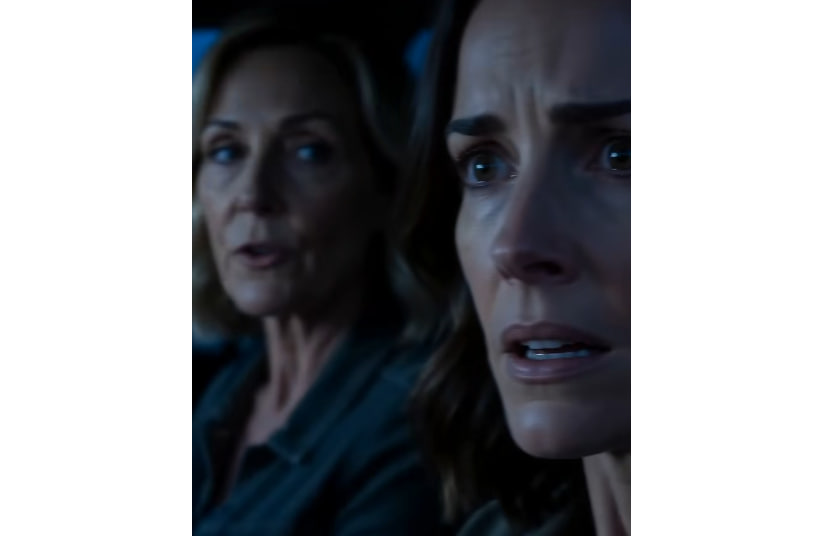

MY PARENTS LEFT ME AND MY 6-YEAR-OLD SON ON A DESERTED HIGHWAY AT 2:13 A.M. — THEY THOUGHT THEY HAD TAKEN AWAY OUR ONLY WAY OUT.
The heavy thud of the SUV doors closing sounded like a gunshot in the dead silence of the Nevada desert.
I stood on the coarse gravel of the shoulder, my hand gripping Noah’s small, trembling fingers. Through the tinted glass, I saw my father’s silhouette shift into gear. He didn’t even glance in the rearview mirror. My mother stared straight ahead, her posture rigidly perfect, a portrait of calculated cruelty.
“Grandpa, please don’t leave us here!” Noah cried, his voice breaking as he took a desperate step forward.
I pulled him back gently against my legs. I didn’t yell. I didn’t chase the vehicle. I stood perfectly still and watched the red taillights of their SUV shrink into the swallowing darkness of U.S. Route 95, waiting until they disappeared completely over a distant ridge.
The silence that followed was absolute, broken only by the whistling of the high desert wind. The temperature was already plummeting, hovering somewhere in the low forties. We were at least twenty miles from the nearest town of Beatty. My parents had orchestrated this with surgical precision. By taking my wallet, they ensured I couldn’t flag down a cab or book a room if I somehow made it to civilization. By taking my charger, they put a ticking clock on my only lifeline.
They wanted me to panic. They expected me to watch my battery drain, feel the biting cold, look at my shivering son, and finally break. They were waiting for my name to flash on their phone screen so I could beg for their forgiveness, submit to their financial and custodial demands, and admit that I could not survive without their benevolent control.
They had spent my entire life trying to frighten me into submission. But they had spent the last fifteen years willfully ignoring who I had become.
I reached into the pocket of my jeans and pulled out my phone. The screen illuminated the darkness. Battery: 11%.
“Mommy, it’s cold,” Noah whispered, burying his face into my hip.
“I know, bug,” I said, my voice entirely steady. The panic they had banked on simply wasn’t there. In its place was the cold, sterile clarity of a command mindset. “We’re going to play a game, okay? It’s called extraction.”
I unzipped my heavy fleece jacket and wrapped it around Noah, kneeling in the dirt to bundle him up so only his eyes were visible. I guided him a few yards off the asphalt, positioning him behind a large cluster of sagebrush that acted as a natural windbreak.
“Stay right here. You are my overwatch,” I told him, tapping his nose. “Don’t take your eyes off the road.”
Noah nodded, taking the mission seriously, his tears drying in the wind.
I looked at my phone. 10%. I didn’t dial 911. A local dispatcher would send a single highway patrol car, which could take an hour to arrive. Then I would have to explain myself, deal with local bureaucracy, and my parents would have time to execute whatever narrative they were spinning. I needed an immediate, overwhelming response, and I needed absolute control of the operation.
I dialed a number I had memorized years ago. It rang twice.
“Vance,” a deep, gravelly voice answered.
“David, it’s Kincaid.”
Major David Vance was my executive officer at Nellis Air Force Base, a man who had pulled me out of a burning command tent in Kandahar and whose loyalty to me was absolute.
“Audrey? It’s 0220. What’s wrong?” The sleep instantly vanished from his voice, replaced by the sharp cadence of a soldier on alert.
“I need an immediate extraction. I am on U.S. Route 95, northbound shoulder. I passed mile marker 74 approximately four minutes before my vehicle stopped. I am with a civilian, my son Noah. We are exposed to the elements. No injuries, but the temperature is dropping.”
“Understood,” David said, the sound of a laptop flipping open echoing in the background. “Who left you out there?”
“My parents. They took my wallet and charger. They’re trying to force a domestic submission.”
A heavy, dangerous silence fell over the line. “Copy that, Commander. I am pinging your phone’s GPS now just to confirm the coordinates. I am dispatching a base security detail and I will personally contact the Nevada State Police to coordinate. Sit tight. We’ll be there in under forty minutes.”
“Battery is at eight percent. Going dark to conserve. Kincaid out.”
I slid the phone back into my pocket and sat down in the dirt next to Noah, pulling him into my lap to share body heat. The physical cold was biting, but my mind was entirely insulated. My parents had fundamentally misunderstood the nature of my silence in their car. They thought my quiet obedience when my father told me to get out was a sign of shock or defeat. They didn’t realize it was tactical compliance. You do not argue with a hostile force in an enclosed space when you have a vulnerable asset to protect. You secure the asset, exit the kill zone, and call in the cavalry.
Forty-five miles south, in a brightly lit, twenty-four-hour diner in Beatty, Richard and Evelyn Kincaid sat in a vinyl booth, nursing black coffees.
My father kept his phone on the table, the screen facing up. It was 3:15 A.M.
“She’s stubborn,” my mother noted, taking a delicate sip of her coffee. “She always has been.”
“She’s freezing,” my father countered, checking his watch. “She’ll break. She has the boy with her. Once it hits thirty-five degrees, her pride won’t matter. She’ll call, and when she does, we make her agree to the trust restructuring before we turn the car around.”
But as the digital clock on the diner wall ticked toward 4:00 A.M., the phone remained black and silent. My father’s smug confidence began to curdle into nervous agitation. He hadn’t accounted for my resilience, and he certainly hadn’t accounted for the fact that I might not need him.
“We have to change the angle,” my father muttered, suddenly standing up. “If a passing truck picks her up, she’s going to spin this against us.”
“What do we do?” my mother asked, her pristine composure finally cracking.
“We get ahead of the narrative. We go to the local sheriff right now.” My father grabbed the keys. “We tell them Audrey had a psychotic break. PTSD from her deployments. We tell them she started screaming, pulled the emergency brake, grabbed Noah, and ran into the desert. We say we searched for hours in the dark but couldn’t find her. By the time they find her, she’ll look like an unfit, hysterical mother, and we’ll be the terrified grandparents trying to save our grandson.”
It was a brilliantly vicious plan. If I had been an ordinary civilian—cold, exhausted, terrified, and crying when the police finally found me—it would have worked flawlessly.
At 4:10 A.M., the desolate highway was illuminated by a blinding wave of strobe lights.
A Nevada Highway Patrol cruiser tore over the ridge, followed closely by two matte-black military police SUVs. They pulled onto the shoulder in a tactical diamond formation, shielding us from the wind and any oncoming traffic. Doors flew open.
Major David Vance stepped out of the lead SUV, his face set in stone. He tossed a heavy, heated tactical blanket to one of the MPs, who immediately wrapped it around Noah.
“You good, Audrey?” David asked, handing me a thermos of hot coffee.
“I’m fine,” I said, taking a long drink. The warmth flooded my system, chasing away the final remnants of the desert chill. “Noah is secured. Now, I need a favor, David. I need to borrow the Trooper’s radio.”
The State Trooper, a tall man with a graying mustache, approached us, looking deeply perplexed by the military presence. “Ma’am, we have a BOLO out for you. Your parents just walked into the Nye County Sheriff’s substation in Beatty. They’re claiming you had a violent mental breakdown, assaulted your father, and dragged your son into the desert.”
I looked at David. A slow, chilling smile touched the corners of my mouth.
“Major,” I said smoothly. “Let’s go to Beatty.”
The sun was just beginning to crest over the jagged Nevada mountains, bleeding pale morning light through the blinds of the Nye County Sheriff’s substation.
My parents were sitting in the small waiting area, playing their roles to absolute perfection. My mother was dabbing her dry eyes with a tissue. My father was leaning over the desk, speaking to the duty sergeant in a hushed, gravely concerned voice.
“You have to understand, officer, she’s a veteran,” my father was saying, shaking his head tragically. “She’s seen things. Her mind just snapped. We tried to stop her, but she’s trained. We just want our grandson safe. She is simply not fit to care for him.”
The heavy glass doors of the substation opened.
My father didn’t turn around at first, assuming it was just another deputy. Then the room fell dead silent.
He slowly turned around. The carefully rehearsed tragedy melted entirely off his face, replaced by a sudden, suffocating horror.
I stood in the doorway, perfectly composed. I wasn’t shivering. I wasn’t crying. I was flanked by a Nevada State Highway Patrol Captain and two uniformed Military Police officers. Through the open doors, my father could see Major Vance holding Noah, who was happily drinking hot cocoa on the hood of a federal vehicle.
“Audrey,” my mother gasped, dropping her tissue.
I didn’t acknowledge her. I looked directly at the duty sergeant behind the desk.
“Sergeant,” I said, my voice ringing with absolute, unshakable authority. “My name is Commander Audrey Kincaid. The two individuals in your lobby abandoned a minor and a federal officer on a deserted stretch of highway at 0213 hours, stealing my personal identification and means of communication in the process.”
“She’s lying!” my father shouted, panic finally shattering his voice. “She’s sick! She jumped out of the car!”
The State Trooper who had accompanied me stepped forward, pulling a digital tablet from his vest.
“Actually, sir, she isn’t,” the Trooper said dryly. “Commander Kincaid gave us her exact coordinates. We ran the tire tracks on the shoulder. They show a smooth deceleration, a three-minute idle, and a rapid acceleration. There are no signs of a struggle, no emergency brake skid marks, and no footprints indicating someone running wildly into the desert. Furthermore, she possessed the presence of mind to initiate a precision federal extraction without a physical phone charger, which heavily contradicts your claim of a psychotic break.”
My father’s mouth opened, but no sound came out. His eyes darted to the military officers, to the state police, and finally, to me. He realized, in one crushing instant, that the daughter he had tried to break in the dark had brought an army with her into the light.
“You’re also holding my wallet and keys, Richard,” I said, using his first name, stripping him of the paternal title he had just weaponized against me. “Which elevates this from simple child endangerment to grand larceny.”
“Audrey, please,” my mother whispered, her face pale as a sheet. “We were just… we were just trying to help you realize you need us. You were being so difficult about the trust.”
“Sergeant,” I said, ignoring her completely. “I am formally pressing charges for felony child endangerment, grand theft, and filing a false police report.”
The duty sergeant stood up, unhooking his handcuffs from his belt. “Richard and Evelyn Kincaid, stand up and place your hands behind your backs.”
My father looked at me, a desperate, pleading look in his eyes—the exact look he had hoped to see on my face hours ago. “Audrey, you can’t do this. We’re your parents. We’re family!”
I stood perfectly still as the deputies moved in.
“You abandoned your family in the desert at two in the morning,” I replied, my voice dropping to a whisper that echoed in the quiet station. “The only thing you left me with was my training. You really should have known better.”
I turned on my heel and walked out of the station, the heavy doors closing behind me. The Nevada sun was fully up now, casting a brilliant, blinding light across the horizon. I walked over to the black SUV, scooped Noah into my arms, and held him tight.
My parents had tried to leave me with nothing, but as the engine roared to life and we drove away from the substation, leaving them locked in the dark reality of their own making, I had never felt more entirely in control.
