
True Strength: A Marine's RestraintThe Story of Robert Walker
The drive to the county hospital was a blur of traffic lights bleeding red into the gray afternoon. The adrenaline that had sustained me in the gym was rapidly burning out, leaving behind a cold, hollow ache in my chest. I have seen the aftermath of violence. I have walked through triage tents in combat zones, smelling the copper tang of blood and the sharp, chemical odor of antiseptics. I was accustomed to the physical destruction of the human body. But nothing—no amount of military training, no stoic philosophy—could prepare a father for the prospect of seeing his own child broken.
The automatic doors of the emergency room slid open, greeting me with a blast of over-conditioned air. The waiting area was a purgatory of uncomfortable plastic chairs, flickering fluorescent lights, and the low, anxious murmurs of people having the worst days of their lives. I didn’t stop at the reception desk. I saw Linda immediately. She was standing outside Room 4, her arms wrapped tightly around her own torso, staring blankly at the linoleum floor.
When she looked up and saw me, her eyes were red-rimmed and swollen. She took one look at my face, at the tight set of my jaw and the rigid posture of my shoulders, and she knew exactly where I had been.
“You went to the gym,” Linda said. It wasn’t a question. It was an accusation born of sheer terror.
I nodded slowly, coming to a halt in front of her.
She pressed her lips together, her hands trembling as she reached out to grip my jacket. “Why, Robert? Why would you do that?”
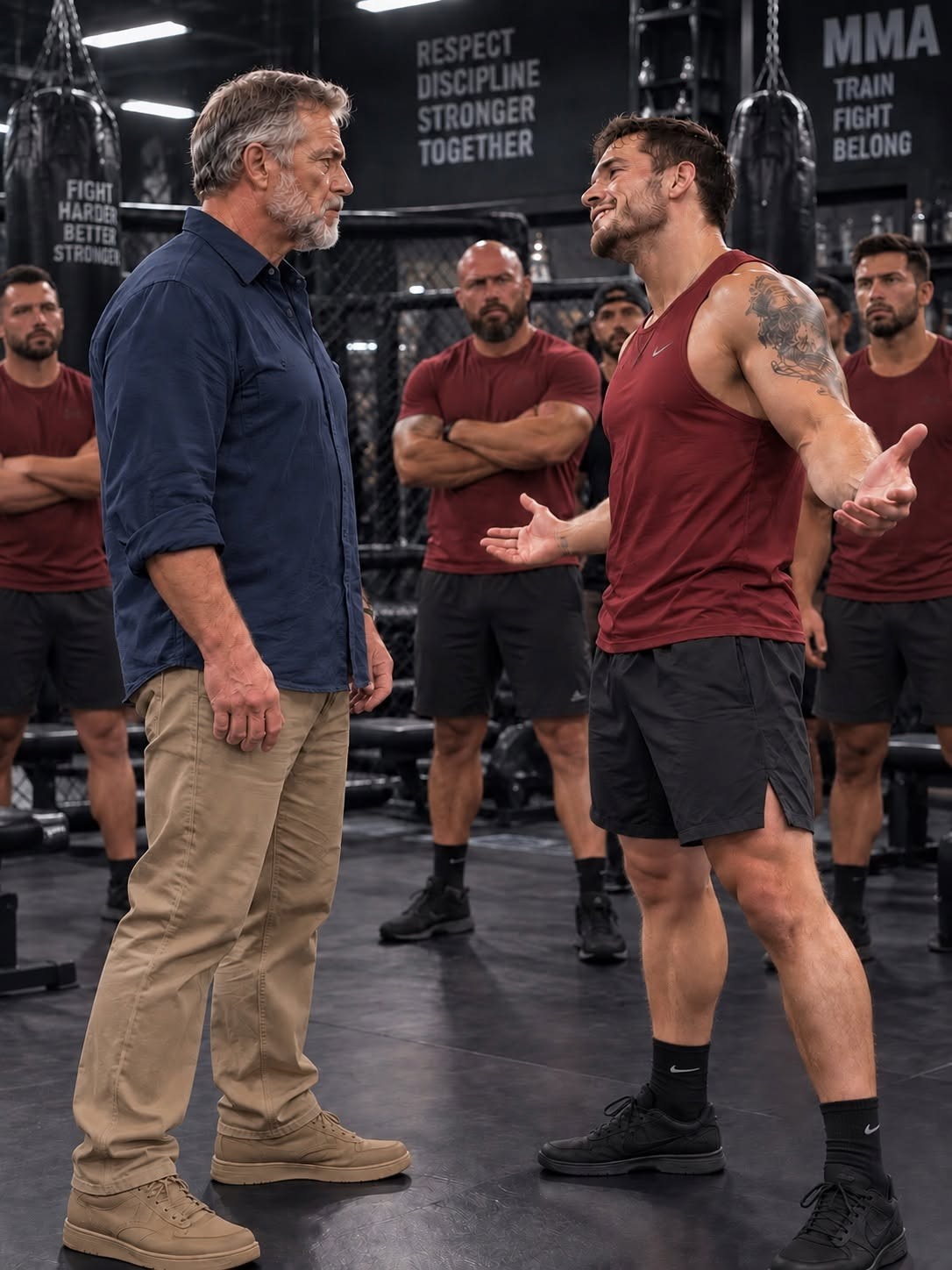
I looked down at the floor, unable to meet her eyes. “Because I was angry, Linda. Because I couldn’t just sit in the garage and sand a piece of wood knowing the man who did this was standing behind a counter laughing.”
Linda’s eyes filled with fresh tears. “So am I! Do you think I’m not angry? Do you think I don’t want to see him destroyed for what he did to our little girl?” Her voice cracked, dropping to a desperate whisper. “But she needs her father right now. Not a man who might end up in a jail cell because he couldn’t control his temper. Not a man who gives Dustin a reason to claim he’s the victim.”
I swallowed the heavy, bitter lump in my throat. Every word she said was entirely, painfully correct. I had let my ego disguise itself as protection. “I know,” I said softly.
Linda touched my arm, her grip grounding me to the reality of the sterile hallway. “Then go in there and be her father.”
I took a deep breath, steeling myself, and gently pushed open the door to Room 4.
The room was painfully bright. The rhythmic, electronic beeping of a heart monitor provided a stark, clinical soundtrack. Marcy was sitting upright in the narrow hospital bed, her knees pulled up slightly toward her chest, looking incredibly small. Her dark hair, usually so meticulously styled, was pulled into a messy, loose ponytail. She was wearing a faded hospital gown that swallowed her frame.
Then, I looked at her face.
There was a dark, blossoming purple discoloration spreading across her left cheekbone, stark against her pale skin. A small, white adhesive bandage covered a laceration just above her right eyebrow. But it wasn’t the physical injuries that devastated me. It was her posture. She looked exhausted, hollowed out, her shoulders hunched defensively as if anticipating another blow.
When she heard the door click shut, she jumped slightly. Her eyes darted toward me, wide and frantic.
“Dad?” she whispered, her voice rasping.
I crossed the room quickly, my heart breaking into a thousand jagged pieces. “Hey, sweetheart,” I said, trying to keep my voice as gentle and steady as possible.
Marcy didn’t reach for me. Instead, her eyes darted down to my hands. She was looking for blood. She was looking for split knuckles or torn clothes. When she found none, she looked back up to my face, her expression twisting into a mask of pure panic.
“Where were you?” she asked, her breathing hitching.
I pulled a small plastic chair to the edge of the bed and sat down beside her. “I went to Dustin’s gym.”
Her expression entirely collapsed. The fragile composure she had been holding onto shattered instantly. “No,” she gasped, shaking her head frantically. “No, Dad. You didn’t.”
“Marcy—” I started, reaching a hand out to comfort her.
“No!” She tried to sit up straighter, violently flinching as the movement pulled at her bruised ribs. She let out a sharp hiss of pain, clutching her side.
“Easy, easy,” I cautioned, pulling my hand back, terrified of causing her more pain.
She shook her head, tears spilling over her bruised cheek. “You don’t understand, Dad. You don’t understand what you just did.”
“I know,” I lied gently.
“He’s going to be furious,” Marcy sobbed, her voice dropping to a terrified whisper, as if Dustin were hiding in the hospital closet listening to us. “He told me… he told me what would happen if I told you. He said his uncle would ruin you. He said he would send people to the house.”
I looked at my daughter, a successful, independent woman who had bought her own car and managed a marketing firm, now reduced to a trembling child terrified of a shadow.
“I’m sorry,” I said, and I meant it with every fiber of my soul. “I should have come here first. I let my anger make the decision.”
Marcy stared at me, the tears flowing freely now. “He’s going to hurt you, Dad.”
I leaned forward, making sure I caught her eyes, forcing her to look at me. I needed to transmit every ounce of strength and certainty I possessed into her. “Listen to me, Marcy. I am not going back there. I didn’t touch him. I didn’t give him a reason to call the police. I just looked him in the eye and left. I am not going to let him bait me into a fight.”
She looked over at Linda, who had quietly stepped into the room and was standing at the foot of the bed, wiping her own eyes. Linda nodded reassuringly.
“I promise,” I said, my voice resolute.
The tension that had been holding Marcy’s body rigidly together finally snapped. Her shoulders began to shake, her chest heaving as she pulled in ragged, desperate breaths. And suddenly, my daughter was crying. It wasn’t the quiet, polite tears she had shed at home over a bad day at work or a broken heart. This was a deep, primal weeping, a release of pure, unadulterated terror and trauma that came from somewhere deep inside her bones.
I moved closer, abandoning the chair. “Can I hold you?” I asked softly.
She nodded, a tiny, desperate movement.
I leaned over the bed and wrapped my arms around her carefully, meticulously avoiding her injured right side. I cradled the back of her head, feeling her bury her face against my shoulder. Her tears soaked instantly through my flannel shirt. She felt so fragile, like a bird with a broken wing.
She clung to my shirt, her fingers twisting the fabric, and whispered a sentence that will haunt me until the day I die.
“I thought he was going to kill me.”
I have heard frightened people say many things. I have held young Marines as they bled, listening to them speak through exhaustion, panic, and the blinding grief of losing their brothers. I thought I knew what trauma sounded like. But nothing in my sixty-one years of life had prepared me for hearing those words from my own child. The universe narrowed down to the sterile walls of Room 4.
I didn’t ask her to explain. I didn’t tell her she should have left sooner, or that she should have seen the red flags. I didn’t demand to know why she had stayed with a man who made her feel this way. I simply held the back of her head and said, “I’m here. You’re safe. I’m here.”
She cried harder, letting go of the terrible secret she had been carrying alone. Linda sat on the other side of the bed, resting her hand on Marcy’s uninjured leg. For a long, indeterminate amount of time, the three of us stayed exactly like that, an island of grief in the middle of the emergency room.
Later, when the tears had slowed to quiet hiccups and the nurse had brought her a cup of water, Marcy was finally ready to tell us what had happened.
She stared at the paper cup in her hands, her voice detached and monotonous, a common psychological defense mechanism against reliving the trauma. She had gone to Dustin’s apartment that morning to collect some winter clothes she had left there. She had decided, after weeks of escalating verbal abuse and controlling behavior, that she wanted to end the relationship. She had packed her bag quickly, hoping to be gone before he woke up.
But he had woken up. He had demanded to know where she was going. When she calmly told him she needed space and was going back to her own apartment, his demeanor had flipped like a light switch. He became enraged, blocking the bedroom door. He grabbed her by the upper arms—she pulled back the hospital gown slightly to reveal deep, purple, finger-shaped bruises blooming on her biceps. She had tried to pull away. He shoved her violently backward.
She lost her balance and fell hard against the heavy, oak edge of his coffee table, the impact cracking against her ribs. Before she could even process the pain, he had leaned over her and struck her across the face.
Marcy stopped speaking. The silence in the room was deafening. I stared at the linoleum floor, my jaw clenched so tightly my teeth ached, using every ounce of my willpower to keep myself seated in the chair.
“He kept saying I made him do it,” Marcy whispered, a fresh tear sliding down her bruised cheek. “He said if I had just listened, if I wasn’t so disrespectful, he wouldn’t have had to teach me a lesson. He told me if I called the police, Victor Hale would make sure you lost your carpentry business, and that they would find me no matter where I went.”
Linda took her daughter’s hand, kissing the knuckles gently.
Marcy looked up at me, guilt swimming in her dark eyes. “Dad, I know I should have told you. I know you never liked him. I was just so ashamed.”
I shook my head slowly, reaching out to gently touch her uninjured shoulder. “You’re telling me now, Marcy. The shame doesn’t belong to you. It belongs to him. Entirely to him.”
A few minutes later, there was a soft knock on the door. A woman in a neat cardigan holding a clipboard stepped into the room. She introduced herself as a hospital social worker. The ER doctor, noting the pattern of injuries, had flagged the case. She asked Marcy if she was willing to speak privately about what had happened.
Marcy hesitated, looking at me.
“It’s your choice, sweetheart,” I said, standing up. “We can step outside if you want.”
Marcy took a deep breath and nodded at the social worker. “You can stay, Dad. I have nothing left to hide.”
The next hour was a grueling, bureaucratic navigation of the darkest corners of domestic violence. The social worker was kind, efficient, and thorough. She explained the available resources, the mechanics of safety planning, and the legal options for reporting the assault to the police. She made it clear that Marcy was an adult, and the decisions were entirely hers.
I wanted to make every single decision for her. I wanted to call the police captain, whom I knew personally from the VFW post. I wanted to hire a lawyer. I wanted to drive back to the gym, consequences be damned, and make Dustin understand the exact magnitude of what he had destroyed.
Instead, I sat quietly by the window and listened. I forced myself to be a support system, not a commander.
When the social worker asked whether Marcy felt safe returning to her own apartment, Marcy shook her head, a tremor returning to her voice. “Dustin has a key. He knows my schedule. He knows my neighbors.”
“Is there somewhere else you can stay?” the social worker asked gently. “A friend? Or a women’s shelter?”
Marcy looked at us, her eyes wide with apprehension.
Linda answered immediately, her voice fiercely maternal. “You can come home, sweetheart. Your room is exactly how you left it.”
Marcy began crying again, a quiet, relieved sobbing.
I took her hand. “You don’t have to decide everything tonight,” I told her. “We take this one hour at a time.”
We formulated a plan. It was tactical, precise, and entirely focused on defense. Marcy would stay with us in her childhood bedroom after she was discharged. She would under no circumstances return to Dustin’s apartment alone to retrieve the rest of her belongings. She would screenshot and preserve every single message he had sent her. She would take the night to rest, and in the morning, she would decide whether and how to make a formal police report with the support of a victim’s advocate.
It sounded simple when outlined on the social worker’s clipboard. But I knew the reality of trauma. It wasn’t a clean, linear process. It was a messy, terrifying war of attrition.
But as the nurse came in to unhook the IV and prepare her discharge papers, I looked at my daughter. She was battered, terrified, and exhausted. But she was alive. And she was coming home. We had a plan, and it was a plan that put her safety above my ego, above my anger, and above everything else.
The hardest battle wasn’t going to be fought on the mats of Dustin’s gym. It was going to be fought in the quiet, sleepless hours of the night, in the long road to reclaiming a life that had been violently disrupted. And for the first time all day, I finally felt like a father again.
