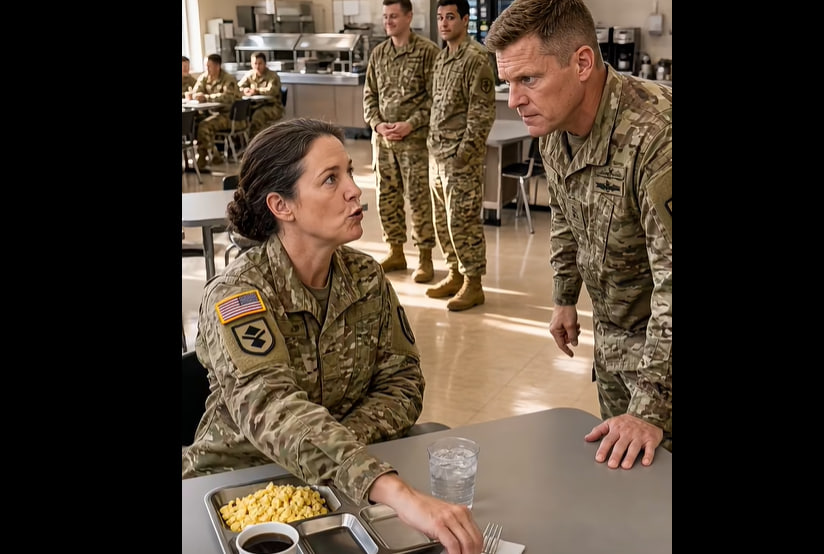

HE HUMILIATED HER IN FRONT OF THE ENTIRE CAFETERIA… WITHOUT KNOWING WHY SHE WAS REALLY THERE.
The new workspace assigned to Captain Derek Stone was located in the sub-basement of the base’s administrative annex—a cramped, suffocating room utterly devoid of windows. Gone were the sprawling tactical maps spread across glass tables. Gone was the crisp snap of boots snapping to attention whenever he entered a room. And gone, completely and irrevocably, were the deferential, fearful glances of junior officers.
Now, Derek’s entire world had been violently compressed into stacks of shipping manifests, ammunition inventory logs, and the dry, relentless hum of an ancient ventilation fan rattling in the ceiling.
Three weeks had passed since the catastrophe in the mess hall. Three weeks since Major General Sarah Jenkins had publicly stripped him of his command of Alpha Company, reducing his rising-star career to a cautionary tale whispered in the barracks.
Derek stared at the flickering computer monitor, the neon green numbers of the logistics database blurring together. A hollow, gnawing emptiness chewed at his chest. In the immediate aftermath of his demotion, the humiliation had fermented into a toxic, defensive bitterness. During his first few days in the basement, he had remained combative. He barked at the low-ranking supply clerks, scoffed at the civilian contractors, and clung desperately to the delusion that he was the victim of a cruel, bureaucratic power play. He convinced himself that he was a brilliant tactician who had merely tripped over an insignificant breach of etiquette.
Then, the command climate assessment report for Alpha Company arrived.
General Jenkins hadn’t simply relieved him of duty and flown back to the Pentagon. She had left her Inspector General team behind to dig deep into the bedrock of Derek’s former unit. Late one evening, the Base Commander, Colonel Hayes, had marched down to the basement and slammed a thick, heavily redacted manila folder onto Derek’s cold metal desk.
“Read it, Stone,” Hayes had said, his voice stripped of any lingering camaraderie or pity. “Read every single page. Because you need to understand exactly why you are sitting down here in the dark, and why I completely endorse General Jenkins’s decision.”
Derek had stayed awake the entire night, turning the pages with trembling fingers. The report did not contain the live-fire qualification times or the armor maintenance percentages he had always paraded in front of his superiors. Instead, it was filled with pages of anonymous, verified testimonies from the very soldiers he had commanded.
“Captain Stone doesn’t lead; he rules. Anyone who offers a tactical alternative is humiliated in front of the entire platoon.”
“We don’t respect him. We survive him. If we ever deploy to a combat zone, I don’t know a single squad leader who would trust him with their lives. He would sacrifice any of us to polish his own evaluation report.”
“He treats the supply clerks, the medics, and the mess staff like second-class citizens. To him, you aren’t a soldier unless you’re carrying a rifle, and you aren’t human unless you outrank him.”
The words were scalpels, slicing effortlessly through the thick armor of his ego. Derek had always believed that his rigid, unrelenting harshness was the forge that created elite warriors. But the stark black-and-white reality on the page painted a horrifying picture: he hadn’t built a cohesive fighting force at all. He had engineered a fractured, deeply resentful collective paralyzed by fear. The incident where he deliberately spilled water on a “nobody” in the cafeteria wasn’t a momentary lapse in judgment. It was the absolute, undeniable symptom of a rot that had infected his entire soul.
The realization washed over him like ice water. Derek rested his forehead against the cold metal of his desk, burying his face in his hands. For the first time in his military career, he didn’t feel anger. He felt a profound, crushing shame. He had failed the fundamental test of an officer.
In the days that followed, a quiet but monumental shift began to take place in the windowless office.
Derek stopped throwing clipboards at the privates who delivered late reports. When Private First Class Ramirez—a nervous, twenty-year-old logistics clerk—tripped over a cable and spilled a mug of scalding black coffee all over Derek’s finalized shipping manifests, the young soldier squeezed his eyes shut, bracing for the inevitable, career-ending explosion of rage.
But the explosion never came.
Derek slowly stood up, grabbed a roll of paper towels, and knelt on the floor beside the terrified private. “It’s alright, Ramirez,” Derek said, his voice surprisingly gentle and devoid of any razor-sharp sarcasm. “I can pull the backups from the server. Just help me get the floor dry before someone slips.”
Ramirez blinked, staring at the former terror of the battalion as if he had just sprouted wings. He nodded frantically, scrubbing at the linoleum. That one, infinitesimal moment of grace rippled through the logistics bay. The enlisted staff slowly began to notice a very different Captain Stone. He was quieter. He worked through his lunch breaks. He spent his afternoons in the motor pool, covered in grease, helping the mechanics troubleshoot supply trucks. And most shockingly of all, he started using the word “Thank you.”
The ultimate test of this transformation arrived on a frigid Thursday night at the end of the month, when the worst winter storm in a decade unexpectedly hammered the installation. A massive blizzard slammed into the region, dumping three feet of snow in a matter of hours, severing the main supply routes, and knocking out the power grid for half the base.
Worse yet, two companies of infantrymen were currently undergoing a winter survival training exercise in the northern mountainous training area. The sudden, severe drop in temperature turned a routine field exercise into a life-threatening crisis. Radio communications were severely degraded by the atmospheric interference, and the last broken transmission indicated that several soldiers were exhibiting early signs of hypothermia.
The base operations center descended into controlled chaos. Colonel Hayes was shouting into a dead radio handset, demanding rescue contingencies. The problem was insurmountable: standard wheeled convoys couldn’t punch through the heavy snowdrifts, and the hurricane-force winds grounded every medevac helicopter within two hundred miles.
That was when Derek pushed through the doors of the command center. He wasn’t wearing his pristine dress uniform. He was wearing a grease-stained, heavy canvas mechanic’s coat, clutching a rolled-up topographical map.
“Sir,” Derek’s voice cut through the panicked chatter of the room, steady and resonant. “I have a viable extraction plan.”
Every eye in the room snapped toward the disgraced captain. A few staff officers sneered, but Colonel Hayes, desperate and out of options, gestured for him to speak.
“The main access roads are impassable, and wheeled vehicles are a death sentence out there tonight,” Derek said, spreading the map over the tactical plotting board. “But over the last three weeks, I’ve been conducting inventory in Maintenance Bay Seven. We have four decommissioned M88 armored recovery vehicles sitting in the back, slated for auction. They are fully tracked, heavily armored, and they possess the engine torque to plow through six feet of snow without stalling.”
“How do you know the engines are even operational?” the Battalion Executive Officer demanded skeptically. “They’ve been off the maintenance roster for six months.”
“Because Private Ramirez and I spent the last three days rebuilding their alternators and flushing their fuel lines in our off-hours,” Derek replied, holding the officer’s gaze with absolute conviction. “They will run. I know the northern ridge perfectly because I led Alpha Company through it last spring. There is an old, narrow logging trail that bypasses the main valley. It’s shielded from the worst of the wind shear. The M88s can navigate it. We load them with thermal blankets, portable generators, and medical supplies.”
“Who is going to drive them?” Hayes asked, his eyes narrowing. “My engineers are stretched thin keeping the base generators online.”
“I am,” Derek said. “I’ll lead the convoy. I just need three volunteer drivers from the motor pool who know how to handle tracked armor.”
Time was a luxury they didn’t possess. Within forty minutes, the makeshift rescue convoy was roaring to life. Derek hauled himself into the commander’s hatch of the lead M88. As the heavy steel doors sealed shut, the brutal, deafening howl of the blizzard enveloped them.
The journey was a nightmare of whiteout conditions and treacherous, icy inclines. In the past, Derek would have screamed into the radio headset, berating his drivers for moving too slowly or taking a turn too wide. Tonight, his voice was the only anchor his team had in the blinding snow.
“Keep your RPMs steady, Ramirez,” Derek coaxed over the crackling radio, his tone remarkably calm, projecting an unshakeable confidence. “You’re doing perfectly. Don’t fight the ice, let the tracks do the work. I’ve got eyes on the trail. Just follow my treads.”
For five agonizing hours, the four massive steel beasts chewed through the frozen wilderness. Derek guided them around sheer drops and through deep snowdrifts, treating his drivers not as subordinates to be commanded, but as partners to be trusted. When they finally breached the tree line and lumbered into the infantry encampment, the sight of the roaring M88s was met with tears of relief from the freezing soldiers.
By dawn, the storm had broken. The morning sun reflected blindingly off the fresh snow as the convoy rumbled back through the main gates of the installation. They had extracted every single soldier. Not a single life was lost.
As Derek climbed down from the armored vehicle, exhausted, freezing, and covered in diesel soot, a crowd of officers and enlisted personnel had gathered in the motor pool. A spontaneous wave of applause broke out.
Derek didn’t salute the crowd. He didn’t puff out his chest. He simply turned, walked over to a shivering Private Ramirez, and gripped the young man’s shoulder. “Excellent driving, Ramirez,” Derek said quietly. “You saved a lot of lives tonight. I’m proud to serve with you.”
Three days later, Derek received a summons to the Base Commander’s office.
When he stepped through the heavy oak doors and snapped to attention, he felt the air leave his lungs. Sitting in the leather chair opposite Colonel Hayes was Major General Sarah Jenkins. She looked exactly as she had a month ago—impeccably dressed, terrifyingly calm, with the worn leather folder resting on her lap.
“At ease, Captain,” General Jenkins said, gesturing to the chair in front of the desk.
Derek sat, keeping his posture rigidly straight.
General Jenkins opened the folder and withdrew a single sheet of paper. “I have reviewed the after-action report regarding the blizzard extraction,” she began, her sharp eyes studying him carefully. “The tactical execution was flawless. But what I found vastly more interesting were the sworn statements from the logistics personnel who rode with you. They reported a convoy commander who listened to his mechanics, who spoke with patience, and who gave his only thermal ration to a freezing private on the ride back.”
She paused, steepling her fingers. “This behavior is highly inconsistent with the man who believed rank gave him the right to humiliate a stranger over a cafeteria table. Care to explain the discrepancy, Captain?”
Derek looked directly at the two-star general. He didn’t offer an excuse. He didn’t beg for his career back.
“There is no excuse for who I was, Ma’am,” Derek said, his voice steady and deeply sincere. “You were completely right. I was arrogant, and my leadership was a poison to my soldiers. Relieving me of my command was the only way to make me realize that I had spent my entire career looking down on the very people who hold this Army together. In that storm, rank didn’t matter. We only survived because we trusted each other.”
Silence stretched across the room, thick and heavy. General Jenkins watched him, her expression unreadable. Finally, she closed the leather folder.
“I do not reinstate officers who have shattered the trust of their unit,” General Jenkins said flatly. “Alpha Company belongs to a new commander now. You will never lead them again.”
Derek nodded, swallowing the lump in his throat. “I understand, General.”
“However,” Jenkins continued, a faint, almost imperceptible ghost of a smile touching the corners of her mouth. “The military does not require leaders who are flawless. It requires leaders who can look into the abyss of their own failures, dismantle their ego, and rebuild a man of actual character from the wreckage. Therefore, your administrative freeze is lifted.”
Derek’s eyes widened slightly.
“Colonel Hayes needs a new Deputy Director of Installation Logistics,” General Jenkins said, standing up. Derek and Hayes immediately rose to their feet. “It is a thankless, grueling position, Captain Stone. You will deal with spreadsheets, broken engines, and supply shortages every single day. And you will work side-by-side with the lowest-ranking soldiers on this base.”
She walked toward the door, stopping just inches from Derek.
“Show me that the man in the blizzard is who you truly are,” she said softly. “Do not make me regret this.”
“I won’t, General,” Derek replied, the words carrying the weight of a blood oath. “Thank you.”
As the door clicked shut behind her, Derek took a deep breath. He had lost his prestigious command, and his path forward would be paved with grease, sweat, and humility. But as he turned to head back down to the windowless basement to start his shift, Captain Derek Stone realized something profound: for the first time in his life, he was finally ready to lead.
