
Chapter 1: The Dismissal
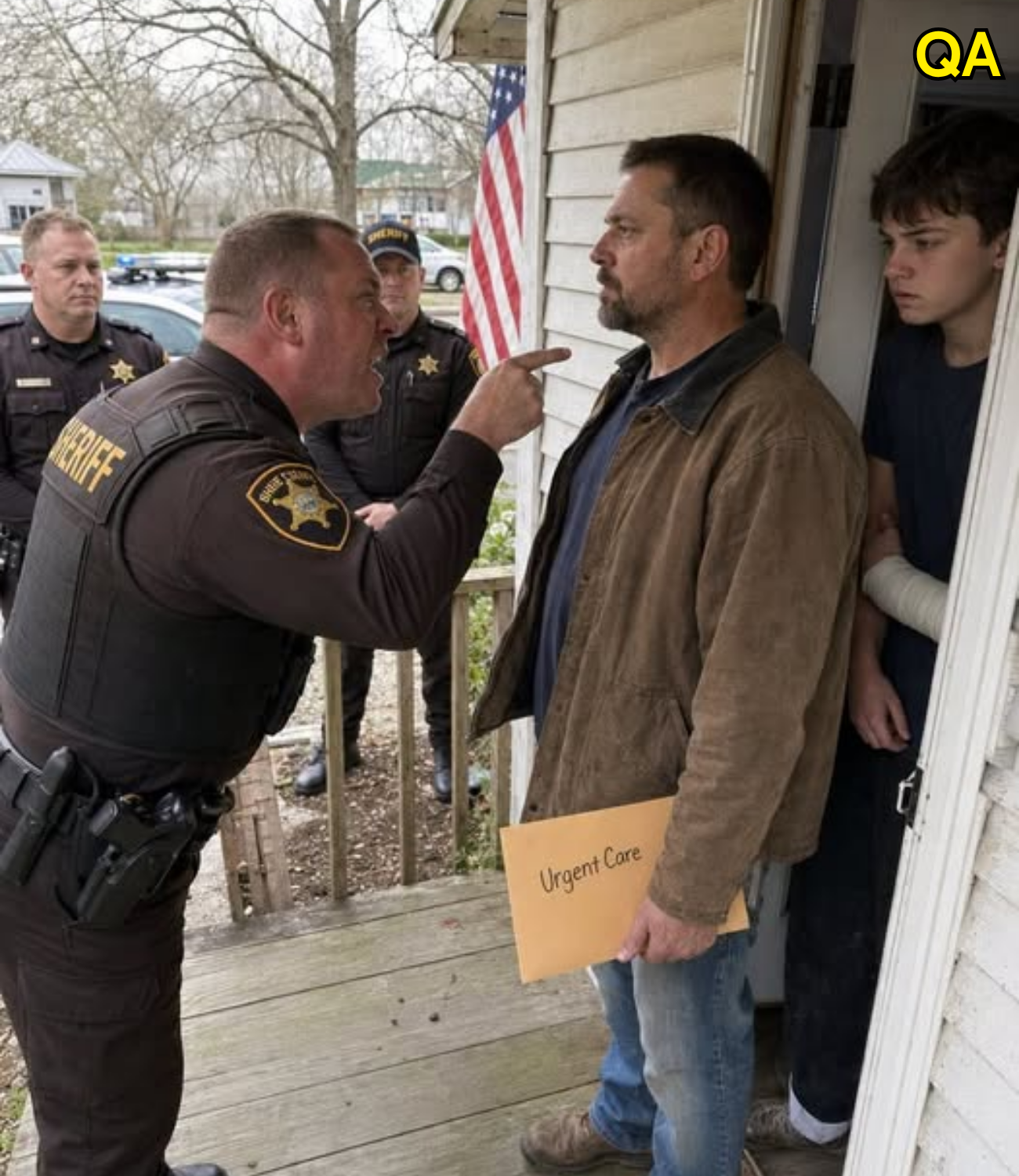
I watched Sheriff Carl Gaines lean casually back in his executive chair, his dusty boots propped up on the corner of his polished oak desk, treating my son’s medical X-ray like a punchline he had heard a thousand times before.
“Boys will be boys,” he said, waving a hand dismissively as if broken bones and bruised ribs were standard extracurricular activities in this town. When I didn’t rise to his bait, refusing to scream or lose my temper, his smug smile thinned into something much meaner, cold and calculating. “In this county, I decide how things are handled. What are you going to do about it?”
He expected noise. He expected a rash threat, a raised fist, or a reckless mistake that he could instantly write up in an incident report and bury at the bottom of the precinct safe.
Instead, I didn’t say a single word. I simply reached across the desk, pulled my son’s medical files from his grasp, and walked out of the office without looking back.
Chapter 2: Building the Case
I took my son home, settled him safely on the living room couch with a warm blanket, and immediately opened my laptop.
I didn’t waste energy on useless fury; I channeled every ounce of my adrenaline into documentation. I wrote down dates, specific times, hallway corners in the local school, echoing locker rooms, the cowardly way teachers’ eyes slid away when approached, and the cynical warnings from coaches telling us not to “make trouble for the team.”
I contacted Helena, a trusted legal advocate from the state capital, collected official administrative procedures, and routed detailed emails through every independent oversight channel that didn’t answer to the sheriff’s badge.
Within forty-eight hours, other parents’ harrowing stories began arriving in hushed whispers from dark garages and back porches—each terrifying account acting as another fracture in the carefully constructed myth of the sheriff’s untouchable, golden-boy son.
Chapter 3: The State Arrives
Three days later, the heavy morning silence of our quiet town was broken by the low, rumbling hum of heavy engines.
A convoy of unmarked state police SUVs and investigators’ vehicles rolled slowly down Main Street, tires hissing against the damp asphalt. They parked directly in front of the municipal building and the sheriff’s department, their federal and state insignias gleaming in the pale daylight.
I stood by my living room window, watching through the blinds as local deputies scrambled out of the precinct doors, their arrogant postures instantly replaced by panic.
For the first time in a very long time, the sheriff wasn’t the only man in town asking what someone was going to do about it. But this time, the question wasn’t a taunt—it was a reckoning.
Chapter 4: A New Dawn
The investigation moved with swift, unstoppable precision. By noon, the doors of the sheriff’s office were sealed with state warrants, and the systematic abuse of power that had choked our community for decades was finally exposed to the harsh light of day.
Sheriff Gaines was escorted out of his building in handcuffs, stripped of his badge and his illusion of absolute immunity, facing a grand jury that couldn’t be bought or intimidated.
Later that afternoon, my son walked into the kitchen, his arm still in a brace, but his shoulders held high, free of the heavy, silent fear that had weighed him down for months. I poured him a glass of juice, smiled, and pulled out a chair. The storm had finally broken, and the town was finally ours again.
Chapter 5: The Aftermath and the Rebuilding
The heavy oak doors of the county courtroom echoed with a dull, resonant thud as the final gavel fell, signaling the conclusion of the preliminary arraignment. Outside, the midday sun broke through the dense cloud cover that had hung over Milwood Creek for days, casting a warm, golden light across the stone steps of the courthouse. But for the first time in over a decade, the warmth felt genuine, unmarred by the chilling shadow of corruption that had dictated life in our town.
I stood on the top landing of the steps, my hands resting lightly in my pockets, watching the steady stream of reporters and state investigators disperse. Across the plaza, Sheriff Carl Gaines—now stripped of his uniform, his firearm, and the arrogant swagger that had once terrorized local families—was led toward a state transport van. His head remained bowed, his eyes fixed on the pavement, desperately trying to avoid the flashing cameras of journalists who had ignored our quiet pleas for years.
My son walked up beside me, his arm still supported by a lightweight medical brace, but his posture was entirely transformed. The heavy, suffocating hunch of fear that had weighed on his shoulders ever since the incident at the school gymnasium was gone. He looked out at the bustling town square, where neighbors who had once crossed the street to avoid eye contact were now nodding, waving, and walking with their heads held high.
“Dad,” my son said quietly, breaking the calm silence between us. “Do you think things are really going to change around here?”
I turned to look at him, placing a reassuring hand on his uninjured shoulder. “Change isn’t something that happens overnight, son. But accountability? That’s a start. And people who thought they were above the law just learned that no badge is thick enough to shield them from the truth.”
The journey ahead would not be easy. A town doesn’t heal from decades of intimidation and institutional rot in a single afternoon. The school board still needed to be restructured, the athletic department required a complete overhaul with unbiased oversight, and the community itself had to rebuild the trust that had been systematically eroded by a man who viewed public service as a personal fiefdom.
Yet, as Helena walked down the courthouse steps toward us, carrying a thick leather briefcase filled with the remaining deposition files, I knew the hardest part was behind us.
“Well,” Helena said with a faint, tired smile, adjusting her glasses against the glare. “The federal grand jury has accepted all counts. The preliminary indictments cover not just the cover-up of the assault, but financial embezzlement, intimidation of witnesses, and abuse of state authority. Gaines isn’t making bail anytime soon.”
“And the department?” I asked.
“State police have placed an interim captain in charge until a transparent, community-voted election can be held next month,” Helena replied, handing me a secure flash drive containing the latest administrative updates. “The old guard is out. The precinct is being audited from top to bottom.”
I nodded, feeling a profound sense of closure settle deep within my chest. I thought back to the moment I had sat in Gaines’s office, staring at my son’s X-ray while the sheriff leaned back in his leather chair with his boots on the desk, asking that cold, mocking question: What are you going to do about it?
At the time, he thought he held all the cards. He believed that isolation, fear, and institutional inertia were invincible. He had underestimated the quiet resilience of a parent driven not by vengeance, but by the fundamental right to protect their child and demand justice.
We walked down the courthouse steps together, the three of us, stepping off the cold stone and onto the sunlit sidewalk of Main Street. A local store owner smiled and nodded as we passed, and for the first time in months, my son smiled back, offering a wave of his own.
The shadows that had loomed over Milwood Creek for so long had finally been swept away by the harsh, unyielding light of accountability. We hadn’t just survived the storm; we had dismantled the walls that created it. And as we turned the corner toward home, the road ahead finally stretched out before us—wide, open, and completely free.
