
Chapter 1: The Weight of a Whisper
The bathroom felt smaller than usual, the fluorescent overhead lights buzzing with a low, irritating hum that seemed to amplify the pounding in my temples. The air smelled sharply of antiseptic and the strawberry-scented detangler I used on my daughter’s hair every morning. Seven-year-old Lily sat on the edge of the closed toilet lid, her small legs swinging back and forth, entirely unaware of the tectonic plates shifting beneath the surface of our seemingly normal evening. I was tending to a dark, purple bruise blossoming on her knee—a badge of honor from a playground tumble, easily explained and easily treated with an ice pack and a colorful bandage. But it wasn’t the bruise that made my heart stop. It was the conversation that accompanied it.
“Grandma picked me up from the park today,” Lily had murmured, wincing slightly as I pressed the cold pack against her skin. “She bought me ice cream.”
I frowned, my hand freezing mid-motion. I hadn’t arranged for my mother-in-law, Eleanor, to pick Lily up. In fact, I had specifically planned a quiet afternoon for just the two of us after I finished my shift at the clinic. Eleanor’s sudden, unannounced appearances had become a recurring theme in our lives, a suffocating pattern of overstepped boundaries disguised as grandmotherly devotion.
“She did?” I kept my voice light, casual, trying not to alarm her. “Did she call Daddy first?”
Lily shook her head, her bright blue eyes dropping to the tiled floor. “No. But… Grandma said not to tell you we saw each other. She said it was our special secret.”
Those words—Grandma said not to tell—landed heavier than any physical impact I had ever experienced. It was a quiet confession wrapped in a child’s innocent loyalty and underlying fear. The bruise on her knee was a simple accident of childhood physics; the betrayal stitched into that whispered secret was deliberate, calculating, and deeply sinister. For months, I had felt a creeping sensation of being watched, a paranoid flutter in my stomach that I constantly tried to suppress. Every time we went to the grocery store, every impromptu trip to the park, every supposedly secret weekend getaway, Eleanor would somehow manifest. Oh, I just happened to be in the neighborhood! she would chirp, waving a manicured hand. What a lucky coincidence!
But as I looked at my daughter, clutching the edge of the sink to steady myself, I realized that luck had absolutely nothing to do with it. The paranoia I had been aggressively medicating with logic and deep breathing exercises wasn’t paranoia at all. It was intuition.
“Lily, sweetie,” I said, my voice trembling slightly despite my best efforts to control it. “Can you hand me your new backpack? The one Grandma bought you for the start of the school year?”
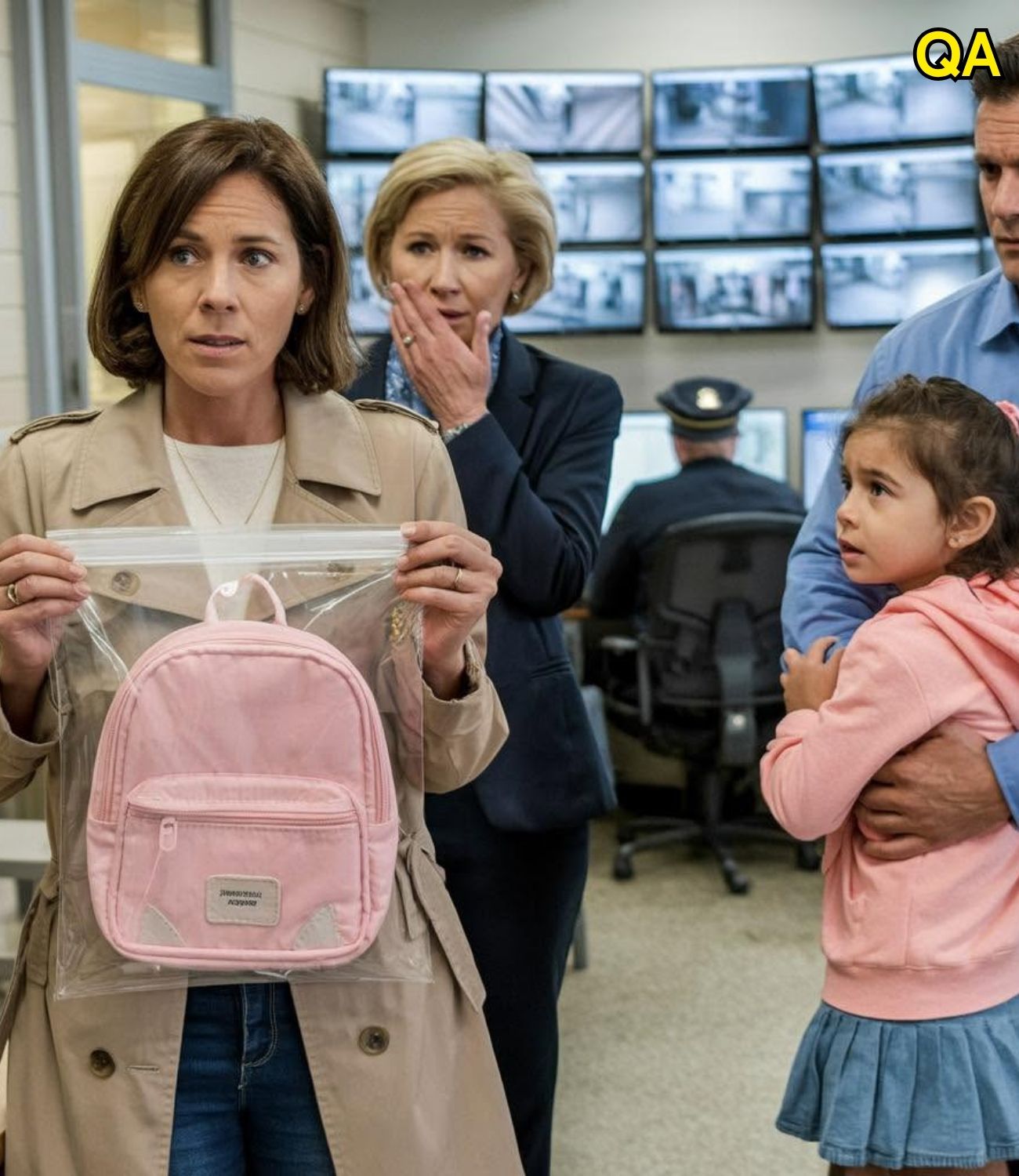
Lily hopped off the seat and retrieved the bright pink, heavily embroidered backpack from the hallway. It was a beautiful piece, custom-made, a gift Eleanor had presented with great fanfare just a month prior. Only the best for my granddaughter, she had declared, shooting me a thinly veiled look of superiority. As I took the bag from Lily’s small hands, it felt uncharacteristically heavy on one side. I sent Lily to the living room to watch her favorite cartoon, needing absolute silence for what I was about to do.
Sitting on the edge of the bathtub, I ran my fingers over the thick canvas material. I felt along the seams, pressing deeply into the padding of the back panel. There, right near the bottom, completely invisible from the outside, my fingertips brushed against a hard, rectangular lump embedded within the lining. It wasn’t cardboard. It wasn’t extra padding. I went to the medicine cabinet, my hands shaking so violently I nearly dropped the small pair of surgical scissors I kept for first aid. With clinical, desperate precision, I slit open the soft, pink fabric of the inner lining.
I reached into the dark crevice and pulled it out. It was a small, black, hard plastic square, no larger than a matchbox. I turned it over in my trembling palm. A tiny, singular green light blinked back at me, pulsing rhythmically in the dim bathroom light like a mechanical, malicious heartbeat. The truth was cold, hard, and undeniably real. It was a GPS tracker.
Chapter 2: The Anatomy of an Invasion
Staring at the tracker in my palm, the entire architecture of my reality began to violently reconstruct itself. Suddenly, every uncanny coincidence, every “lucky” encounter, every time my mother-in-law appeared before we had even turned off the car ignition, snapped into a new, terrifying, and razor-sharp focus. The world around me seemed to tilt on its axis. The bathroom, with its comforting smells of childhood bath time, suddenly felt like a crime scene.
My mind raced backward, aggressively cataloging the past six months. I remembered the spontaneous trip to the botanical gardens three towns over. We hadn’t told anyone we were going; it was a last-minute decision made over breakfast. Yet, within twenty minutes of our arrival, Eleanor had strolled up the path, holding two iced coffees and feigning utter surprise. I just felt like looking at the orchids today! she had claimed, her smile wide and unblinking. I remembered the pediatrician appointment I had rescheduled quietly to avoid her constant hovering. She had been sitting in the waiting room when we arrived.
“I just worry about you,” she would say whenever I tried to assert a boundary, her voice dripping with a saccharine, practiced concern that made it impossible for my husband, Mark, to see her true intentions. “The world is so dangerous. I only want to make sure my family is safe.”
But this was not worry. Worry is a natural, human emotion that prompts phone calls or offers of help. Worry does not orchestrate a covert surveillance operation. Worry isn’t supposed to crawl into your seven-year-old child’s belongings, stitch itself into the fabric of her daily life, and live there, unseen and parasitic. It isn’t supposed to make your daughter whisper like she’s protecting a dirty secret that isn’t hers to carry. This was not care; this was a manifestation of absolute, pathological control.
I sat on the bathroom floor, my back pressed against the cold porcelain of the bathtub, the tracker still blinking its steady, mocking rhythm in my hand. I thought about Mark. How was I going to explain this to him? For years, Mark had acted as a buffer, constantly excusing his mother’s overbearing nature as a byproduct of her being a widow with an empty nest. She means well, Sarah, he would say, rubbing his tired eyes after another one of her invasive visits. She just doesn’t know how to express her love without overwhelming people. Just humor her.
But how do you humor a tracking device? How do you compromise with a woman who treats your child like a tagged animal in a wildlife preserve? If I showed this to Mark, would he finally see the deep, disturbing pathology underlying his mother’s actions, or would he somehow find a way to rationalize this, too? Maybe she just wanted to know Lily was safe at school, my inner voice mocked, mimicking the exact tone of denial I had come to expect from him.
The green light blinked again. Blink. Blink. Blink. Every flash was a transmission, a constant, silent scream broadcasting our exact coordinates back to a woman who viewed us not as a family, but as possessions. I felt profoundly violated. The sanctity of my motherhood, the safe haven of our home, the innocent independence of my daughter—all of it had been compromised, polluted by Eleanor’s obsessive need to monitor and manipulate.
I wrapped the tracker tightly in a thick towel, hoping to muffle its signal, though I knew logically it wouldn’t do much. I needed a plan. I couldn’t just confront her in a fit of rage; Eleanor thrived on emotional chaos. She was a master manipulator who would easily twist an angry confrontation into a narrative where I was the unstable, paranoid daughter-in-law, and she was the victimized, well-meaning grandmother. I had to be strategic. I had to be cold. I had to dismantle her illusion of control using the very tools she had used against me. The era of playing the polite, accommodating daughter-in-law was officially over.
Chapter 3: The Silent Game
For the next forty-eight hours, I lived a double life. Outwardly, I was the same organized, slightly exhausted mother I had always been. I made Lily’s lunches, helped her with her spelling homework, and smiled when Mark came home from work. But internally, I was operating like a covert operative behind enemy lines. The tracker remained securely hidden in a small Faraday bag I had rushed out to purchase from an electronics store, effectively killing its signal and plunging Eleanor into a blind panic.
The silence from her end lasted exactly four hours before the barrage began. My phone buzzed incessantly with text messages, each one escalating in manufactured panic. Where are you? Are you and Lily okay? I haven’t heard from you all day! I ignored them all, letting her stew in the dark void she had created for herself. When she finally called Mark in a hysterical fit, claiming she had a “terrible premonition” that something was wrong with Lily, I sat on the couch, sipping tea, and watched my husband try to calm her down.
“Mom, she’s fine. Lily is right here watching TV,” Mark sighed into the receiver, pacing the living room. “Sarah just had her phone on silent. There’s nothing to worry about.”
I could hear her shrill voice through the speaker, demanding to know our exact whereabouts. The desperation in her tone was palpable, and for the first time in my marriage, I didn’t feel a shred of empathy for her. I felt a cold, hard satisfaction. This was the consequence of playing god with other people’s lives; the moment you lose the omniscient view, the anxiety consumes you.
When Monday morning arrived, I unsealed the Faraday bag and placed the blinking tracker back into Lily’s ruined backpack. However, I didn’t send the backpack to school with my daughter. Instead, I gave Lily her old, faded blue backpack from the previous year, telling her the zipper on the new one was broken. Then, I took the pink backpack, with its mechanical heartbeat pulsing inside, and placed it on the passenger seat of my car.
My plan was simple, yet devastatingly effective. I spent the entire day driving. I drove to the most random, inexplicable locations I could think of. I parked outside a seedy motel on the edge of town for two hours. I drove to the county courthouse and idled in the visitor lot. I visited a divorce attorney’s office complex and sat in the coffee shop across the street. With every erratic stop, I imagined Eleanor sitting at her pristine dining room table, staring at a glowing screen, watching the little blue dot dart across the map in a pattern that made absolutely zero sense. I was feeding her a narrative of chaos, forcing her to confront a reality she could no longer predict or control.
By mid-afternoon, my phone rang. It was Eleanor. I let it ring until the last possible second before answering, making sure to sound breathless and distracted.
“Sarah!” she barked, her voice stripped of its usual sweet veneer. “Where on earth are you? I’ve been trying to reach you.”
“Oh, hi Eleanor,” I replied smoothly, staring at the brick wall of a defunct industrial park. “I’m just running some errands. Is something wrong?”
“Errands? What kind of errands take you to the industrial district?” she snapped, the mask slipping entirely.
I paused, letting the silence stretch out between us, thick and heavy. The trap had sprung. She had just admitted, out loud, that she knew exactly where I was.
“How do you know I’m in the industrial district, Eleanor?” I asked, my voice dropping an octave, losing all trace of the polite daughter-in-law.
There was a sharp intake of breath on the other end of the line. She realized her mistake the moment the words left her mouth. She stammered, scrambling for an excuse, “I… I drove past your car! I was in the area and I saw your car parked there.”
“Really? Because I’m parked inside a gated, private lot behind a concrete wall,” I replied, my voice steady, cold as ice. “I think we both know how you know where I am. I’ll be at your house in thirty minutes. Have Mark meet us there. We need to have a family meeting.”
Chapter 4: The Reckoning and the Ruin
Eleanor’s house was a monument to pristine, suffocating control. Everything from the perfectly vacuumed cream carpets to the precisely arranged porcelain figurines screamed of a woman who needed her environment to bend to her absolute will. When I walked through the heavy oak front door, carrying the pink backpack by its straps, the air inside felt thick, charged with an impending storm.
Mark was already there, looking bewildered and anxious, standing awkwardly in the formal living room. Eleanor sat rigidly on the edge of a floral armchair, her face pale, her hands clasped tightly in her lap. She looked like a cornered animal trying to maintain the illusion of regal dignity.
“Sarah, what is going on?” Mark asked, stepping toward me. “Mom called me at work, crying, saying you were acting erratic and threatening her.”
I didn’t answer him immediately. I walked calmly to the heavy, glass-topped coffee table in the center of the room. I placed the pink backpack on the glass. With deliberate, slow movements, I unzipped the main compartment, reached into the slit I had cut in the lining, and pulled out the small, black, blinking device. I dropped it onto the glass table. The plastic casing made a sharp, clattering sound that echoed in the silent room.
“Do you know what this is, Mark?” I asked, pointing to the pulsing green light.
Mark stared at the device, his brow furrowing in confusion. “It looks like… is that a GPS tracker? Where did you find that?”
“I found it stitched into the lining of the backpack your mother bought for Lily,” I said, my voice eerily calm, refusing to let emotion hijack the facts. “She has been tracking our seven-year-old daughter. She has been tracking me. Every park visit, every grocery run, every movement we have made for the past month has been monitored and recorded by the woman sitting in that chair.”
Mark physically recoiled, his eyes darting from the tracker to his mother. “Mom? Tell me this is a joke. Tell me Sarah is wrong.”
Eleanor’s face contorted, tears welling in her eyes, but they were tears of exposure, not remorse. “I was only trying to protect her!” she cried out, her voice shrill, defensive. “The world is so dangerous, Mark! You work so many hours, and Sarah is always distracted. Someone has to look out for my granddaughter. I had a right to know she was safe!”
“You had a right?” I repeated, taking a step toward her, the years of repressed anger finally breaking through the surface. “You don’t have a right to spy on my child. You don’t have a right to violate our privacy, to stalk us, to teach my daughter to keep secrets from her own mother. That isn’t protection, Eleanor. That is sickness. It’s an obsession with control.”
Mark was staring at his mother as if she were a stranger. The decades of excuses, the rationalizations, the blind eye he had turned to her invasive behavior—it all shattered under the weight of the blinking black box on the table. There was no defending this. There was no spinning it as “worry.” It was a deliberate, calculated invasion of his family’s safety and trust.
“You put a tracker on my daughter?” Mark whispered, his voice cracking with a mix of profound disappointment and rising anger. “You treated her like property?”
“I love her!” Eleanor sobbed, reaching a hand out toward him.
“If you loved her, you wouldn’t make her a pawn in your sick surveillance game,” I said, picking up the tracker. “This is the end of the line, Eleanor. The spontaneous pop-ins, the unannounced school pickups, the boundary-stomping—it’s over. If you come within a hundred feet of my daughter’s school without my explicit, written permission, I will take this device straight to the police and file for a restraining order.”
I turned to Mark. “We are leaving. Now.”
I didn’t wait to see if he would follow. I walked out of the pristine, suffocating house, leaving the pink backpack on the table as a monument to her ruined illusions. As I walked down the driveway toward my car, the late afternoon sun felt warm on my face. The tracker was still in my hand, but it no longer felt like a symbol of violation. It felt like the key that had finally unlocked the cage. I dropped the heavy plastic device onto the concrete driveway and brought the heel of my boot down on it, crushing the casing until the green light blinked one final time and went entirely, permanently dark.
