
Chapter 1: The Shattered Lens
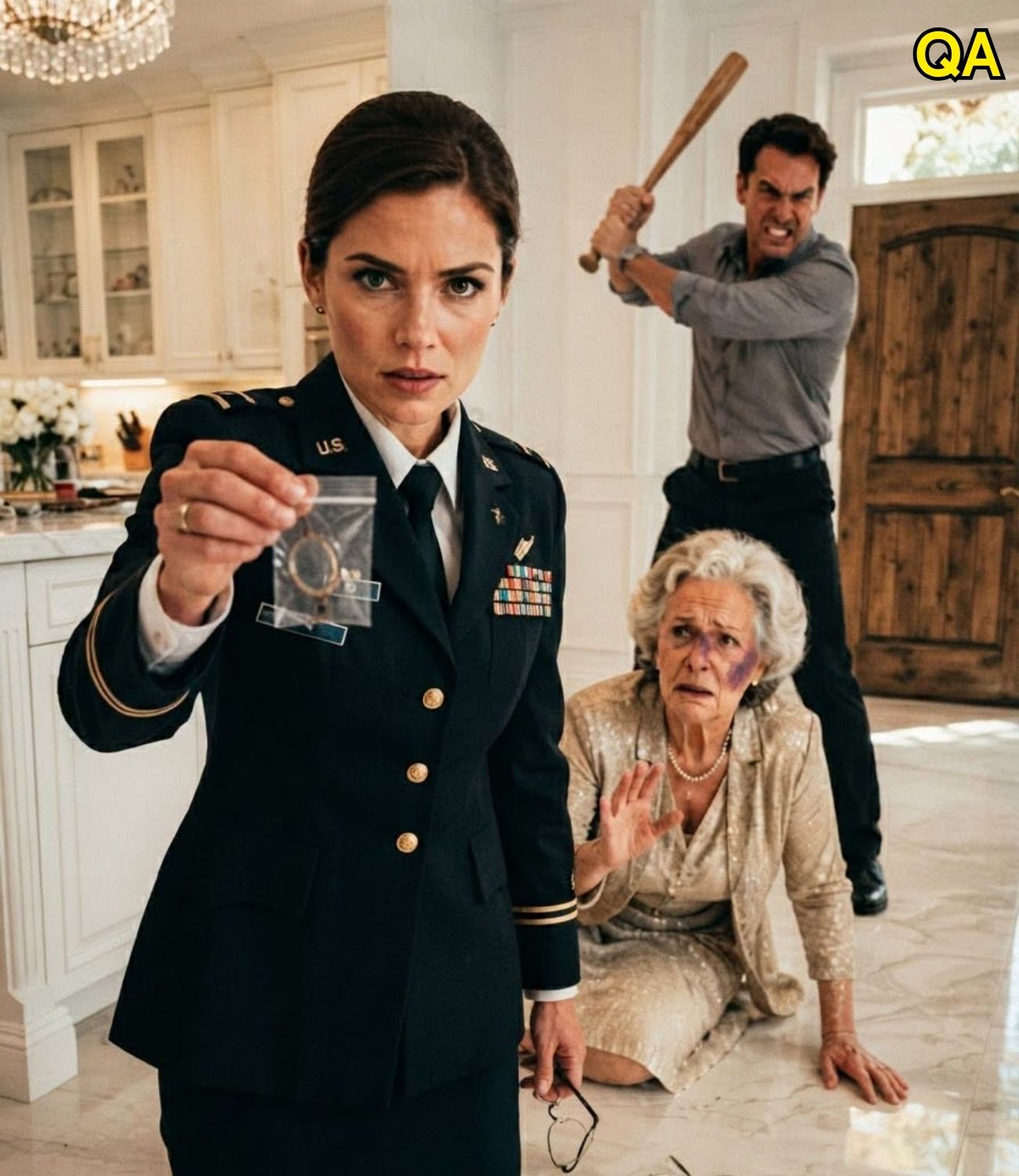
The evidence bag sat between us like a third person in the room: a gold rim and a thin sliver of glass—my mother’s missing lens. Ryan had sworn he had never been inside her house, yet there he was, standing on the one piece of proof that could destroy him. I had spent fifteen years loving that man, but in one silent minute, everything I thought I knew about him began to crack.
The fluorescent lights hummed above me, while stale coffee and floor wax hung in the air. I steadied my breathing the way I had been trained to do in every interrogation room I had ever entered.
“Sergeant Christopher,” I said, “I need the dispatch report. Exact timestamps.” “Yes, Lieutenant Colonel,” he replied. “I also need photographs of my husband’s injuries.”
He nodded. “This way.”
I glanced back at my mother before leaving. She sat with her good hand pressed over the ice pack, her eyes closed. She looked smaller than I had ever seen her—seventy-one years old, and the man I married had broken her ribs with a baseball bat.
Christopher spread the photographs across the table. Ryan’s forearm showed a faint red mark, the kind of mark you get from brushing against a doorframe, with no swelling, no bruising, and no defensive wounds.
“The medic documented your mother’s injuries,” he said quietly. “Fractured right shoulder. Two cracked ribs. Extensive contusions consistent with blunt force trauma.”
I closed my eyes for one long moment, and when I opened them, I was calm again.
“You said he called at 10:14.” “Yes.” “Who made the first call?”
Christopher hesitated. “The neighbor.”
I looked up. “The neighbor called before my husband?”
“Yes. At 10:02.”
Twelve minutes before Ryan called. Twelve minutes he spent doing something. Thinking. Planning.
“Did the responding officers take body camera footage?” “Yes.”
I watched the footage on the evidence room monitor. The first officer arrived at 10:20. Ryan was standing on the lawn, calm—too calm—and waved the officer over before the car had fully stopped. His voice on the recording was steady: “I’m the one who called. My mother-in-law attacked me. She’s inside.” No panic, no shaking—just a man who had rehearsed his lines. Then the second officer went inside and found my mother on the floor with blood on her blouse and glass everywhere. She was still conscious. She looked up at the officer and said, “My son-in-law hit me with a bat.”
The officer’s camera caught Ryan’s face at that exact moment. His mask slipped, just for an instant, as he looked at the house like he wanted to burn it down.
“Where is he now?” I asked. “The lobby.”
Chapter 2: The Interrogation of a Husband
I walked toward the lobby with the stillness I had spent my career perfecting. My boots echoed against the linoleum like a heartbeat. Ryan stood near the vending machine, and when he saw me, his face rearranged itself into the mask of a worried husband.
“Kelsey.”
I stopped three feet away.
“I was so scared,” he said. “I thought something might happen to you on the drive over.” “Did you?”
He flinched, recognizing that tone. He had heard me use it on suspects during my work; he just never expected to hear it directed at him.
“What does that mean?” “It means I read your statement.”
His jaw tightened. “I can explain—”
“You never went inside my mother’s house?” He paused—a tiny pause, but I had spent sixteen years catching pauses. “No. I told you. She attacked me on the porch.” “My mother doesn’t have a porch.”
His mouth opened and closed.
“She has a concrete step,” I said. “Two feet wide. No railing. No room for a seventy-one-year-old woman to swing a fireplace poker.” “Kelsey—” “You claimed she used a poker.”
He said nothing.
“My mother’s house is all electric. There is no fireplace. There has never been a fireplace. My father installed baseboard heating in 1987 because he was afraid of chimney fires.”
Ryan stared at me as the mask cracked, just slightly.
“I must have been confused.” “Confused?” “The adrenaline. Everything happened so fast.” “Mm.”
I took a step closer. “Where is the baseball bat, Ryan?”
He blinked. “What?”
“Your statement never mentions a bat. You told police she attacked you. You never mentioned her weapon.” “I—” “So where does a bat fit into this?”
His face lost its color.
“The neighbor heard glass breaking. Police found the shattered glasses inside the house. Not on the step. Inside.”
He swallowed hard.
“Ryan,” I said softly. “I have been interviewing liars for sixteen years. You are not going to be the one who changes my record.”
His eyes changed. For one second, I saw something I had never seen in fifteen years of marriage: fear—not fear of being caught, but fear of losing something.
“Kelsey, please,” he whispered. “You need to hear me out.” “I’m listening.” “Not here.” “Then where?”
He glanced around the lobby. “Give me one night. Let me explain everything. I’ll tell you the whole truth.”
The whole truth. That was an interesting phrase. It implied there had been partial truths, and partial truths were the most dangerous kind.
Chapter 3: The Desk in the Study
I returned to my mother in the small examination room. Her shoulder was wrapped, her ribs were taped, and the shattered glasses lay in a paper bag on the table.
“I didn’t sign anything,” she said. “Good.” “You found out something.”
It was not a question. I sat down beside her and took her hand.
“Mom. Has Ryan been to the house before tonight?”
She looked away. “He came twice last week.”
The words hit me like cold water. “Twice?”
“Tuesday and Thursday.” “You didn’t tell me.” “He made me promise not to.” “Why?” “He said he was planning a surprise for your birthday. He asked me to help him hide boxes in your father’s old study.”
My whole body went still. “He asked to use the study?”
“Yes.” “And you let him?” “He brought a locksmith.”
I stared at her. “He brought a locksmith to my father’s study?”
“He said he needed to copy a key for a storage unit.” “Whose lock?”
She hesitated. “Your father’s desk.”
The floor shifted beneath my feet. “Did you see him open the desk?”
“No. He asked me to stay in the kitchen. He said it would ruin the surprise.” “Did he take anything?”
Her face crumpled. “I don’t know. I checked the desk after he left. Everything looked the same.”
“Then why do you look scared?”
She reached into her purse with shaking hands and pulled out an old, faded photograph, bent at the corners. My father stood beside another man, shaking hands outside a building that no longer existed. I knew the other man’s face; I had seen it in Ryan’s childhood photos. Ryan’s father.
“Where did you find this?” “Under the drawer liner in your father’s desk.”
I turned it over. On the back, in my father’s handwriting, it read: “Douglas Vance. September 1989.” Douglas—Ryan’s father.
“You never told me they knew each other,” I said. “I thought it was over.” “Over?”
My mother looked at me with tired eyes. “Your father and Douglas were business partners. They started a company in the late eighties. Import and export. Very successful.”
I had never heard any of this.
“When you started dating Ryan, I wanted to tell you. Your father said no.” “Why?” “Because he was afraid.” “Afraid of what?” “Afraid of what it would do to you. Afraid of what Ryan’s family might do if they knew you had found out.”
I forced myself to breathe. “Mom. What happened?”
She took a long, slow breath. “A year before your father died, he discovered money was missing from the business.”
“How much?” “Nearly two million dollars.”
The number landed in my chest like a stone.
“He confronted Douglas. Douglas denied everything. Your father hired an accountant and found a trail of forged documents.” “Forged documents?” “Paperwork that made it look like your father took the money.” “He was setting him up.” “Yes. The night before your father planned to go to the authorities, he received a phone call.” “From who?” “I never knew. He never told me. But after that call, he said he wasn’t going to report it.” “Why?” “Because the voice on the phone told him that if he did, he would never see you grow up.”
My blood turned cold. “He was threatened. Ryan’s father threatened him.”
My mother began to cry. “Your father died three days later. The doctors called it a heart attack.”
“He had no history of heart problems.” “I know.”
I reached for her hand. “Mom, why didn’t you ever tell me?”
“Because he made me promise. He said the less I knew, the safer I would be.” “Until when?”
She shook her head. “I don’t know.”
“Mom. Ryan didn’t come to your house tonight to talk about our marriage.”
Her eyes widened. “He came to find something.”
“What?”
I stood up. “I need to see the study.”
Chapter 4: The False Bottom
Sergeant Christopher drove us to my mother’s house as the sun was rising, pale gray light leaking over the roof of the old house like a slow wound. The living room still held the smell of blood and fear, with dried stains marking the floor near the kitchen and the baseball bat missing.
I walked past the kitchen and stopped in front of my father’s study door. The lock had not been picked; it had been replaced with fresh screws and scratches around the keyhole. Someone had been here before us, wanting to make sure whatever was inside stayed hidden.
I kneeled and studied the desk. The wood was too smooth in one corner, so I pressed. The bottom panel gave way to a false bottom. My breath caught as I lifted the panel. Inside lay a single envelope, yellowed with age, with my father’s handwriting stretched across the front: “Kelsey.”
My hands shook as I opened it to a single sheet of paper:
“Kelsey,
If you are reading this, it means Ryan has come back. That means I failed to protect you. I am sorry. I did not die of a heart condition. The documents that prove this are in vault number 407 at the Bank of Columbia, under your grandmother’s maiden name. She knows what to do.
Do not trust the police. Do not trust Ryan. Get the box. Take it to the FBI field office in Baltimore. Ask for Agent Marcus Webb. He is the only one who knows the whole truth.
Your father.”
I stood in the gray morning light, holding a letter written twenty years ago. He knew Ryan would come back—he knew before I ever met the man I married. That meant Ryan’s father had told him about me, about my family, and about the money. I had been a target from the very beginning; the man who held my hand at the altar was hunting something my father had hidden.
My phone rang. I looked at the screen. Ryan.
I answered. “Kelsey,” his voice was raw. “I know where you are.”
“You’re at the house.” “No.”
Then I heard a sound I knew intimately: the creak of my father’s study door. A floorboard behind me groaned, and I turned around to find Ryan standing in the doorway, holding a baseball bat.
