
Part One: The Cry Behind the Painting
The first sound Isabella Ramos heard behind the ballroom music was not loud enough to be called a scream. That was what made it terrifying. Screams belong to panic, to sudden pain, to someone who still believes the world might rush in and help. This sound was smaller. Weaker. A broken, trembling cry swallowed by stone walls and old pipes, the kind of cry that comes from a child who has already learned nobody is coming.
Isabella stood frozen in the service hallway of Blackstone House, wearing a blue-and-white housekeeping uniform, yellow rubber gloves, and an expression she had trained for years to keep invisible. Behind her, New York’s elite laughed beneath chandeliers bright enough to make diamonds look modest. In front of her, a narrow corridor stretched toward the kitchen, lined with brick, antique portraits, and a large oil painting that had always looked too grand for a hallway used by staff carrying dirty glasses and silver trays.
The cry came again. Isabella’s fingers tightened around the tray of empty champagne flutes until the glass stems clicked together. A child. She knew that sound because she knew the child who made it. Ten-year-old Oliver Blackstone had been missing from the house for five days.
Missing, according to Vivienne Blackstone, was not the correct word. “Visiting relatives in Vermont,” she had smoothly told the staff. But Isabella knew Oliver. She knew his voice, and she knew the sound was coming from directly behind the heavy hunting painting on the wall.
Isabella placed both gloved hands on the frame and pushed.
With a faint metallic click, the painting shifted inward like a door. Cold air breathed through the gap into the narrow, dark opening.
“Oliver?” she whispered.
Curled against the far wall was a boy wearing wrinkled pajama pants and a sweater too thin for the cold. His face was streaked with dried tears, his lips cracked. A plastic water bottle lay empty near his hand. His blue eyes widened when the light touched him.
“Miss Bella?” he breathed.
The name nearly broke her. She stepped inside and crouched beside him. “What happened?”
He tried to stand and failed. “She said Dad wouldn’t believe me,” he whispered, his eyes moving toward the hidden door. Vivienne.
Footsteps clicked at the far end of the corridor—sharp, measured, and approaching fast. Oliver froze, gripping Isabella’s arm in terror.
“I’m coming back,” she whispered, her voice a fierce vow. “I promise.”
She slipped out, pulled the painting back into place, and grabbed the tray just as Vivienne Blackstone appeared around the corner. Vivienne was thirty-three, flawlessly dressed in an ivory satin gown, her blond hair pinned back. But away from cameras, her sweetness fell from her face like a veil.
“Is everything all right, Isabella?” she asked, her voice a warning.
“Yes, Mrs. Blackstone. I was straightening the frame. It looked uneven.”
Vivienne leaned closer, her perfume sharp. “Make sure everything in this house stays perfect tonight. We wouldn’t want anyone discovering things that aren’t meant to be seen.”
The message was calm and unmistakable. Isabella stood motionless until the sound of heels disappeared. She could not call security because Vivienne controlled the household team tonight. She could not text Julian, who was surrounded by guests and advisors. There was only one place Vivienne could not control the story: the ballroom.
Isabella removed her yellow gloves, picked up an unused microphone from the service podium, and walked toward the chandeliers.
Part Two: The New Mrs. Blackstone
Before Vivienne arrived, Blackstone House had been sad, but honest about its sadness. Julian Blackstone, billionaire real estate magnate, had grown dangerously absent in the fog of grief after his first wife, Elena, died of a sudden aneurysm. Vivienne had arrived eighteen months later like a silk curtain drawn over a room still smelling of smoke: beautiful, elegant, and determined to make everyone stop looking backward.
Vivienne changed everything in thirty days—removing Elena’s photographs, dismissing Oliver’s nanny, and restricting his access to food and family. Julian, busy and grieving, had placed the emotional care of his home into Vivienne’s hands because her confidence felt like relief.
Now, six hundred guests filled the ballroom for The Blackstone Renewal Benefit, raising funds for children who had lost parents—an irony so sharp Isabella could barely look at the banners.
Isabella reached the edge of the ballroom, lifted the microphone, and spoke into the system. The microphone crackled.
“May I have everyone’s attention, please?”
Conversations stopped in uneven ripples. Six hundred faces turned toward the housekeeper standing between the dessert table and the side doors.
“I apologize for interrupting,” Isabella said, her voice steadying. “But there is a child in this house who needs help.”
Vivienne moved toward her, her tone too bright. “Isabella, this is not the time.”
Isabella did not look at her. She looked at Julian. “Mr. Blackstone, your son is not in Vermont. He is here. He has been here for days. Behind the large hunting painting in the service corridor, in a hidden space behind the wall. He is frightened, hungry, and asking for you.”
The room erupted into shock and horror. Vivienne’s face twisted. “She is lying! She is unstable! Julian, tell them!”
Julian did not move, his expression sharpening. “If she is lying, we will know in one minute.”
Julian crossed the ballroom, leading Isabella through the side doors as reporters and guests followed. Vivienne chased them, screaming.
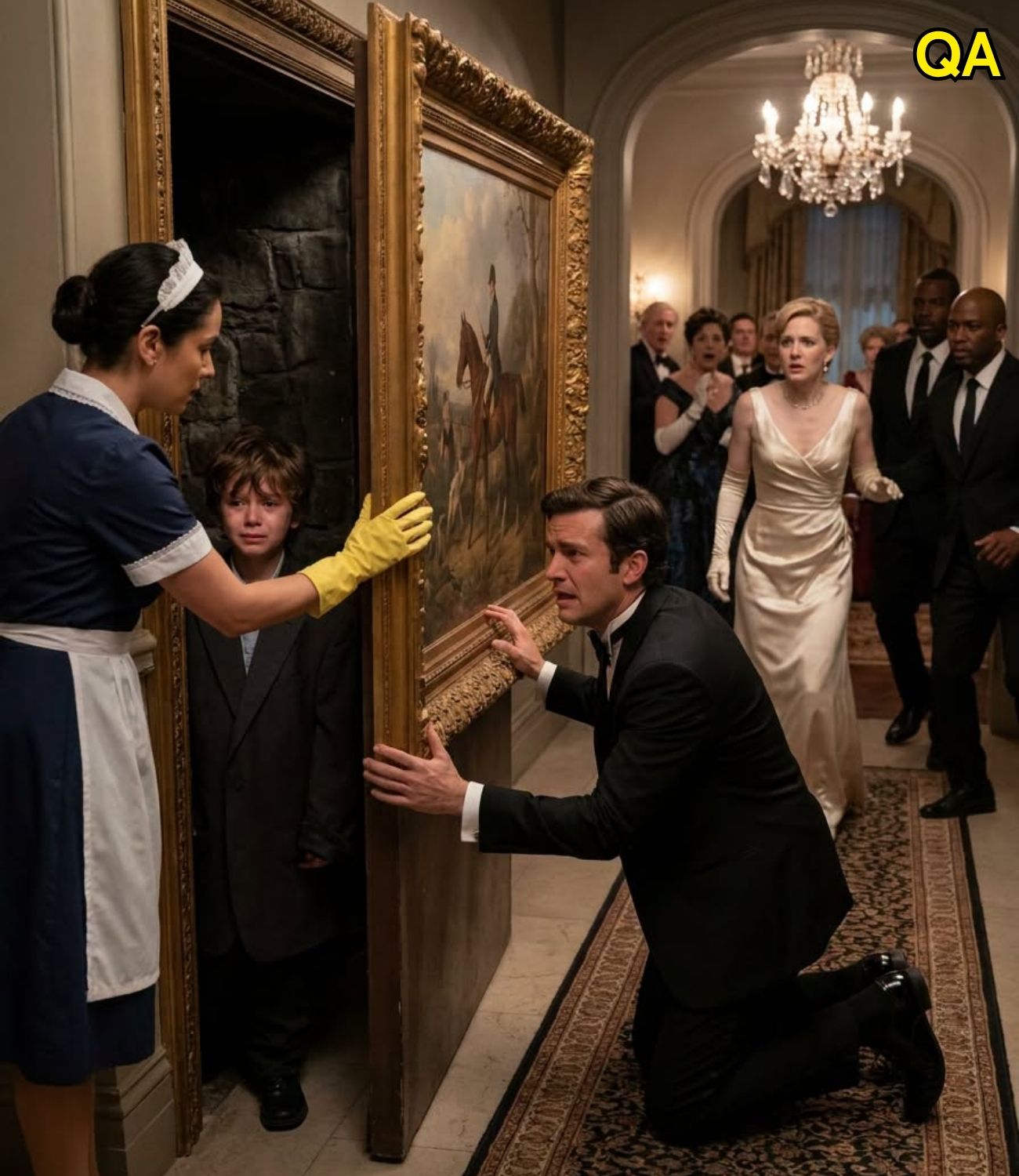
Isabella reached the painting and pushed. The hidden door opened, spilling cold air and light into the hallway. Oliver was curled against the wall, blinking at the brightness.
Julian made a broken sound. “Oliver.”
The boy lifted his head. “Dad?”
Julian dropped to his knees, crawling into the narrow space to gather his son into his arms. Oliver clung to him fiercely. “She said you didn’t want me upstairs.”
Julian’s eyes closed, shaking openly as cameras captured the moment. “No. Never. Never.”
Behind them, security caught Vivienne as she tried to run.
Part Three: What the Wall Was Hiding
The police, paramedics, and child protective specialists arrived quickly. Oliver was taken to the hospital with Julian beside him, holding Isabella’s hand until she promised to stay nearby. Vivienne was escorted away, screaming that she had been set up.
Inside the hidden chamber—once part of the mansion’s original wine storage—investigators found blankets, a flashlight, empty water bottles, and a locked metal case hidden behind a loose brick.
That case contained Vivienne’s true secret. Not only had she hidden Oliver; she had built a trap. Investigators found forged psychiatric evaluations describing Oliver as unstable, emails to a Swiss boarding facility for behavioral transition, and trust documents designed to shift Oliver’s inheritance under Vivienne’s control. Messages between Vivienne and her brother revealed a calculated plan: by hiding the boy for days, they intended to make him appear disoriented and unstable at the gala, using him as proof to lock away his inheritance.
Julian did not leave Oliver’s hospital room for three days. When Oliver asked if he had ruined the party, Julian knelt beside the bed.
“No. You did not ruin anything… I was tired because I was sad and because I worked too much. That was not your fault. None of this was your fault.”
The days that followed exposed how Vivienne had systematically isolated the boy, while trusted staff had stayed silent out of fear. Vivienne’s public image collapsed entirely as she faced charges of unlawful imprisonment, child endangerment, fraud, and conspiracy.
Refusing to return to the mansion, Julian and Oliver temporarily moved to Elena’s old lake cottage in the Hudson Valley. Julian asked Isabella to continue working with the family as household director and Oliver’s trusted caregiver—on one strict condition: that truth and transparency would always protect the home.
Part Four: The Trial of the Perfect Wife
Vivienne’s trial lasted months. Her attorneys attempted to argue that Oliver had hidden voluntarily and that Isabella had exaggerated the situation. But overwhelming evidence—including timestamped security records, forged trust documents, and the hidden case files—shattered their defense.
The verdict named what had been done: Vivienne was convicted on multiple felony counts of unlawful imprisonment, child endangerment, and conspiracy to commit financial fraud. Her brother accepted a plea agreement, and Julian pursued civil cases to dismantle the professional networks Vivienne had used to target grieving families.
At the lake cottage, Oliver healed slowly. He still woke from nightmares and hid snacks in his robe pockets, but Julian’s patient repetition—answering his fears with absolute reassurance—became a steady anchor.
One afternoon in the garden, Oliver looked up at his father.
“If Mom was here, would she be mad at me… for not being brave sooner?”
Julian dropped his gardening tools, knelt in the dirt, and took his son’s hands. “Your mother would never be mad at you for crying. Neither am I. Crying helped Miss Bella find you.”
Oliver smiled faintly, looking toward the cottage where Isabella was bringing out fresh lemonade, finally safe in a home built on truth rather than silence.
