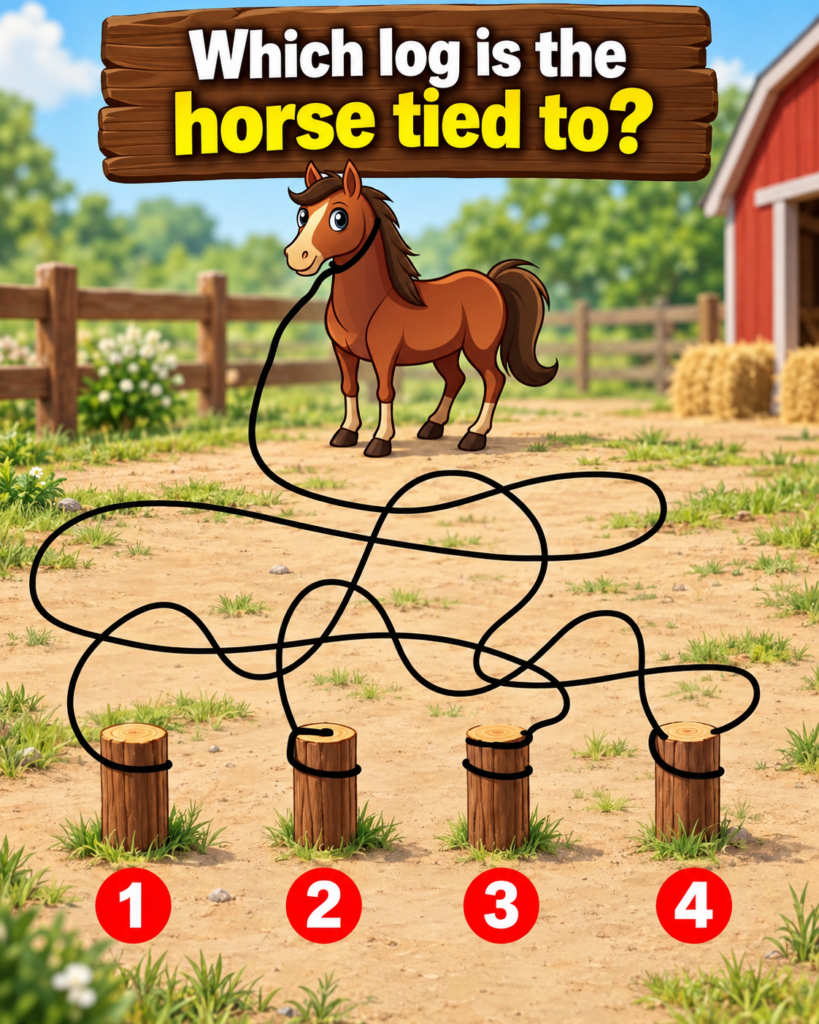

Can You Solve This Tricky Horse Rope Puzzle? Find the Correct Log Number
Hello, puzzle friends! Are you ready to challenge your observation skills and put your logical thinking to the test? Today’s visual puzzle looks simple at first, but it requires patience, concentration, and careful attention to detail.
This horse rope puzzle is an entertaining brain exercise for children and adults. The objective is straightforward: follow a long, tangled rope and determine which of four wooden logs is connected to the horse’s halter. Although the answer may seem obvious at first glance, the complicated arrangement of loops and crossings makes this challenge more difficult than expected.
Before looking at the solution, take a moment to examine the illustration and see whether you can identify the correct connection independently.

Understanding the Horse Rope Puzzle
The illustration contains several important elements that provide the information needed to solve the challenge. Understanding how these elements relate to one another is the first step toward finding the correct answer.
At the top of the image, you can see a friendly-looking horse wearing a halter. A halter is a piece of equipment commonly used to guide and handle horses. It fits around the animal’s head and provides an attachment point for a lead rope.
In this puzzle, a long black rope is attached to the horse’s halter. Instead of following a simple, straight path, the rope extends downward and forms numerous loops, curves, and overlapping sections.
The rope’s complicated appearance is the main source of difficulty. It moves in different directions, creating a visual pattern that can make it challenging to determine which section connects to the horse and which section leads toward the ground.
At the bottom of the illustration, four wooden logs are positioned in the ground. Each log is identified by a number displayed inside a red circle:
- Log 1: The first possible connection point.
- Log 2: The second possible connection point.
- Log 3: The third possible connection point.
- Log 4: The fourth possible connection point.
One end of the rope is attached to the horse, while the other end forms a loop around one of these four logs. Your task is to identify the correct log by following the rope’s actual path.
Why Is This Rope Puzzle Difficult?
At first, the challenge may appear to be a straightforward visual matching exercise. However, the rope contains several twists and overlapping sections that make it easy to lose track of its direction.
When multiple lines cross or run close together, the human visual system can sometimes interpret their arrangement incorrectly. A person may follow one section of the rope and accidentally switch to another nearby section, leading to the wrong conclusion.
This is why simply looking at the general shape of the rope is not enough. The solution depends on identifying the continuous path from the horse’s halter to the final loop around a wooden log.
There are several common reasons why people might find this puzzle challenging:
- Overlapping lines: Some sections of the rope appear close together, making it difficult to distinguish their individual paths.
- Multiple curves: The rope changes direction repeatedly, requiring the viewer to maintain visual attention.
- Similar-looking sections: Several loops may appear connected even when they belong to different parts of the rope’s path.
- Premature conclusions: People sometimes select a log before tracing the entire rope.
- Visual distractions: The overall tangled pattern can draw attention away from the specific connection that matters.
The most reliable approach is to ignore the apparent complexity of the entire illustration and concentrate on following one continuous line.
How to Solve the Horse Rope Brain Teaser
You do not need specialist knowledge or complicated calculations to solve this challenge. A systematic approach is enough. The following steps can help you examine the illustration carefully and avoid common mistakes.
Step 1: Begin at the Horse’s Halter
Start by locating the point where the black rope attaches to the horse’s halter. This is your starting position.
Rather than immediately looking at the four numbered logs, concentrate on the rope near the horse’s head. Identify the direction in which the rope begins and follow its visible outline.
Starting at a known endpoint is useful because it reduces the possibility of confusing the rope with another nearby section.
Step 2: Follow the Rope Slowly
Move your eyes along the rope, following every curve and change in direction. If you are viewing the puzzle on a phone, tablet, or computer, you can use your finger or a cursor to help maintain your position.
Pay particular attention to the sections where the rope bends back toward itself. These areas can make it difficult to remember which direction you were following.
Do not skip any section simply because it looks familiar. Even a small mistake can change the final answer.
Step 3: Examine Every Crossing Point
The crossing points are among the most important parts of the puzzle. When two sections of a rope overlap visually, it is easy to assume that they connect.
However, two lines appearing close together do not necessarily mean they belong to the same continuous path. Examine the direction of each visible section and determine which one continues the route you are following.
Maintaining a consistent direction is essential. If you begin at the horse, continue following the same rope rather than switching to another section when the lines become confusing.
Step 4: Compare the Four Wooden Logs
Once you have followed the rope through its complicated arrangement, turn your attention to the four possible endpoints.
Examine the area around each numbered log and look for the loop formed by the end of the rope. The correct option is the log connected to the continuous path originating at the horse’s halter.
Remember that the goal is not to identify the log that looks closest to the horse. It is to establish the actual connection by tracing the rope.
Step 5: Check Your Answer
Before making your final selection, retrace the route once more. Start at the horse’s halter and follow the rope all the way to the endpoint.
You can also approach the puzzle from the opposite direction. Begin at each wooden log and attempt to follow its connected rope section upward. Comparing the paths can help confirm your original conclusion.
This second method is particularly useful when the central part of the rope looks confusing. Checking your answer from both directions can reduce the chance of making an accidental visual mistake.
What Skills Does This Visual Puzzle Exercise?
Visual puzzles are popular because they provide an accessible way to practise observation and logical reasoning. Although solving one puzzle does not establish a measurable improvement in intelligence, these activities can encourage people to pay closer attention to visual information and approach problems systematically.
The horse rope challenge involves several useful thinking skills.
1. Visual Attention
Visual attention is the ability to concentrate on relevant information while filtering out distractions. In this puzzle, the many loops and curves compete for your attention.
To identify the correct endpoint, you must focus on one section of the rope at a time. This encourages a more deliberate approach to examining complicated images.
2. Logical Reasoning
Logical reasoning involves using available information to reach a conclusion. The puzzle provides four possible answers, but only one satisfies the requirement of following the continuous rope from the horse.
Instead of choosing randomly, you can eliminate incorrect possibilities by checking the actual connections.
3. Problem-Solving Strategies
Successful problem-solving often involves breaking a large challenge into smaller, manageable steps.
Rather than trying to understand the entire tangled arrangement at once, you can begin at the horse, follow one section, examine each crossing, and gradually work toward the endpoint.
This approach is useful beyond recreational puzzles. Similar step-by-step methods can help people organize information and investigate everyday problems.
4. Patience and Concentration
Some visual challenges cannot be solved accurately through a quick glance. They require sustained attention and a willingness to check details that might initially seem unimportant.
Taking your time is therefore an important part of the activity. The objective is not to finish before everyone else but to reach the correct conclusion through careful observation.
5. Spatial Awareness
Spatial awareness helps people understand how objects and visual elements relate to one another. In this challenge, you must interpret the rope’s direction as it moves through a crowded arrangement of loops and bends.
Following the rope encourages you to consider how different sections are positioned and how their paths relate to the four possible attachment points.
Is This Horse Rope Puzzle Suitable for Children and Adults?
Yes. This type of visual brain teaser can be enjoyed by people of different ages, making it a convenient activity for families, classrooms, and casual puzzle groups.
For younger children, the challenge can introduce basic ideas about observation, direction, and following a sequence. Parents and teachers can encourage children to explain how they reached their answers instead of simply announcing the correct number.
For adults, the puzzle offers a short mental activity that can be completed during a break or shared with friends. It can also provide an opportunity for friendly discussion about different ways of approaching the same visual problem.
One useful variation is to let each participant trace the rope independently before comparing answers. This allows everyone to develop their own strategy and explain which sections they found most confusing.
Common Mistakes to Avoid When Solving Rope Puzzles
Even relatively simple visual puzzles can produce incorrect answers when people rely on assumptions rather than carefully checking the available information.
Here are some mistakes worth avoiding:
- Guessing too quickly: Do not select a number based on the apparent direction of the rope near the bottom.
- Ignoring small curves: A short bend may determine which section continues toward the endpoint.
- Switching between lines: Keep following the same continuous rope instead of jumping to a nearby section.
- Overlooking the starting point: Always establish where the rope attaches to the horse before tracing its path.
- Failing to verify the result: Retrace the route before settling on your final answer.
These simple precautions make the challenge easier to approach and help ensure that your conclusion is based on the actual rope arrangement.
Final Answer: Which Log Is Connected to the Horse?
Have you followed the entire rope from the horse’s halter to its endpoint? If you carefully examined the loops, curves, and overlapping sections, you should now have enough information to identify the correct wooden log.
The correct answer is number 3.
Why Is Number 3 Correct?
The rope’s continuous path leads to the loop attached to the third wooden log. Although the tangled arrangement makes the connection difficult to recognize at first, carefully tracing the line reveals the correct endpoint.
This is the key lesson of the puzzle: visual complexity does not necessarily mean that a problem is difficult to solve. By breaking the image into smaller sections and following the evidence systematically, you can reach the correct answer without relying on guesswork.
Congratulations if you identified log number 3 without looking at the solution! If you selected another number, do not worry. The overlapping rope sections are specifically what make this visual challenge interesting.
Challenge Your Friends with This Horse Rope Brain Teaser
Now that you know the answer, why not share the puzzle with your family members, friends, or colleagues? Ask them to identify the correct log without revealing the solution immediately.
You can make the activity more engaging by asking everyone to explain how they traced the rope. Some people may prefer starting at the horse, while others may find it easier to examine the numbered logs first.
There is no need to rush. Give everyone enough time to inspect the image and make an independent decision.
Did you find the correct answer on your first attempt? Share your result and challenge someone else to solve this entertaining visual puzzle!
Sources
This article describes an original recreational visual puzzle. The correct answer is based on the supplied illustration. The puzzle instructions and solution do not require external factual claims or specialist research.
- Encyclopaedia Britannica – General reference information and educational resources.
- American Psychological Association – Research and educational information about attention, cognition, and psychological processes.
- National Geographic – Educational resources about animals and the natural world.
Disclaimer: This content is intended for entertainment purposes only and is not based on real events.