
A Promise of Love: How One Family Gave a Grieving Little Girl a New Home
Family is often described as a bond created by blood, shared history, and lifelong relationships. However, some of the most meaningful family connections develop through compassion, patience, and a willingness to stand beside someone during the most difficult moments of life. For one young girl named Emma, the loss of nearly everyone she loved left her feeling frightened, alone, and uncertain about her future. What began as an unexpected encounter on a cold afternoon eventually became a life-changing journey toward stability, belonging, and a loving home.
Emma’s story highlights the importance of childhood security, emotional support, and the role that adoption can play in providing children with opportunities to build new relationships after experiencing significant loss. It also demonstrates why helping a grieving child requires more than providing food and shelter. Patience, consistency, and respect for a child’s individual emotional needs are equally important.
An Unexpected Encounter on a Cold Afternoon
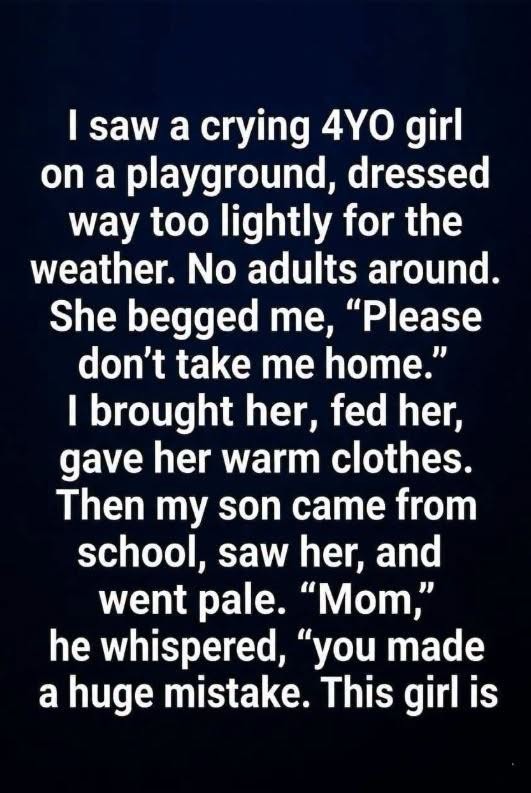
It was a cold afternoon when I noticed a young girl sitting alone on a playground swing. The weather was freezing, yet she appeared to be wearing clothing that offered little protection against the cold. Her shoulders were hunched, and tears quietly ran down her face.
Concerned about her well-being, I approached her carefully and asked whether she was all right. Rather than answering directly, the little girl grabbed my sleeve and pleaded with me not to take her home.
Her reaction immediately suggested that something more serious might be happening in her life. She appeared frightened and uncertain, and it was clear that she needed immediate attention and reassurance.
I decided to bring her somewhere warm and safe while trying to understand her circumstances. At my house, I provided her with warm clothes, a comfortable blanket, and something to eat. She finished the food remarkably quickly, making me wonder how long she might have gone without a proper meal.
Although I did not yet know her name or understand the circumstances that had brought her to the playground, I knew that her immediate needs deserved attention. A child who is cold, hungry, and visibly distressed should never have to face those difficulties without appropriate support.
Discovering Emma’s Difficult Family History
When my son returned home, he immediately recognized the little girl. Her name was Emma, and she was the granddaughter of Mrs. Rose, a beloved teacher known to our community.
My son explained that Emma had already experienced devastating changes in her young life. Her parents had died in an accident, leaving her grandmother to take responsibility for raising her.
Mrs. Rose had become the most important person in Emma’s world. After losing her parents, her grandmother represented familiarity, protection, and the sense of security every child needs. She was not simply a caregiver; she was the person who had helped Emma navigate life after an earlier family tragedy.
Unfortunately, Mrs. Rose had also passed away. With her grandmother gone, Emma had lost the only close family connection she could remember.
Following this second major loss, Emma was placed in an orphanage where adults could provide supervision and basic care. However, adjusting to her new circumstances proved extremely difficult. She repeatedly ran away, apparently hoping to find her grandmother and return to the familiar life she had known.
Her behavior was deeply concerning, but it also revealed how difficult it can be for children to understand and accept permanent separation from loved ones. For Emma, the orphanage was an unfamiliar environment, while her grandmother’s absence represented a loss she was not emotionally prepared to process.
Understanding the Emotional Needs of Children Experiencing Loss
Children who experience the death of parents, grandparents, or other important caregivers may respond to grief in many different ways. Some become withdrawn, while others display anxiety, anger, changes in behavior, or difficulty trusting new adults.
Grief during childhood can be particularly complicated because children are still developing their understanding of relationships, permanence, and emotional security. Their reactions may also change as they grow older and begin to understand their experiences differently.
For children like Emma, establishing a predictable environment can be an important part of rebuilding a sense of safety. Consistent caregiving, supportive relationships, and opportunities to express emotions without judgment can help children gradually adjust to major life changes.
It is also important to recognize that emotional recovery does not follow a fixed schedule. A child may appear comfortable one day and become distressed the next. This does not necessarily mean that progress has been lost. It may simply reflect the complicated nature of grief and adjustment.
Professional guidance from child psychologists, grief counselors, and trained social workers can also help caregivers understand a child’s needs. Every child’s circumstances are different, so support should be adapted to their age, experiences, and emotional development.
A Difficult Decision and a Promise to Return
Although I wanted to keep Emma with me, I understood that the situation required more than an emotional decision. She was already under the care of an established institution, and any permanent change in her living arrangements needed to follow the appropriate legal and child-welfare procedures.
Returning her to the orphanage was one of the hardest decisions I had faced. Emma had already experienced so much uncertainty, and I worried that another separation might make her feel abandoned again.
Before she left, I made her a promise: I would come back.
It was a simple statement, but I understood how important it could become. Children who have experienced repeated losses may find it difficult to believe that adults will remain present in their lives. For that reason, promises should be made carefully and followed through consistently.
I wanted Emma to know that the kindness she had experienced that afternoon was not temporary. I was determined to explore whether I could provide her with a permanent home and become a dependable adult in her life.
The Adoption Process: Patience, Preparation, and Commitment
Deciding to pursue adoption was only the beginning of a much longer process. Providing a child with a permanent home involves legal requirements and careful assessments designed to protect the child’s welfare.
Over the following months, I began completing the necessary paperwork, participating in home inspections, and addressing the legal requirements involved in the adoption process.
Although the process sometimes felt overwhelming, I understood why these procedures existed. Adoption is a significant lifelong commitment, and authorities must establish that a prospective home can provide a safe, stable, and supportive environment.
Home assessments and related evaluations can consider several aspects of family life, including living arrangements, financial stability, caregiving capacity, and the emotional readiness of prospective adoptive parents. Requirements differ depending on local laws and the circumstances of the child.
For children who have experienced significant bereavement, the transition into an adoptive family may also require additional emotional preparation. Caregivers need to understand that adoption does not erase a child’s previous experiences or replace the people they have lost.
Instead, adoption can create an opportunity for a child to develop new relationships while maintaining a meaningful connection to their personal history.
There were moments when the paperwork and waiting seemed endless, but I continued because I believed Emma deserved the opportunity to grow up in a dependable family environment.
Emma Officially Becomes Part of Our Family
After months of preparation and legal procedures, the long-awaited moment finally arrived. Two months ago, Emma officially became a member of our family through adoption.
For me, the final approval represented the completion of a difficult process and the beginning of an entirely new chapter. What had started with a chance encounter on a playground had developed into a lasting family commitment.
However, I knew that the legal completion of an adoption did not mean that Emma would immediately feel comfortable in her new surroundings. A permanent home provides an important foundation, but emotional trust develops gradually through everyday experiences.
We needed to give her time to become familiar with our household routines, understand that she was safe, and develop relationships at her own pace.
Rather than expecting immediate closeness, I focused on creating an environment where Emma could feel accepted without having to meet anyone else’s expectations.
Building Trust Through Everyday Moments
Today, Emma smiles more often. She sleeps more peacefully and is gradually learning to trust the people around her.
These changes may appear small to someone observing from the outside, but they mean a great deal to our family. They suggest that she is becoming more comfortable with her surroundings and beginning to experience the consistency she needs.
One thing I have never demanded from Emma is that she call me Mom. Although I would naturally welcome that moment if it happened, I understand that the word carries deep emotional meaning.
Her grandmother was an important part of her life, and I do not want Emma to feel that accepting a new family requires forgetting the people she loved before. Her memories and feelings deserve respect.
Instead, I allow our relationship to develop naturally. Whether she chooses to use a particular name for me is less important than knowing that she can approach me when she needs help, comfort, or reassurance.
Building trust involves many ordinary experiences: keeping promises, listening carefully, maintaining predictable routines, and responding calmly when a child feels overwhelmed. These actions communicate that a caregiver is dependable.
For a child who has experienced repeated loss, consistency can become an especially meaningful source of reassurance.
How My Son Became Emma’s Greatest Protector
Another important part of Emma’s adjustment has been the relationship she has developed with my son.
Initially, he questioned my decision to pursue adoption. Bringing another child into the household was a significant change, and he needed time to understand what it would mean for our family.
His initial concerns were understandable. Adoption affects everyone in a household, and existing family members may need time to adjust to new responsibilities, routines, and relationships.
Over time, however, his attitude changed. As he became more familiar with Emma and understood the difficulties she had experienced, he began developing a strong protective bond with her.
Today, he has become one of her greatest supporters. Their growing relationship demonstrates how family connections can develop through shared experiences, everyday kindness, and mutual care.
His transformation has also reinforced an important lesson for me: welcoming a child into a family is not simply about making space in a home. It involves helping every family member understand the transition and allowing relationships to develop naturally.
Why Adoption Is About More Than Providing a Home
Emma’s experience illustrates an important distinction between meeting a child’s immediate physical needs and supporting their long-term emotional development.
Food, clothing, shelter, education, and medical care are essential. However, children also need dependable relationships, encouragement, emotional understanding, and opportunities to develop a positive sense of identity.
Adoptive parents may need to navigate questions about a child’s past, family memories, grief, and personal identity. Approaching these conversations with honesty and sensitivity can help children feel that their experiences are accepted rather than ignored.
It is equally important to avoid comparing one child’s adoption experience with another’s. Some children adjust quickly, while others require more time and professional support. Neither experience should be treated as a measure of how successful an adoption will become.
Families considering adoption can benefit from learning about trauma-informed caregiving, childhood development, and available support services. Guidance from qualified adoption professionals and child-development specialists can help caregivers prepare for both the practical and emotional responsibilities involved.
A New Understanding of What Makes a Family
Before meeting Emma, I understood family primarily through the relationships and responsibilities that develop between relatives. Her journey has expanded that understanding.
Family is not defined exclusively by biological connections. It can also be built through commitment, compassion, and the decision to remain present when someone needs support.
That does not mean a child’s previous family relationships become unimportant. Emma’s parents and grandmother will always be part of her story. Giving her a new home does not erase those relationships or diminish the love she once received from them.
Instead, our responsibility is to help her understand that she can carry her memories while also building new experiences and meaningful connections.
Her journey is still unfolding. There will undoubtedly be more adjustments, questions, and emotional challenges along the way. We do not expect every day to be easy, nor do we believe that love alone can solve every difficulty.
What matters is that Emma now has a home where she is welcomed, protected, and valued. She has people who are committed to supporting her as she grows, and she no longer has to face the future without a dependable family environment.
Conclusion: The Lasting Power of Keeping a Promise
What began as a chance encounter with a frightened little girl on a playground became one of the most meaningful experiences of my life. Emma’s story involved loss, uncertainty, difficult decisions, and months of preparation before adoption could become official.
Today, seeing her smile more frequently and gradually become comfortable in our home reminds me why the journey mattered. Her progress is not measured by whether she calls me Mom or how quickly she adjusts. It is reflected in the growing sense of security she experiences and the relationships she is beginning to build.
Emma has taught our family that love is not simply something people say. It is demonstrated through patience, reliability, understanding, and everyday actions.
Family can be created in many different ways. Sometimes, it begins with a simple act of kindness and grows into a lifelong commitment. For Emma, a promise made on a cold afternoon became the beginning of a new chapter filled with hope, belonging, and the opportunity to feel at home again.
Sources
The story above is based on the supplied personal narrative. The following established organizations provide additional information about childhood bereavement, adoption, child welfare, and the importance of stable caregiving environments.
- Child Welfare Information Gateway – Information about adoption, foster care, and child welfare services.
- UNICEF – Resources on children’s rights, protection, and well-being.
- World Health Organization (WHO) – Information about child development and mental health.
- National Child Traumatic Stress Network – Educational resources on childhood trauma, grief, and supportive caregiving.
- American Academy of Pediatrics – Guidance on children’s emotional development and family health.
- Child Bereavement UK – Support and educational resources for children experiencing bereavement.
Disclaimer: This content is intended for entertainment purposes only and is not based on real events.