
Chapter 1: The Echo of the Ice
A homicide detective’s memory is a cursed filing cabinet. You don’t get to choose which files stay buried and which ones snap open in the middle of the night.
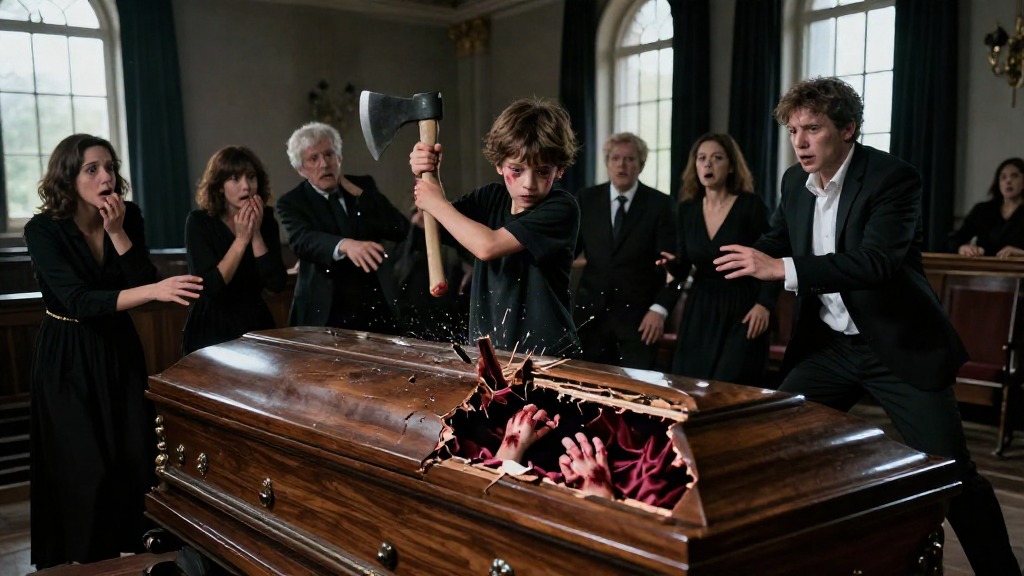
Two years had passed since the morning I ripped my brother out of a mahogany casket in the center aisle of St. Jude’s Cathedral. Two years of intense therapy for Marcus, of quiet vigilance for Leo, and of me trying to convince myself that the nightmare was permanently behind us.
Then I walked into Room 114 of the Starlight Motel on a rainy Tuesday morning, and the heavy, suffocating scent of the past hit me like a physical blow.
The crime scene was a grim, cheap room reeking of stale tobacco and copper. A man in his late forties was slumped against the peeling wallpaper, two bullet holes grouped tightly in his chest—a professional double-tap. My younger partner, Miller, was already bagging evidence on the stained carpet.
“No forced entry, Tommy,” Miller said, looking up as I ducked under the yellow police tape. “Looks like a professional hit. Guy opened the door, caught two in the sternum, and the shooter walked away. We found his wallet on the nightstand. Name is Carl Hektor.”
The name sent a violent, freezing jolt straight down my spine. The styrofoam coffee cup in my hand crumpled slightly under my sudden, involuntary grip.
“Carl Hektor,” I repeated, my voice dropping to a gravelly whisper.
“You know him?” Miller asked, raising an eyebrow.
I knew him. Every night for the past two years, I had seen his name stamped on the official crash report sitting in my desk drawer. Carl Hektor was the driver of the commercial transport truck that had jackknifed on the black ice of Route 9, crushing my brother’s pickup against the concrete barrier and leaving him to freeze to death. It was the accident that put Marcus in the morgue, and eventually, into that box.
At the time, the state troopers had ruled it a tragic, weather-related accident. No charges were filed.
But looking at a professional hit in a seedy motel, the instincts I had honed over two decades began screaming at me. Ordinary, careless truck drivers don’t get executed with military precision.
I stepped past Miller, my heart hammering a dark, frantic rhythm against my ribs. I knelt beside Hektor’s body and inspected the scattered belongings on the cheap dresser. Among the loose change and cigarette packs was a heavy, brass money clip holding a stack of crisp hundred-dollar bills. But it wasn’t the money that caught my eye. It was the logo deeply engraved into the brass.
Oakhaven Lumber Yard.
The exact same lumber yard where my brother had been working the night he was almost killed.
The freezing rain from two years ago had always been blamed for the crash. But as I stared at the brass clip, a terrifying, icy realization washed over me. Marcus’s crash wasn’t an accident caused by black ice.
It was an attempted murder. And whoever ordered it was tying up loose ends.
Chapter 2: The Mahogany Connection
I didn’t wait for the crime scene techs to finish. I drove straight to Marcus’s house, my cruiser’s tires aggressively chewing up the wet suburban asphalt.
Marcus was in the garage, wearing safety goggles and running a piece of raw pine through a table saw. He had quit the Oakhaven yard after his recovery, choosing to start a small, independent custom carpentry business out of his home. He still refused to work with mahogany. The mere smell of that specific dark wood triggered violent, suffocating panic attacks that would leave him gasping on the floor, clawing at his own throat.
He killed the saw as I pulled up the driveway. He took one look at my face and his posture stiffened.
“Where’s Leo?” I asked, slamming the cruiser door shut.
“Inside. Playing video games,” Marcus said, wiping sawdust from his forearms. He studied my eyes. “Tommy, you have your ‘bad news’ face on. What’s going on?”
I didn’t sugarcoat it. I never did. “Carl Hektor is dead. Murdered in a motel room across town this morning. Professional hit.”
Marcus froze. The color drained slightly from his cheeks, leaving him looking uncomfortably close to the man I had pulled from the casket. “The truck driver?”
“Yeah,” I said, stepping into the garage. “Marcus, I found an Oakhaven Lumber Yard money clip on his dresser. I need you to think back to the night of the crash. I know you hate talking about it, but you have to. What exactly were you doing before you drove home?”
Marcus swallowed hard, leaning heavily against his workbench. His eyes darted toward the corners of the garage, a nervous habit he developed whenever his claustrophobia flared up.
“I was running late,” Marcus rasped, his vocal cords still carrying the permanent, gravelly damage from screaming inside the coffin. “The foreman, Silas, asked me to stay behind to audit a late-night import shipment. It was a massive order of raw timber from South America. High-end stuff.”
“What kind of wood?” I pressed.
Marcus closed his eyes, his breathing growing shallow. “Mahogany. Massive, uncut logs of it. But Tommy… the weight was wrong on the manifest. I brought a forklift over to move one of the crates, and it was way too light. I popped the crate open to check for damage. The logs inside… they had been hollowed out. Completely cored from end to end.”
My blood ran cold. “Did you see what was inside?”
“No,” Marcus said, rubbing his chest. “Silas came around the corner before I could look closer. He was furious. He yelled at me to go home, said he’d handle the audit. As I was walking to my truck, I saw Hektor pulling his commercial transport rig into the loading bay. Hektor and Silas were arguing in the rain. I didn’t think anything of it. I just wanted to get home to Leo.”
It all clicked together with terrifying clarity. Oakhaven Lumber was being used as a front for a massive smuggling operation—likely cartel narcotics or illicit weapons hidden inside the hollowed-out mahogany. Marcus had stumbled onto the physical evidence. Silas couldn’t let him leave. He paid Hektor to follow Marcus onto the icy highway and run him into the concrete barrier, making it look like a tragic winter fatality.
“Did you document it?” I asked urgently. “Did you take a picture of the manifest or the hollow logs?”
“Yeah,” Marcus whispered, his eyes snapping open. “I took a picture of the hollow log with my cell phone to show the supplier the defect.”
“Where is that phone, Marcus?”
“I don’t know,” he stammered. “It was in my jacket pocket during the crash.”
My mind raced. The phone had been recovered at the scene two years ago. It was sitting in an unexamined, archived personal-effects box in the precinct’s deep storage. We never pulled the data because we thought it was just a traffic accident.
“Lock the doors,” I ordered, turning back toward my cruiser. “Don’t let anyone inside. I’m going to the precinct to get that phone. As soon as I have the picture, I’m bringing a SWAT team to Oakhaven.”
Chapter 3: The Dark Box
I should have never left them alone. It is the single greatest regret of my career.
By the time I reached the precinct and fought my way through the bureaucratic red tape of the evidence locker, the sun had set, and a heavy, violent thunderstorm had rolled over the city. Thunder rattled the reinforced glass of the police station.
I finally got the battered, cracked phone plugged into a forensic charger. It flickered to life. I opened the camera roll, and there it was—a crystal-clear, timestamped photograph of a massive mahogany log, hollowed out and packed tightly with vacuum-sealed bricks of white powder.
I immediately grabbed my radio to dispatch a raid team. But before I could key the mic, the dispatcher’s voice cracked over the frequency.
“All units, 911 hang-up at 442 Elm Street. Neighbors report hearing breaking glass and suspected gunfire.”
My heart completely stopped. It was Marcus’s address.
Silas must have realized Hektor’s murder would draw police attention to the crash, and by extension, to the only surviving witness. He had sent a cleanup crew.
I threw the phone at Miller, screamed at him to roll the tactical teams, and sprinted out to my cruiser.
Back at Elm Street, the storm had knocked out the neighborhood power grid. Marcus’s house was plunged into absolute, suffocating darkness.
Inside the home, Marcus was living his ultimate nightmare all over again.
When the front window shattered and heavy, booted footsteps echoed in the hallway, Marcus didn’t freeze. He grabbed Leo, his hand clamping tightly over his son’s mouth to keep him quiet, and dragged him toward the basement. But the hitmen had flashlights, their beams cutting through the dark living room, searching systematically.
Marcus knew they couldn’t outrun bullets. He had to hide.
He pulled Leo into the basement utility closet—a tiny, cramped space under the stairs, barely large enough for a water heater. He pulled the heavy wooden door shut, sealing them inside.
It was pitch black. The air was incredibly tight. The walls felt like they were pressing inward, crushing his ribs.
Marcus began to hyperventilate. The agonizing memory of the silk-lined mahogany casket crashed over him like a tidal wave. He could feel the phantom splinters under his fingernails. He could smell the stale, dying oxygen. His throat closed up, a violent panic attack seizing his nervous system. He was going to die in a dark box. Again.
But then, a tiny, warm hand reached out in the pitch black and grabbed his trembling, scarred fingers.
Leo didn’t speak. He simply took his father’s hand, and using his small index finger, he scratched a rhythm against Marcus’s palm.
Two quick scratches. A pause. One loud tap.
I Love You.
The panic inside Marcus instantly shattered. He wasn’t a victim trapped under the earth anymore. He was a father protecting his son. The terror was completely overridden by a primal, burning rage. He refused to let the men who put him in a grave take his son’s life.
Chapter 4: The Swing of the Axe
Upstairs, two armed men moved methodically through the kitchen, their tactical flashlights sweeping the dark corners.
“Check the basement,” a gruff voice commanded.
Heavy footsteps creaked down the wooden stairs. The beam of a flashlight illuminated the concrete floor, sweeping slowly toward the utility closet.
Inside the closet, Marcus let go of Leo’s hand. He reached up in the darkness, his fingers wrapping around the thick, smooth hickory handle of a tool he had mounted on the inside of the closet door frame.
It was the forty-pound, solid steel wood-splitting axe. The exact same axe Leo had dragged down the church aisle. Marcus had kept it, storing it out of sight, a morbid but powerful reminder of the day his son saved his life.
The hitman approached the closet door, raising his suppressed pistol. He reached out, grabbing the doorknob, and yanked it open.
He expected to find a cowering, terrified man.
Instead, the door exploded outward with terrifying, violent force.
Marcus lunged out of the darkness, a feral, guttural roar tearing from his damaged vocal cords. He hoisted the massive steel axe high over his right shoulder, his scarred hands gripping the wood with unbreakable strength.
He didn’t hesitate. He swung the heavy steel blade directly downward, smashing the flat, blunt backside of the axe head squarely into the hitman’s chest. The impact lifted the man entirely off his feet, throwing him backward into the concrete wall with a sickening crunch. His weapon clattered uselessly to the floor.
The second hitman, standing at the top of the stairs, raised his weapon in shock.
But before he could pull the trigger, the front door of the house was kicked entirely off its hinges.
I burst into the foyer, my service weapon raised, the beam of my weapon-light blinding the man on the landing. “Police! Drop it!” I roared.
The hitman spun toward me, and I fired twice. The deafening cracks echoed through the house, dropping the man instantly.
I kept my weapon trained on the stairs, my heart pounding in my throat, until the silence of the house was broken only by the sound of heavy rain outside.
“Marcus!” I yelled into the dark. “Marcus, sound off!”
From the shadows of the basement, a figure slowly stepped into the beam of my flashlight. Marcus was standing over the unconscious body of the first hitman. The heavy steel axe was resting on his shoulder. He looked exhausted, covered in sweat, but his eyes were completely clear, completely devoid of the panic that had haunted him for two years.
He reached back into the closet and gently pulled Leo out into the open. The boy wrapped his arms around his father’s waist, burying his face in his side.
“We’re here, Tommy,” Marcus rasped, a fierce, exhausted smile breaking across his face. “We’re not going back in the box.”
Later that night, the state police raided the Oakhaven Lumber Yard, seizing millions in cartel narcotics and arresting Silas. The ghost of the freezing highway was finally, permanently put to rest.
I stood on Marcus’s porch hours later, watching the crime scene cleaners finish their work. The storm had passed, leaving the night air crisp and clean.
Marcus stepped out onto the porch, handing me a cup of hot coffee. We stood in silence for a long moment, looking out at the flashing police lights.
“You good?” I asked quietly.
Marcus looked back through the open door, watching Leo sleep peacefully on the living room couch, completely unafraid of the dark.
“Yeah, Tommy,” my brother said, taking a slow sip of his coffee. “For the first time in two years, I can finally breathe.”
