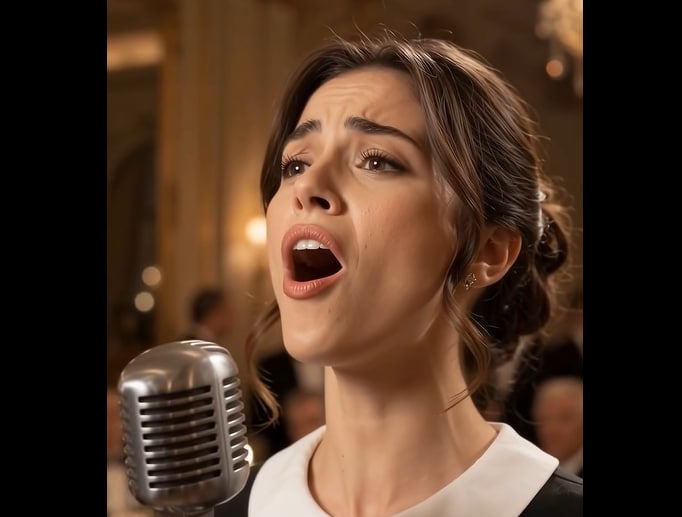

The sound of shattering glass echoed against the velvet-lined walls of Vetro Nero, sharp and piercing, completely severing the suffocating silence of the room.
Shards from the glass in Alessandro Moretti’s hand scattered across the marble floor, glittering under the crystal chandelier like broken diamonds. But not a single person in this room of two hundred dared to look down. All eyes were fixed on me, and then quickly shifted to the man standing at the center.
Alessandro Moretti, the man known as the “King of New York,” stood paralyzed. His usually cold gray eyes, which had looked at me with mockery and disdain just minutes ago, were now ablaze. He stared at me as if I had just stepped out of a grave.
“What did you just say?” His voice was thick, dangerous like the rumble of thunder before a storm.
I swallowed hard, acutely feeling my heart pounding in my chest. The stiff fabric of my waitress uniform seemed to scrape against my ice-cold skin.
“I said…” I kept my head high, forcing myself not to step back. “The person who taught me that technique was my father, Luca Russo.”
A murmur rose from the VIP tables, followed by tense whispers that spread like wildfire. At the grand piano, Joseph Keller remained frozen, his hands hovering over the black and white keys, his pale face dripping with sweat. He knew. Anyone in this room who truly understood music, and perhaps those who understood the underworld, had just realized something terrifying.
Alessandro stepped forward. Every step he took carried an invisible pressure, forcing even the most powerful guests in Manhattan to automatically step back and make way. When he stopped in front of me, I could smell the heavy scent of sandalwood mixed with a hint of the 1982 Bordeaux soaking the lapel of his expensive suit—the very stain I had accidentally caused.
“Follow me,” he ordered, his volume only loud enough for the two of us to hear.
“I’m still on my shift,” I replied stubbornly, even though my hands, hidden behind my back, were trembling. “And you still haven’t told me how you know my father.”
A bitter, ruthless smirk flashed across Alessandro’s lips. He reached out, his long, cold fingers wrapping tightly around my wrist—not hard enough to hurt, but enough to confirm I had no choice.
“Your waitressing job is over, Camila Russo,” he gritted his teeth. “And if you want to survive the night to learn the truth about Luca, you’d better not resist.”
Before I could react, two massive men in black suits emerged from the shadows, clearing a path for us toward the restaurant’s side exit. My manager, Mr. Henderson, ran up with a panicked face, intending to apologize on my behalf, but a single razor-sharp glare from Alessandro slammed his mouth shut. He stepped back in silence.
The night air of New York hit my face with the biting cold of October. A sleek black Maybach was already idling by the curb. The door opened, and Alessandro gently pushed me into the plush leather back seat before getting in beside me. The car glided away instantly, merging into the rushing Manhattan traffic, leaving the brilliant lights of Vetro Nero behind.
The cabin fell into silence. The windows were heavily tinted, completely isolating us from the noisy world outside. The partition between the driver and passenger seats was already raised, creating a stifling, hermetic space.
I rubbed my wrist, trying to regain my composure. “Can you speak now? Why did your expression change when you heard me sing that vocal transition? And why do you know my father’s name?”
Alessandro leaned back, reaching up to loosen his silk tie. Under the streetlights passing through the window, his chiseled face looked far more exhausted and complex than the arrogant billionaire from moments ago.
“You sang it wrong, Camila,” he spoke, breaking the silence.
I frowned, the pride of a classically trained musician flaring up. “I didn’t sing it wrong. That was the climax of Queen of the Night. The rhythm was perfect, the pitch was absolute, and the modulation at the end of the fourth measure is a masterclass vocal technique my father spent years perfecting.”
“No,” Alessandro interrupted, turning to look me dead in the eye. “The modulation at the end of the fourth measure… compressing the D minor tempo down a half-step… that isn’t a vocal technique. That is a cipher.”
My heart skipped a beat. “A cipher?”
“Luca Russo wasn’t just a nobody vocal coach,” Alessandro explained slowly, each word dropping like a heavy stone into a still pond. “In our world, he was called Il Maestro—The Conductor. He was a cryptographic genius and the keeper of the ledger that held every secret, money-laundering pipeline, and black account for the three largest Mafia families on the East Coast.”
My mind reeled. My father? The gentle man with calloused hands who patiently played the piano for me to sing every afternoon? The man who quietly packed his bags and left on a rainy night eleven years ago, right when my mother started coughing up blood and our family was drowning in medical debt?
“You’re lying,” I whispered, shaking my head frantically. “He was just a poor musician. He left because he couldn’t handle the pressure…”
“He left to protect you and your mother,” Alessandro cut in grimly. “Eleven years ago, when the organization was under heavy federal scrutiny, a traitor sold Luca out. They hunted him for the ledger. To keep his family safe, Luca made himself the bait, severed all ties, and vanished. We all assumed he was dead, taking all his secrets to the grave. Until tonight.”
He leaned forward, closing the distance between us until I could see my own trembling reflection in the depths of his gray eyes.
“That passage you just sang, that half-step D minor modulation… is Luca’s cryptographic signature. It’s an absolute authentication signal, the way he sealed top-secret documents. And you, Camila, just stood in the middle of a room containing representatives of the Russian Bratva and the Irish Mob, and belted out that exact cipher flawlessly.”
A chill ran down my spine. The naive satisfaction of thinking I had just taught an arrogant billionaire a lesson with my voice shattered completely. In its place was sheer terror.
“What… what will they think?” my voice was hoarse.
“They will think Luca passed the ledger down to you,” Alessandro replied coldly. “They’ll think the modulations, the vocal exercises he forced you to practice in the dark every day weren’t just music. That the ledger isn’t written on paper, but hidden in your very memory, in every note, every technique you possess.”
I squeezed my eyes shut. Childhood memories came rushing back. My father, with dark circles under his eyes, forcing me to sing specific arias over and over. “Remember this modulation, Camila. Never forget it. Carve it into your veins.” I had thought it was just an artistic obsession. It turned out, he was turning me into a living key.
“So what now?” I opened my eyes, facing Alessandro. The initial panic was slowly giving way to a strange resilience. If my father had traded his life to protect me, I couldn’t just crumble so easily. “Did you take me to kill me before the others get to me? Or to bleed the information out of me?”
Alessandro looked at me in silence for a few seconds. A very faint, almost imperceptible flash of admiration crossed his cold eyes.
“If I wanted to kill you, I would have let you walk out of the restaurant doors alone. Within twenty minutes, your dilapidated apartment in Queens would be torn apart, and they’d probably burn it to ashes,” he said, his voice even but carrying the weight of a thousand pounds. “But I put you in this car.”
“Why?”
“Because my wager earlier is no longer a joke.”
The car suddenly slowed, steering through massive iron gates and entering the private grounds of a secluded mansion hidden in the heart of Manhattan. The headlights illuminated heavily fortified stone walls and dozens of armed guards patrolling the courtyard.
Alessandro turned to me, his gaze sharp as a hawk’s.
“I declared in front of two hundred of New York’s most powerful people that if you successfully sang Queen of the Night, I would marry you. At the time, I only intended to humiliate a waitress. But now, it is the only way to save your life.”
I froze. “You want… a real marriage?”
“Under the title of the Moretti family’s wife, no syndicate—not the Bratva, nor the Irish Mob—will dare lay a finger on you without sparking a bloody war across the entire East Coast. A marriage with me is the only umbrella that can shield you from the storm you just triggered.”
The car door opened. The night wind rushed in, bringing a biting chill. Alessandro stepped out first, then extended his hand toward me. His hand was large, steady, and held the life-and-death power of an entire underworld empire.
“The most brilliant marriage in New York,” he whispered, that ruthless half-smile reappearing. “You will have money, absolute protection, and the freedom to find out where your father really is—because I don’t believe he’s dead. In exchange, you will help me decode the sheet music he left behind.”
I looked at the hand offered to me. An invitation from the devil, or the only life preserver in a sea of fire? Rage, fear, and a burning desire to find my lost father intertwined in my chest.
I had spent eleven years hiding in a faded waitress uniform, concealing my voice and my talent in the shadows. It was time for me to step into the light, even if it was the blinding, blood-soaked light of the underworld.
I placed my hand in Alessandro Moretti’s, feeling his fingers tighten possessively.
“Deal,” I said, holding my head high as I stepped out of the car. “But remember this, Mr. Moretti. I am not a pawn for you to command at will. I am the one holding the sheet music. And from now on, we play to my tempo.”
The heavy oak doors of the Moretti estate closed behind us with a resounding, definitive thud that echoed through the cavernous foyer. It sounded like the sealing of a vault. Or a tomb.
The interior of the mansion was a masterclass in weaponized wealth. Soaring ceilings painted with Renaissance-style frescoes loomed over floors of imported black marble, polished to such a blinding shine that it reflected the crystal chandeliers hanging above us. But beneath the Gilded Age opulence, the reality of Alessandro’s world was glaringly obvious. The men standing at the corners of the grand staircase weren’t butlers; they were heavily armed guards in tailored suits, their eyes tracking my every movement with cold, calculated suspicion.
“Dismissed,” Alessandro said, his voice echoing sharply in the vast space.
The guards vanished into the shadows without a single word, leaving us alone in the suffocating silence of the foyer.
Alessandro didn’t look at me. He shrugged off his charcoal suit jacket—the one still bearing the dark, sprawling stain of the 1982 Bordeaux I had spilled on him less than an hour ago. He tossed it carelessly over the back of a velvet chair, revealing a holster strapped snugly against his crisp white dress shirt. The dull gleam of the firearm resting against his ribs was a jarring reminder that I had just traded a minimum-wage waitressing job for a front-row seat in a mafia war.
“My study,” he ordered, rolling up his sleeves as he walked past me. “Keep up, Camila. We have less than four hours before the sun comes up, and by then, the rest of the Five Families will know exactly who you are.”
I followed him down a long, dimly lit corridor lined with oil paintings and antique weaponry. My cheap, rubber-soled work shoes squeaked faintly against the hardwood, a pathetic sound in the middle of this fortress of power. I wrapped my arms around myself, suddenly hyper-aware of how vulnerable I was.
“You said they’d think I have the ledger,” I said, my voice steady despite the tremor in my hands. “But I don’t even know what this ledger looks like. Is it a book? A hard drive? If my father really was the financial architect for the East Coast syndicates, why would he hide it in vocal scales?”
Alessandro pushed open a set of heavy mahogany double doors, ushering me into a sprawling, two-story library. The room smelled of old paper, leather, and expensive scotch. Floor-to-ceiling bookshelves lined the walls, accessible by rolling brass ladders, but my eyes were immediately drawn to the center of the room. Sitting on a raised mahogany platform was a flawless, midnight-black Steinway & Sons grand piano.
“Because Luca Russo trusted music more than he trusted technology,” Alessandro said, walking over to a crystal decanter on a side table. He poured two glasses of amber liquid, handing one to me. I didn’t drink, but I took the glass, letting the warmth of the crystal seep into my freezing fingers.
“A hard drive can be hacked,” Alessandro continued, leaning against the edge of his massive oak desk. “A physical book can be burned, stolen, or used as evidence by the FBI. But a cipher hidden inside a symphony? An encryption key built into the muscle memory of a classically trained soprano? That is entirely bulletproof. Unless someone knows exactly which notes are wrong, it just sounds like a masterpiece.”
He set his glass down and turned to a large oil painting behind his desk. He pressed a hidden mechanism, and the painting swung outward to reveal a state-of-the-art biometric safe. He pressed his thumb to the scanner, and the heavy steel door clicked open.
“Ten years ago, a few months after your father disappeared, my men intercepted a package meant for a high-ranking captain in the Irish Mob,” Alessandro said, his tone turning dangerously quiet. He reached into the safe and pulled out a translucent evidence bag. Inside was a piece of parchment—burnt at the edges, water-stained, and practically falling apart. “The Irishman was killed before he could receive it. We secured the package. This was inside.”
He walked over and laid the bag on the lid of the Steinway.
I stepped closer, my heart hammering against my ribs. Through the plastic, I could see hand-drawn musical staves. The ink was faded, smudged by time and water, but the handwriting was unmistakable. The sharp, aggressive slant of the treble clefs. The heavy, deliberate dots on the staccatos. It was my father’s handwriting.
“We brought in cryptographers from the NSA, codebreakers from MI6, and world-class concert pianists,” Alessandro said, watching my face intently. “They spent six years trying to decipher it. The mathematicians found no numerical sequences. The musicians said it was a heavily altered, practically unplayable variation of Mozart’s Requiem. A mess of conflicting tempos and dissonant chords. It was deemed a dead end.”
“It’s not a dead end,” I whispered, my eyes scanning the chaotic cluster of notes. “They just didn’t know how to read it.”
“Can you?”
I looked up at him. The arrogant billionaire from the restaurant was entirely gone. In his place was a man standing on the edge of a precipice, waiting for me to build the bridge. The realization hit me like a physical blow: Alessandro Moretti, the King of New York, desperately needed me.
“I need it out of the bag,” I said, my voice commanding in a way I hadn’t known I was capable of.
Alessandro didn’t hesitate. He carefully unsealed the plastic and slid the fragile parchment onto the piano’s music stand.
I sat down on the leather bench. The keys of the Steinway were cool and smooth under my fingertips. I took a deep breath, letting the familiar scent of wood and felt ground me. For a moment, I wasn’t in a mafia boss’s mansion. I was back in our cramped apartment in Queens, sitting beside my father, listening to his raspy voice demanding perfection.
“Look beneath the melody, Camila. The truth is never in the loudest note. It’s in the silence between them.”
I stared at the first measure. It was the Lacrimosa, but heavily distorted.
“Your experts failed because they looked at this as a mathematical equation,” I said softly, my fingers hovering over the keys. “But my father was a romantic. He didn’t use math. He used a polyalphabetic substitution cipher based on the circle of fifths.”
“English, Camila,” Alessandro demanded, stepping closer.
“In classical music, the circle of fifths is a visual representation of the relationships among the twelve tones of the chromatic scale,” I explained, playing a soft, cascading arpeggio to demonstrate. “Look at the bass clef in the third measure. There’s an E-flat where there should naturally be an E-natural. To a musician, it sounds like a mistake, a dissonant clash that ruins the harmony.”
I pressed the two clashing keys simultaneously. An ugly, grating sound filled the quiet study.
“But if you apply the vocal modulation he taught me—the exact half-step shift I sang tonight at the restaurant—you don’t play the note written on the page.” I adjusted my hand positioning. “You transpose it. You push the dissonance down into the minor key, and suddenly…”
I played the corrected phrase. It was breathtakingly beautiful, a dark, haunting melody that sent shivers down my arms.
“It aligns,” Alessandro murmured, his eyes fixed on my hands.
“Exactly,” I said, my pulse racing as the puzzle began to unlock in my mind. “Every time there is an intentional dissonance in the score, it’s not a mistake. It’s a marker. A letter. If you map the transposed notes to the Italian musical alphabet, they spell out words.”
I grabbed a silver pen and a blank piece of stationary from Alessandro’s desk. I leaned over the sheet music, my eyes darting between the burnt staves.
“Measure four… A-natural transposed is a C. Measure seven… that’s an A.” I scribbled furiously, the years of grueling, tear-filled lessons finally making sense. My father hadn’t been torturing me with those impossible vocal exercises. He had been teaching me the alphabet of his secret language.
The silence in the room was absolute, save for the scratch of my pen and the occasional chord I struck on the piano to verify a transposition. Ten minutes passed. Then twenty. Alessandro stood completely motionless, watching me work with an intensity that made the air in the room feel thick.
Finally, I stopped. I stared at the letters I had written down. They didn’t form a bank account number, nor a list of names. It was a single phrase in Italian, followed by a set of coordinates.
I looked up at Alessandro, my throat suddenly dry.
“What does it say?” he asked, his voice low.
I slid the paper across the polished mahogany of the piano.
SOTTO LE ACQUE DEL LEONE. 45.4336° N, 12.3383° E.
“Under the waters of the lion,” Alessandro translated, his brow furrowing as he read the coordinates. He pulled his phone from his pocket, his thumbs flying across the screen. A second later, the glow of the screen illuminated his sharp features. His eyes widened slightly.
“Venice,” he said, looking up at me. “The coordinates point to the foundations of the Teatro La Fenice. The opera house in Venice.”
“The Lion of Saint Mark,” I whispered, the realization dawning on me. “The symbol of Venice. My father… he didn’t hide the ledger in New York. He hid it in the flooded catacombs beneath the opera house where he first met my mother.”
Before Alessandro could respond, the heavy oak doors of the study burst open.
One of the armed guards from the foyer stood in the doorway, his chest heaving, a sleek assault rifle now gripped tightly in his hands.
“Boss,” the guard said, his voice tight with urgency. “We have a problem. The perimeter sensors on the East Gate just tripped. It’s Volkov’s men. The Bratva didn’t wait for sunrise. They’ve brought heavily armored SUVs, and they are demanding you hand over the girl.”
Alessandro’s expression didn’t change, but his eyes went ice-cold. He calmly picked up the burnt sheet music, folded it carefully, and slid it into the breast pocket of his shirt. He drew the firearm from his shoulder holster, checking the chamber with a sharp, metallic click.
“They know she’s the key,” Alessandro said, looking at me. “Volkov is dying. If he gets his hands on Luca’s ledger, the Bratva can seize the entire East Coast before the month is out. He won’t leave without you.”
Fear, cold and paralyzing, gripped my lungs. I was a waitress. I didn’t know how to dodge bullets. I didn’t know how to survive a mafia siege.
Alessandro walked over to me, grabbing my chin and forcing me to look at him. His touch was firm, grounding me in the reality of the moment.
“You are Camila Russo,” he said softly, his gray eyes blazing with a fierce, terrifying light. “You hold the map to the greatest underworld fortune in history. You do not cower. You do not break.”
He let go of my face and turned toward the door, raising his weapon.
“Tell the men to lock down the estate,” Alessandro ordered the guard. “And prep the chopper on the roof. We aren’t negotiating with Volkov tonight.”
He looked back at me over his shoulder, the ruthless half-smile returning to his face.
“Pack light, mia sposa (my bride). We’re going to Venice.”
