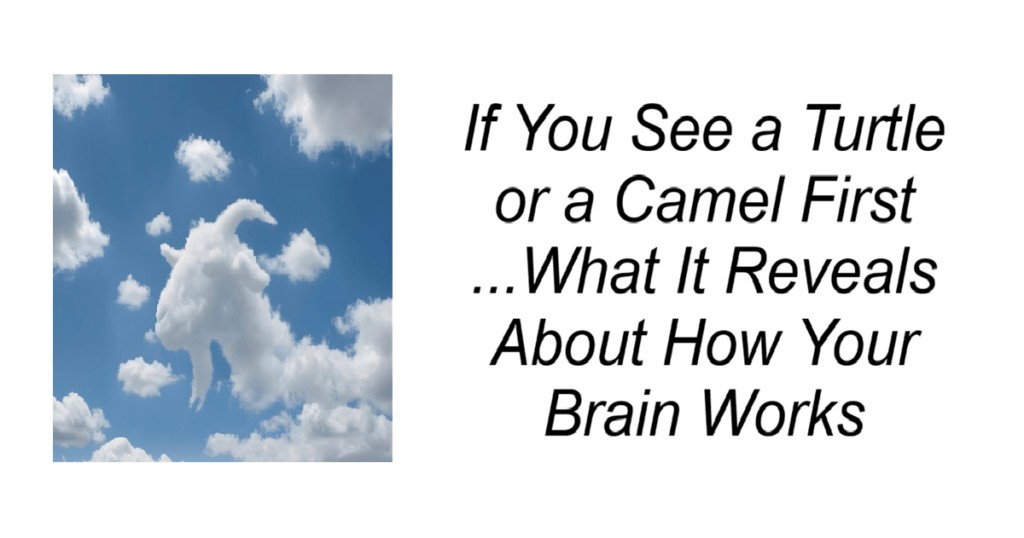

If You See a Turtle or a Camel First …What It Reveals About How Your Brain Works
Images that appear to contain more than one object are popular online because they encourage a simple but intriguing question: what did you notice first? In a visual illusion that can be interpreted as either a turtle or a camel, some people immediately identify one animal while others see the alternative image. It can feel as though that first impression reveals something deeply personal.
These images are entertaining examples of how quickly the human brain interprets visual information. However, it is important to approach personality claims with care. Seeing a turtle or a camel first does not provide a reliable diagnosis of intelligence, personality, emotional awareness, creativity, or whether someone is “left-brained” or “right-brained.” Scientific research shows that perception is influenced by many temporary and personal factors, including attention, expectations, prior experience, visual context, and the way an image is designed.
Rather than treating this kind of image as a psychological test, it is more accurate to view it as a starting point for learning about perception. The turtle-or-camel question can illustrate how the brain organizes incomplete or ambiguous information into meaningful patterns, often within a fraction of a second.
Why People See Different Things in the Same Image
The human visual system does not function like a camera that simply records the world exactly as it appears. Vision is an active process. Light enters the eyes, but the brain must interpret shapes, shadows, edges, colour, depth, and movement. It then compares this information with knowledge gained through past experience to decide what it is seeing.
When an image is deliberately ambiguous, the brain may have more than one plausible interpretation. A line that looks like part of a turtle’s shell to one viewer may help form the outline of a camel to another. Once the mind settles on one pattern, it may become difficult to notice the other immediately. This is a normal feature of perception, not evidence that one person’s brain is fundamentally better or more creative than another’s.
Psychologists often describe such pictures as ambiguous figures or bistable images. A famous example is the Rubin vase illusion, in which a viewer may see either a vase or two faces looking toward each other. Another is the Necker cube, a simple line drawing that can appear to shift orientation. These illusions demonstrate that the brain can alternate between valid interpretations when visual information does not point clearly to only one answer.
What a person sees first may be affected by where their eyes land on the image, how large the picture appears on a screen, the amount of time they spend looking at it, and whether they have encountered a similar image before. Even a small prompt, such as being asked to look for an animal, can influence attention and make one interpretation more likely.
If You Saw a Turtle First
In many social-media personality quizzes, seeing a turtle first may be linked with imagination, intuition, empathy, or an appreciation for visual details. These descriptions can be appealing because they highlight positive qualities that many people recognize in themselves. A person who enjoys art, storytelling, design, music, or reflective thinking may feel that a creativity-focused description fits their experiences.
There is nothing unusual about identifying strongly with those traits. Creativity can involve generating original ideas, making unexpected connections, approaching problems from different perspectives, and communicating feelings or experiences in distinctive ways. Empathy, meanwhile, involves recognizing or understanding another person’s emotional state. Both are valuable human abilities that can be developed through learning, relationships, work, and practice.
Still, seeing a turtle before a camel cannot scientifically establish that someone is especially intuitive or creative. Personality and cognitive abilities are complex. Researchers assess them through carefully developed questionnaires, behavioural tasks, interviews, and repeated observations rather than a single response to an optical illusion.
A more useful reflection might be to ask why the turtle stood out. Perhaps its shape was more familiar, perhaps a feature of the image resembled something the viewer had recently seen, or perhaps their attention was drawn to a particular part of the picture. The answer may say more about the moment of viewing than about a fixed personal identity.
If You Saw a Camel First
People who spot the camel first may encounter descriptions suggesting that they are practical, organized, detail-oriented, or analytical. These traits can certainly be strengths. Analytical thinking often helps people compare evidence, break down complex problems, create plans, and make decisions based on available information. Structure and attention to detail are important in fields ranging from engineering and finance to health care, education, public service, and everyday household planning.
However, it would not be accurate to conclude that a first impression of a camel proves a person is more logical than others. The same individual may be highly organized in professional settings while imaginative in their hobbies, or intuitive in social situations while methodical when managing practical tasks. Human thinking is flexible and strongly shaped by context.
Someone may notice the camel because its outline is more visually prominent to them, because they began looking at a particular section of the image, or because the animal is more familiar or memorable. Attention is selective: the brain constantly prioritizes some details while filtering out others. That process is necessary because people receive far more sensory information than they can consciously examine at one time.
The “Left-Brained” and “Right-Brained” Idea Is Oversimplified
One of the most common claims attached to visual personality tests is that creative people are “right-brained” while logical people are “left-brained.” This idea contains a small element of truth but is often presented in a misleading way.
The two hemispheres of the brain do have some specialized functions. For example, language functions are frequently more concentrated in the left hemisphere for many people, while certain aspects of spatial processing may involve the right hemisphere more strongly. Yet the brain’s hemispheres are closely connected and work together continuously. Everyday thinking, including language, problem-solving, artistic expression, emotion, planning, and decision-making, relies on networks that involve many regions across both sides of the brain.
Neurological research does not support the popular claim that people are broadly “left-brained” or “right-brained” personality types. A person is not destined to be logical rather than creative because one hemisphere supposedly dominates. Creativity itself can involve planning, memory, communication, emotional processing, and technical knowledge, while logical reasoning may require imagination, visual thinking, and flexible problem-solving.
Understanding this distinction matters because overly simple labels can limit how people see themselves. Someone who believes they are “not a creative person” may avoid opportunities to draw, write, invent, or experiment. Likewise, a person who thinks they are “not analytical” may underestimate their ability to learn practical skills. Human abilities are not neatly divided into two categories, and many can improve through experience and education.
What Optical Illusions Can Teach Us About Attention
Although a turtle-or-camel image is not a valid personality assessment, optical illusions are useful educational tools. They reveal that perception is constructed rather than passively received. The brain makes rapid predictions about what visual signals mean, using context and prior knowledge to create a coherent picture of the world.
This efficiency is usually helpful. It allows people to recognize faces, read expressions, navigate familiar spaces, and respond to changing surroundings quickly. But ambiguous images expose the shortcuts involved. When the available information supports more than one interpretation, different viewers may reach different conclusions, and the same viewer may switch between interpretations after looking longer.
Researchers study visual perception to better understand attention, consciousness, memory, and the relationship between the eyes and the brain. This work can also support practical fields such as road safety, interface design, medical imaging, education, and accessibility. For example, designers need to know how people notice visual cues on a screen, while clinicians and researchers may study perception to understand how certain neurological conditions affect vision.
For everyday viewers, the main lesson is simple: first impressions are powerful, but they are not always complete. Taking a second look can reveal information that was present all along but initially overlooked.
Can a Visual Personality Test Measure Personality?
Reliable psychological assessment requires more than a single image or a brief online result. Professional personality measures are developed through extensive research and are tested for reliability and validity. Reliability means a measure should produce reasonably consistent results under similar conditions. Validity means it should actually measure what it claims to measure.
Many viral quizzes do not meet these standards. They often rely on broad, flattering statements that can seem personally accurate to a wide range of people. Psychologists refer to this tendency as the Barnum effect, also called the Forer effect. People may be more likely to accept generalized descriptions when they are positive, emotionally resonant, or framed as being specially tailored to them.
This does not mean that all self-reflection is meaningless. Fun quizzes can encourage people to think about their preferences, habits, and strengths. The key is to treat the result as entertainment or a conversation starter, not as scientific evidence about mental health, personality, or cognitive ability.
If someone wants a more informed understanding of their personality, it can be helpful to consider long-term patterns across different situations. Feedback from trusted people, reflective writing, structured assessments administered appropriately, and conversations with qualified mental health professionals may provide more useful insight than a single visual illusion.
Creativity and Logic Work Better Together
The most constructive way to interpret the turtle-or-camel image is not to choose between imagination and logic. Both ways of thinking are useful, and they often support one another.
Creative thinking helps people explore possibilities, imagine alternatives, communicate ideas, and develop novel solutions. Analytical thinking helps them test those ideas, identify limitations, organize information, and put plans into action. Scientific discovery, technological innovation, art, business, and community problem-solving all benefit from a balance of curiosity and careful evaluation.
A writer may use imagination to develop a story but rely on planning and editing to make it clear. An engineer may use mathematical analysis while also thinking creatively about design challenges. A teacher may apply evidence-based methods while adapting lessons imaginatively to meet students’ needs. These examples show why rigid labels rarely capture how people actually think.
Whether you saw a turtle or a camel first, the image offers a reminder that perception is personal, active, and sometimes surprising. It may be enjoyable to compare answers with friends or family, but there is no correct result and no hidden verdict about who you are. The more meaningful question is what the illusion teaches about the brain’s remarkable ability to find meaning in what it sees.
Sources
Disclaimer: This content is intended for entertainment purposes only and is not based on real events.