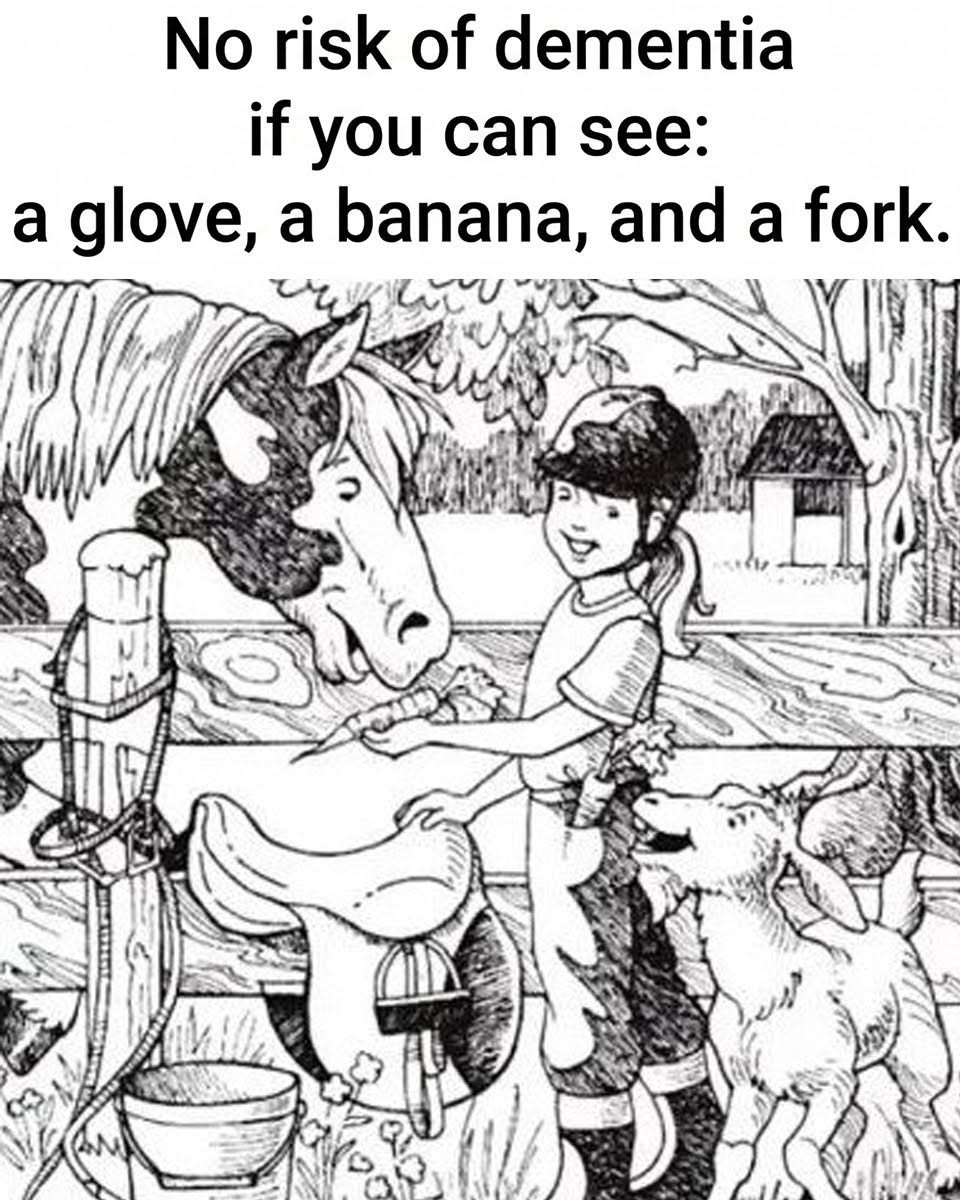

Hidden Object Puzzle: Find the Glove, Banana, and Fork
A peaceful farm illustration becomes a visual challenge when viewers are asked to spot three unexpected objects hidden within its lines: a glove, a banana, and a fork.
A Calm Farm Scene With a Visual Twist
At first glance, this black-and-white farm drawing appears simple and familiar. A young girl wearing a small hat stands beside a horse and appears to offer it a carrot. A goat is nearby, while a wooden fence and trees create the impression of a quiet countryside setting. The scene uses recognizable details that encourage the viewer to understand it quickly as an ordinary rural moment.
However, the illustration is also a hidden object puzzle. Somewhere among the outlines of the girl, animals, fence, and landscape are three everyday items that do not naturally belong in the scene: a glove, a banana, and a fork. Their presence changes the image from a straightforward drawing into a test of visual attention.
These puzzles are designed to make people look beyond the first impression. Rather than placing objects in obvious locations, the artist blends them into shapes that already belong to the image. A curved line may resemble part of an animal, a tree branch, or a piece of clothing before it is recognized as something else. The viewer’s task is not only to look carefully, but also to reconsider what familiar lines may represent.
Why Hidden Object Puzzles Can Be So Difficult
Hidden object games often seem easy until a person begins searching for a specific item. This happens because the human visual system is efficient: it quickly identifies the overall meaning of a scene and filters out details that seem unimportant. In this drawing, most viewers immediately notice the girl, horse, goat, fence, and trees. Once the brain categorizes the picture as a farm scene, it may become less likely to expect unrelated items such as a banana or fork.
This tendency is connected to visual attention, the process through which people select certain information from their surroundings while ignoring other details. Everyday life requires this ability. People do not consciously process every object, color, outline, and movement around them at all times. Instead, the brain prioritizes information that appears relevant to the current task.
In a hidden object puzzle, that useful mental shortcut can become an obstacle. The items are deliberately disguised within expected features of the image. A viewer may look directly at the hidden object but fail to identify it because the object has been interpreted as part of the larger drawing. This is one reason the solution can feel surprisingly obvious once it has been found.
Researchers who study perception and attention have long examined how expectations influence what people notice. A person looking for a particular shape, such as a fork, may be more likely to see lines that resemble its handle and prongs. By contrast, someone who is simply looking at the farm scene may not consider that those same lines could form a utensil.
How to Search for the Hidden Glove, Banana, and Fork
The most effective way to approach this type of visual puzzle is to search methodically. Randomly moving the eyes across the page can be entertaining, but it may also cause the viewer to revisit the same areas repeatedly while missing quieter details elsewhere. A structured search makes it easier to inspect the whole illustration.
Start With the Main Characters
Begin by examining the girl, the horse, and the goat. Look closely at clothing folds, the edges of hats, animal legs, tails, ears, and facial outlines. Hidden objects are often incorporated into areas that already contain curved or irregular lines. Because a glove has multiple finger-like sections, it may be suggested by details that initially seem to be part of a hand, leaf, mane, or clothing shape.
Study Curves and Unusual Silhouettes
The banana is likely to be the most recognizable object once viewers focus on its general form. Rather than looking for a detailed fruit illustration, search for a long, gently curved silhouette. The shape may be rotated, partially concealed, or integrated into a larger object. In hidden object art, orientation matters: an object does not need to be upright to be present.
It can help to mentally rotate the image or look at it from a different angle. Some people find that stepping back from the screen, zooming in, or briefly looking away makes an overlooked form easier to notice when they return to the puzzle.
Look for Repeated Straight Lines
The fork may be hidden through its most distinctive features: a narrow handle and several short, parallel prongs. Search the fence, branches, background textures, and clothing details for line patterns that appear slightly more regular than the surrounding artwork. The object may not be drawn as a complete, separate fork. Instead, its outline may be shared with another part of the scene.
Divide the Drawing Into Sections
A useful technique is to divide the image into imaginary zones. Search from left to right and from top to bottom. Start with the upper background, move to the characters, then inspect the lower foreground. This reduces the chance of overlooking an area because it looked unimportant at first.
Another strategy is to focus on one item at a time. Searching simultaneously for a glove, banana, and fork can make the task feel more complicated. Instead, spend several minutes looking only for curved banana-like shapes. Then reset your attention and search for the glove. Finally, inspect the image for the fork’s prongs and handle.
The Role of Pattern Recognition in Visual Puzzles
Pattern recognition is central to hidden object challenges. It allows people to identify objects even when they are incomplete, partly covered, or shown from unfamiliar angles. In ordinary situations, this ability helps people recognize faces in poor lighting, read handwritten words, and identify familiar places from a distance.
Artists use this same ability to create visual puzzles. They can embed a recognizable outline within another object and rely on the viewer’s mind to complete the image. The hidden glove, banana, and fork do not need to include every realistic detail. A small number of defining characteristics may be enough for the brain to recognize them.
This is also why viewers often experience a sudden “aha” moment. Before recognition, the lines appear to be a normal part of the farm illustration. After recognition, it becomes difficult to see them only as background details. The object has become meaningful, and the brain now gives it priority.
Different people may find different objects first. Someone who pays close attention to outlines may spot the banana quickly, while another person may notice the fork because they are sensitive to repeated straight lines. Experience, expectation, screen size, lighting, and the amount of time spent searching can all influence the result.
Hidden Object Activities and Mindful Observation
Hidden object puzzles are often enjoyed as brief, low-pressure activities. They can be completed alone, shared with family members, or used as a friendly challenge among classmates and colleagues. The purpose is generally entertainment, but the activity also encourages slow observation in a world where people often move quickly from one image or task to the next.
Searching carefully through a detailed picture can promote patience and concentration. The viewer has to pause, scan, compare shapes, and resist the urge to give up after an initial unsuccessful glance. These are not clinical tests of intelligence or vision, and puzzle performance should not be treated as a measure of a person’s abilities. Still, they can be a pleasant way to practice focused attention.
For younger participants, hidden object illustrations can support conversations about vocabulary and visual description. Adults can ask children to describe where they have searched, which shapes look unusual, and why a certain line might resemble an object. For older participants, these puzzles can be an accessible recreational activity that does not require special equipment beyond a printed page or screen.
Accessibility also matters. People with visual impairments, color-vision differences, or difficulty viewing small details may find black-and-white drawings challenging depending on line contrast and image size. Providing a larger version of the image, allowing zoom controls, and avoiding time pressure can make the activity more inclusive.
Why the Farm Setting Makes the Puzzle Effective
The farm setting is a smart choice for a hidden object illustration because it contains many natural visual elements. Animal outlines, fence rails, tree branches, grass, clothing, and tools all create opportunities to disguise unexpected objects. The scene is also familiar enough that viewers can understand it immediately, allowing the hidden details to remain unnoticed at first.
A glove can visually blend with hands, leaves, or folds of fabric. A banana can be concealed in a curved tail, a section of landscape, or the outline of an animal’s body. A fork can be incorporated into fence details, branches, or other closely spaced lines. The effectiveness of the puzzle comes from this balance: the objects must be visible enough to be found, yet subtle enough to escape a quick scan.
The contrast between the peaceful rural scene and the unrelated household objects adds to the appeal. A fork and banana are familiar items, but they are not items viewers expect to see hidden near a horse and goat. That mismatch encourages the brain to revise its first interpretation of the image.
Tips for Enjoying Visual Search Puzzles
If the glove, banana, and fork do not appear immediately, there is no need to rush. Take a short break, then return to the image with a different search strategy. Looking from the outer edges inward can be helpful if you started in the center. Alternatively, inspect negative space, the empty-looking areas between objects, rather than only studying the main figures.
Try changing the scale of the image if possible. Zooming in can reveal short lines and small contours, while zooming out can make larger silhouettes easier to recognize. Viewing the image in good light and at a comfortable distance may also reduce visual fatigue.
Most importantly, treat the puzzle as an opportunity to enjoy the process. The goal is not merely to identify three concealed items, but to notice how a familiar drawing can hold more information than it first appears to contain. Whether the objects are found in seconds or after several minutes, the challenge demonstrates the creative relationship between art, attention, and perception.
Sources
Disclaimer: This content is intended for entertainment purposes only and is not based on real events.