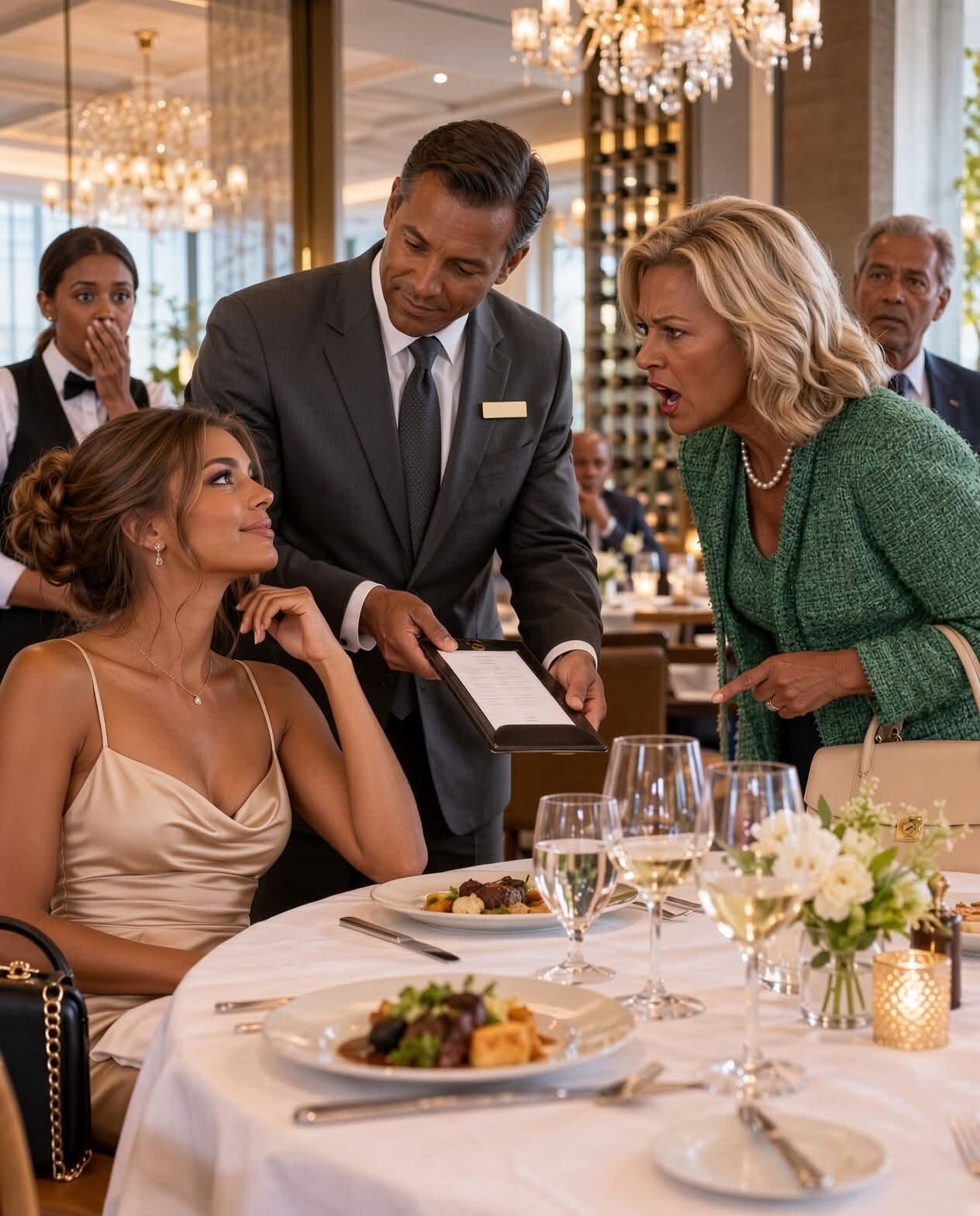

Chapter 1: The Revelation
My mother slowly lowered her wineglass. For the first time all evening, my cousin Preston was not smiling.
I opened the leather folder on the table. Inside was a receipt showing a zero balance and a handwritten note from Valmere’s general manager, Adrian Cole: Welcome, Ms. Hayes. Congratulations on the board vote.
Mom looked from Adrian to me. “What does he mean, the new CEO?”
Adrian remained impeccably professional. “Ms. Hayes was appointed chief executive of Valmere Hospitality this afternoon.”
My aunt blinked in stunned silence. Preston leaned forward. “Olivia?”
I looked at Adrian. “Thank you. And please make sure Ethan isn’t blamed for anything that happened at this table.”
The waiter, Ethan, looked startled.
“Of course,” Adrian said. Then he turned to my mother. “Mrs. Hayes, our employees are not required to participate in humiliating a guest, regardless of who is paying the check.”
Mom’s cheeks reddened. “I was joking.”
Adrian did not argue. “We want every employee here to feel comfortable declining requests that demean another guest or member of staff.”
The silence in the private dining room was absolute. Finally, Preston asked, “Wait. Olivia, you own this place?”
“Not personally,” I said.
Nine months earlier, my investment company, Northstar Table Group, had acquired a controlling stake in Valmere Hospitality, the parent company operating Valmere and six other restaurants. The transaction had saved the group from bankruptcy. I was the majority investor. That afternoon, after months serving as interim board chair, the directors had formally appointed me CEO. The announcement to the employees was scheduled for Monday. I had not expected my family to learn about it over dessert.
Mom stared at me as though I had betrayed her. “You told me you worked in restaurants.”
“I do.”
“You let me think you were still doing catering.”
“I never said that.”
“You never corrected me.”
“How many times did you ask?”
Her mouth opened, then closed.
Preston frowned. “Since when are you qualified to run a hospitality group?”
“I founded a restaurant logistics platform. We processed procurement and staffing data for more than eight hundred independent restaurants before I sold it.”
“You sold that little app?” Preston asked.
Little app. “Yes.”
“For how much?”
“That isn’t relevant.”
Grandma Eleanor, who had been quietly watching from the end of the table, tapped her spoon against her cup. “I knew.”
Mom spun toward her. “You knew?”
“Olivia told me years ago.”
“And you didn’t tell me?”
“It wasn’t mine to tell.” Grandma winked at me.
Money had always been a performance in our family. If you had it, you were expected to display it. If you did not display it, they assumed you did not have it.
Mom pushed back her chair. “You sat there while everyone embarrassed me.”
I stared at her. “Mom, you told a waiter your adult daughter couldn’t afford dessert. If I were exactly the person you thought I was—working hourly shifts and struggling financially—would what you said have been acceptable?”
She looked away.
Adrian quietly asked whether I wanted the private room cleared. I declined. Dinner was over.
As Ethan approached to collect the glasses, Mom scoffed. “Well, apparently none of us need to pay.”
I looked at Adrian. “Actually, change that. The company will cover Grandma’s meal and mine. Everyone else receives their own check.”
Preston laughed once. “You’re serious? You invited us.”
“Mom invited us.”
Mom stared at me. “You’re making me pay for my own birthday dinner?”
“I’m declining to use company money for a private family party.”
Governance was not revenge. Valmere was not my personal wallet. When the checks arrived, my aunt suddenly remembered she had ordered only one glass of wine. Preston disputed a bottle he had enthusiastically selected two hours earlier. Grandma watched with dangerous amusement.
I kissed her cheek, promising to call her tomorrow, and headed for the door. Mom tried to stop me, demanding we talk, but I refused. I stepped out into the cold air. I had expected satisfaction. Instead, I just felt tired.
Chapter 2: The Fallout
For years, I had imagined what it might feel like if my family finally understood what I had built. In those fantasies, Mom apologized. Preston looked impressed. Everyone realized they had underestimated me.
Reality was far less satisfying. Their first reaction was outrage that I had allowed them to underestimate me in the first place.
Adrian followed me outside to apologize in case he had overstepped, knowing I wanted the CEO announcement kept internal until Monday.
“No,” I told him, looking through the window at Ethan clearing our table. “You did the right thing protecting him.”
That was a primary reason I had bought Valmere. The company had once been admired, but its founder had expanded too quickly. Debt grew, food costs rose, managers cut labor, and turnover exploded. When he contacted me for software advice, I offered capital with strict conditions: transparent tip policies, predictable scheduling, independent reporting for harassment, and an end to wage theft disguised as “family culture.” Over nine months, we stabilized the company. Luxury was its business. Cruelty was not.
The next morning, my phone started ringing at 7:03 AM. It was Mom. I let it ring. At 7:11, Preston called. At 7:18, my aunt texted congratulations, followed quickly by a message saying my mother was devastated. It made me laugh—the person humiliated at the table had somehow become responsible for comforting the person who did the humiliating.
At nine, Grandma called to tell me she had turned off her hearing aids to ignore my mother’s frantic calls. “Don’t let one ugly dinner decide what you do next,” she advised.
On Monday morning, Valmere Hospitality officially announced my appointment. The press release was deliberately boring, focusing on operational stabilization and responsible growth. No family drama.
By noon, business publications had picked it up. Then Preston texted: $84 MILLION???
An article had estimated the payout from the sale of my catering-tech company. The actual transaction was a complex mix of cash, stock, and distributions, but the estimate was close enough to destroy my family’s favorite narrative about me.
He called, and this time I answered. He was in disbelief. “Why didn’t you tell us?”
“Because when I was building the company, you called it my little catering project,” I reminded him. “When I got my first major contract, Mom asked when I was getting a real job.”
“You made us look stupid,” he sighed.
“I am not responsible for correcting every assumption you make about me. If we’re family, maybe you should have been curious.”
Chapter 3: Shifting the Culture
I met Mom three days later at a neighborhood café where nobody knew me. She arrived wearing sunglasses, immediately asking why I didn’t trust her.
“This is about trust?” I asked.
“You hid your entire life.”
“I hid my net worth. I told you I was building restaurant technology. You decided it was small.”
Her jaw tightened. “You could have corrected me. Why didn’t you?”
“Because I got tired of auditioning for your respect.”
The words hit her hard. I reminded her of how she framed Preston’s first internship offer letter, yet asked if I was still waiting tables when I signed my first major corporate client. She knew Preston’s promotion schedule and office floor, but couldn’t explain the business I had spent seven years building.
“I thought you were struggling,” she said, wiping at an eye. “I would have helped.”
“Would you? When I asked to borrow two thousand dollars for the first prototype, you told me failure would teach me realism.”
Grandma had loaned me the money instead.
“I thought I was protecting you,” Mom whispered. “From chasing something impossible.”
“And Preston was on a traditional path. You trusted the path you recognized. That doesn’t make you evil, but it made you dismissive.”
Before I left, she apologized for how she treated the waiter. I asked if she would be sorry if I weren’t the CEO. Her long silence was answer enough. I told her that one apology wouldn’t fix a pattern, and that she needed to start being interested in people before knowing if they were impressive.
Back at Valmere, there were more urgent problems. The acquisition had stabilized the company, but some managers still believed luxury hospitality meant employees should silently absorb abuse. A week later, Ethan told me about a regular customer who repeatedly made degrading comments to female servers. Previous managers had ignored it because the man spent fifty thousand dollars a year.
I told Ethan to follow the conduct policy. The guest received a formal warning, violated it again two weeks later, and Valmere permanently declined his future reservations. Revenue did not collapse. The world continued. More importantly, the employees noticed. Anonymous engagement scores improved, and turnover began falling. People finally believed the policies were real.
Chapter 4: A New Baseline
Grandma visited the restaurant a month later—not for dinner, but for lunch in the kitchen. She ate half a croissant, announced that her local diner still made better pie, and made the pastry chef laugh.
“You did all this with my two thousand dollars?” she asked, looking at the renovated employee break room.
“Not directly.”
“I’m taking credit anyway.”
Then she surprised me. She told me Mom had asked to read my old business plan. She was trying to understand what she should have understood years ago. I cautiously watched as Mom began asking questions about the software and the acquisition. They were awkward and basic, but they were a start.
Preston took longer. Being the “successful child” was his core identity; my success felt like theft to him. At a family lunch, he finally admitted that he needed me to be struggling so he knew he stood above me.
“What happens if neither of us needs to be above the other?” I asked him.
He shrugged. “I guess I have to figure out who I am without winning.”
For the first time, I saw the cost our family hierarchy had imposed on him, too. Praise tied to status is just another kind of cage.
Six months into my CEO role, Valmere returned to operational profitability. We didn’t open a new location; instead, we paid down debt, raised kitchen wages, and created an emergency assistance fund for employees. I showed the board the retention numbers to prove that when people believe a company won’t discard them, loyalty stops being just a slogan.
Eight months after Mom’s disastrous birthday, she returned to Valmere. This time, she made the reservation herself.
When Ethan approached, Mom put down her menu. “Before we order, I owe you an apology. The last time I was here, I involved you in humiliating my daughter. I put you in an unfair position while you were working. I’m sorry.”
She didn’t mention my title or make excuses. Ethan smiled politely, thanked her, and took our orders.
When the dessert menus arrived, everyone went quiet. Mom looked at me. “Olivia, would you like dessert?”
I smiled. “I can’t afford it.”
Grandma laughed so hard she started coughing. Even Mom laughed. Something old loosened inside me. When the bill came, we split it. No company comp. No executive privilege. Just a normal dinner.
Chapter 5: The Real Investment
My relationship with Mom never became perfect. She still occasionally mentioned someone’s job title before their name, but she learned to catch herself. Preston changed, too. He left corporate banking for a smaller firm where he actually enjoyed the work. Mom surprised us both by supporting his happiness over the prestige of his old title.
Grandma remained Grandma. At her eighty-fifth birthday, we held dinner at Valmere because she liked Ethan, who was now an assistant manager. He brought her a slice of pie from her favorite diner, and she declared him the only sensible person in fine dining.
Valmere eventually expanded again, slowly and responsibly. We created profit-sharing for senior operating teams, and the company became known for its unusually low staff turnover in a notoriously difficult industry.
Years later, a business magazine profiled me. The reporter asked about the moment I knew I wanted to change restaurant culture. I could have told the birthday story—it would have made perfect clickbait—but I didn’t. Ethan and Grandma hadn’t consented to being characters in my family drama. Instead, I talked about my early years working in the sweltering heat of a diner kitchen, where servers and cooks were treated as invisible.
After the article was published, Mom mailed me a copy with a sticky note: I finally understand what you built. Love, Mom.
Part of me wished she had understood before the money and the titles, but healing isn’t rewriting the past. It’s deciding what to do when the present changes. I called to thank her, and that was enough.
Chapter 6: A Place at the Table
Preston and I grew closer once the competition vanished. He was great with numbers; I excelled at operational systems. When I asked him to review a financing structure, he caught a covenant issue my team had missed. He looked ridiculously pleased. Sibling relationships improve dramatically when nobody needs the other person to lose.
One evening, long after the restaurant had closed, I sat alone at Valmere. Ethan—now the general manager—placed a leather receipt folder in front of me. Inside was a blank receipt with a handwritten note: NO CHARGE TONIGHT. THE CEO COMPLAINED ABOUT THE SERVICE.
I looked up. He was grinning. “What was wrong with it?”
“The CEO stayed four hours after closing.”
“That sounds like a management problem,” I laughed.
I kept that fake receipt in my desk, right next to Grandma’s original two-thousand-dollar loan agreement. Two pieces of paper. One represented the first person who believed in me; the other represented the night everyone else realized they had been wrong.
For a long time, I thought the second one mattered more. It didn’t. Being revealed as successful is satisfying for a moment, but being believed in before the success exists changes your life entirely.
When Grandma passed away at eighty-eight, Valmere closed for lunch on the day of her funeral. The staff requested it. Ethan placed a single slice of diner pie on a table in the empty dining room. After the funeral, Mom, Preston, and I ate there together. No hierarchy. No jokes about who could pay. Just family.
Sometimes people tell the story of my mother’s birthday dinner as though the best part was the big reveal. The perfect reversal. The perfect humiliation.
But that isn’t the part I remember most. I remember Ethan’s face when my mother tried to force him to participate in humiliating me. I remember realizing that wealth doesn’t reveal character—what people believe wealth permits them to do reveals character.
My mother thought her status allowed her to make someone smaller. For years, I hid my money because I was afraid it would change how people treated me. Eventually, I learned that the goal isn’t to hide power, but to wield it carefully.
I didn’t fire anyone that night. I didn’t make my family beg or turn Valmere into a weapon. I simply stopped accepting disrespect as a baseline.
The last time my mother celebrated her birthday at Valmere, she ordered dessert first. When Ethan jokingly asked who would be paying, Mom pointed at herself.
“I am,” she said, smiling at me. “And my daughter can afford her own.”
I could. But by then, that was the least interesting thing about me. The important part was that even if I couldn’t afford it, I still deserved a place at the table. The waiter still deserved respect. The person washing dishes mattered just as much as the person ordering truffles.
That was the company I wanted to run. And, eventually, it became the family I wanted to keep.
