
The Girl Who Became Queen of England for Nine Days
She was proclaimed Queen of England at just sixteen. Nine days later, she had lost her claim to the throne. Seven months after that, she was dead.
Lady Jane Grey’s story remains one of the most heartbreaking episodes in Tudor history. Remembered as the Nine Days’ Queen, she became a monarch not through a traditional royal succession, but through a political struggle that placed her at the centre of a dangerous battle for England’s future.
Jane was young, highly educated, and deeply committed to the Protestant faith. She was also connected to the Tudor royal family through her grandmother, Mary Tudor, the younger sister of King Henry VIII.
Yet Jane had little control over the political ambitions that shaped her fate. Powerful men placed her name at the centre of their plans, and when those plans collapsed, she became one of the most vulnerable figures in the kingdom.

Lady Jane Grey’s Royal Ancestry and Education
Lady Jane Grey was born around October 1537, the eldest daughter of Henry Grey, Duke of Suffolk, and Lady Frances Brandon.
Her mother was the daughter of Mary Tudor, making Jane a great-granddaughter of King Henry VII and a member of the extended Tudor royal family. This ancestry gave her a legitimate connection to the English succession, although she was not among the immediate heirs traditionally expected to inherit the crown.
Jane received an unusually strong education for a young noblewoman of her time. She studied Latin, Greek, and other subjects, and developed a reputation for intelligence, discipline, and religious conviction.
She became particularly devoted to Protestantism, which was significant in an England still divided by religious change. Under Edward VI, Protestant reforms had gained considerable ground, but his Catholic half-sister Mary represented a very different religious future.
Jane’s education and faith would later make her an attractive candidate to those determined to preserve Protestant rule.
However, being intellectually capable and having royal ancestry did not mean Jane was prepared to become queen. Her life was about to be transformed by decisions made in the highest circles of government.

Edward VI’s Final Decision Changed Her Destiny
In 1553, England was ruled by the young King Edward VI, the only legitimate son of Henry VIII. His health was deteriorating, and it became increasingly clear that he might not live long.
The question of who would succeed him became urgent.
Under the succession arrangements established during Henry VIII’s reign, Edward’s half-sister Mary was next in line, followed by Elizabeth. But Edward was determined to prevent Mary, a committed Catholic, from restoring Catholicism as the dominant religion in England.
He therefore developed a plan known as his ‘Devise for the Succession’. Its final version directed the crown towards Lady Jane Grey and her male heirs, bypassing Mary and Elizabeth.
The decision was politically controversial and conflicted with the succession established by earlier legislation. It also benefited John Dudley, Duke of Northumberland, one of the most powerful men in Edward’s government.
Northumberland had arranged for his son, Lord Guildford Dudley, to marry Jane in May 1553. If Jane became queen, his family would gain an extraordinary position of influence.
Edward VI died on July 6, 1553, at just fifteen years old. His death set off a struggle that would determine the future of the English monarchy.
July 10, 1553: Jane Was Proclaimed Queen
After Edward’s death, the Duke of Northumberland and his supporters moved quickly to secure the succession in Jane’s favour.
Jane was informed of the decision at Syon House. Historical accounts suggest that she was deeply distressed by the news and did not welcome the prospect of becoming queen with enthusiasm.
Nevertheless, on July 10, 1553, she was proclaimed Queen of England in London.
She was taken to the Tower of London, which traditionally served as a royal residence before a coronation. However, Jane was never crowned. Her position depended on political support that was already beginning to weaken.
Meanwhile, Mary Tudor refused to accept the arrangement. As Henry VIII’s eldest surviving daughter and the recognised heir under the established succession laws, she asserted her own right to the throne.
Mary travelled to gather supporters, and many people across England rallied behind her. Her claim attracted considerable support, while Northumberland’s attempt to control the succession began to unravel.
Jane’s position was becoming increasingly impossible to defend.
Nine Days Later, Mary Tudor Took the Throne
On July 19, 1553, the Privy Council changed sides and proclaimed Mary queen in London.
Jane’s brief reign was over.
Her father, Henry Grey, eventually abandoned her cause, and the political establishment shifted its allegiance to Mary. Northumberland’s attempt to secure the throne for Jane had failed.
The young woman who had been placed at the centre of a royal succession crisis was now a prisoner.
Jane was confined in the Tower of London, the same fortress where she had been brought as queen. Her husband, Guildford Dudley, was also imprisoned.
In November 1553, both were convicted of high treason. At first, however, their sentences were not immediately carried out.
Queen Mary appeared reluctant to execute her young cousin. Jane was a Protestant claimant to the throne, but she had not personally led the movement that placed her there.
For a time, it seemed possible that she might survive.
Wyatt’s Rebellion Made Jane’s Position More Dangerous
In early 1554, another political crisis changed everything.
Queen Mary planned to marry Philip of Spain, the son of Emperor Charles V. The proposed marriage caused widespread opposition among those who feared foreign influence over England.
In January 1554, Sir Thomas Wyatt led a rebellion against Mary’s marriage plans. The uprising attracted support from several opponents of the queen, including Jane’s father, Henry Grey.
Although Jane was not known to have directly participated in the rebellion, her continued existence represented a potential danger to Mary’s rule. She had already been proclaimed queen once, and her Protestant ancestry made her a possible alternative around whom opponents of Mary could gather.
The rebellion was eventually defeated, but its consequences were severe.
Mary’s government became increasingly determined to remove threats to the throne. Jane’s previous conviction for treason, combined with her family’s involvement in the uprising, made her position far more precarious.
The possibility of mercy disappeared.

February 12, 1554: The Execution of Lady Jane Grey
On February 12, 1554, Lady Jane Grey was taken to Tower Green for execution.
Earlier that morning, her husband, Lord Guildford Dudley, had been executed on Tower Hill. Contemporary accounts describe him asking those present to pray for him before he was led to the scaffold.
Jane was reportedly able to see his body being brought back towards the Tower, an experience that must have made her own approaching death even more difficult.
Before her execution, Jane addressed the people gathered to witness it. She acknowledged her involvement in the events that had placed her on the throne, while maintaining her Protestant faith.
She carried a prayer book and used her final hours to pray.
One of the most enduring stories about her death concerns the moment she was blindfolded. According to accounts later repeated in historical literature, Jane struggled to locate the execution block and asked where it was.
The Lieutenant of the Tower, Sir John Brydges, reportedly helped guide her towards it.
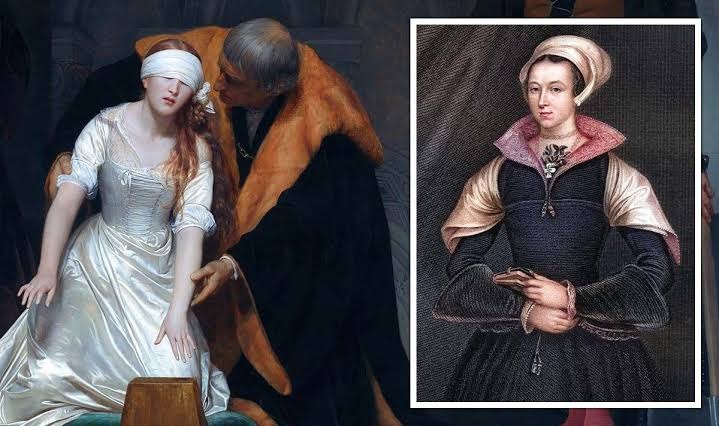
This moment later became famous through Paul Delaroche’s painting The Execution of Lady Jane Grey, completed in 1833. The painting portrays the young woman blindfolded and reaching for the block, surrounded by witnesses overwhelmed by the scene.
Although the artwork is a nineteenth-century interpretation rather than a contemporary record, it helped shape the way generations have imagined Jane’s final moments.
She was beheaded on Tower Green on February 12, 1554. She was approximately sixteen years old.
Why Lady Jane Grey Became Known as the Nine Days’ Queen
Lady Jane Grey’s story has endured because it reveals how dangerous royal succession could become in Tudor England.
Her claim to the throne was supported by powerful political figures who wanted to prevent Mary from becoming queen. Yet the same political forces that elevated Jane could not protect her when public and political support shifted.
She was never crowned, and her reign lasted only nine days, from her proclamation on July 10 until Mary was proclaimed queen on July 19, 1553.
Her fate was also shaped by the religious conflict of the period. England had experienced major changes under Henry VIII and Edward VI, and Mary’s accession threatened to reverse many of the Protestant reforms introduced during her brother’s reign.
Jane became a symbol of that struggle, even though the decisions that placed her in power were largely made by others.
Today, she is remembered not simply as a failed queen, but as a young woman caught between dynastic ambition, religious division, and the ruthless realities of Tudor politics.
The Tragedy of a Queen Who Never Had the Chance to Rule
Lady Jane Grey’s life was shaped by a crown she never truly had the opportunity to wear.
She was born into the Tudor aristocracy, educated to a remarkable standard, and connected by blood to the royal family. Yet her brief place in the succession turned her into a political target.
At sixteen, she was proclaimed Queen of England. Nine days later, she was removed from power. Seven months after that, she was executed within the walls of the Tower of London.
Her story remains a reminder that royal titles did not always bring security or power. Sometimes, they made those who received them more vulnerable than ever.
Jane Grey entered history as the Nine Days’ Queen. But behind that title was a teenager whose life was taken by a political conflict she had little power to control.