
Chapter 1: The Evidence on the Screen
Daniel pressed play.
The image on his laptop was grainy but clear enough. A timestamp glowed in the corner of the bank’s security recording: the glass doors opening and Irene walking into the branch with a blue folder tucked beneath her arm. She approached the loan officer’s desk, sat down, and removed the trustee authorization bearing my copied signature.
No one in my kitchen spoke.
On the recording, the loan officer examined the page and asked a question. The video had no sound, but Irene’s answer was obvious from the way she nodded quickly and tapped my forged name with one polished fingernail.
Daniel paused the footage. “The bank’s internal notes say you represented yourself as Stephanie’s authorized agent,” he said.
Irene’s face tightened. “I was helping the family.”
“You told the bank Stephanie had reviewed and approved the entire cash-out schedule.”
“She had agreed to the loan!”
“I agreed to review the final documents,” I said, my voice steady despite the tension in the room. “I never agreed to pay off your credit cards, Mike’s SUV, or Tyler’s future car.”
Mike planted both hands on my table. “It was all part of the same package! We were going to make the payments.”
Daniel looked at him calmly. “You are already four months behind on the SUV, three months behind on two credit cards, and facing a collection action from a vacation lender. What income were you planning to use?”
Mike glanced at Mom. That glance told me more than his answer ever could.
Mom lowered herself into a chair, still holding my unopened gift bag. The gold tissue paper trembled in her hands. “Your father wanted this house to take care of us,” she murmured.
Daniel opened the sealed file on the table. Inside were the original trust agreement, two amendments, a certified deed, and a cream-colored envelope with my name written in Dad’s slanted handwriting.
I recognized it instantly. Dad’s handwriting had grown shakier during his final year, but he still pressed hard enough to leave deep grooves in the paper.
Daniel placed the deed between us. Seven years earlier, while Dad was receiving treatment for heart failure, he had transferred the family home into the Hart Family Property Trust. Mom was given the right to live there for the rest of her life, provided she maintained the property, paid basic expenses, and did not pledge it as security for anyone else’s debts.
Mike had no ownership interest whatsoever. I had been named the successor trustee and controlling beneficiary.
After Dad died, Mom told me the trust was just routine estate paperwork. She said Daniel would contact me if I ever needed to do anything. I was grieving, running my store, raising my daughter, and trying to keep peace with a family that treated basic questions like accusations. I had believed her.
“You knew,” I said quietly to Mom.
Mom stared down at the deed. “I knew your father put some protections in place.”
“You knew the house wasn’t Mike’s.”
“He lives there!” she snapped. “He takes care of me! That should count for something.”
“It does not make him the owner,” Daniel stated flatly.
Mike snatched the deed from the table and scanned it, his eyes moving faster as he reached the second page. “This is ridiculous. Dad would never leave her in control.”
Daniel removed the first amendment from the file. “He did not make the decision casually.”
The amendment had been signed eighteen months after the original trust was drafted. It strengthened the restrictions on borrowing and required my explicit written approval for any lien, refinance, or transfer. Attached to it was a memorandum dictated by Dad.
Daniel read the first paragraph aloud: “I have observed repeated pressure placed upon my daughter Stephanie to solve financial problems she did not create. I intend for the family property to remain protected from emotional coercion, favoritism, and the debts of any child or grandchild.”
Mike’s jaw clenched. Mom shut her eyes tight.
I thought of every time she had told me Dad expected me to help. Every repair bill she had pushed across my kitchen counter. Every emergency that somehow became my burden because Mike had expenses, Mike had children, Mike needed another chance.
My daughter Emma had once asked why Uncle Mike’s emergencies were always louder than ours. She had been ten years old at the time. I had told her that families helped each other.
What I had not understood back then was that help flowing in only one direction was not kindness. It was an extraction system.
Mike threw the deed back onto the table. “Fine! She controls the paperwork. That doesn’t give her the right to destroy my life over a stupid prank.”
“Your car was repossessed because you stopped paying for it,” I replied coldly. “The refinance was only delaying what you had already caused.”
Irene stepped forward, folding her arms. “You are punishing a child. Tyler made one bad joke.”
The soda stain was still visible on the dress hanging over a chair in my laundry room. I could smell the sour sweetness even from the kitchen.
“Tyler repeated what he had been taught,” I said. “And then every adult at that table showed him it was acceptable.”
Mom looked up sharply. “I never told him to pour anything on you!”
“Did you tell him I didn’t belong there?”
She opened her mouth, but no sound came out. Mike answered for her. “People say things when they’re frustrated.”
“So she did say it.”
Mom’s fingers tightened around the gift bag. “I said you always sit there judging us, like you’re better than everyone because your shop is doing well! I said sometimes it feels as though you don’t belong with this family anymore. Tyler just twisted it.”
“He quoted you.”
Her face hardened. “You have been distant ever since Emma died! We never know what to say around you.”
The words landed with surgical precision. They had spent three years treating my grief as an inconvenience, and now she was using it as evidence against me.
I felt the old instinct rise—the urge to explain, soften, reassure, and make my pain easier for them to tolerate. I breathed through it and let the instinct pass.
“You could have said her name,” I replied softly. “That would have been a start.”
For once, Mom had no answer.
Chapter 2: The Truth Unraveled
Daniel turned his attention to the bank packet. “There is another issue. Stephanie’s provisional consent was attached to an application describing roof repairs and medical expenses. The version submitted for approval contained an additional eighty-six thousand dollars in personal debt and a forged trustee authorization. The lender has frozen the file and referred it for internal fraud investigation.”
Irene folded her arms tightly. “Are you threatening us with the police?”
“No,” Daniel said calmly. “I am explaining what the bank has already set in motion.”
Mike began pacing the kitchen floor. “We can fix this. Steph signs a new authorization, the loan funds, I get the SUV back, and nobody has to make a big deal out of a paperwork mistake.”
“A forged signature is not a paperwork mistake,” I said.
“You owe me this!” Mike exploded, his voice dripping with entitlement.
“Why?”
He stopped pacing and glared at me. “Because I stayed! I stayed near Mom. I raised a family. I kept the house going while you built your little business and disappeared into your own problems!”
“I paid the property taxes twice when you couldn’t,” I reminded him. “I covered the furnace replacement. I paid for the upstairs bathroom after the pipe burst.”
“You had the money!”
“That did not make it yours.”
Daniel slid a printed ledger across the table. It listed every payment I had made into the trust account since Dad’s death. Taxes, insurance, structural repairs, emergency plumbing, roof deposits, and utility arrears totaled more than sixty-three thousand dollars.
Mike had contributed less than eight thousand.
Mom stared at the ledger as though she had never seen the numbers collected in one place.
“You told me Mike handled most of the upkeep,” I said to her.
“He helped in other ways…” she stammered.
“By living there rent-free?”
Mike kicked the leg of a chair. “So this is all about money now?”
“It became about money when you tried to borrow against property you do not own.”
A car door slammed outside. Mike looked toward the window, perhaps expecting law enforcement. Instead, Tyler stood on the sidewalk in yesterday’s clothes. Someone had dropped him off at the end of the driveway. He walked up to my porch and knocked once.
I opened the door but did not invite him in.
Without the cheering audience from the birthday party, he looked much younger. His shoulders curved inward, and his eyes kept darting toward the adults behind me.
“Dad said you took the car,” he muttered.
“I did not take it. The lender repossessed it.”
“He said you canceled everything because of me.”
“I removed myself because the adults lied on a loan application,” I told him clearly. “What you did at the party simply showed me how they speak about me when I’m not in the room.”
His face flushed dark red. “I was just joking.”
“Who was supposed to laugh?”
He stared at his shoes.
“You poured a drink on someone who lost her child, and you used her grief as entertainment,” I said. “That isn’t a joke. It’s a choice.”
Behind me, Irene snapped, “He came to apologize! Don’t interrogate him.”
Tyler looked back at her, then turned to me again. “Grandma said you’d ruin the party if anyone mentioned Emma,” he whispered softly. “She said you were too broken to be normal.”
The hallway went dead quiet.
Mom rose from her chair so quickly the gift bag slipped from her lap onto the floor. “Tyler, that is not what I said!”
“You said Aunt Steph makes everything sad,” Tyler continued, looking at his grandmother. “You said Dad deserved the house because he gave you a real family.”
Mike grabbed Tyler’s shoulder firmly. “Enough.”
Tyler pulled away from his father’s grip. That small movement felt like a crack in his conditioning. He was still responsible for his actions, but I could finally see the machinery behind them: praise when he mocked me, silence when he crossed lines, and adults who fed him their bitterness because they enjoyed hearing it spoken by a younger voice.
Tyler looked at me once more. “I’m sorry about the soda.”
It wasn’t a grand speech. It didn’t erase what had happened. But there was no smirk on his face this time.
“Thank you for saying it without an audience,” I replied. “That is where real apologies begin.”
Chapter 3: Facing the Consequences
After Tyler left, Daniel handed Mom a formal legal notice.
As the sole trustee, I was suspending all further borrowing activity and requiring a full accounting of the trust property. Since Mike and Irene had no legal tenancy agreement, and their attempt to encumber the trust had violated the occupancy terms, they were being given thirty days to sign a legitimate lease, disclose their financial records, and pay their share of property expenses—or sixty days to vacate.
Mike took the notice and tore it in half.
Daniel calmly removed another copy from his folder. “Tearing paper does not alter the trust,” he noted.
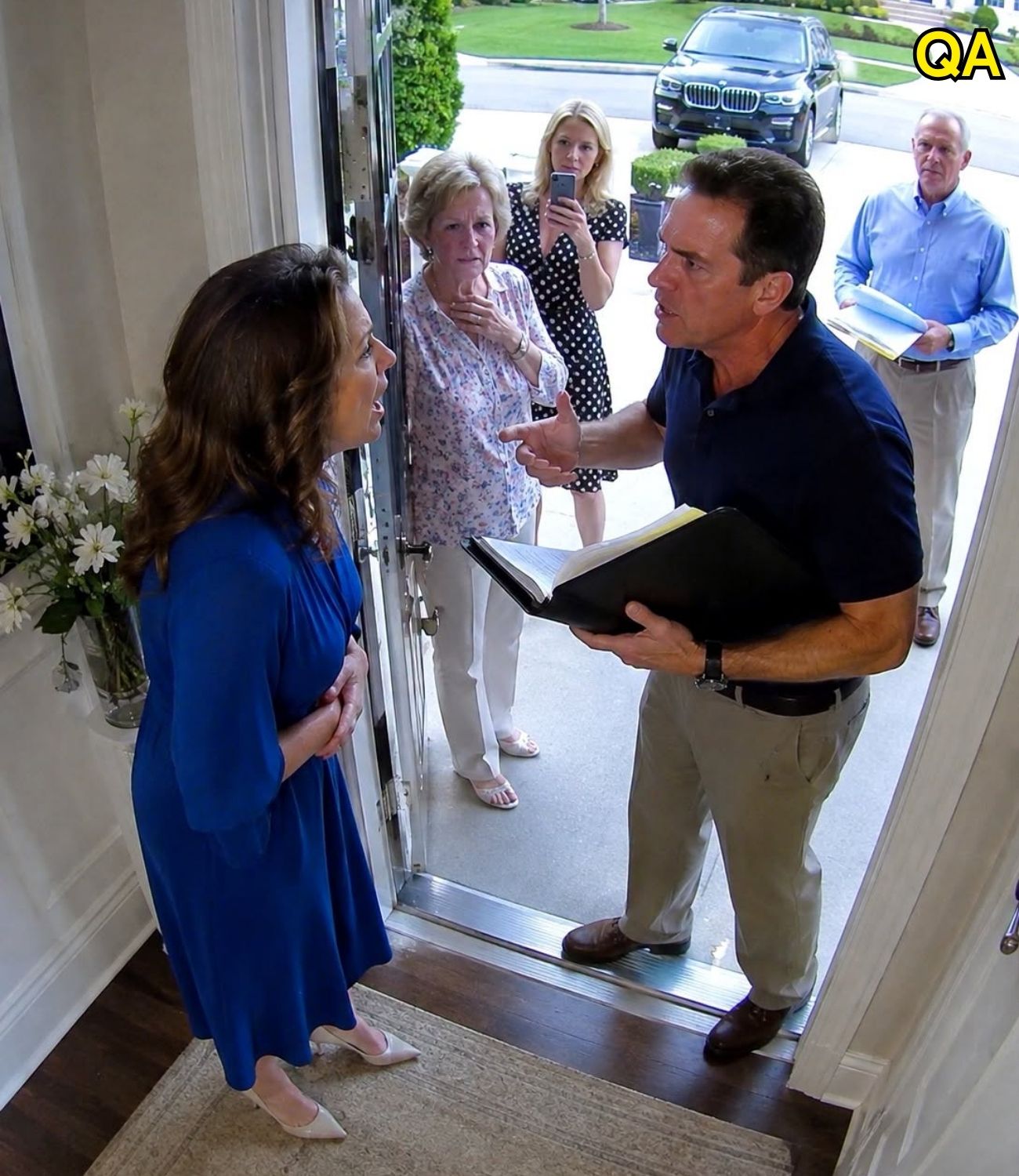
Irene pulled out her phone and began recording again, pointing the camera directly at my face. “Say it clearly, Stephanie. Tell the camera you’re throwing your own mother into the street because a teenager spilled soda on you.”
I looked straight into the lens. “My mother has a legally protected right to housing. You and Mike do not have the right to forge my signature, leverage trust property for personal debt, or teach your son that humiliating me is entertainment.”
Irene lowered the phone, her face pale.
That afternoon, Daniel and I met with the lender’s fraud investigation officer. The findings were far worse than expected.
The bank had recovered an email thread between Irene and Mom discussing the application. In one message, Irene asked what they should do if I refused to approve the expanded loan amount.
Mom had replied: “Use the signature from the roof repair form. Steph never reads everything when I tell her it’s for family.”
There it was. Not confusion. Not desperation. A deliberate plan.
Mom read her own words on the conference room monitor and began to weep. For most of my life, her tears had functioned as a command—a signal that I was supposed to stop asking questions and start comforting her.
I stayed seated and remained silent.
The bank formally canceled the refinance. Because I had reported the fraud before the funds were disbursed, they agreed not to pursue legal fees against the trust, but the forged authorization was referred to the state attorney’s office for review.
Mike’s SUV remained with the lender. His overdue balance didn’t disappear, nor did his mounting credit card debt.
The investigator asked if I wished to file a formal criminal complaint. Across the table, Mike stared at me. “You wouldn’t,” he whispered.
I remembered the cold soda soaking through my dress. The laughter around the table. Mom telling me not to ruin her birthday. Emma’s memory treated like an embarrassing stain everyone wished I would hide.
“I will provide a complete and truthful statement,” I told the investigator.
The review dragged on for several months. Irene eventually admitted to submitting the copied signature after Mom assured her I would sign off later. Mike claimed he hadn’t known the specifics of how the paperwork was obtained, though recovered text messages proved he knew personal debts were being hidden from me.
In the end, no one served prison time. The bank accepted a restitution agreement for its investigation costs, and Irene entered a pretrial diversion program after agreeing to cooperate. Mike was forced to resolve his vehicle default directly with his lender.
The consequences were far less dramatic than revenge stories suggest. They consisted of certified letters, formal payment plans, legal fees, and long, uncomfortable silences where my family finally had to sit with the reality of what they had done.
Mike and Irene refused the lease terms Daniel drafted. They moved into a smaller rental property across town and told our relatives that I had stolen their childhood home. The public land records, however, made that narrative impossible for anyone to believe.
Chapter 4: A New Foundation
Mom stayed in the house for four more months. Without Mike filling the rooms with noise and chaos, the house seemed far too vast for her.
She called me frequently—sometimes angry, sometimes tearful—but I stopped answering every call immediately. Setting boundaries felt harsh only because my family had spent decades training me to mistake unrestricted access for love.
Eventually, Mom conceded that the house was too expensive and difficult for her to maintain alone. Under the terms of the trust, I sold the property and purchased a modest, fully accessible two-bedroom condominium registered under the trust with protected lifetime occupancy for her. The remaining proceeds were locked into a secure maintenance fund, exactly as Dad had originally intended.
On the day she moved out of the old house, I found my unopened birthday gift sitting on the bare dining room table. The gold tissue paper was still folded around it.
“I opened it,” Mom said softly, stepping into the room.
Inside was a silver necklace featuring a small oval locket. One side held a photograph of Mom cradling Emma as a newborn. The other was engraved with four simple words from a card Emma had once made for her: LOVE DOESN’T DISAPPEAR, GRANDMA.
Mom touched the locket around her neck. “Why would you give me this after everything that happened?”
“I bought it before everything happened,” I replied.
She looked toward the empty hallway where Tyler had poured the drink. “I was jealous of your strength,” she admitted quietly. “After Emma died, you kept your business running. You helped the community shelter. You didn’t rely on me the way Mike did.”
“I needed a mother,” I said.
Tears welled in her eyes. “I know that now.”
I wanted those words to heal every past wound, but they couldn’t. They couldn’t undo the years she had spent rewarding Mike’s dependence while punishing my independence. They couldn’t erase that awful birthday dinner or the forged signature.
But her words were true, and truth was finally something solid enough to stand on without needing to pretend it was instant forgiveness.
“Knowing is the beginning,” I told her. “It isn’t the end.”
Two weeks later, Tyler came by my store. He carried a plain paper bag containing the exact cost of the ruined dress, earned from working weekend shifts at a local grocery store. He also handed me a handwritten letter that contained no excuses about his age, his parents, or the adults who had laughed.
I accepted the letter. I didn’t offer him a job or tell him everything was instantly forgotten, but I asked if he would be willing to spend a Saturday helping unload donations at the local shelter my store supported.
He showed up at seven o’clock that Saturday morning and worked silently for six hours without once taking out his phone. That action mattered far more than any speech.
A year after that fateful birthday, the legal affairs surrounding the trust were completely settled. My store expanded into the neighboring commercial space, and I named the new community workshop room after Emma. The inaugural program taught women leaving crisis situations how to build small retail product lines and establish financial independence.
Daniel attended the opening ceremony. So did Mom, wearing the silver locket.
Mike did not come.
I no longer measure love by who sits at my table out of obligation. I measure it by who can sit there without asking me to make myself smaller.
That evening, after the last guest had left, I locked the front door of the shop and placed the key beside Emma’s photograph on my desk.
For years, my family had treated belonging as a privilege they could grant or revoke at will. The deed proved the house had never been theirs to give away—and walking away from that table proved something even greater.
Neither was my dignity.
