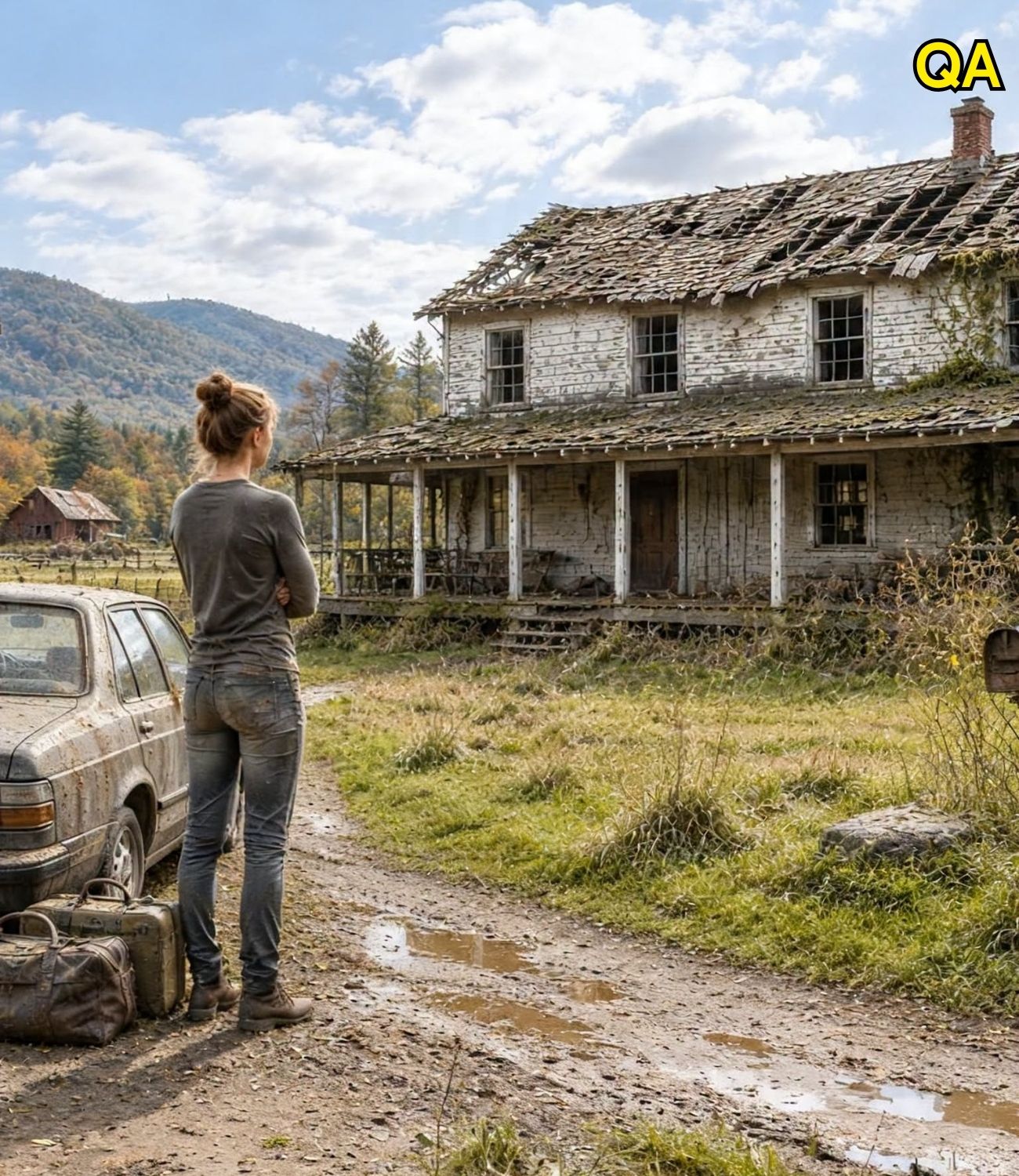

Chapter 1: The Will
My uncle smiled when the lawyer announced that my grandmother had left me nothing.
Not the farmhouse where I had spent every summer since I was six. Not the chipped blue bowl she used to make blackberry cobbler. Not even the rusted pocketknife she had once pressed into my palm and told me to keep for the day I learned that blood did not always mean family.
Nothing.
Then Uncle Richard leaned across the polished conference table and whispered, “Guess she finally figured out what you were worth.”
The lawyer heard him. My mother heard him. My cousin Mason heard him and covered a laugh with a cough.
I did not give Richard the reaction he wanted. I closed the leather notebook in front of me, placed my pen across it, and looked at the attorney.
“Is that the complete will, Mr. Hollis?”
Walter Hollis was seventy if he was a day, with silver eyebrows and hands that trembled only when they were still. He had handled my grandmother’s affairs for more than thirty years. That morning, his hands would not stop moving.
“It is the most recent document admitted for probate,” he said carefully.
“That isn’t what I asked.”
Richard’s smile thinned. My mother touched my wrist beneath the table. Her fingers were cold. “Claire,” she murmured. “Don’t.”
I moved my arm away.
Walter Hollis studied me for a moment. Then he glanced at Richard. “The document was executed eleven months ago,” he said. “There is also a codicil dated three months before your grandmother’s death.”
“Which says?” I asked.
“The codicil confirms that you are to receive no property, funds, personal effects, or interests from the estate of Evelyn Bennett.”
My mother inhaled sharply, though she had already heard the words once. I watched Hollis instead.
“Does it explain why?”
“No.”
“Did you witness her signature?”
“No.”
“Did anyone from your office?”
His gaze dropped. “No.”
That was the first crack. It was small, but Grandma Evelyn had taught me how to find weakness in a fence before the cattle did. She had taught me how to read what people avoided, and that when someone wanted you emotional, the smartest thing you could do was become very, very calm.
So I became calm.
The lake house went to Richard. Her investment accounts went to Richard. Her collection of antique furniture went to my mother, Denise, though Richard had already arranged for an auction company to appraise it. Mason received Grandma’s restored 1967 Ford pickup, two hundred thousand dollars, and her share in Bennett Freight Services. My aunt Marilyn received the jewelry.
The old farm was not mentioned. That absence interested me more than my own name.
“Where is Maple Hollow?” I asked.
Mason stopped smirking. Richard’s right thumb rubbed the edge of his tie clip.
“The farm is not part of the probate estate,” Hollis said. “It was transferred out of Mrs. Bennett’s name shortly before her death to Maple Hollow Agricultural Holdings.”
“Gone where?” my mother asked.
“Tax foreclosure,” Richard interjected dismissively. “The roof collapsed over the kitchen, the orchard is dead, and the creek ate half the south field. It’s a hundred and eighty acres of mud, mold, and unpaid bills.”
“Grandma never missed a tax payment in her life,” I said.
“She was eighty-two and sick,” Richard countered, his jaw tightening.
Mason tossed a set of truck keys onto the table. “Why do you even care? You left.”
Chapter 2: The Five Words
I had left Bellwether, Missouri, at twenty-three after Richard accused me of taking twenty thousand dollars from Grandma’s farm account. There had been no proof—just Richard standing in Grandma’s kitchen with a bank statement. My mother believed him because it was easier than challenging him. Grandma did not believe him, but she refused to explain why she would not defend me publicly. She only hugged me on the porch the night I packed my car and said, “Sometimes you save the house by letting the thief think he owns it.”
I moved to Kansas City, finished my accounting degree at night, and became a forensic auditor for an insurance investigations firm. I specialized in following paper trails when money disappeared.
I looked at Walter Hollis. “When is the foreclosure sale?”
“Friday morning. Ten o’clock. Cedar County courthouse steps,” Hollis replied.
Richard stood abruptly, ending the meeting. As he and the rest of the family filed out, my mother lingered, whispering for me not to do anything reckless.
Once the room cleared, Walter Hollis opened his desk drawer and removed a plain white envelope. My name was typed on the front.
“I received this yesterday,” he said. “It was left beneath the outer office door before dawn.”
Pressed into a dark red circle of wax on the flap was the outline of a small hen—Grandma’s private mark.
I had Hollis scan both sides before I opened it. Inside was a single index card with five words written in Grandma’s square handwriting:
BUY THE FARM. COME ALONE.
Below that was a string of numbers: 37–4–19–2.
Hollis stared at the card. “What does it mean?”
“I don’t know,” I lied.
Thirty-seven was the number of fence posts between the old dairy and the north pond. Four was the loose stone in the dairy wall. Nineteen was the row of floor tiles beside the milk drain. Two was the number of knocks Grandma used before opening any locked door.
It was a map.
Chapter 3: The Auction
I spent the next thirty-six hours digging into public records, corporate filings, and land registry logs.
Maple Hollow sat nine miles from Interstate 49 and less than two miles from an abandoned freight line. It was positioned directly in the middle of a confidential $620 million industrial development called Project Granite, managed by a Delaware firm named Argosy Continental. Without Maple Hollow, Argosy’s proposed logistics corridor required a costly nine-mile detour through wetlands.
Richard’s trucking company was deeply in debt, facing default on nearly three million dollars in loans. Argosy didn’t need to bribe Richard; they only needed to offer his business survival. He was helping orchestrate the quiet sale of the farm through shell companies to clear the land for development.
At eight Friday morning, my mother met me outside my hotel. She handed me a folded auction notice mailed to Grandma’s house six weeks before her death, with a handwritten note from Grandma across the top: Denise, make certain Claire sees this. Do not trust your brother.
My mother apologized through tears for not standing up for me years ago. I didn’t hold a grudge, but I took the paper and headed to the courthouse steps.
The county trustee opened bidding at twenty-six thousand, seven hundred thirty-one dollars.
A representative for Cobalt Ridge Acquisitions—an Argosy shell company—bid against me. The price climbed quickly: thirty thousand, thirty-four thousand, thirty-six thousand.
At thirty-seven thousand, the man hesitated and glanced at Richard, who stood near the back of the crowd.
Grandma’s first number on the card flashed in my mind: 37. She had known their cap before they even set foot on the steps.
“Thirty-seven thousand, six hundred,” I called out.
The man looked at Richard again, but Richard gave no sign. The trustee called it three times and slammed the gavel down.
“Sold to bidder twelve.”
As I walked inside to finalize the paperwork, Richard stepped into my path, his eyes cold. “You just bought a graveyard.”
“Then why did your bidder want it so badly?” I countered, holding up my receipt. “Eleven years of being underestimated made me smart, Richard. This just makes me the owner.”
Chapter 4: The Hen and the Key
At noon, I drove out to Maple Hollow. The old farm appeared slowly through the sycamore trees—the rusted entrance gate, the waist-high grass, and the sagging farmhouse with its collapsed kitchen roof.
The back door had been forced open. Inside, drawers were dumped and baseboards pulled away. Someone had torn the house apart searching for something small.
In the parlor, only one item remained on the mantel: a ceramic red hen with a chipped wing that I had painted at summer camp when I was nine.
I picked it up. Something rattled inside. Peeling back a fresh circle of felt from the base, a small brass key fell into my palm. Its bow was shaped like a four-leaf clover.
Four. The second number.
I carried the key two hundred yards north to the stone dairy building. Counting thirty-seven fence posts from the old pond, I located the fourth stone from the north corner of the dairy wall. A small clover was scratched into the mortar beside it.
I inserted the brass key into a hidden slot behind the stone and turned it. Then I knocked twice.
Metal clicked inside the wall, and the stone shifted outward. Behind it rested a heavy steel key and an oilcloth holding a note:
Nineteen tiles. Bring light. Trust Eli.
I knew Eli Parker. He had grown up on the neighboring farm, served in the Army, and now ran a local vehicle repair shop. I called him immediately. Within twelve minutes, his dark green Ford truck pulled up to the dairy.
He looked at the tire tracks near the gate and frowned. “Those belong to Mason’s truck. You shouldn’t be here alone, Claire.”
Eli explained that before Grandma died, Richard had taken her checkbook, changed her locks, and forced her out. Grandma had instructed Eli to watch the property but not to contact me unless I officially bought the farm at auction.
“She said if you came back too soon, Richard would know where to look,” Eli said.
Chapter 5: The Hidden Vault
We cleared the threshold of the stone dairy and entered the milk room. The floor was covered in six-inch cream-colored tiles.
I counted nineteen tiles from the north wall. The nineteenth tile had a hairline crack along its edge. Eli used a suction cup from his toolkit to lift it, revealing a steel plate beneath with a clover-shaped keyhole.
I inserted the heavy steel key and turned it. A section of the floor released with a low mechanical thud.
Together, we pulled up a square hatch, exposing a steel ladder descending twelve feet into the dark. Eli ran an air quality test before we climbed down into a concrete bunker stretching ten feet wide and twenty feet long beneath the dairy floor.
Shelves lined the walls, holding hundreds of glass canning jars filled with heirloom seeds, each neatly labeled in Grandma’s handwriting: Bennett Gold Dent 1932, Ruth’s October Bean 1948, Blue Creek Winter Wheat 1919.
Grandma had built a private seed bank—a preservation vault for rare, non-patented crops capable of surviving harsh climate shifts.
At the far end stood a workbench. Three metal cash boxes sat open, their locks forced open years prior. Flakes of rust inside confirmed they had been cleared out long before Mason’s recent break-in.
Eli pointed his flashlight toward a heavy wooden cabinet against the back wall.
“Look here,” he whispered.
I stepped closer. Fresh scratches marked the concrete around the cabinet’s legs. Someone had tried to move it recently, but failed.
I pulled open the cabinet doors. Inside hung rows of old work coats, but behind them, the back panel of the cabinet held a keypad and an iron wheel mechanism embedded directly into the solid rock face.
Grandma hadn’t just built a seed bank. She had secured the real evidence of Richard’s fraud in an airtight vault beneath the farm—and now I had the keys to open it.
