
Chapter 1: The Wine Glass
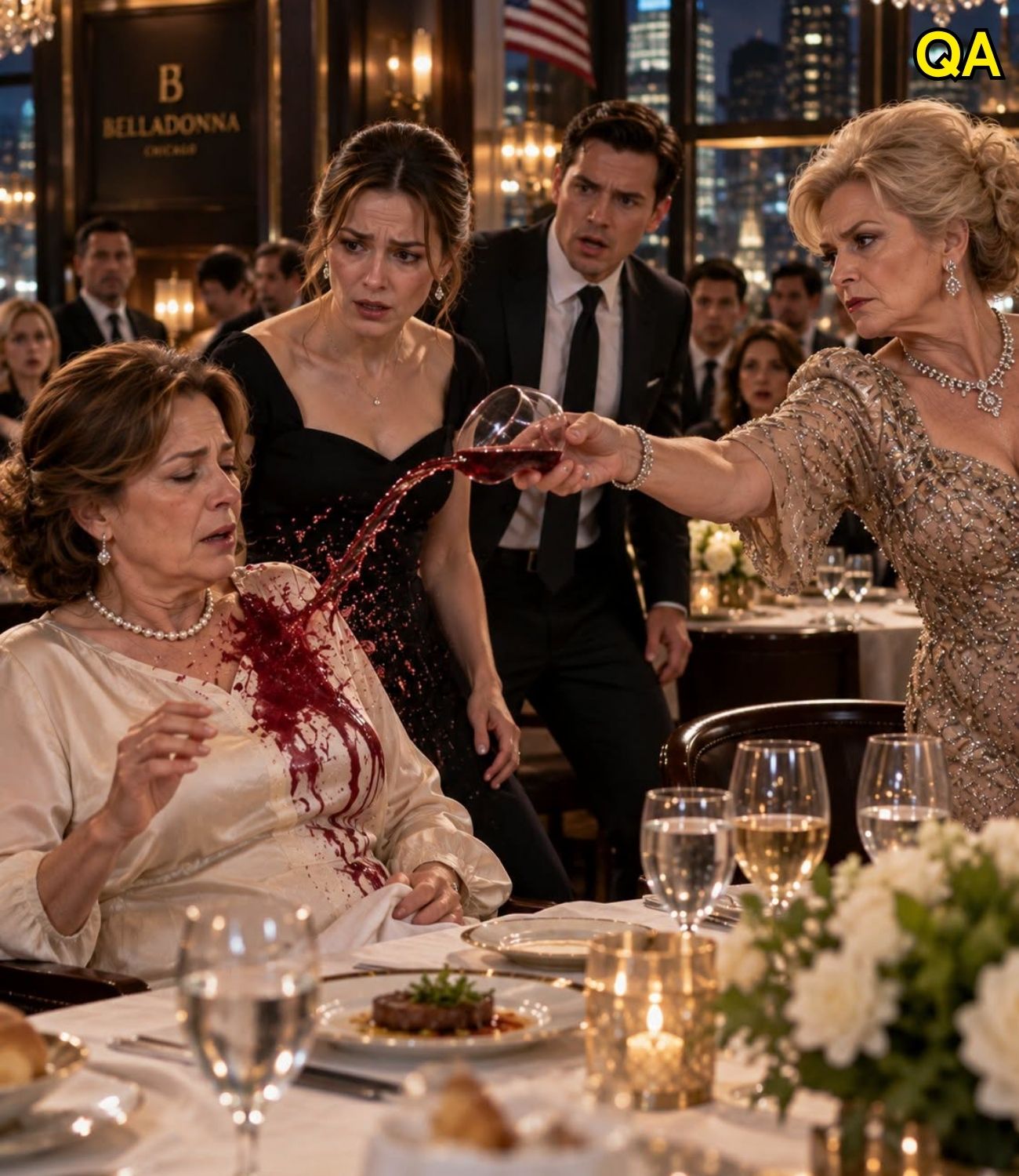
The wine hit my mother in the face before anyone at the table had time to understand what was happening. One second, Vivian Mercer was standing beside our table at Belladonna, one of Chicago’s most prestigious restaurants, arguing with my mother about something so insignificant I can barely remember the original subject. The next, half a glass of expensive Cabernet was dripping from my mother’s cream blouse, staining the white tablecloth and splashing across the silverware.
The dining room went silent. Even the pianist seemed to hesitate for half a beat. My mother, Eleanor Reed, sat perfectly still, one hand resting on the table as a red drop slowly rolled from her sleeve onto the floor.
Across from me, my fiancé, Ethan Calloway, shot to his feet. “Mom! What are you doing?”
Vivian barely looked at him. Her eyes remained fixed on me. “This,” she said coldly, “is what happens when people forget their place.”
I knew exactly what she meant. For three years, I had worked at Belladonna after finishing college, first as a server and eventually as an operations consultant for several of its private events. I had stayed because I liked the work, because I enjoyed learning the business from the ground up, and because earning my own money mattered to me. Vivian knew I worked there. What she didn’t know was that she had spent three years completely misunderstanding why the managers always treated me with unusual respect, why senior staff consulted me about difficult events, and why the executive chef sometimes asked my opinion before putting a new dish on the menu.
To Vivian, I was simply a waitress. Worse, I was a waitress marrying into a family she considered superior.
She leaned toward my mother with a contemptuous smile. “Ethan could have married into a respectable family. Instead, he chose a girl who serves tables for a living.”
My mother’s face tightened, but she didn’t answer. I did. “That’s enough.”
Vivian laughed. “Oh, please. Don’t pretend you belong in rooms like this just because you’re getting married.”
That word—belong—hit me harder than the wine had hit my mother. For three years, Vivian had picked at everything about my family. Our clothes. Our neighborhood. My mother’s accent. The fact that I had chosen to work instead of living off my family’s money. She had even once told Ethan that marrying me would “lower the family standard.” He had always asked me to ignore her, telling me she was just difficult. But difficult was one thing; cruel was another.
Vivian raised her glass again. “This entire evening is being ruined because people like you don’t know how to behave.”
I stood. My mother gently touched my wrist. “Emily, don’t.”
Before I could answer, a man approached from across the dining room. It was Robert Dawson, Belladonna’s general manager. Behind him were two security officers.
Vivian smiled triumphantly. “Good. Finally, someone sensible. Please remove them.”
Robert stopped beside me. “Ms. Reed?”
“Yes?”
“Would you like me to call the police?”
Vivian blinked. “Why would you ask her that? I was the one who was insulted.”
Robert didn’t answer her. He was looking at me. I glanced toward the small security camera mounted high above the dining room. “Not yet,” I said.
Vivian followed my gaze. Her expression changed slightly.
I looked back at her. “You know, there’s something you don’t know about Belladonna.”
She folded her arms. “And what’s that?”
“My father owns it.”
She laughed. It was the last confident sound she made that evening. “What?”
I took a breath. “He owns Belladonna Restaurant Group. He owns this building. And he owns the private events company handling your daughter’s engagement party and our wedding.”
Vivian stared at me. Ethan slowly turned toward me. “What?”
The side door opened. My father, Thomas Reed, walked out from his office. He had been in the building the entire time. He looked at my mother’s wine-soaked blouse, and then at Vivian. His expression was so calm that it frightened me more than anger would have.
“Robert,” he said quietly, “preserve the footage.”
Vivian’s face went pale. “The footage?”
My father looked at her. “Every second.”
The restaurant remained silent. No one spoke. No one moved.
Then Vivian whispered, “You own this place?”
My father nodded. “Yes.” He glanced toward my mother. “And apparently, someone just assaulted a member of my family in one of my restaurants.”
That was when Vivian finally understood. The woman she had spent years calling a poor waitress was not an outsider. She was the owner’s daughter. And every insult Vivian had just thrown across that table had been recorded.
Chapter 2: The Camera Never Forgets
For several seconds, Vivian simply stared at my father. Then, as people like her often do when the truth becomes inconvenient, she changed the story. “It was an accident.”
My mother looked at her. “You poured it directly at me.”
“I was upset.”
“You called my daughter a poor waitress.”
“I was angry.”
“You said she wasn’t good enough for your son.”
Vivian looked toward Ethan. “Ethan knows how stressful this wedding has been.”
Ethan’s face was pale. “Mom, stop.”
She turned on him. “You’re taking their side?”
Ethan looked at the wine dripping from my mother’s sleeve. “No. I’m taking the side of reality.”
That sentence seemed to wound Vivian more than anything else. My father quietly instructed Robert to preserve all surveillance footage from the dining room, the private hallway, and the surrounding entrance cameras. Then he told me to take my mother upstairs to his private office.
Downstairs, my father began reviewing the footage. What appeared on the screen was worse than I remembered. Vivian had spent nearly twenty minutes insulting us before the wine was thrown. The recording showed everything: no misunderstanding, no accidental movement. Vivian picked up the glass deliberately, leaned forward, and threw it.
Then Robert entered with another folder. “There’s something else. We found unusual financial activity connected to the wedding.”
I looked at him. “What kind of activity?”
“Payments that were supposedly made by Vivian. She has been telling vendors that the Calloways are paying for the reception. They aren’t. Your father is covering the venue. Your family is covering the catering. Vivian has been telling outside vendors she arranged premium transportation, upgraded wine service, and several private suites.”
My father looked at the documents. “Did she pay for any of them?”
“Almost none.”
Then my father’s phone rang. It was Vivian’s husband, Harold Mercer. He sounded exhausted. “Thomas, I think you need to know what she’s been doing.”
My father put him on speaker. Harold explained that Vivian had been telling potential investors she had an official partnership with Reed Hospitality Group—using my father’s restaurant and venue as leverage to attract deposits and investment money for a luxury event-planning company she was trying to launch.
“How much?” my father asked.
Harold hesitated. “Nearly sixty thousand dollars.”
My stomach tightened. “What did she promise them?”
“Exclusive access to your properties.”
My father closed his eyes. “She forged my name.”
Harold answered quietly, “Yes.”
Ethan stood up. “Mom did all that?” His father said nothing. And suddenly, the wine glass didn’t feel like an isolated act of cruelty anymore. It felt like the eruption of something much larger.
Chapter 3: The Lie Behind the Wedding
By the next morning, my father’s attorneys had delivered Vivian a formal cease-and-desist notice. She was ordered to stop using Reed Hospitality Group’s name, return all money obtained through false representations, and stay away from all Reed properties. Attached to each notice were copies of the security footage.
Vivian called Ethan twenty-seven times and me nineteen times. I answered neither. Then she sent Ethan a voice message crying, accusing us of humiliating her, and saying I had turned everyone against her. Ethan listened twice, then blocked her number.
That evening, Ethan came to my apartment. He didn’t bring flowers or make excuses. He simply sat across from me. “I owe you an apology.”
“Yes,” I said.
He took a breath. “I spent years asking you to ignore her because I was afraid of confronting her. I thought if I kept everyone calm, things would improve. I was wrong. I watched her insult your family over and over and convinced myself that silence was the same thing as peace.”
I looked at him. “You don’t get to apologize once and expect ten years of damage to disappear.”
“I know.”
“Do you?”
He nodded. “Yes. I don’t want to become my mother.”
That was the first thing he had said that made me look at him differently. Because he finally understood the real problem: cruelty survives not because nobody notices it, but because the people who notice it are too afraid to challenge it.
Chapter 4: The Wedding That Nearly Didn’t Happen
Six weeks later, our wedding day arrived at The Rowan House, one of my father’s private event venues overlooking the Chicago River. Harold and Vivian had separated, several former business partners were demanding their money back, and her event-planning company had collapsed.
Exactly one hour before the ceremony, security called my father: “She’s here.”
I was in the bridal suite. My heart stopped. “Who?”
“Vivian.”
She had arrived wearing an extravagant designer gown, carrying herself as though she had every right to walk through the doors.
My father looked at me. “What do you want me to do?”
I thought about that dinner, the wine, my mother’s face, and my conversation with Ethan the night before. I told my father, “Let her come inside. But no one humiliates her.”
Security escorted Vivian into a private room, and I went in alone. She looked at me with tears in her eyes. “I just wanted to see my son get married.”
“You could have come without insulting my mother,” I said.
She lowered her head. “I know.”
I sat across from her. “You spent years trying to prove that my family was beneath yours. Why?”
She took a long breath. “Because I was terrified.”
She explained that her business had been failing long before anyone knew. She had accumulated debts trying to maintain a lifestyle she believed her family deserved, lying and manipulating to keep up appearances. Whenever she felt herself losing control, she attacked someone she thought had less power. “You were easy to look down on.”
“I know,” I replied.
She began crying. “I hated that you didn’t need any of the things I spent my whole life chasing.”
Suddenly, I understood that beneath all her arrogance had been fear. It didn’t excuse what she did, but understanding it helped me let go of the hatred.
“The ceremony starts in twenty minutes,” I said, standing up.
She looked up. “Can I stay?”
“You can sit in the back,” I told her.
Her eyes filled with tears. “Thank you.”
“Don’t thank me. Just behave.”
For the first time, Vivian gave a small, broken laugh. “I will.”
Chapter 5: The Truth Finally Caught Up with Her
Vivian didn’t interfere with the ceremony. She sat quietly in the back row. When Ethan saw her, he looked at me, and I simply nodded. The ceremony went ahead beautifully: my mother walked me down the aisle, my father stood proudly beside us, and Ethan took my hands with genuine humility.
After the ceremony, the legal consequences continued moving forward. The fraudulent investment agreements were investigated, false claims of partnership were withdrawn, and investors she had misled were compensated through a settlement. My father refused to turn it into a public spectacle; he simply demanded accountability.
Vivian eventually sold several luxury items to repay debts, her business disappeared, and Harold divorced her. But something unexpected happened: she began volunteering at a women’s financial-literacy organization, admitting publicly that she had spent years confusing appearance with worth.
I didn’t become her best friend, but I stopped seeing her as a villain and started seeing her as a deeply flawed person who finally had to confront herself.
Chapter 6: The Woman They Called a “Poor Waitress”
Two years after the wedding, Belladonna opened a new training program for young hospitality workers, and my father asked me to lead it. We gave scholarships to young people who wanted careers in restaurants but couldn’t afford culinary school.
One afternoon, I interviewed an eighteen-year-old girl who worked two jobs while finishing high school, dreaming of becoming a pastry chef. When I handed her a scholarship acceptance letter, she started crying and hugged me.
That moment reminded me of that restaurant dinner years earlier. I finally understood that there had never been anything shameful about being a waitress, earning your own money, or starting at the bottom. The shame belonged to people who believed another person’s job determined their worth.
Years later, Ethan and I had a daughter named Grace. My father loved her, my mother taught her how to bake, and Vivian eventually became part of our lives again on completely different terms—with firm boundaries, honest conversations, and no more pretending.
One Christmas Eve, I found Vivian sitting beside Grace near the fireplace.
Vivian looked up at me. “She has your mother’s kindness.”
I smiled. “And your son’s stubbornness.”
We both laughed. Then Vivian became quiet. “I’ve thought about that night at Belladonna a thousand times. Because I thought I was humiliating you. But all I really did was expose myself.”
She reached for my hand. “I am sorry.”
This time, I believed her—not because she had earned back every ounce of trust overnight, but because she had stopped asking me to forget.
Epilogue: What Real Class Looks Like
My father retired five years later. Before his retirement party, he showed me the original security-camera report from the night Vivian threw the wine.
“Do you still have this?” he asked.
“Yes.”
“Why?”
“Because I don’t want to forget,” I said.
He nodded. “Good. But don’t confuse remembering with holding a grudge.”
He was right. I didn’t keep it because I hated Vivian. I kept it because that night taught me something invaluable: people reveal themselves when they believe you have no power. Some reveal kindness, some reveal cruelty, and some reveal fear. But none of them get to decide your worth.
The last time I walked through Belladonna’s dining room, a young server smiled and greeted me. I smiled back, looking at the polished tables and the people laughing over dinner.
I thought about the woman Vivian had called a poor waitress. She had never been poor; she had been working. There is a difference between having money and having class. And sometimes, the most powerful response to humiliation is not revenge, but living a life that proves your worth was never theirs to define.
