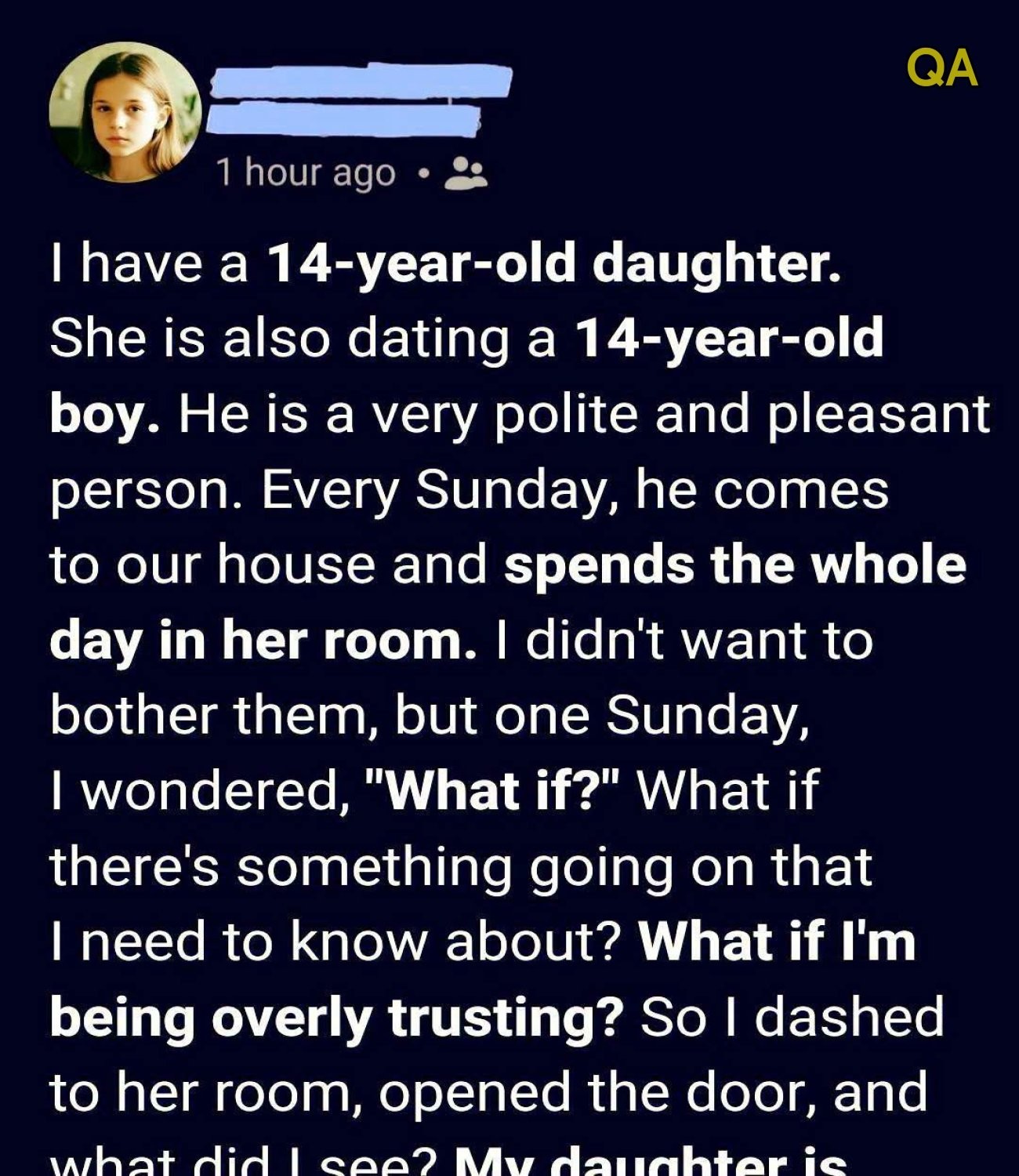

I Burst Into My Teen Daughter’s Room in Panic …What I Saw Left Me Frozen
Editor’s note: The story below is presented as a personal anecdote and cannot be independently verified. Rather than treating it as a factual news report, this article examines the broader, well-documented themes it raises: parental worry, teenage privacy, healthy communication, and the value of youth community involvement.
Parenting teenagers often involves a difficult balance between supervision and trust. As children move through adolescence, they usually seek more independence, private time, and opportunities to make decisions without constant adult direction. For parents, that transition can bring uncertainty. A closed bedroom door, a new relationship, or an unfamiliar quietness in the house may trigger concern even when there is no evidence that anything is wrong.
The anecdote titled I Burst Into My Teen Daughter’s Room in Panic …What I Saw Left Me Frozen turns on that familiar tension. A mother worries about her 14-year-old daughter spending regular Sunday afternoons with a classmate. When she enters the room unexpectedly, she expects to find behavior that confirms her fears. Instead, she sees the teenagers planning a community literacy project intended to help the girl’s grandfather reconnect with a sense of purpose after a stroke.
Its emotional conclusion is simple: assumptions can obscure positive realities. Yet the underlying issues are more complex. Families benefit when adults protect young people’s safety while also respecting their developing autonomy, listening carefully, and creating space for honest conversation.
Why Parents Worry About Teenage Privacy
Adolescence is a period of rapid emotional, social, and cognitive development. Teenagers often place growing importance on friendships, peer acceptance, romantic interests, and personal identity. Privacy can be a normal part of this process. It allows young people to reflect, communicate with friends, pursue interests, and practice independence.
For parents, however, privacy can be difficult to interpret. A teenager who spends more time in their room may simply be reading, studying, creating art, playing a game, messaging friends, or working on a school project. In other cases, a change in routine may be worth discussing, particularly if it appears alongside withdrawal from family, declining school engagement, persistent sadness, sleep changes, or other signs that a young person may need support.
Health organizations generally encourage parents and caregivers to keep communication open rather than relying only on surveillance or suspicion. The U.S. Centers for Disease Control and Prevention notes that connected relationships with caring adults can support adolescent well-being. Connection does not mean abandoning household rules. It means setting clear expectations, being available, and approaching concerns in a way that makes a teenager more likely to speak honestly.
In practical terms, parents can establish reasonable family expectations before problems arise. These may include rules about visitors, open-door policies when appropriate, shared spaces, check-ins, digital safety, school responsibilities, and respectful conduct. The details will vary by family, culture, maturity level, and household circumstances. What matters most is that rules are clear, consistent, and explained rather than imposed without discussion.
Trust and Boundaries Can Coexist
The central parent-child conflict in the story is not really about a bedroom. It is about uncertainty. The mother wants to keep her daughter safe, but she also does not want to become controlling or dismissive. Many caregivers recognize that dilemma.
Trust should not be confused with a lack of boundaries. Healthy trust often grows through everyday habits: teenagers following agreed schedules, parents responding calmly when mistakes happen, and both sides discussing concerns before they become confrontations. A parent can ask who will be visiting, what activities are planned, and whether an adult will be nearby without treating a child as though they have done something wrong.
Likewise, teenagers can benefit from understanding that parental questions are often motivated by care. That does not mean every parental reaction is ideal. Adults can make assumptions, become anxious, or react too quickly. When this happens, acknowledging the mistake can strengthen a relationship. An apology from a parent can model accountability and show a teenager that respect goes both ways.
Family communication experts frequently recommend using open-ended questions. Instead of asking, “What are you doing in there?” in an accusatory tone, a caregiver might say, “How is your afternoon going?” or “Is there anything you are working on that you would like help with?” These approaches leave room for conversation. They also reduce the chance that a young person will feel interrogated.
Teen Relationships and Age-Appropriate Guidance
The story includes two 14-year-olds who are described as dating. Early adolescent relationships can be an important part of social development, offering young people opportunities to learn about communication, consent, mutual respect, boundaries, and emotional responsibility. Adults can play a constructive role by discussing these topics in age-appropriate, nonjudgmental language.
Guidance is especially useful when it focuses on values and safety rather than shame. Parents and caregivers can talk with teenagers about kindness, respect for personal boundaries, the importance of never feeling pressured, online privacy, and how to seek help from a trusted adult. These conversations are most effective when they happen regularly, not only after a parent becomes worried.
It is also important to avoid making broad assumptions about teenagers based on whether they are quiet, private, or spending time with a friend. Behavior should be considered in context. A calm afternoon behind a closed door is not, by itself, evidence of a problem. At the same time, parents should feel able to maintain appropriate oversight and intervene if there are genuine safety concerns.
The Positive Role of Youth Volunteering
The surprise in the anecdote is that the two teenagers are designing a literacy initiative. Although the specific project in the story is unverified, youth volunteering and service-learning are real activities with potential benefits for young people and their communities.
Community service can help teenagers develop practical skills such as planning, teamwork, public speaking, budgeting, writing, and problem-solving. It can also introduce them to people of different ages and backgrounds. Projects involving reading support, neighborhood cleanups, food assistance, mentoring, arts programs, or local community centers can help young volunteers understand how collective action addresses everyday needs.
A literacy project, for example, might involve collecting age-appropriate books, organizing a reading event, helping younger children select materials, or supporting staff at a library or community center. Such efforts should be coordinated with qualified adults and local organizations. Volunteers, particularly minors, need clear responsibilities, safeguarding procedures, and supervision that fits the setting.
Community organizations can make volunteering more meaningful by giving young people real, manageable roles rather than treating them only as helpers. Teenagers may be able to design posters, help create an event schedule, prepare book lists, welcome participants, or suggest activities that make reading enjoyable. When adults take young people’s ideas seriously, they can foster confidence and civic engagement.
Supporting Older Adults After a Stroke
Another important theme in the story is the grandfather’s effort to remain useful after a stroke. Stroke recovery varies widely depending on the type and severity of the stroke, a person’s overall health, and the support available. Some people experience lasting changes in mobility, communication, memory, mood, or energy. Others regain many abilities through rehabilitation and time.
For many older adults, recovery is not only a medical process. It can also involve rebuilding routines, confidence, and social connections. Feeling included in family life and community activities may support emotional well-being. However, relatives should avoid assuming what a person can or cannot do. The best approach is to ask the individual what roles feel meaningful and manageable, while following advice from their health care team.
A former teacher may enjoy helping choose children’s books, sharing memories of the classroom, reviewing a program plan, or offering encouragement to volunteers. Depending on communication and physical abilities, they may also participate directly in a community activity. Small contributions can matter. The goal should be inclusion and dignity, not pressure to return immediately to previous levels of activity.
The World Health Organization emphasizes the importance of rehabilitation and long-term support for people living with the effects of stroke and other health conditions. Families can ask medical professionals about rehabilitation services, communication support, emotional health, and local resources. Community centers, stroke associations, libraries, and senior programs may also provide opportunities for safe social participation.
How Families Can Turn Concern Into Conversation
The lasting lesson of the story is not that parents should ignore their instincts. It is that concern is most helpful when it leads to communication rather than immediate judgment. A parent who notices a change in a teenager’s behavior can pause, gather context, and begin a calm conversation.
Useful steps may include:
- Choose a quiet moment rather than raising concerns in the middle of conflict.
- Describe what you have noticed without making accusations.
- Ask open questions and listen to the answer fully.
- Explain household expectations clearly and fairly.
- Encourage teenagers to come to a trusted adult if they feel unsafe, pressured, or overwhelmed.
- Recognize responsible behavior and positive contributions when you see them.
- Seek professional support if a young person shows persistent signs of emotional distress or if family conflict becomes difficult to manage.
Trust is not a one-time decision. It is built gradually through reliable behavior, mutual respect, and repair after misunderstandings. Teenagers need adults who are attentive and protective, but they also need adults who can recognize their growing capacity for empathy, initiative, and good judgment.
A Reminder to Look Beyond First Impressions
The dramatic framing of “what I saw left me frozen” reflects a common storytelling device: fear gives way to relief and pride. Real family life is rarely so neatly resolved. Parents may still have questions, teenagers may still want more privacy, and families may not always agree on the right boundaries.
Nevertheless, the story offers a constructive reminder. A closed door does not automatically indicate danger, and a worried parent is not automatically unreasonable. The healthiest response is often to combine awareness with empathy. By talking openly, setting appropriate limits, and celebrating young people’s positive choices, families can turn anxious moments into opportunities for connection.
When teenagers are trusted with meaningful responsibilities, whether at home, at school, or in the community, they can demonstrate qualities that adults may not always expect: creativity, compassion, persistence, and a genuine desire to help others. Those qualities deserve support, recognition, and room to grow.
Sources
Disclaimer: This content is intended for entertainment purposes only and is not based on real events.