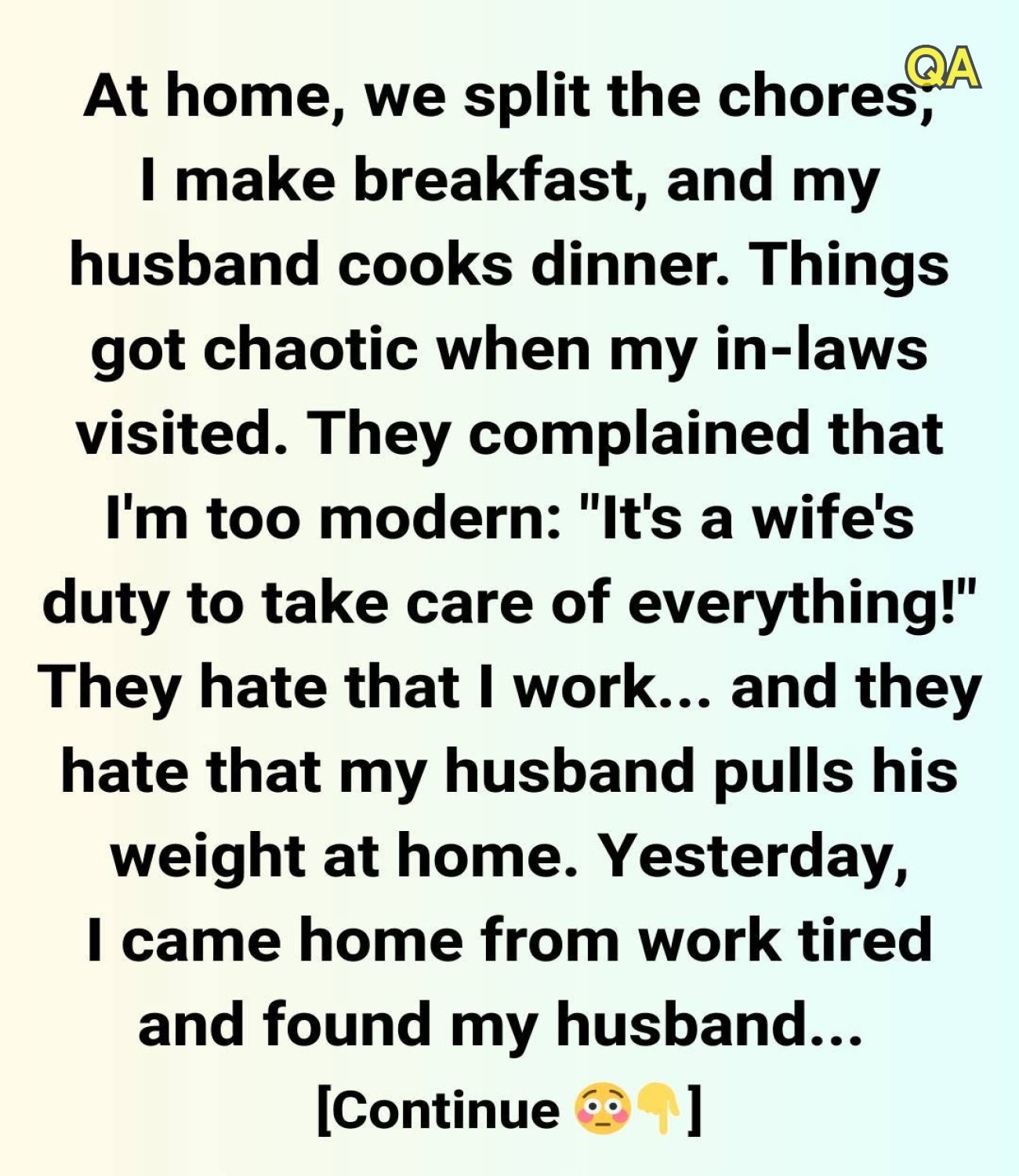

Marriage often brings together two people with different family backgrounds, values, and expectations. While couples may agree on how they want to build their lives together, tensions can arise when relatives have strong opinions about traditional gender roles. For one working mother, the conflict became particularly painful when her mother-in-law decided that being a good wife meant taking responsibility for every household task.
What began as an uncomfortable family visit eventually exposed a deeper disagreement about marriage, financial independence, respect, and the importance of standing together as partners. The incident also forced a difficult question: Can a marriage remain balanced when one partner allows parental expectations to undermine the agreements made within the relationship?
Growing Up With Different Ideas About Marriage and Family
My husband and I were raised in very different households, and those differences shaped how we viewed marriage long before we became parents.
My husband grew up in a family where traditional gender roles were considered normal. His mother stayed home, raised the children, managed the household, and took care of nearly all the domestic responsibilities. His father worked outside the home and provided financially for the family.
That arrangement was familiar to him, but my childhood taught me a different lesson.
My mother worked hard throughout her life. She believed women should have opportunities to support themselves financially and make independent decisions. One message she repeated was simple: Never become financially dependent on a man.
Her advice was not about distrusting relationships or rejecting marriage. Instead, she wanted me to understand that financial independence provides security, confidence, and the freedom to make important life decisions.
Consequently, when I got married, I never imagined giving up my career simply because I had become a wife. I wanted to continue working, earn my own income, and build a household where both partners contributed according to their circumstances.
Fortunately, my husband initially appeared to share those values.
Building an Equal Partnership as Working Parents
Although my husband had grown up watching his mother manage the household, he made a conscious effort to establish a different kind of family life.
He cooked meals, cleaned the house, helped care for our children, and attended parent-teacher meetings. He understood that raising children and maintaining a home were shared responsibilities rather than duties automatically assigned to women.
Our arrangement worked well for years. I generally prepared breakfast, while lunch was taken care of at work or school. My husband usually prepared dinner, and we shared the remaining household responsibilities.
We also hired a cleaner to help maintain the house. This arrangement allowed both of us to balance professional commitments with family life without expecting either person to carry the entire domestic workload.
Research on household labor and family relationships frequently examines how couples divide unpaid work, childcare, and employment responsibilities. Although every family develops its own arrangement, a recurring issue in discussions about work-life balance is whether both partners consider their contributions fair.
For us, equality did not mean dividing every task into precisely equal portions. It meant recognizing that both people worked, both contributed, and neither partner should automatically be expected to perform all domestic duties.
For a long time, I believed we had found a sustainable balance.
My In-Laws Never Approved of Our Modern Family Arrangement
Unfortunately, my husband’s parents did not share our perspective.
They disapproved of me continuing to work after becoming a mother. They considered me overly independent and frequently questioned why my husband cooked dinner or participated so actively in household responsibilities.
They also disliked the fact that we hired someone to help clean the house. In their opinion, a wife should naturally take responsibility for keeping her home organized, preparing meals, and looking after her family.
To them, my priorities represented a departure from what they considered appropriate behavior for a married woman.
I understood that their opinions came from the environment in which they had been raised. Their marriage followed a particular arrangement, and they believed that arrangement had worked for their family.
However, I did not believe their personal choices gave them the right to determine how my marriage should function.
We discussed the issue directly during the early years of our relationship. I explained respectfully that I had no intention of criticizing their lifestyle, but I expected them to extend the same courtesy to me.
I made it clear that they were welcome in our home, but they could not dictate what kind of wife or mother I should become.
For the most part, they appeared to accept those boundaries. That changed when they came to stay with us for two weeks.
A Two-Week Visit Creates Unexpected Household Tension
Our usual routine continued during the visit. I prepared breakfast, everyone arranged their own lunch, and my husband generally handled dinner.
Our regular cleaner happened to be on holiday, meaning the house required a little more attention than usual. Nevertheless, my husband and I simply cleaned up after ourselves and maintained our normal responsibilities.
I did not see a reason to reorganize our entire household simply because we had guests. We were both working, and our existing arrangement had been established through mutual agreement.
Then one evening, an incident occurred that changed the atmosphere in our home.
I arrived home from work at approximately 6:20 p.m. Feeling exhausted and hungry, I took a quick shower before going downstairs. Dinner was normally served around seven, so I expected my husband to have started preparing the meal.
Instead, I discovered that nothing had been prepared.
There were no ingredients ready, no dishes arranged, and no indication that anyone had planned dinner.
Confused, I asked my husband what had happened and whether we were still eating at our usual time.
Before he could respond, my mother-in-law interrupted.
She explained that her son had decided not to cook that evening. Then she turned toward me and suggested that it was time for me to fulfill my responsibilities as a wife by preparing dinner for the family.
My husband avoided looking at me.
At that moment, I realized that this was not simply an unexpected change in plans. It seemed that my in-laws expected me to abandon our normal arrangement and take over the cooking because they believed it was my responsibility as a woman.
Ordering Takeaway Instead of Accepting Their Expectations
I decided not to turn the kitchen into an argument.
Instead of putting on an apron and preparing a meal to satisfy my mother-in-law’s expectations, I picked up my phone and ordered takeaway.
When the food arrived, I served myself and the children before sitting down to eat. Eventually, my husband and his parents joined us.
However, the disagreement did not end there.
During dinner, my mother-in-law began explaining why she believed women should take greater responsibility for their homes. She spoke nostalgically about earlier generations, when women were expected to prioritize domestic responsibilities and family life.
She criticized modern women for concentrating too heavily on their careers and suggested that children needed mothers who were more available at home.
Then she directed her criticism toward me personally.
She called me a failure as a wife.
I was deeply hurt, but I still hoped my husband would intervene. I wanted him to remind his parents that our household arrangements were decisions we had made together.
Instead, he surprised me by agreeing with his mother.
My Husband’s Response Hurt More Than My MIL’s Criticism
When I asked my husband whether he had anything to say, he initially remained quiet. Eventually, he admitted that he thought his mother had a point.
He suggested that I should behave more like a traditional woman and pay greater attention to the household.
He also argued that traditions existed for a reason and implied that my approach suggested I considered myself better than the way he had been raised.
His response was especially painful because it contradicted the partnership we had spent years developing.
My husband had previously demonstrated that he understood the importance of shared responsibilities. He had willingly cooked, cleaned, participated in childcare, and supported my career.
We had built a family based on those shared values. Yet, when his parents challenged our choices, he appeared willing to abandon that agreement to gain their approval.
I finally responded with a remark about our financial circumstances. My husband earned approximately $35,000 annually, and I questioned how he could expect to support a family of five on that income alone while insisting on a traditional arrangement.
Then, in the heat of the moment, I added that he was too financially stretched to behave so confidently about traditional gender roles.
The comment immediately changed the atmosphere at the table.
My husband’s expression fell. His eyes filled with tears, and he quietly stood up and left the room.
His parents remained silent, while I sat at the table trying to process what had just happened.
Recognizing the Difference Between Standing Firm and Being Hurtful
As my initial anger faded, I began to feel uncomfortable about the way I had handled the confrontation.
I still believed that my mother-in-law had crossed a boundary and that my husband should have supported the partnership we had established. However, I also recognized that my financial remark had been deliberately hurtful.
What made the situation more complicated was that our children had witnessed the argument.
Children learn about relationships not only through what parents tell them but also through how adults handle disagreements. A household disagreement can become an opportunity to demonstrate respectful communication, but it can also become unnecessarily distressing when personal attacks replace constructive discussion.
I regretted making the comment in front of them.
At the same time, I did not want my regret to be mistaken for acceptance of the expectations placed upon me.
There was an important distinction between apologizing for insulting my husband and apologizing for wanting an equal marriage. I was prepared to do the first, but not the second.
A Private Conversation About Respect, Boundaries, and Marriage
Later that evening, I found my husband sitting alone. His eyes were still red, and he appeared deeply upset.
I sat beside him and apologized for the remark I had made during dinner, particularly because our children had heard it.
I explained that I had not intended to humiliate him or reduce his worth to his income. I also acknowledged that the argument had become more personal than it should have been.
However, I made another point equally clear: I was not going to apologize for refusing to become the kind of wife his mother expected.
I reminded him that I loved him and appreciated the effort he had made to establish a different family life from the one he had experienced growing up.
Changing beliefs learned during childhood is not always easy. Family traditions can influence expectations about marriage, parenting, and household responsibilities for many years.
I had never expected my husband to reject his parents or pretend that his upbringing did not matter. I simply expected him to recognize that our marriage was a separate relationship with its own agreements and priorities.
If he genuinely wanted a traditional household, he was entitled to discuss that preference. However, he could not make that decision unilaterally or expect me to abandon the life we had built together.
Then I told him something I had never imagined needing to say:
If he wanted a traditional wife, he needed to decide whether he actually wanted to remain married to me.
He did not immediately respond. I left him some time to think about what had happened and what he genuinely wanted from our relationship.
Why Couples Need to Establish Their Own Household Expectations
Family disagreements about traditional and modern gender roles are not unusual. Couples frequently bring different assumptions into marriage because their childhood experiences have shaped what they consider normal.
For some families, one partner taking primary responsibility for earning money while the other manages the household is a mutually satisfying arrangement. Other couples prefer dual incomes, shared childcare, and a more flexible division of domestic responsibilities.
Neither arrangement automatically determines whether a marriage is successful. What matters is whether both partners genuinely agree, feel respected, and have the opportunity to express their needs.
Financial circumstances also matter. A household’s income, living costs, childcare expenses, and professional opportunities can influence whether a single-income arrangement is practical.
More importantly, couples should discuss these decisions together rather than allowing extended family members to impose expectations.
Healthy boundaries with relatives do not require hostility or disrespect. They simply establish that parents and in-laws can offer advice without controlling another couple’s decisions.
In this situation, the biggest problem was not necessarily that my mother-in-law preferred traditional marriage roles. She was entitled to her own beliefs. The deeper problem was that my husband appeared to prioritize her approval over the agreement we had made as partners.
What This Family Conflict Revealed About Marriage
For years, I had believed that our different childhood experiences were no longer an obstacle because my husband had demonstrated his commitment to an equal partnership.
That evening made me question whether our shared values were as firmly established as I had thought.
I could understand why his parents preferred the lifestyle they had chosen. I could even understand why my husband might feel uncomfortable challenging beliefs that had been part of his upbringing for so long.
What I struggled to accept was the possibility that he would change our household expectations simply because his parents disapproved of them.
Marriage involves more than affection or shared financial responsibilities. It also requires communication, mutual respect, and the ability to make decisions together when outside opinions create pressure.
I still loved my husband, and I recognized the positive things he had contributed to our family. But I also needed him to understand that being a supportive wife did not mean becoming submissive to his parents.
Tradition can provide a connection to family history and cultural identity. However, it should not become a justification for denying another person independence or imposing responsibilities without mutual agreement.
Ultimately, a successful partnership should reflect the choices of the two people living within it, not simply the expectations of the generations that came before them.
My biggest question was no longer whether my mother-in-law approved of me. It was whether my husband would continue choosing the life we had built together or return to living according to his parents’ expectations.
Because tradition may explain where someone comes from, but it should not determine who they are allowed to become. And it should never be used as an excuse to dictate what another person must sacrifice to keep everyone else comfortable.
Sources
This article is a rewritten personal relationship narrative based on the supplied account. The events, dialogue, and financial details have not been independently verified. The following reputable organizations provide additional information about family relationships, household responsibilities, employment, and work-life balance.
- Pew Research Center – Research on family life, gender roles, employment, and changing social attitudes.
- U.S. Bureau of Labor Statistics – Data on employment, working households, and economic participation.
- American Psychological Association – Resources on communication, relationships, and family psychology.
- World Health Organization – Information about family well-being and broader social determinants of health.
- UN Women – Research and resources concerning unpaid care work and gender equality.
Disclaimer: This content is intended for entertainment purposes only and is not based on real events.