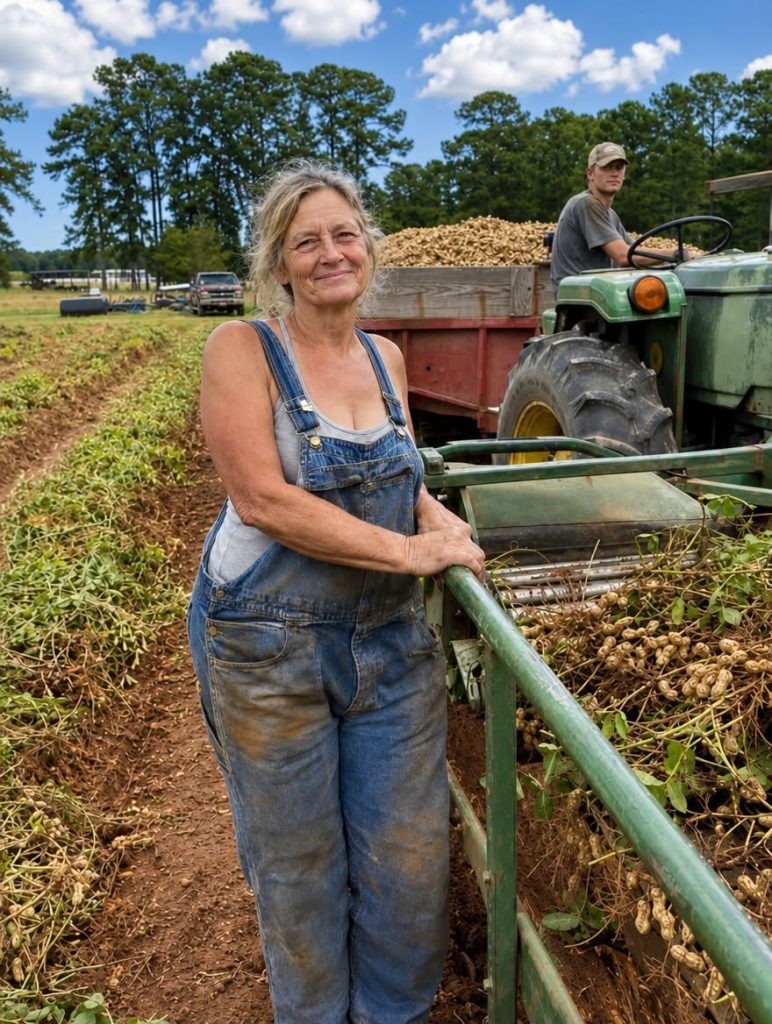

Protecting Our Peanut Harvest: A Family Farm’s Race Against Time
Peanut farming requires careful planning, reliable equipment, favorable weather, and cooperation among everyone involved in the harvest. For one Georgia farming family, a longstanding agreement with a trusted relative suddenly became uncertain, putting an entire season’s work and a significant portion of the family’s income at risk.
What began as a routine harvesting arrangement quickly developed into a race against approaching rain. With 180 acres of peanuts already dug and arranged in rows to dry, the family faced an increasingly difficult situation. Their experience highlights the importance of agricultural preparation, dependable partnerships, equipment maintenance, and the ability to adapt when unexpected challenges threaten a farm’s livelihood.
A Fifteen-Year Farming Arrangement Suddenly Changes
For fifteen years, Hoyt and his uncle Lamar had maintained a straightforward working relationship. Lamar was responsible for harvesting the family’s 180 acres of peanuts, receiving an agreed payment of $50 per acre. The total compensation amounted to $9,000, making the arrangement familiar and predictable for both parties.
Over the years, this agreement had become part of the family’s regular farming routine. Hoyt trusted his uncle to complete the work, while Lamar understood the timing and expectations associated with the harvest. A reliable harvesting arrangement is particularly important in agriculture because crops cannot always wait for convenient scheduling.
This year, however, the agreement took an unexpected turn. Lamar requested payment before beginning the work, and Hoyt agreed without hesitation. Having worked together for so many years, Hoyt had little reason to anticipate that the arrangement would become a source of concern.
Lamar promised to arrive on Friday morning. By then, the peanuts had already been dug and arranged in rows, leaving them to dry before the next stage of harvesting. The family had organized its work around the promised schedule and expected the operation to proceed as planned.
The Harvesting Delay Creates an Immediate Problem
When Friday arrived, Lamar eventually brought his harvesting equipment to the fields. However, instead of beginning work on Hoyt’s property, he started harvesting his own peanuts.
Hoyt was understandably concerned. The family had fulfilled its side of the financial arrangement, and the promised harvesting date had already arrived. He approached Lamar and reminded him of their agreement, including the advance payment.
Lamar responded that he would harvest Hoyt’s peanuts after completing his own fields. His response left Hoyt with little reassurance about when the work would actually begin.
The problem was not simply a disagreement over scheduling. Peanut harvesting involves several stages that must be coordinated with crop maturity and weather conditions. Once peanuts have been dug, they are left in windrows to dry before being collected by specialized harvesting equipment.
Although some flexibility is necessary in agricultural operations, prolonged delays can increase exposure to changing weather conditions. For a family depending on the harvest as a major source of income, uncertainty about the schedule can quickly become a serious financial concern.
Approaching Rain Raises the Stakes for the Georgia Peanut Crop
The situation became more urgent when the family learned that Tropical Storm Pilar might bring heavy rainfall to Georgia by Monday. With only a limited amount of time remaining, the possibility of substantial rain threatened to disrupt the entire harvesting operation.
The family’s 180 acres represented approximately $200,000 in potential income. That figure made the consequences of a delayed harvest especially significant. A substantial portion of the family’s annual agricultural revenue depended on successfully collecting the crop.
Weather is one of the most important variables in farming. Producers can carefully manage planting schedules, field preparation, equipment maintenance, and labor arrangements, but they cannot control rainfall or other changing environmental conditions.
Peanuts are particularly dependent on proper harvesting practices. After digging, plants are placed in windrows so the pods can dry under suitable field conditions. Harvesters subsequently collect the peanuts from these rows. Excessive moisture during this period can interfere with field operations and increase the risk of crop deterioration.
For the family, the approaching storm transformed an inconvenient scheduling dispute into a time-sensitive agricultural problem. Waiting for Lamar to finish his own fields was no longer a dependable strategy.
Protecting an Elderly Family Member’s Financial Security
Beyond the potential loss of income from their own 180 acres, the family had another important responsibility. Sixty acres of the peanuts belonged to Hoyt’s eighty-one-year-old mother, Inez.
Her portion of the harvest provided essential financial support throughout the year. Income from the crop helped cover everyday necessities, including groceries, electricity, medication, and medical expenses.
For an older person relying on agricultural income, an unsuccessful harvest can have consequences that extend well beyond one growing season. Regular household expenses continue regardless of whether crops are collected successfully.
This made the situation especially difficult for Hoyt and the rest of the family. They were not simply trying to protect the value of a commercial crop. They were also trying to safeguard an important source of financial independence for an elderly parent.
In family farming operations, different generations often share both responsibilities and economic risks. Land ownership, crop revenue, equipment, and labor can connect several members of a household. Consequently, a disruption affecting one part of the operation may influence the financial well-being of the entire family.
For Inez, losing the harvest could mean greater uncertainty about paying for necessities. The family therefore had an additional reason to find an alternative harvesting solution as quickly as possible.
Searching for Alternative Harvesting Services
Recognizing that the original arrangement might not work, the family began contacting other farmers in the area. They hoped someone with available harvesting equipment could take over the work before the expected rainfall arrived.
Unfortunately, finding replacement equipment and labor at short notice proved difficult. Other farmers were already committed to their own harvesting schedules, while some were dealing with mechanical problems.
This situation illustrates a common challenge in seasonal agriculture: demand for specialized machinery can rise sharply during narrow harvesting windows.
Farm equipment is expensive, and not every farming operation owns every machine needed for each stage of production. Some producers therefore rely on custom harvesting services or arrangements with neighboring farmers. These relationships can improve equipment utilization and reduce the cost of purchasing machinery that may only be needed during certain periods.
However, depending on outside harvesting services also introduces scheduling risks. When multiple farms need the same equipment at approximately the same time, delays can become difficult to avoid.
Hoyt’s sons, Beau and Clayton, joined the effort to find a solution. They contacted potential alternatives and considered whatever practical options remained available. As the weather deadline approached, the family realized that securing another farmer’s services might not be possible.
An Unexpected Solution: A Peanut Picker From 1985
Just when the available options appeared limited, a forgotten piece of family equipment came to mind. The narrator remembered that her late father had owned an older peanut picker.
The machine dated back to 1985 and had remained beneath a protective tarp for approximately six years. Although it was considerably older than the equipment commonly used in modern harvesting operations, it had served her father throughout his farming career.
Rather than immediately abandoning the idea, the family decided to inspect the machine and determine whether it could still operate.
Removing the tarp revealed a machine that would require considerable attention before it could return to the field. Its belts were damaged, one tire was flat, and several components showed signs of wear.
These problems were not surprising given the machine’s age and the length of time it had remained unused. Agricultural equipment requires regular inspection and maintenance, particularly when it has been stored for extended periods.
Belts, tires, bearings, hydraulic systems, and other mechanical components can deteriorate or develop problems when machinery is left idle. Before operating an older machine, farmers must determine whether its components are safe and functional.
Nevertheless, the discovery offered something the family had been struggling to find: an alternative that did not depend on Lamar’s availability or another farmer’s schedule.
Evaluating the Equipment and Finding Replacement Parts
Hoyt believed that the old peanut picker might still be useful if the necessary repairs could be completed. Although its two-row design was slower than modern harvesting equipment, its previous performance gave the family a reason to investigate further.
The first priority was identifying the parts required to make the machine operational. Hoyt began contacting agricultural equipment dealers and searching salvage yards for suitable replacements.
Finding components for older machinery can require patience. Some manufacturers discontinue parts for aging equipment, while other components may only be available through specialist suppliers or secondhand equipment dealers.
Salvage yards can provide an additional source of replacement components, particularly for farmers who maintain older machinery. However, compatibility and condition must be checked carefully before installing used parts.
The family also needed to consider the machine’s overall condition rather than focusing exclusively on its visibly damaged components. A successful repair would require ensuring that the equipment could operate reliably and safely under field conditions.
Time remained the biggest obstacle. Even if replacement parts could be located, repairs and testing would need to be completed before the weather threatened the exposed crop.
Why Older Agricultural Equipment Can Still Matter
Modern agricultural machinery has transformed farming through improvements in productivity, precision, and operating efficiency. Newer equipment can often complete fieldwork faster and incorporate features designed to reduce labor requirements.
However, older machinery can retain practical value when it is properly maintained and suitable for the work required. For smaller operations, family farms, and producers facing unexpected equipment shortages, an existing machine may provide an important backup option.
Older equipment can also reduce dependence on external contractors during busy periods. A farm that maintains functional backup machinery may have greater flexibility when its primary equipment becomes unavailable.
There are limitations, of course. An older two-row picker may require more operating time than a modern machine, and replacement components can be difficult to source. Fuel consumption, maintenance requirements, operating capacity, and safety should all be considered when evaluating whether restoration is worthwhile.
Nevertheless, the value of backup equipment is not measured solely by its age or technological sophistication. Its usefulness also depends on whether it can perform the required task within the available time and at a reasonable cost.
A Family’s Determination to Protect Its Livelihood
By the end of the initial search for solutions, the family’s situation remained uncertain. The old peanut picker had not yet been confirmed as ready for operation, and the approaching storm continued to place pressure on the harvesting schedule.
However, the discovery changed the family’s position. Instead of depending entirely on an unreliable outside arrangement, they had identified equipment that might allow them to complete at least part of the work themselves.
Hoyt continued looking for replacement parts, while other family members remained involved in finding a practical solution. Their efforts reflected the cooperative nature of family farming, where difficult decisions often require several generations to contribute time, knowledge, and resources.
The experience also demonstrated the importance of maintaining flexibility. Agricultural production involves uncertainties that cannot always be anticipated, including weather changes, mechanical failures, labor shortages, and scheduling conflicts.
For this Georgia family, the immediate objective was clear: repair the old machine if possible, protect the peanuts already lying in the fields, and preserve the income that supported several members of the household.
Whether the restored picker could complete the harvest remained an open question. What was certain was that the family had decided not to wait helplessly for circumstances to improve. They were prepared to explore every reasonable option using the resources available to them.
Lessons for Farmers: Preparation and Backup Planning
The family’s experience offers several practical lessons for agricultural producers facing seasonal harvesting challenges. One of the most important is the value of having contingency plans before harvesting begins.
Farmers who depend on outside contractors may benefit from confirming schedules in advance, documenting payment arrangements, and maintaining communication throughout the harvesting period. Establishing alternative contacts can also reduce the consequences of unexpected scheduling conflicts.
Equipment preparation is equally important. Inspecting machinery before the harvesting season allows producers to identify worn belts, damaged tires, mechanical problems, and missing components before those issues become urgent.
According to the University of Georgia Cooperative Extension’s peanut production guidance, proper equipment adjustment plays an important role in harvesting efficiency and reducing crop losses. The condition of windrows, combine settings, and operating speeds can all influence the quality and quantity of peanuts collected.
Weather monitoring is another essential part of harvest planning. Farmers should consider rainfall forecasts alongside crop maturity, field conditions, drying requirements, and available harvesting capacity. Coordinating these factors can help reduce unnecessary delays and protect crop quality.
Understanding the Importance of Peanut Drying
The family’s concern about rain is supported by established agricultural research. Peanut harvesting involves more than simply removing plants from the ground. The crop must pass through several stages to achieve suitable moisture levels and preserve product quality.
After digging, peanut plants are inverted and arranged in windrows. This positioning exposes the pods to air and sunlight, allowing moisture to decrease naturally. Once the peanuts reach an appropriate moisture level, a combine separates the pods from the vines.
The University of Georgia Cooperative Extension explains that commercially produced peanuts in Georgia are generally harvested directly from windrows using specialized combines. Proper timing and machine adjustment help minimize mechanical damage and harvesting losses.
The United States Department of Agriculture’s Agricultural Research Service also explains that freshly dug peanuts contain substantial moisture and must undergo additional drying after harvesting. Commercial curing operations use heated air to reduce moisture to levels appropriate for storage.
Rainfall during field drying can complicate this process. Research published in Peanut Science has examined how rainfall exposure affects peanut pods left in windrows, including potential reductions in shell strength and product quality. These findings demonstrate why weather conditions matter so much during the period between digging and combining.
For producers, the objective is to coordinate field drying and harvesting so that peanuts are collected at suitable moisture levels without unnecessary exposure to unfavorable conditions.
Moving Forward With Determination
At the conclusion of the family’s initial search for a solution, the future of the harvest was still uncertain. The old peanut picker needed repairs, replacement parts had to be located, and the approaching weather continued to create pressure.
Nevertheless, the family had identified a possible way forward. The equipment inherited from the narrator’s father represented more than an aging agricultural machine. It was also a reminder of the family’s farming history and the importance of preserving useful resources.
For Hoyt, the priority remained protecting the family’s investment and ensuring that his mother’s 60 acres were not overlooked. Beau and Clayton continued helping their parents explore practical alternatives, while the search for replacement components offered hope that the old picker could return to service.
The outcome of the repairs and the final harvest was not yet known. However, the family’s response demonstrated an important principle of agricultural resilience: when one plan fails, preparation, cooperation, and resourcefulness can help create another opportunity.
Farming has always required the ability to respond to circumstances beyond anyone’s control. Weather, machinery, labor availability, and market conditions can all influence the success of a growing season. Families who combine experience with practical problem-solving are often better positioned to navigate these uncertainties.
For this Georgia family, an unexpected harvesting delay became a test of trust, responsibility, and determination. Their immediate challenge was to protect the peanuts before the rain arrived, but their broader goal was to preserve the livelihood that supported their family across generations.
Sources
The following agricultural and research organizations provide additional information about peanut production, harvesting, drying, and equipment management:
- University of Georgia Cooperative Extension – Peanut Production Field Guide
- University of Georgia Extension – Peanut Digger and Combine Efficiency
- USDA Agricultural Research Service – National Peanut Research Laboratory
- Peanut Science – Research on Rainfall Exposure and Peanut Shell Strength
- American Peanut Council – Peanut Growing and Harvesting
- University of Florida IFAS Extension – Peanut Production Guide
Disclaimer: This content is intended for entertainment purposes only and is not based on real events.