
The Stolen $100 Bill Puzzle: How Much Money Did the Store Actually Lose?
The stolen $100 bill puzzle is a classic mathematical brain teaser that continues to challenge readers because its answer seems straightforward but involves a subtle accounting detail. At first glance, the situation appears to involve several separate losses: $100 stolen from a cash register, $70 worth of merchandise given away, and $30 returned to the customer as change. Adding these amounts might suggest that the store has lost $200. However, this calculation counts the same money more than once.
The correct answer is $100. Although the puzzle may initially seem confusing, understanding the sequence of transactions makes the solution relatively simple. The store ultimately loses $70 worth of merchandise and $30 in cash. Together, these losses equal $100.
This puzzle is a useful example of how basic arithmetic, logical reasoning, and careful accounting can help resolve seemingly complicated problems. It also illustrates why understanding the movement of money is more important than simply adding every amount mentioned in a transaction.
Understanding the Stolen $100 Bill Puzzle
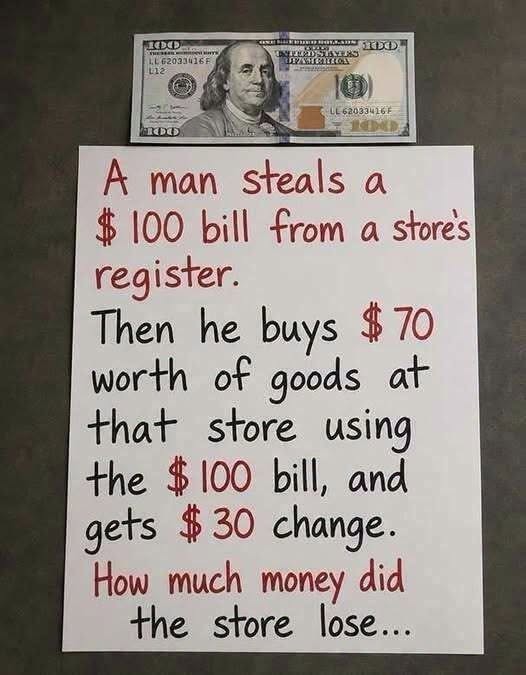
The puzzle describes a man who steals a $100 bill from a store’s cash register. After taking the money, he leaves the premises. Later, he returns to the same store and uses the exact $100 bill he previously stole to purchase merchandise worth $70.
The cashier accepts the bill as payment and gives the customer $30 in change. The man then leaves the store with two things: merchandise valued at $70 and $30 in cash.
The central question is how much money the store has actually lost after both incidents have taken place.
There are several possible answers that people commonly suggest:
- $200: This calculation adds the initial $100 theft, the $70 merchandise, and the $30 change.
- $100: This calculation considers the final value of the goods and cash taken by the thief.
- $70: This answer focuses only on the merchandise that left the store.
Of these answers, $100 is correct under the assumptions of the puzzle. The reason is that the original stolen banknote returns to the store during the purchase. It cannot be counted as an additional loss after it has been recovered.
Step-by-Step Explanation of the $100 Loss
To understand the answer, it helps to divide the puzzle into two separate events: the initial theft and the subsequent purchase. Looking at each event independently makes it easier to track the store’s assets and identify the actual financial loss.
Step 1: The Thief Takes $100 From the Register
Initially, the store has $100 in its cash register that belongs to the business. The thief takes this money without making a purchase or providing anything in return.
At this point, the store has experienced a direct cash loss of $100. Its register contains $100 less than it did before the theft.
For the purpose of the puzzle, the stolen banknote is still the same physical $100 bill. This detail becomes important when the thief returns to the store.
Step 2: The Thief Returns and Makes a Purchase
The thief subsequently returns and selects merchandise with a stated value of $70. Instead of paying with money obtained elsewhere, he presents the exact $100 bill that he previously stole from the register.
The cashier accepts the payment because the bill appears to be a legitimate $100 banknote. The store therefore receives the original bill back.
This changes the financial situation. Although the store initially lost $100 in cash, that same $100 has now returned to its possession. The initial cash shortage has effectively been reversed.
Step 3: The Cashier Gives $30 in Change
Because the merchandise costs $70 and the customer pays with a $100 bill, the cashier gives him $30 in change.
The transaction can be represented using a simple calculation:
$100 payment – $70 purchase = $30 change.
The store now has the original $100 bill in its register, but it has also handed over $30 in additional cash. The merchandise worth $70 has left the store as well.
Therefore, the final losses consist of:
- $70 in merchandise.
- $30 in cash given as change.
Adding these two amounts produces the total loss:
$70 + $30 = $100.
Why the Answer Is Not $200
The most common mistake in this puzzle is adding the original stolen $100 to the $70 worth of merchandise and the $30 in change.
The calculation looks reasonable because all three amounts represent something that happened during the story. However, it does not accurately represent the store’s final financial position.
The problem is double-counting.
When the thief initially takes the $100 bill, the store loses $100 in cash. However, when he returns and uses that exact bill to pay for the merchandise, the store recovers the same $100. The bill has not disappeared permanently.
Counting the original $100 theft as a continuing loss while also counting the merchandise and change ignores the fact that the bill was returned. This produces an inflated figure of $200.
A useful way to avoid this mistake is to compare the store’s position before the theft with its position after the entire sequence of events.
Before the incident, the store owns its original cash and merchandise. After the incident, it has recovered the $100 bill but no longer has the $70 merchandise or the $30 that was handed over as change.
The difference between these two positions is exactly $100.
A Simple Accounting Method to Solve the Puzzle
One of the most reliable ways to solve financial brain teasers is to use a basic accounting approach. Instead of adding every amount mentioned in the story, identify the assets entering and leaving the business.
In this example, the store experiences three important movements:
- It loses $100 in cash when the thief takes the banknote.
- It receives $100 in cash when the thief uses the stolen banknote to pay for the purchase.
- It gives away $30 in cash and $70 worth of merchandise during the transaction.
The first two movements cancel each other out because they involve the same $100 bill.
The remaining losses are the change and merchandise. The final calculation is therefore:
Total loss = Cash change + Merchandise value
Total loss = $30 + $70 = $100
This approach is consistent with the basic principle of tracking changes in assets. Every amount should be considered in relation to whether it remains with the business at the end of the transaction.
Cash Loss Versus Merchandise Loss
Another reason people find the stolen $100 bill puzzle confusing is that cash and merchandise are different types of business assets.
Cash is relatively easy to measure because its face value is clearly stated. Merchandise, however, can be evaluated in different ways depending on whether the calculation uses retail price, purchase cost, or accounting value.
In the puzzle, the merchandise is described as being worth $70. This means the intended calculation uses its stated value rather than the store’s wholesale acquisition cost.
The $30 change represents an actual cash outflow. The $70 merchandise represents the value of goods transferred to the thief. Together, they account for the $100 economic loss described in the puzzle.
In a real business, however, the accounting treatment could be more detailed. Retail price is not necessarily the same as inventory cost. A retailer might have purchased the merchandise for less than its selling price.
For example, if the merchandise had a retail price of $70 but an inventory cost of $40, the store’s direct asset loss, measured using inventory cost and cash, would be $70 rather than $100, assuming no other costs or effects were involved.
This distinction does not change the intended answer to the brain teaser. It simply demonstrates why real-world financial reporting requires clearly defined measurement methods.
What This Puzzle Teaches About Logical Thinking
The stolen $100 bill puzzle is more than a simple arithmetic exercise. It highlights several important reasoning skills that are useful in everyday financial decisions, business operations, and problem-solving.
1. Avoid Counting the Same Amount Twice
Double-counting occurs when the same financial value is included more than once in a calculation. This can happen when people focus on individual events without considering how those events are connected.
In this puzzle, the original $100 appears in two different stages of the story: first as stolen money and later as payment. Although it is involved in two events, it is still one banknote.
Recognizing this relationship is essential to reaching the correct answer.
2. Follow the Entire Sequence of Events
Looking at only the first theft creates an incomplete picture. Similarly, considering only the final purchase without understanding where the payment originated can make the situation seem confusing.
Effective problem-solving requires examining the complete sequence from beginning to end. Each transaction should be evaluated according to its effect on the final outcome.
3. Distinguish Between Cash Flow and Total Value
Cash flow describes money entering and leaving a business, while total asset value includes other resources such as inventory and equipment.
The puzzle involves both cash and merchandise. A correct answer must account for both rather than concentrating exclusively on the money in the register.
4. Use a Consistent Starting and Ending Point
Comparing the store’s financial position before and after the incident is more reliable than adding isolated figures from the story.
This method is useful in budgeting, inventory management, financial analysis, and everyday decisions involving purchases or payments.
How the Same Principle Applies to Real-World Business
Although the stolen $100 bill puzzle is fictional, its underlying accounting principle has practical applications.
Retail businesses regularly track cash receipts, refunds, inventory movements, discounts, and payment adjustments. If these transactions are not recorded correctly, financial reports can contain inaccurate figures.
For example, imagine a customer returns an item and receives a refund. If the original sale is recorded as revenue but the refund is not properly accounted for, the business may overstate its income.
Similarly, inventory systems must distinguish between goods sold, returned, damaged, or transferred. Counting the same inventory movement more than once can create discrepancies between recorded stock and actual stock.
These examples demonstrate why accurate recordkeeping depends on following transactions through their full lifecycle.
The puzzle also illustrates the importance of reconciliation. Businesses compare recorded transactions with actual cash balances and inventory records to identify differences. This process helps detect mistakes, missing entries, and inconsistencies.
In professional accounting, the details are more complex than those in a brain teaser, but the fundamental idea remains similar: financial outcomes should be measured by examining the complete movement of assets and liabilities rather than adding unrelated transaction amounts.
Frequently Asked Questions About the Stolen $100 Bill Puzzle
How much money did the store lose in the puzzle?
The store lost $100 in total, based on the stated value of the merchandise. This consists of $70 worth of goods and $30 in cash given as change.
Why is the answer not $200?
The original $100 bill returns to the store when the thief uses it to pay for the merchandise. Counting the initial theft as an additional final loss would count the same banknote twice.
Does the store get its original $100 back?
Yes. According to the puzzle, the thief uses the exact banknote that he originally stole. The cashier accepts it, so the store recovers that $100 bill.
What does the thief leave with?
The thief leaves with $70 worth of merchandise and $30 in cash. Their combined stated value is $100.
Is the $70 merchandise value the same as the store’s actual accounting loss?
Not necessarily in a real business. The puzzle uses the stated merchandise value of $70. Actual accounting losses may instead be measured using inventory cost, which can differ from the retail selling price.
What is the main lesson of the puzzle?
The main lesson is to track the movement of money and assets carefully. Avoid double-counting amounts that appear in multiple stages of a transaction, and compare the final financial position with the original position.
Final Answer: The Store Lost Exactly $100
The stolen $100 bill puzzle becomes much easier once the entire transaction is examined rather than treating every amount as a separate loss.
The thief initially takes $100 from the store. However, he later returns the same bill as payment for $70 worth of merchandise. The store therefore recovers its original cash, but the cashier gives the thief another $30 in change.
At the end of the transaction, the thief has $70 in merchandise and $30 in cash. The combined value is $100.
Final calculation: $70 + $30 = $100.
The store’s total loss is therefore $100, not $200. The key to solving the puzzle is understanding that the original stolen bill should not be counted twice. This simple example demonstrates how careful accounting and logical reasoning can prevent common calculation errors.
Sources
The puzzle is a hypothetical arithmetic exercise, and its solution follows directly from the stated transaction values. The following established resources provide additional information about accounting principles, financial reporting, and the treatment of business assets.
- International Financial Reporting Standards (IFRS) – International accounting standards and financial reporting principles.
- Financial Accounting Standards Board (FASB) – U.S. financial accounting and reporting standards.
- AccountingCoach – Educational explanations of basic accounting concepts, assets, and transactions.
- Investopedia – Financial education resources covering cash flow, inventory, and accounting fundamentals.
Disclaimer: This content is intended for entertainment purposes only and is not based on real events.