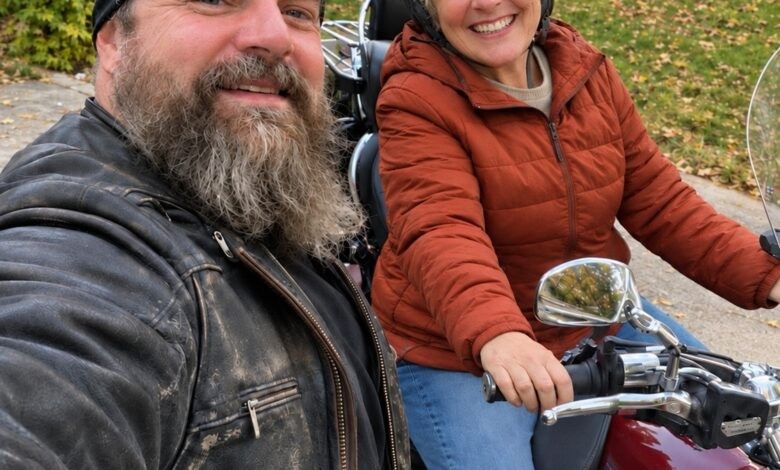

This is a fictional, reflective narrative about grief, family relationships, accountability, and reconciliation. It does not present real events or reporting.
For months after my father died, I watched my mother climb onto the back of a motorcycle every Saturday afternoon.
The rider was a broad-shouldered man named Connor, someone I had never heard her mention before. He arrived in leather boots and a dark helmet, his motorcycle rumbling loudly enough to shake the windows of her quiet house. Then my mother, Frances, would put on a jacket, take the spare helmet he offered, and leave with him for hours.
When she came back, she looked different. Her hair was flattened by the helmet, her cheeks were pink from the wind, and some of the heaviness she had carried since Dad’s death seemed briefly lifted. I assumed the rides were helping her survive widowhood. I assumed Connor was simply giving her a reason to leave the house, feel the air move around her, and remember that life had not entirely stopped.
I was wrong about where they were going. More importantly, I was wrong about what those rides meant.
Grief, Independence, and a Mother’s New Routine
My father, Richard, had been the most visible kind of person. He sang while washing dishes, made friends in grocery store lines, and could turn a simple family dinner into a long evening of stories. My mother was quieter. She liked gardening, crossword puzzles, recipe cards, and remembering every birthday in the family.
After Dad died, the silence inside their house felt unnatural. I began visiting every weekend, bringing groceries, taking out trash, fixing small things that did not really need fixing. I told myself I was helping. In truth, I was frightened by how much could change without warning.
One Saturday, I found Mom kneeling near a baseboard with a dust cloth in her hand. I reached for it immediately.
“Mom, give me that,” I said.
She looked up, tired but amused. “Mia, I’m grieving, not helpless.”
Before I could respond, the sound of Connor’s motorcycle filled the driveway. I rushed to the front window and saw a large man in a leather jacket standing beside a bike that looked far too powerful for my mother.
“Do you know there’s a biker in your yard?” I asked.
To my surprise, she smiled. “That’s Connor. He’s my ride.”
I reacted as a worried daughter might: with suspicion, fear, and an immediate need for details. Who was he? Where was he taking her? Why had she not told me about him? Mom listened to my questions and then reminded me, gently but firmly, that she was still allowed to make her own choices.
“I can’t spend the rest of my life avoiding every road because your father isn’t here to take it with me,” she said.
Her words stopped me. Grief can make family members protective, but protection can easily become control when fear is allowed to speak louder than respect. I watched her climb onto Connor’s motorcycle, wrap her arms around his waist, and disappear down the street.
The Small Signs of an Unfinished Past
Connor came almost every Saturday after that. My mother began baking again, something she had barely done since Dad died. One morning she placed a lemon cake carefully into a box. When I asked whether it was for Connor, she only said it was for “someone with excellent taste.”
Another weekend, she put on lipstick before he arrived. I teased her about it, expecting her to dismiss the question. Instead, she looked at herself in the mirror and said, “Something should have happened a long time ago.”
When I asked what she meant, her expression changed.
“Have you ever waited so long to apologize,” she asked, “that the apology starts feeling selfish?”
I did not know how to answer. I asked who she had hurt. She did not tell me.
That uncertainty became more difficult when her health began to decline. She became short of breath more easily and tired after even routine activity. Medical appointments followed, and our family learned that she had a serious heart condition. Connor sometimes arrived in a truck instead of on his motorcycle, but Mom still insisted on going with him.
One afternoon, I stood between her and the front door. I told her she needed to stay home and rest. She looked past me toward Connor, who was waiting quietly outside.
“I’m trying not to leave something unfinished,” she said.
“What is unfinished?” I asked.
“I’m not ready to tell you,” she replied. “Because it isn’t only my story.”
At the time, I thought she was protecting someone. Later, I understood that she was also confronting the limits of confession. An apology may be necessary, but it does not entitle the person apologizing to immediate relief, forgiveness, or control over how others remember what happened.
A Family Secret Revealed After the Funeral
Two months later, my mother died.
At her funeral, Connor found me near the back of the room. Without his leather jacket, dressed in a dark suit, he seemed less intimidating. His eyes were red, and his voice was quiet.
“Your mom was an amazing woman,” he said. “But you need to know where we really went.”
My stomach tightened immediately.
Connor told me that the Saturday rides had not been scenic drives. He had taken Mom to visit his mother, Diane.
The name meant nothing to me until he added that Diane had once known my Uncle Mike.
That name changed everything.
Mike had been a major part of my childhood. He was my father’s brother, present at holidays and family gatherings, someone who had taught Connor baseball when Connor was a boy. Years earlier, Mike had moved away, married someone else, and later died in a car accident. I had never known there had been another important relationship in his life.
Connor returned later that day with Diane, a silver-haired woman who entered my mother’s living room and immediately looked at the family photographs on the wall.
“Mike,” she whispered.
Diane explained that she and my mother had been best friends in high school. They had shared dances, picnics, long conversations, and the ordinary closeness of teenage friendship. Then a young man named Sam entered their lives. My mother loved him, but Sam chose Diane.
Years later, Diane and my Uncle Mike fell in love.
How Jealousy and Silence Can Reshape a Family
Diane told me that my mother had never fully released the resentment she felt over Sam. When Diane and Mike began building a relationship, Mom could not separate the past from the present. She saw Diane not as an old friend with her own life, but as the person she believed had taken something from her decades earlier.
According to Diane, Mom pressured Mike to end the relationship. She made it clear that remaining with Diane would affect his place in the family. Mike left. Diane and Mike never had the opportunity to learn what their future might have been.
I rejected the story at first. I said my mother loved Mike. I said she would never deliberately hurt him. Diane did not argue with my grief.
“People can love someone and still hurt them,” she said.
That sentence was painful because it was true. Family stories often turn loved ones into simplified figures: the dependable parent, the kind sibling, the difficult relative, the person who always knew what was right. Real people are rarely that uncomplicated. A person can be loving in one relationship and unfair in another. They can be generous, frightened, loyal, jealous, compassionate, and deeply wrong at different points in the same life.
After Diane and Connor left, I searched through my mother’s belongings. In an old wooden box, I found photographs of Mom and Diane as teenagers, laughing together at a dance and sitting on the hood of a car. I found a picture of Sam looking toward Diane while my mother looked at him. I found another photograph of Mike with Diane, Connor standing in front of them wearing a baseball glove.
Mom had kept the evidence of a history she had never discussed.
A Letter About Accountability and Forgiveness
The next morning, while opening Mom’s recipe box, I found an envelope addressed to me.
“My Mia,” it began.
The letter did not excuse what she had done. Mom wrote about Sam, Diane, Mike, and the bitterness she had carried for years. She admitted that she had been given a good life with my father but still held tightly to an old wound. She wrote that she had tried to decide Mike’s future because she could not tolerate Diane having another happiness that she did not control.
One line made me stop reading for several minutes.
“Maybe Mike and Diane would have lasted six months. Maybe 40 years. I took it upon myself to make sure they never got to find out.”
She also wrote that my father had confronted her at the time. He had told her that loving Mike did not give her the right to choose for him. She had been angry because she knew he was right.
Her final request was not for me to defend her. It was the opposite.
“Please don’t make me better than I was just because you miss me.”
I drove to Connor’s home and showed the letter to Diane. She told me Mom had apologized during those Saturday visits, but not perfectly at first. Their first conversation had been painful and defensive. Their later conversations became more honest. Mom eventually acknowledged that she had made Diane carry pain that belonged to her own unresolved jealousy.
“Did you forgive her?” I asked Diane.
“Eventually,” she said. “Because she finally stopped defending herself.”
Her forgiveness did not erase the loss or change the past. As Diane explained, forgiving Frances did not restore Mike’s choices or return the years that had been affected by the family conflict. It meant she did not want anger to determine the remainder of her own life.
What Reconciliation Can and Cannot Repair
In the weeks after the funeral, I learned that reconciliation is not the same as forgetting. It is not a demand that injured people stop feeling pain. It is also not proof that the harm was small. Genuine accountability requires recognizing what happened without minimizing it, shifting blame, or asking others to protect a comforting version of the past.
My mother’s late apology could not undo her earlier choices. Still, her decision to face Diane mattered. She knew Diane might refuse to see her. She knew Connor might question her motives. She went anyway.
A week later, I invited relatives to help sort through Mom’s belongings. Connor and Diane came as well. During lunch, someone said that Frances had always protected Mike, especially from relationships that could have complicated his life.
For a moment, I felt the familiar instinct to protect Mom’s reputation. Then I remembered her letter.
“No,” I said. “Mom wasn’t protecting Mike.”
I told the family enough of the truth to prevent the old story from continuing unchanged. I explained that Mom had hurt Diane and Mike, that she had admitted it, and that she had spent her final months trying to make amends.
Diane stood beside me and said, “Frances hurt me. That will always be true. But she also came back knowing I might close the door in her face. That matters too.”
The Meaning of Taking the Long Way Home
After everyone left, Connor brought my mother’s motorcycle helmet in from the garage. I held it in my hands and laughed through tears when he told me she had hated riding at first.
“For how long?” I asked.
“About ten minutes,” he said.
I asked where he had taken her on their final Saturday together. He said they had visited Diane, as usual. Then Mom had asked him to take the long way home.
“Did she say why?” I asked.
Connor looked toward his mother before answering.
“She said she’d spent too much of her life rushing past things she was afraid to face.”
Diane gave me an old photograph of herself and Mom as teenagers, their arms around each other, laughing without any awareness of what life would later ask of them.
“Is this how you remember her?” I asked.
Diane shook her head. “Not instead of everything. Along with everything.”
That became the most honest way I could remember my mother. She was the woman who loved my father. She was the mother who remembered birthdays and baked cakes. She was the widow who needed air, movement, and companionship after loss. She was also a person who allowed jealousy to influence a painful family decision. And she was a person who eventually recognized the harm she had caused and tried, however late, to face it.
For months, I had believed the motorcycle rides were Mom’s attempt to escape death. I now understood them differently. She was not running away from the end of her life. She was moving, slowly and imperfectly, toward a truth she had avoided for decades.
She took the long way home.
Sources
Disclaimer: This content is intended for entertainment purposes only and is not based on real events.