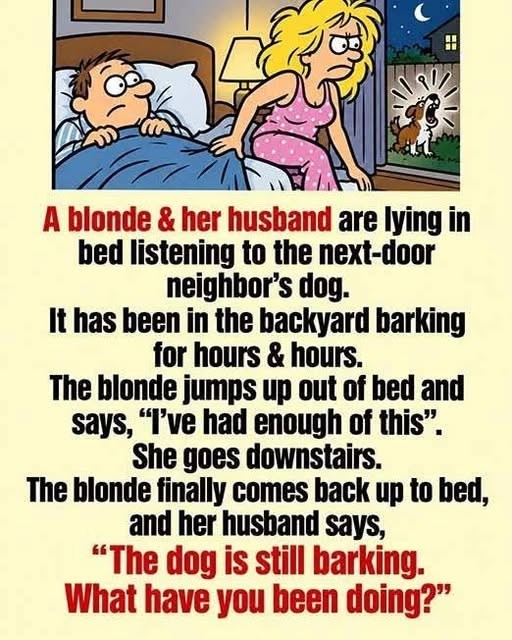

Stories about noisy neighbors often become the basis for familiar jokes, especially when frustration leads a character to believe they have found a clever solution. In one such scenario, a couple cannot sleep because a neighboring dog is barking repeatedly. The woman decides to take action, only for her husband to discover that the noise has not stopped at all. The punch line rests on the fact that her response changes who is inconvenienced in theory, but does not reduce the barking or restore peace in practice.
Although the premise is intended as humor, it reflects a real and common source of neighborhood tension. Persistent barking can affect sleep, concentration, work, family life, and relationships between residents. At the same time, a barking dog may be communicating an unmet need, such as anxiety, boredom, fear, isolation, discomfort, or a reaction to unfamiliar sounds. A constructive response should therefore focus on communication, safety, and animal welfare rather than retaliation.
Why Barking Dog Complaints Can Become Emotional
Noise problems can feel intensely personal because they occur at home, where people expect privacy and rest. A dog that barks during the evening or early morning may interrupt sleep, particularly for people who work shifts, care for children, manage health conditions, or need quiet to study or work remotely. Repeated sleep disruption can contribute to irritability, reduced attention, and strain in everyday interactions.
For the dog’s owner, however, the problem may not always be obvious. Owners may be away from home when barking occurs, or they may not realize how far sound travels through yards, windows, fences, and apartment walls. Some dogs bark mostly when left alone, when people pass by, or when they hear activity outside. This difference in perspective can make a straightforward complaint feel accusatory, even when a neighbor simply wants to discuss the impact of the noise.
The humor in the original scenario comes from a mismatch between intention and outcome. The character believes that moving the source of the noise closer to its owners will create fairness. Yet the immediate problem remains unchanged: the dog is still barking, and the couple is still awake. In real life, actions driven by anger rarely address the underlying cause and can create more serious disputes.
What Persistent Barking May Mean for a Dog
Dogs bark for many normal reasons. Barking can be a response to visitors, wildlife, passing vehicles, unfamiliar sounds, excitement, or territorial instincts. It can also be a way for a dog to seek attention or communicate distress. The American Society for the Prevention of Cruelty to Animals notes that excessive vocalization can be associated with issues including separation anxiety, environmental triggers, insufficient activity, and a lack of appropriate training.
A dog that barks continuously when alone may be experiencing separation-related distress. In these cases, punishment or confrontation is unlikely to resolve the issue and may increase fear. A veterinarian or qualified animal behavior professional can help an owner identify possible medical, behavioral, or environmental factors. Hearing loss, pain, cognitive changes in older animals, and other health concerns can also affect behavior, making professional assessment valuable when barking becomes sudden or unusual.
Responsible pet ownership includes providing exercise, enrichment, regular veterinary care, social interaction, and a safe living environment. Depending on the animal’s needs, helpful approaches may include supervised outdoor time, training plans based on positive reinforcement, reducing visual triggers near a fence or window, and arranging care when the owner is away. These measures are most effective when tailored to the individual dog rather than treated as a one-size-fits-all solution.
Why Retaliation Does Not Solve Neighborhood Noise Problems
Taking a neighbor’s pet, entering another person’s property, threatening an animal, or attempting to create discomfort for another household can lead to serious safety and legal consequences. It can also place the animal at risk. Pets should never be used as part of a dispute between people. Even when a noisy situation feels unfair, removing or handling someone else’s animal without permission is not an appropriate response.
Retaliatory behavior often escalates conflict because it shifts attention away from the original concern. Instead of discussing the barking and seeking a practical solution, neighbors may become focused on accusations, distrust, and possible property or safety issues. The result can be a harder-to-resolve dispute, with less willingness on either side to cooperate.
There is also a practical problem: retaliation does not necessarily reduce noise. The barking may continue because the dog’s emotional state or environmental trigger has not changed. The central lesson behind the joke is therefore useful beyond comedy: an action may feel satisfying in the moment while failing to solve the issue that caused the frustration.
How to Speak Respectfully With a Neighbor About Barking
A calm and direct conversation is often the best first step. If it feels safe and appropriate, a neighbor can raise the concern at a neutral time rather than during an episode of barking. Speaking when everyone is tired or upset may make it harder to find common ground.
It can help to describe the issue in specific, nonjudgmental terms. For example, instead of saying that someone is irresponsible, a resident might explain that barking has occurred regularly between certain hours and has made sleep difficult. This approach gives the owner useful information while avoiding assumptions about their intentions or care for the animal.
Using “I” statements can also lower the temperature of the conversation. Phrases such as “I have been having trouble sleeping because I can hear barking late at night” are generally more constructive than confrontational language. The goal is not to win an argument but to make the owner aware of the impact and invite a workable response.
Some owners may welcome practical details because they are not present when the barking happens. A short written record of dates, times, and duration can help identify patterns. It should be factual and respectful, not used to shame the owner publicly. A pattern may reveal that barking occurs during deliveries, school pickup times, nighttime wildlife activity, or periods when the dog is left alone.
Constructive Options When the Problem Continues
If an informal conversation does not resolve the problem, residents can review the rules that apply in their building, neighborhood, or local authority. Many communities have noise ordinances or animal-control guidelines, though the details vary widely by location. Apartment and condominium residents may also have building management policies related to excessive noise and pet conduct.
Mediation can be a useful option where it is available. Community mediation programs are designed to help people discuss disputes in a structured setting. A neutral facilitator may help neighbors clarify what is happening, identify reasonable expectations, and agree on practical next steps. This can be less adversarial than immediately filing a formal complaint.
When there are concerns about an animal’s welfare, residents should contact an appropriate local animal welfare organization, animal control agency, or law enforcement non-emergency service, depending on local procedures. Reports should focus on observable facts, such as whether an animal appears to be in immediate danger, lacks access to basic necessities, or is left in unsafe conditions. In any emergency involving immediate risk to a person or animal, local emergency services should be contacted.
It is important to avoid recording, posting, or sharing personal information about neighbors online in an attempt to pressure them. Public shaming can intensify conflict and may raise privacy concerns. Private, documented, and lawful channels are more likely to produce a fair resolution.
Reducing the Effect of Noise While a Solution Is Found
Noise reduction measures cannot replace responsible action by a pet owner, but they may provide short-term support for affected residents. Closing windows, using fans or white-noise devices, adding weather stripping, and using heavy curtains may reduce some outdoor sound. Earplugs may help some adults sleep, although anyone considering them should use them safely and be able to hear important alarms or household needs.
For people whose sleep or wellbeing is being significantly affected, speaking with a healthcare professional may be appropriate. The Centers for Disease Control and Prevention emphasizes that adequate sleep supports physical health, mental wellbeing, attention, and daily functioning. Persistent sleep disruption should be taken seriously, even when its cause appears to be an ordinary neighborhood issue.
Building Better Relationships Between Pet Owners and Neighbors
Good neighborhood relationships depend on recognizing that both sides may have legitimate concerns. The person affected by noise deserves to rest peacefully in their home. The pet owner may need time, support, or professional guidance to understand why the dog is barking and how to reduce it. Treating the situation as a shared problem rather than a contest can make cooperation more likely.
Pet owners can take proactive steps by asking trusted neighbors to let them know if barking becomes disruptive, especially when they are away. They can also test how audible their dog is from outside the home, provide enrichment before leaving, and seek advice early if the behavior changes. Neighbors can help by reporting concerns clearly and respectfully before resentment builds.
The comic scenario of a barking dog and a frustrated couple works because the attempted solution is so obviously ineffective. In real communities, the better answer is less dramatic but more useful: communicate early, protect the animal’s welfare, follow local rules, and seek support when needed. Those steps are more likely to reduce noise, preserve safety, and help neighbors live alongside one another with greater consideration.
Sources
Disclaimer: This content is intended for entertainment purposes only and is not based on real events.