
Part One: The Knock at 3:07 A.M.
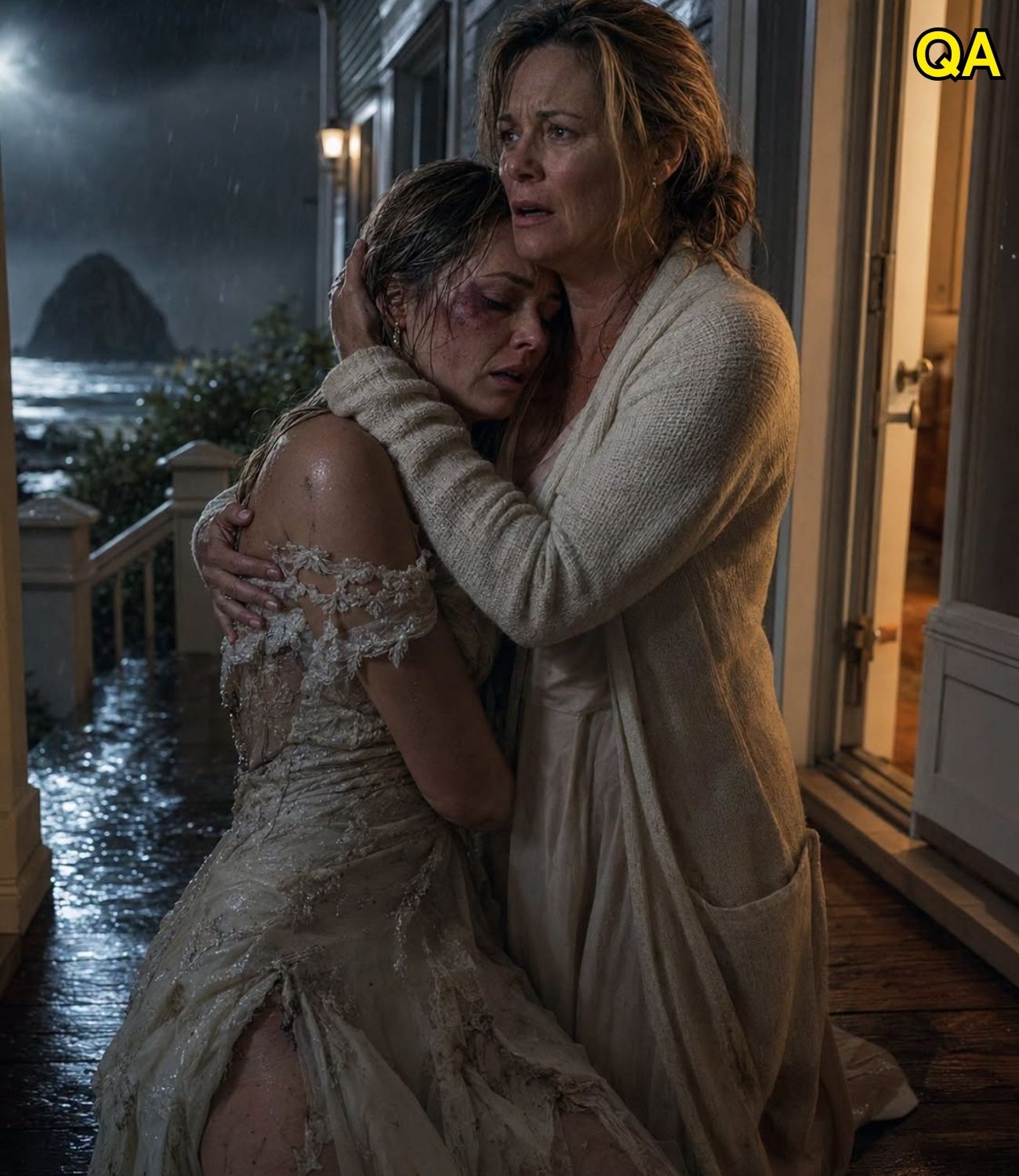
At 3:07 in the morning, my daughter knocked on my front door wearing the wedding dress she was supposed to have slept in only hours earlier. It was ruined with rainwater, dirt, and blood. One sleeve had been torn away. Her veil was gone. Her lip was split, one side of her face was swollen beyond recognition, and she was trembling so violently that she could barely stand without using the frame of the doorway to keep herself upright.
For a second, I did not recognize her. That was the part I have never forgiven myself for. A mother should recognize her child in any room, under any light, in any kind of pain. But my daughter, Vivienne Arlen, had left my house the previous afternoon glowing in ivory silk, smiling beneath strings of lanterns on the Oregon coast, convinced she was marrying the man who would protect her for the rest of her life. The woman standing on my porch looked as though she had escaped a fire.
“Mom,” she whispered. Then her knees gave out. I caught her before she hit the floor.
The rain was coming down hard over Cannon Beach, slanting sideways beneath the porch light and striking the windows of my home like handfuls of thrown gravel. Inside, the grandfather clock marked every second with an almost cruel calmness. I pulled Vivienne through the doorway, locked the deadbolt, and wrapped a blanket around her shoulders.
“They locked me in,” she said at last.
My hands went cold. “Who?”
“Mason. His mother. Judith.”
She pressed both palms to her face and winced. I saw bruising around her wrists then—faint rope marks and a red welt across her collarbone.
“What happened, Viv?”
Her eyes met mine. “They wanted the condo.”
The words did not make sense at first. The waterfront condo was hers—a three-million-dollar property my late father had placed in a protected trust to ensure Vivienne would always have a home that no marriage, no business, and no bad decision could take from her.
“Mason said he had debt,” she whispered. “He said if I loved him, I would help. I thought he meant a loan… Then his mother locked the honeymoon suite door. They had paperwork waiting. Transfer documents. Power-of-attorney forms. He said I would sign before sunrise, or they would make everyone believe I had killed myself.”
Her voice cracked. “Judith held my arms. Mason kept telling me I was being dramatic. His mother counted every time he hit me. She counted, Mom. Like it was a game.”
“How many times?” I asked, my voice turning to ice.
“Forty.”
There are moments when grief feels hot, and moments when it feels cold. This was cold. I wanted to call 911, the district attorney, every judge who had ever spoken about domestic violence from a podium. Instead, I pressed the emergency call button on my home security panel. A private medic arrived within twelve minutes, followed by a domestic violence advocate.
Then I made the other call. I had sworn I would never call Gabriel Voss again.
Gabriel was Vivienne’s father. Years ago, he had been a formidable crisis attorney, corporate strategist, and federal investigator. We had divorced when Vivienne was twelve because his high-risk life had consumed him. But at 3:24 a.m., I opened that door. He answered on the second ring.
“Corinne?”
“They broke our little girl,” I said.
For a moment, Gabriel said nothing. Then his voice changed: “Send me the address.”
Part Two: The Honeymoon Suite Was a Crime Scene
The Pacific Crest Resort looked innocent in daylight. By morning, the rain had softened into mist, and the hotel sat above the coast like a postcard. But on the top floor, inside the honeymoon suite, a crime scene waited.
Gabriel stood in the lobby beside Detective Lena Ortiz, an assistant district attorney, and a digital evidence team. Police discovered that Mason and Judith had already begun building a false narrative. At 5:40 a.m., Judith had called the resort manager claiming Vivienne was “emotionally unstable.” At 5:55, Mason told hotel security his bride had taken medication and might be a “danger to herself.”
They were not looking for her; they were preparing to explain her disappearance.
Records showed the suite door had been deadbolted from the inside and outside, and Mason had disabled the internal latch via a maintenance override. Vivienne had escaped through the bathroom window, climbed down one level onto an exterior maintenance ledge, and reached a laundry room where a night custodian named Pilar Ramos found her crying behind a linen cart. Pilar gave her a spare uniform coat, helped her down the freight elevator, and called a taxi from her personal phone.
Inside the suite, police found the predatory documents Mason wanted her to sign—transfer agreements attempting to place the condo into a holding company controlled by Mason, liquidation sales through a broker linked to Judith’s cousin, and broad financial authority if Vivienne were declared incapacitated.
The wedding had not been a celebration. It was a setup. Mason’s investment fund was almost empty, and Judith’s family home was under foreclosure risk. They needed the condo as an emergency exit.
Part Three: The Family That Needed Her Silence
Mason and Judith Harrow were arrested two days later. Detectives found property transfer forms, a burner phone, and a notebook containing the words “widow narrative” written beside Vivienne’s name.
The charges included kidnapping, coercion, aggravated assault, attempted extortion, unlawful restraint, conspiracy, and financial fraud.
Despite overwhelming evidence—including hotel hallway cameras, security microphones recording Judith saying “Count,” and financial records proving their bankruptcy—the Harrows tried to reclaim control through public perception. Judith’s attorney scheduled a press conference claiming the Harrow family had been financially targeted.
They assumed wealth and polished appearances would make people uncertain. They assumed Vivienne would hide.
They were wrong. Vivienne asked to attend the press conference.
When she walked into the glass conference center wearing a dark blue suit, every camera turned. Detective Ortiz entered with officers to serve additional warrants based on newly recovered video and financial server data.
Vivienne took the microphone. She looked directly at Judith.
“You counted,” Vivienne said cleanly. “You counted every time your son hit me… You told me I had no one who would believe me. You told me you could call it a honeymoon suicide.”
She turned toward Mason. “You looked at me after you hurt me and asked whether I understood what love required… No. You do not get to use my name as a plea.”
She faced the cameras: “I did not come here because I want pity. I came here because people like Mason and Judith depend on one thing: the belief that a victim will be too ashamed, too frightened, too exhausted, or too polite to tell the truth. I was all of those things. But I am still here. And I did not sign.”
The room erupted, and officers led Mason and Judith away in handcuffs.
Part Four: The Life She Signed for Herself
The trial took almost a year. The Harrows’ legal arguments collapsed under timestamped video, forensic medical evidence, and planning documents. The final verdict brought substantial prison sentences and a heavy civil judgment.
Vivienne returned to the waterfront condo six months later. At first, she thought she would sell it, but standing in the empty living room, she realized it belonged to her—not to fear.
She renovated it and created an office for a new nonprofit called The Open Door Project, offering emergency legal support, housing assistance, and financial safety planning for women facing coercion. Pilar Ramos became the first recipient of the project’s education scholarship, eventually graduating from nursing school.
One year after the trial, we returned to Cannon Beach at dawn. Gabriel handed Vivienne a small envelope containing the transfer of the survivor support fund into her sole control, free of conditions or strings.
Vivienne looked at the papers for a long time, then smiled at us. “This is the first gift anyone has given me that feels like freedom.”
I reached for one of her hands, and Gabriel reached for the other. The wedding night had taken much from us, proving that charm can hide cruelty and money can attract danger. But it also proved something stronger: my daughter had taken the future Mason and Judith tried to steal, and signed it back into her own name.
