
Chapter 1: “Sign It, or You’ll Regret It.”
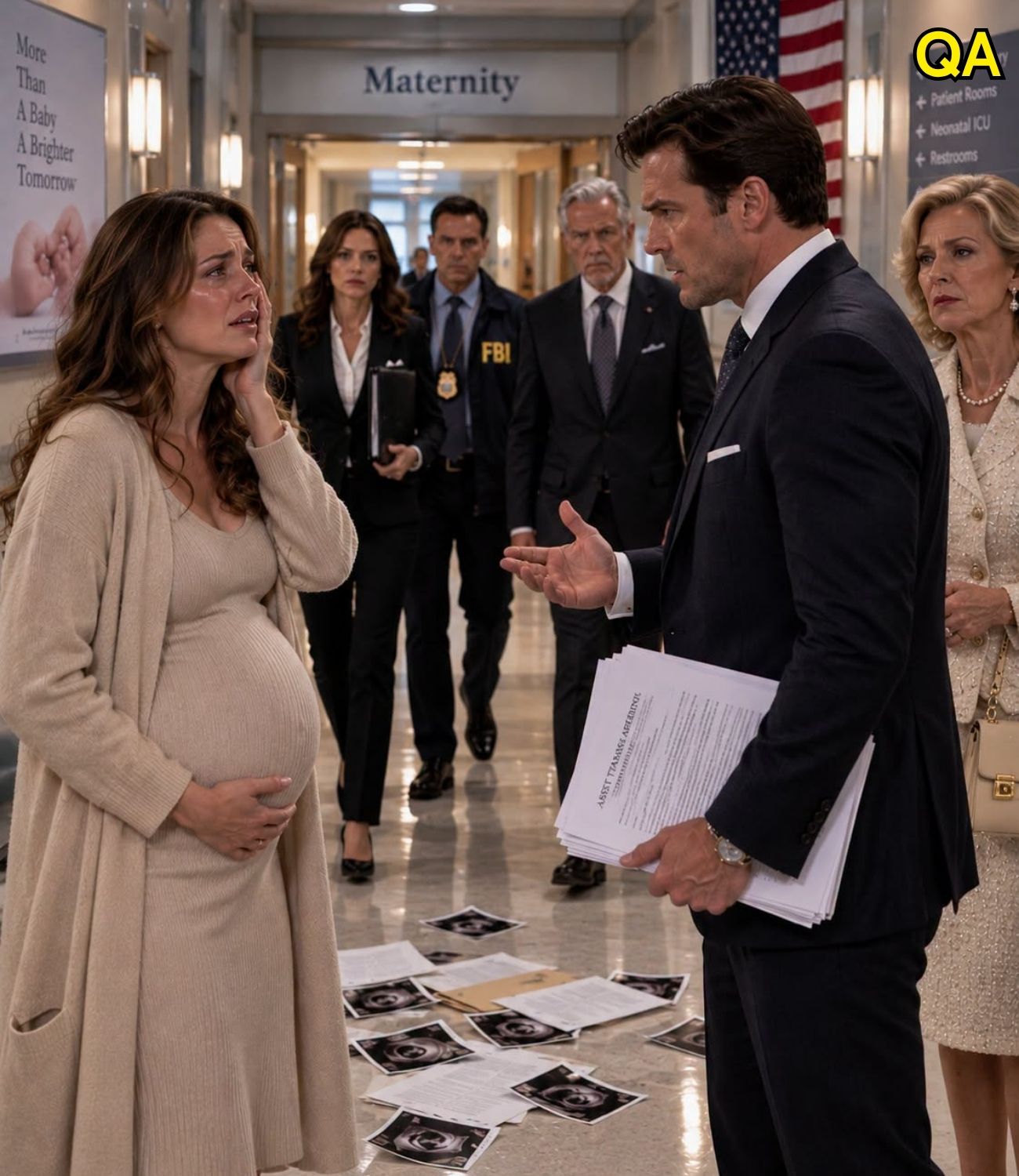
The slap came so suddenly that my ultrasound photographs flew from my hands and scattered across the polished hospital floor.
For a second, I didn’t move.
I stood outside the maternity wing at seven months pregnant, one hand resting protectively over my stomach, the other pressed against my burning cheek.
My husband, Nathan Mercer, stood in front of me holding a thick stack of legal documents. His face was calm, almost bored, as if what he had just done was nothing more than an unpleasant interruption before lunch.
“Sign them,” he said.
I stared at the papers. “What?”
“You heard me.” His voice dropped. “Sign away your rights, and this ends quietly.”
I looked at the first page. It wasn’t a divorce petition; it was an asset-transfer agreement. The second page involved my shares in several investment accounts, and the third contained a waiver of claims against Mercer Biomedical, the company controlled by Nathan’s family.
Then I noticed page eighteen. My hands went cold. A clause buried in the middle of the document stated that our unborn child would have no future claim against a family trust.
I slowly looked up. “Nathan… what is this?”
His mother, Evelyn Mercer, stood several feet away in a cream-colored suit, her arms folded across her chest. She didn’t look concerned; she looked satisfied.
“Be sensible, Lauren,” she said. “You will receive enough money to start over somewhere comfortable. No one is asking you to suffer.”
“Start over?” I echoed.
Evelyn smiled. “Without my son.”
Nathan leaned closer. “You’ve always wanted security. I’m giving you that.”
I stared at him. “You’re asking me to surrender my marriage, my property rights, my financial claims, and my baby’s future.”
He shrugged. “You should be grateful I’m offering you anything.”
That sentence hurt more than the slap. Because I had spent three years telling myself Nathan’s cruelty was just stress, his distance was pressure, and his mother’s interference was simply the price of marrying into a powerful family. I had been making excuses for him for so long that I had almost forgotten what respect felt like.
But he made one mistake. He thought pregnancy had made me vulnerable, distracted by nausea, fatigue, and doctor’s appointments.
He was wrong.
For six months, while Nathan believed I was becoming increasingly dependent on him, I had been quietly building a file. Bank statements, internal emails, corporate records, copies of invoices, screenshots, property documents, messages, and legally preserved recordings. I had stopped asking questions out loud and started keeping answers.
I bent down slowly and picked up one of the ultrasound photographs showing our daughter in profile. Tiny. Perfect. I slipped it into my purse.
Then I looked at Nathan. “No.”
His expression changed. “What did you say?”
“No.”
Evelyn stepped forward. “Don’t be foolish.”
I looked at her. “You’ve been threatening me for months.”
“I have been trying to protect my son.”
“From what?”
Her lips tightened. “From you.”
Nathan grabbed the papers from my hand and pushed them toward my chest again. “Last chance.”
I wiped the corner of my mouth where a tiny streak of blood stained my fingertip. Then I looked at him. “No.”
His smile twisted into something ugly. “You have no idea what you’re doing.”
Actually, I did.
And that was when the heavy oak doors behind him suddenly burst open, and footsteps echoed through the hallway.
Chapter 2: The Secret They Never Knew About Me
Nathan turned, and his entire body went rigid. Because walking through those doors were three people he had never expected to see together: my attorney, Julia Hart; a federal financial investigator named Adrian Cole; and the chairman of Mercer Biomedical’s largest outside investment fund.
Behind them came the man Nathan had spent years dismissing as nothing more than a retired school principal—my father, Samuel Bennett. He wore a charcoal suit, walking slowly, calmly. When he saw the blood on my lip, his expression changed.
He looked at Nathan. “Son,” he said quietly, “you just made this much more serious than it needed to be.”
Nathan recovered first. “This is a family matter.”
Adrian Cole stepped forward and showed his credentials. “No, Mr. Mercer. It became a federal matter when your company’s financial records began indicating identity misuse and potential fraud.”
Nathan stared at him, then at me, and finally at the documents scattered across the floor. “You did this?”
I shook my head. “You did it.”
Julia stepped forward and flipped directly to page eighteen. “You attempted to have a pregnant woman waive future claims involving an unborn child and concealed family assets.”
Nathan’s jaw tightened. “This agreement is confidential.”
“Not anymore,” Julia replied.
His eyes moved toward the ceiling, suddenly remembering the hospital security cameras, the timestamps, and the witnesses. He had forgotten something even more important: he had underestimated me.
Before marrying Nathan, I had worked for nine years as a forensic accountant specializing in corporate fraud. Nathan knew I had been an accountant once, but he assumed that meant basic spreadsheets. He never understood what forensic accounting actually meant: following money, finding patterns, and uncovering the one transaction people desperately wanted you not to notice.
Over the previous six months, I had found plenty.
I opened my phone. “Blue Harbor Advisory.”
Nathan’s face stiffened.
“North Crest Consulting.” Evelyn stopped breathing.
“Sterling Strategic Partners.” I looked at my mother-in-law. “Three companies that supposedly provide outside consulting services to Mercer Biomedical.”
Adrian opened a folder. “None of the three has employees capable of performing the contracts they billed.”
Julia continued. “Yet they received more than forty million dollars in eighteen months.”
Nathan looked at me. “You don’t understand the company.”
“No,” I said, “I understand it better than you think.”
The next document landed on the table, followed by ownership structures, transfers, and offshore accounts. Nathan’s face turned white.
Evelyn stepped forward. “You’re twisting ordinary business expenses into something sinister.”
I turned toward her. “Then explain why one of your consulting companies has the same registered mailing address as a storage unit. Explain why invoices for projects that supposedly lasted six months were created three days before payment. Explain why the company paid for private travel, jewelry, and real-estate expenses through accounts categorized as research expenditures.”
Silence filled the hallway.
Then Adrian spoke. “We also have evidence that a shell entity was created using Lauren’s Social Security information.”
Nathan’s head snapped toward me. “What?”
“They used my identity,” I answered quietly.
My father stepped forward. “The company you thought was a rescue vehicle is not what you believed it was.”
Nathan frowned. “What are you talking about?”
“Six months ago, Mercer Biomedical needed emergency capital,” my father said.
Nathan nodded. “We secured it.”
“No,” my father replied. “You accepted it. The investment came through a fund I control.”
The hallway went completely silent. Nathan’s mouth opened, but no words came out. He knew my father had been a school administrator, but he didn’t know what my father had done twenty-two years earlier: founded a cybersecurity company, sold it for hundreds of millions, and walked away to a quiet life. He never talked about the money, and I had never volunteered the information because I wanted to know whether Nathan loved me—me, not my family or my inheritance.
That experiment had failed spectacularly.
Nathan stared at my father. “You funded us?”
“Because my daughter asked me to,” my father nodded.
Nathan looked at me. “You knew?”
“Yes.”
“When?”
“Six months ago.”
His face changed. “You let me believe you didn’t know anything.”
“No,” I shook my head. “I let you believe I didn’t know everything.”
Chapter 3: The Morning Their Perfect Story Collapsed
By sunrise, Mercer Biomedical was in crisis. The company’s board called an emergency meeting, Nathan’s access to financial systems was suspended, accounts were frozen, and independent directors requested a full forensic audit. The hospital incident was now part of an active criminal investigation.
Nathan called me eleven times. I answered once. “What did you do?”
I was sitting in a quiet hotel room with my attorney. “Nothing.”
“You’re destroying my family.”
“No,” I looked at the medical report on the desk. “Your family did that.”
“You planned this.”
“I prepared for it.”
He was silent for a moment before his voice changed. “Lauren, please come home.”
I closed my eyes. “I was home, Nathan. When your mother threatened me. When you told me I owed your family my loyalty. When you demanded I sign away our baby’s rights. And when you hit me.”
He whispered, “I lost control.”
“No,” my voice stayed calm. “You made a choice.”
I hung up.
That afternoon, Adrian showed me documents I hadn’t seen: bank transfers, email communications, and a draft agreement transferring liability for several questionable transactions to a company registered in my name.
“They were going to blame me,” I realized.
Adrian nodded. “That appears to be the plan.”
My father sat beside me, putting his hand over mine. “You don’t have to fight this alone.”
For three years, I had been surrounded by people who wanted something from me—money, silence, access, control. Sitting there with my father, I finally remembered what protection felt like. Not control. Protection. There is a difference.
Chapter 4: The Recording
The case continued for months. Nathan’s attorneys tried to argue that the hospital confrontation was merely an emotional marital dispute, until Julia introduced a recording of Nathan speaking to Evelyn in our home two weeks prior:
“We just need Lauren to sign.”
Evelyn had asked, “And if she refuses?”
Nathan answered, “Then we make sure she understands what she stands to lose.”
Then came another recording of Evelyn’s voice: “Once she signs, the company will be protected.” And Nathan replying, “She’ll be too distracted with the baby to understand the paperwork.”
I sat completely still. I wasn’t happy or angry; I was heartbroken, remembering the man who had once promised to protect me at our wedding.
The prosecution traced millions in questionable transactions. Nathan eventually admitted he had known about the shell companies, approved several transfers, and designed the liability structure to protect senior family members. Evelyn admitted to authorizing payments from the fake consulting firms.
The company entered restructuring, executives were removed, the family trust was placed under court supervision, and assets were subjected to recovery proceedings. Nathan lost his executive position, and Evelyn lost her board seat.
But the thing that mattered most happened before any sentence was handed down: my daughter was born. Healthy, loud, and perfect. I named her Grace, because I wanted her name to remind me that survival did not have to turn me cruel.
Chapter 5: “You Wanted Me to Disappear.”
Months later, Nathan asked for one final meeting under controlled conditions. He looked older, tired, and completely stripped of his confidence.
“You never loved me,” he said.
“I did,” I looked at him.
“Then how could you do this?”
“I didn’t do this to you,” I shook my head. “You wanted me to stay quiet. You wanted me to sign away my financial rights. You hit me. You tried to use my identity.”
His face tightened. “I didn’t personally do that.”
“You approved the structure that made it possible.”
He looked down, whispering, “I thought you would stay.”
I almost cried—not for him, but for the man I thought he was. “I stayed for three years. I stayed through your mother humiliating me, through the lies, through the financial manipulation, because I believed marriage meant fighting for someone. But the night you hit me while I was carrying our child, I realized something.”
He looked up. “What?”
“I was the only person fighting for this marriage. And you?”
“I stopped.”
Chapter 6: The Thing People Don’t See After Leaving
People often imagine that once the villain is exposed, everything becomes easy. It doesn’t.
I still woke up frightened sometimes. A loud knock could make my heart race, and an unknown number could ruin an afternoon. There were nights when I looked at Grace sleeping and wondered how close I had come to bringing her into a life built on fear.
Therapy helped. So did my family. Slowly, ordinary things returned: morning coffee, walks with Grace, grocery shopping without financial anxiety, and Sunday dinners with my parents.
I had spent years believing wealth could protect people. It couldn’t. Money could buy lawyers and houses, but it couldn’t buy character. That had to come from somewhere else.
Chapter 7: What Happened to the Company
Mercer Biomedical survived, but barely. The restructuring was brutal, leaving some employees jobless and vendors waiting for payment. Innocent people had been affected by decisions they never knew were being made.
When my father’s investment fund gained control of a significant portion of the restructured company, he made a decision. He didn’t strip the company for profit; he stabilized it, brought in independent leadership, restored legitimate financial controls, and created a fund to help former employees who had suffered.
When I asked him why, he shrugged. “Because people shouldn’t have to pay for someone else’s greed forever.”
That sentence changed something inside me. My father reminded me to think about what everyone else deserved: a chance to rebuild, work without fear, and start over. Not watching the people who hurt me fall, but helping people who had been hurt by them stand back up.
Chapter 8: The Last File
A year later, I sat in my office reviewing a final legal file. The brass plaque on the door read:
LAUREN BENNETT FORENSIC FINANCIAL CONSULTING
I had returned to forensic accounting, working independently on financial fraud, hidden assets, and complex family-business disputes. My clients were often women who had been told they didn’t understand money, leading them through the steps of taking control of their lives.
One afternoon, a sixty-one-year-old woman named Patricia came into my office, embarrassed because her husband had controlled every account during their thirty-five-year marriage.
“Where do I start?” she asked.
I handed her a folder. “Start with one document.”
Within thirty minutes, she was asking good, important questions. When she left, she turned back at the door. “Do you know what surprises me? That I thought I was too old to learn.”
“You’re not,” I smiled.
After she left, I thought about myself at the hospital—seven months pregnant, blood on my lip, ultrasound photos scattered on the floor, and a husband telling me to sign. I had thought that moment was the end of my life.
It wasn’t. It was the moment my old life ended.
Epilogue: “I’m Glad You Said No.”
Two years later, I returned to the hospital where everything had changed, not because I was sick, but because Grace had a routine appointment. She was two years old, full of opinions, and wanted the pink chair instead of the blue one. My father sat beside us, spoiling her.
I watched them and smiled, looking toward the hallway where I had once stood trembling. I remembered the papers, the slap, the blood, and the word no.
For a long time, I thought the most important thing I had done that day was expose Nathan. I was wrong. The most important thing I had done was protect my daughter from inheriting a life built on fear.
Forgiving someone does not mean trusting them again or reopening the door. Sometimes forgiveness simply means refusing to carry hatred into the next chapter of your life.
My life is here. My daughter is here. My family is here. And every morning when Grace runs into my room with sleepy eyes, I am reminded that the future I fought for wasn’t a perfect life, but a safe one—a truthful one where my daughter knows that no is a complete sentence.
Years later, I still remember my father’s words when he saw the blood on my face: “You just made this very expensive.”
He was right, but not in the way Nathan feared. The most expensive thing that day wasn’t the legal battle or the company; it was the price they paid for believing that a woman’s silence meant she had nothing to say.
The life I wanted wasn’t waiting for someone to give it back to me. It was waiting for me to have the courage to walk away and build it myself.
