
Chapter 1: The Kitchen Where I Belong
“I’m not exactly the wedding type,” my sister joked as the family once again struck my name from the guest list.
So, when I got engaged, I invited everyone—except them. I even managed to book my dream venue. Furious messages started flooding in before the wedding cake had even been cut.
For nine years, every Langford wedding had one thing in common.
I made the cake.
Four weddings. Two rehearsal dinners. My parents’ anniversary. I even baked one while running a fever.
Nobody ever paid me.
And somehow, nobody ever invited me either. I was simply told the date. There’s a difference.
My name is Maya Langford. I’m 37, and I own a bakery in McMinnville, Oregon.
At every family wedding, my cakes went through the service entrance. I assembled them beside trash bins, catering carts, and staff smoking behind the venue.
Then I went home.
Afterward, Mom always hugged me and said: “We knew we could count on you.”
For years, I thought that was love.
Then came my cousin Dana’s wedding.
My sister Dileia called.
“Cake for 140. Service entrance by two.”
Then she added casually: “The guest list is tight, so you should probably just drop it off.”
Again.
I made the cake. Delivered it. Fixed a tier that shifted during the drive. Stayed forty extra minutes because the venue staff needed help.
Then I sat alone in my truck while the wedding started inside.
Dileia came outside carrying leftovers. She saw me and said: “Don’t take it personally, Maya.”
I waited.
Then she smiled.
“You’re just not wedding material.”
“You’re the one who makes it happen.”
She laughed like she had said something obvious. Then went back inside.
Three weeks later, my boyfriend Grant proposed. He asked me one question: “What do you actually want?”
Not what was practical. Not what would make everyone else comfortable. What did I want?
I stood behind my bakery in an apron and finally said: “I want to be a guest at something.”
“Just once.”
“I want to walk through the front door, sit down, and have somebody bring me a plate.”
Grant nodded. “Then that’s what we’ll do.”
Chapter 2: The Three-Week Window
We booked Ashgrove Vineyard for August 15. For the first time in my life, I was planning a wedding where my name belonged on a chair instead of a bakery invoice.
Then Mom called.
She was excited for exactly thirty seconds. “Maya, Grant is such a good man.”
Then her voice brightened. “Oh! Rowan is engaged too.”
Rowan was Dileia’s daughter. Her wedding was September 5. Three weeks after mine.
Then Mom said: “So we’re all set. You’ll do Rowan’s cake.”
Not “Would you?” Not “Are you available?”
“You’ll do it.”
Three tiers. 180 guests. Dessert table. Coffee service. Two locations.
I said I would check my schedule. Apparently, that answer was already too much.
A few days later, Dileia called.
“Aunt Marilyn can’t make two trips.” “Todd’s family is coming from Idaho.” “People will be tired after your wedding.”
Then she said: “We were wondering if you could move yours to October.”
I went completely still. “My wedding?”
“It’s just a date.”
Then came the line that finally made me hear everything differently.
“You of all people know how these things work.”
Because I was the baker. The useful one. The flexible one. The person whose plans could move because I knew how to make everyone else’s plans work.
“No,” I said.
Nothing else. Just no.
Chapter 3: The Full Price Quote
Weeks later, Dileia walked into my bakery for the first time in nine years. She put an index card on the counter.
Three tiers. 180 servings. Six desserts. Coffee service. Delivery and setup.
She read the entire order to me. When she finished, I asked: “What’s the budget?”
She laughed. “Budget?”
“Maya, it’s Rowan.”
Behind me, one of my employees went completely still.
I picked up my pen. “I’ll send you a quote.”
Dileia stared at me. “A quote?”
“Yes.”
I priced the job exactly as I would for anyone else. $4,850.
Then I reached the line on my template marked family discount. For years, that number had effectively been 100%. I typed it. Deleted it. Typed 25%. Deleted that too.
Then I entered zero. Full price.
I sent the quote at 5:02 Sunday morning. Nobody replied all day.
At 11:40 that night, Mom finally texted: “Your father is very upset.”
Not “Why does it cost that much?” Not “Can we talk?”
Just another assignment. Fix your father’s feelings.
Then something strange started happening. A standing lunch order canceled. Then the church moved its monthly bakery order somewhere else. Then a retirement party I had already quoted suddenly disappeared.
Within weeks, I had lost $2,280 in local business. Nobody said why. They didn’t have to. Someone had turned my quote into a story about Maya charging her own family.
By June, I had also sent out my wedding invitations. Eighty-two of them. There were eleven more sitting in a box.
Mom. Dad. Dileia. Rowan. The relatives whose weddings I had fed for free.
I held those blank invitations in my hands for weeks. Then I put them in the bottom drawer of my desk. I didn’t tear them up. I simply stopped adding.
Chapter 4: A Plate at the Table
August 15 arrived. I got married at 4:30 overlooking the vineyard. Ninety-one people.
For the first time, somebody brought me dinner. I sat down. And let them.
Then at 7:22, my phone started vibrating. Seven messages. Mom. Dileia. Aunt Marilyn. Again and again.
The first one said: “Where are you right now?”
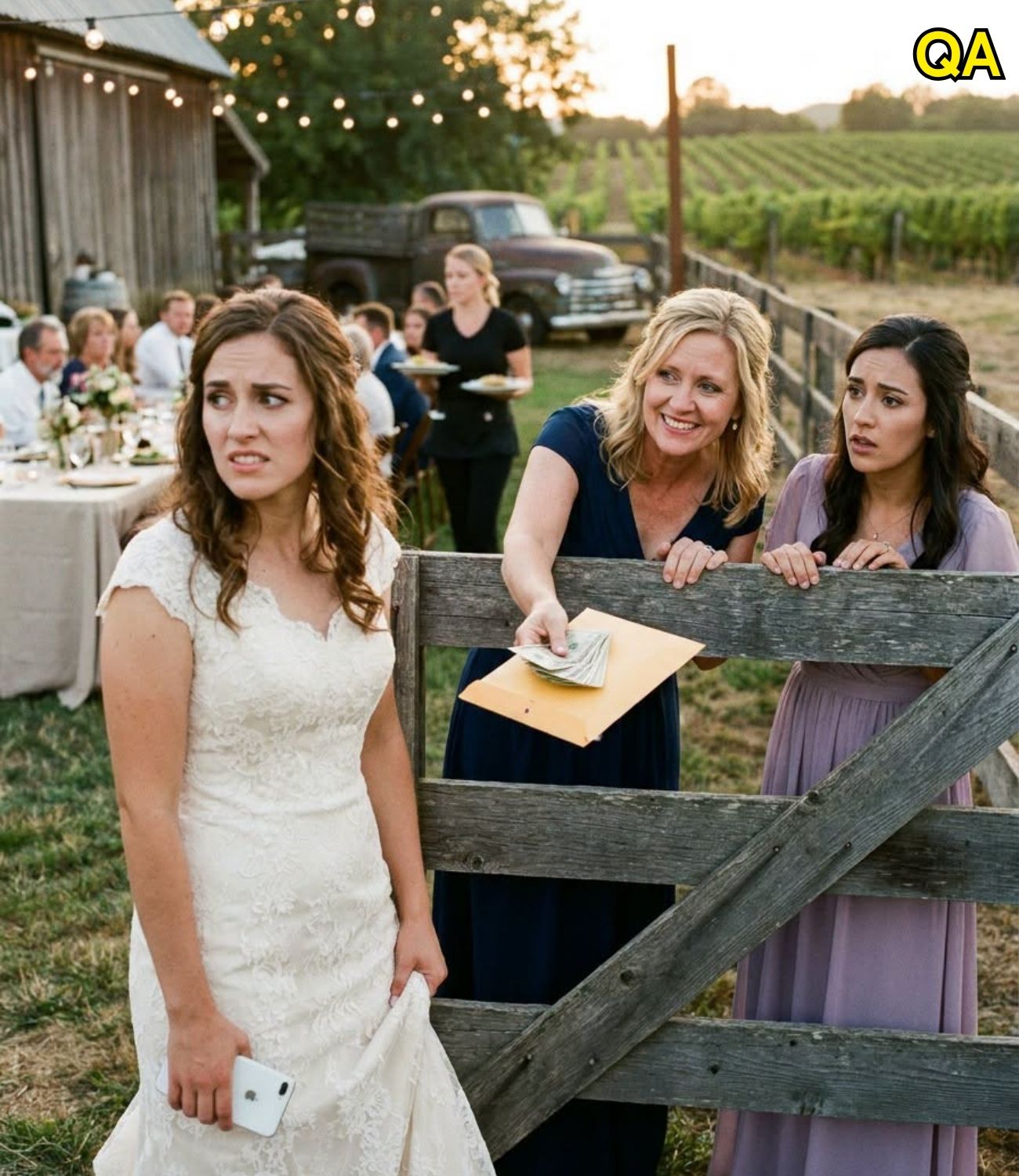
I stood up. Walked toward the gravel entrance. And there they were.
My mother and sister standing outside the gate at my wedding. Dad was sitting in his truck behind them with the engine running.
Mom smiled when she saw me. “Oh, honey. Look at you.”
For one second, I thought they had finally come because they wanted to see me get married.
Then Mom explained why they were really there. The bakery they had hired for Rowan’s wedding had suddenly closed.
September 5. 180 guests. No cake. No desserts. No coffee service. Three weeks left.
Dileia pulled a manila envelope from her bag. “There’s $1,000 cash.”
“This time we’ll pay.”
Then she added: “If the number really is the number, we can discuss the rest later.”
Mom put both hands on the gate. Her eyes filled.
And then she said the sentence that finally explained every cake, every service door, and every missing invitation from the previous nine years.
Chapter 5: The Sentence That Explained Everything
Mom’s fingers curled into the black iron bars of the gate. Her eyes watered with that familiar, theatrical mist she used whenever she needed the world to feel sorry for her.
She looked at me in my white lace wedding dress—a dress paid for with my own money, standing in a vineyard where I was finally a guest of honor—and she sighed.
“Maya, family helps family,” Mom whispered, as if she were imparting profound, sacred wisdom. “We always take care of our own. That’s just what Langfords do.”
There it was.
The entire architecture of my life, built on nine words.
Family helps family.
It sounded noble. It sounded like tradition. But standing there with the sun setting behind the vineyard hills, I finally heard the translation that had been hidden beneath those words for thirty-seven years:
Maya helps everyone. Everyone else takes.
For nearly a decade, “family helps family” meant Maya spends twenty hours standing over a hot commercial oven while everyone else drinks champagne. It meant Maya delivers the cake through the trash cans so she doesn’t ruin the aesthetic of the wedding photos. It meant Maya stays invisible because her utility is more valuable to them than her presence.
And now, here they were, stranded three weeks before Rowan’s wedding, treating my wedding reception like an emergency customer service counter.
My husband, Grant, walked up quietly behind me. He didn’t say a word. He just slid his warm hand into mine, his thumb resting gently against my knuckles. The solid, reassuring weight of him grounded me.
I looked past Mom and Dileia. Through the windshield of the idling pickup truck, my father stared straight ahead, refusing to look me in the eye. He couldn’t even be bothered to walk up to the gate. He expected me to drop everything, run back to the bakery, and rescue them, just like I always did.
I looked back down at Dileia, who was still holding out the manila envelope stuffed with cash.
“One thousand dollars,” Dileia said, her voice dropping into an impatient, bargaining tone when I didn’t immediately reach for it. “That’s serious money, Maya. It’ll cover your ingredients. And we’ll let bygones be bygones about that ridiculous quote you sent. We’re offering an olive branch here.”
An olive branch.
They had boycotted my business, turned local townspeople against me, cost me nearly twenty-three hundred dollars in commercial contracts, ignored my wedding invitations, and then showed up uninvited to my reception gate—not to congratulate me, but to hire me at a discount because their backup plan fell through.
And they called it an olive branch.
“No,” I said.
The word was quiet, but it carried the weight of nine years of unthanked labor.
Mom blinked, startled. “Pardon?”
“I said no,” I repeated, my voice steady.
Dileia’s expression hardened instantly, the theatrical sweetness dropping away to reveal the cold entitlement underneath. “What do you mean, no? Rowan’s wedding is in three weeks! Are you seriously going to punish your own niece because you’re throwing a temper over a bakery quote?”
“I’m not punishing anyone, Dileia,” I said calmly. “I’m simply unavailable.”
“Unavailable?” Mom’s voice rose, cracking with disbelief. “You own a bakery! You bake cakes for a living! You’re standing right here doing nothing!”
“I am currently enjoying my wedding reception with my husband and my friends,” I replied, gesturing toward the vineyard tables where laughter and music were floating softly on the evening air. “And even if I weren’t, my calendar is fully booked.”
“Booked with what? You’re married now!” Dileia scoffed, taking a step closer to the iron gate. “You don’t have another wedding today!”
“No, I don’t,” I said. “But my bakery is closed on Sundays and Mondays. And starting tomorrow, I am taking a two-week honeymoon in the San Juan Islands with Grant. My ovens won’t even be turned on.”
The silence that followed was absolute.
Dileia stared at me as if I had spoken in a foreign language. To them, my bakery wasn’t a business with operating hours, staff boundaries, or a owner who deserved rest. It was a communal utility closet—a public pantry they had a birthright to access whenever their plans went sideways.
“You’re going on a honeymoon?” Dileia repeated, the word tasting like poison in her mouth. “While Rowan doesn’t have a cake?”
“That sounds like something you should take up with the bakery you originally hired,” I said mildly.
“They went out of business, Maya! You know that!”
“Then I suggest you start calling around McMinnville and Portland,” I advised. “Though, finding a custom 180-serving wedding cake with a dessert table and coffee service three weeks out might be difficult. Most reputable bakers book months in advance. You might have to learn how ‘these things work’ the hard way.”
I used her own phrase against her.
Dileia’s face flushed a deep, furious crimson. She opened her mouth to snap back, but Mom cut her off, switching tactics back to emotional manipulation. Tears spilled over Mom’s lower lashes, trembling on her cheeks with practiced precision.
“Maya… how can you do this to us?” Mom sobbed, pressing her palms against the gate bars. “We raised you. We gave you a home, a life, a future. And now, on the happiest day of your life, you’re turning your back on your own flesh and blood over money. Is that all we are to you? Just customers?”
It was the exact same script she had used every time I tried to set a boundary. Make me feel guilty for existing outside of my utility to them.
For thirty-seven years, that script had worked like magic. It made me fold. It made me apologize. It made me bake cookies at two in the morning while running a fever just to earn a passing smile and a hug that meant we knew we could count on you.
I looked at my mother—really looked at her. I saw a woman who had spent decades weaponizing guilt to keep her daughters compliant, a woman who measured love entirely by how much unpaid labor she could extract from her children.
I didn’t feel angry anymore. Surprisingly, I just felt profoundly, beautifully free.
“No, Mom,” I said softly. “You aren’t customers. Customers actually pay for what they get.”
Mom drew back as if I had slapped her.
Before she could recover to launch another round of tears, Grant stepped up beside me, resting his hand gently on the small of my back. He looked past them toward the idling truck where my father sat staring blankly through the windshield.
“Visiting hours at this wedding are over,” Grant said, his voice quiet, calm, but leaving zero room for negotiation. “If you don’t step away from the gate, I’ll call vineyard security to escort you off the property.”
Dileia let out a harsh, disbelieving laugh. “You’re throwing us out? We’re her family!”
“No,” I corrected, looking my sister straight in the eye. “You’re people I used to bake for.”
I turned around, linking my arm through Grant’s.
Behind us, Mom’s voice cracked in a genuine, unscripted panic as she realized the manipulation had completely failed. “Maya! Maya, wait! We can talk about the price! We’ll pay the four thousand! We’ll pay whatever you want!”
I didn’t stop.
I didn’t look back.
We walked back down the gravel path, past the blooming grapevines heavy with late-summer fruit, toward the glowing string lights and the sound of laughter waiting for us at the reception tables.
When we sat back down, Aunt Sarah—one of the few real relatives who had actually received an invitation and shown up with a genuine smile—handed me a fresh glass of sparkling cider.
“Everything alright at the gate, honey?” she asked gently.
I took the glass, smiled, and felt the last heavy knot in my chest dissolve completely into the evening air.
“Everything,” I said, looking around the table at the people who were actually glad to see me, “is finally exactly where it belongs.”
