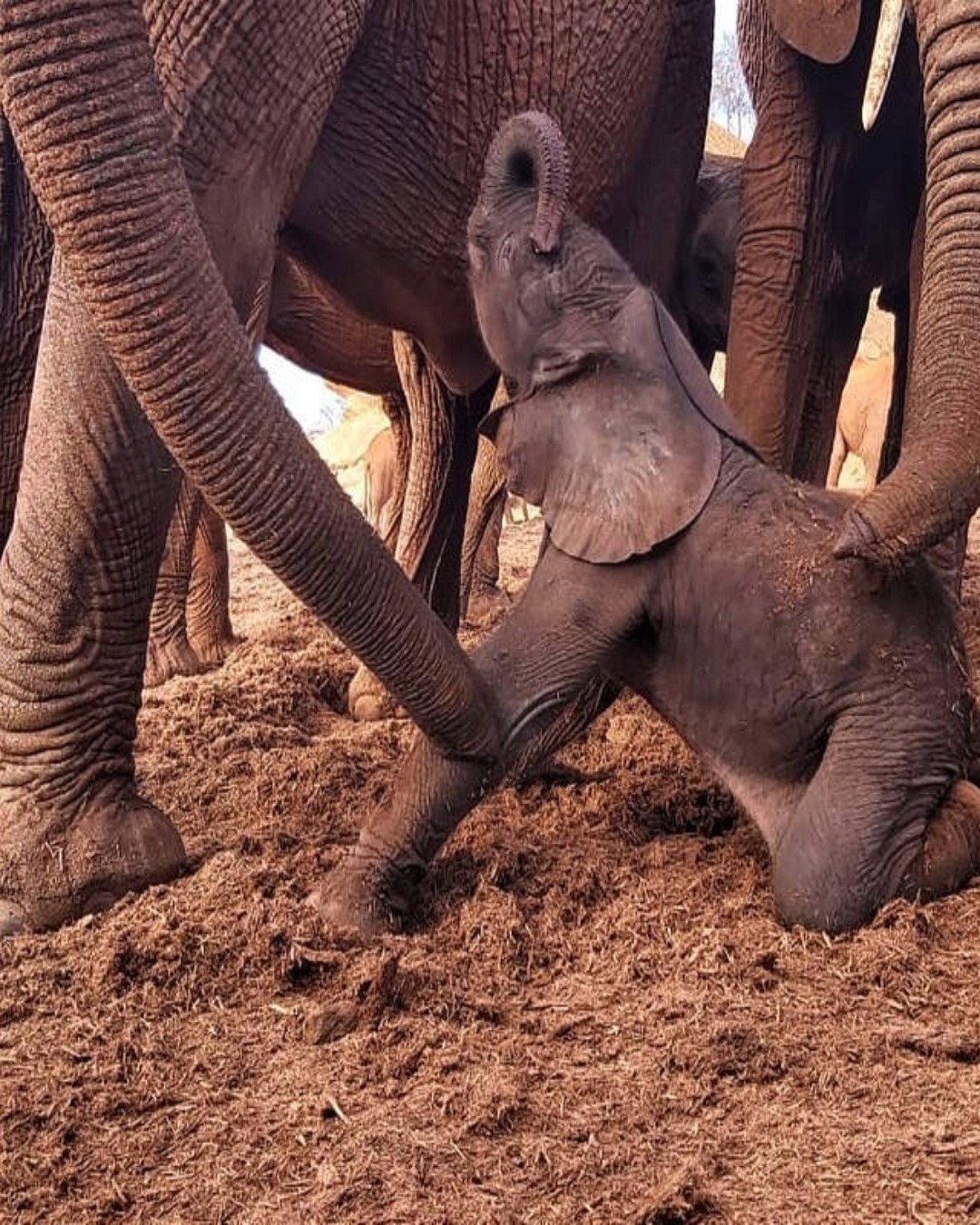

In the soft glow of early morning, when the first strands of sunlight brushed the red earth of Tsavo, a quiet miracle unfolded. It was the kind of moment that seemed almost timeless, echoing the deep history of elephant families that have roamed these landscapes for generations. Within a peaceful clearing, an elephant stood over a newborn calf — a tiny, trembling being who had just arrived in the world. This calf was the first newborn welcomed by the orphan herd in eight years, and its appearance marked more than the beginning of a life. It marked the completion of a circle.
The mother, Melia, had once been a vulnerable orphan herself. She had been found as a frail infant, uncertain and alone, before being taken in by a group of caretakers and eventually embraced by elephants who would become her new family. Now, at dawn, she brought her own calf into the same world that once embraced her.
What happened next reflects not only the instinctive wisdom of elephants but also the rich cultural narratives surrounding them and the scientific insights that continue to shape our understanding of their remarkable lives.
A Birth That Sparked a New Chapter
Melia’s Moment of Uncertainty
As the sun rose, Melia stood quietly over her newborn calf. The little one trembled softly, still adjusting to brightness, sound, and the unfamiliar air. Wrapped in its birth materials, the calf waited, instinctively seeking the comfort of its mother’s presence.
Melia, however, hesitated. For a brief moment, she stepped back, unsure of how to respond. Motherhood, especially for elephants experiencing it for the first time, can be overwhelming. The mix of instinct and inexperience often creates a period of confusion.
But the story of elephants is never about a single individual. It is about the collective.

The Guidance of the Herd
The Matriarch’s Wisdom
The herd’s matriarch, Loijuk, was the first to reach the newborn. With the calm assurance characteristic of older elephants, she lowered her trunk and gently touched the calf. Elephants communicate extensively through touch, and this simple gesture carried meaning — comfort, guidance, acceptance.
Loijuk encouraged the calf to rise, slowly supporting it as its unsteady legs searched for balance. The newborn wobbled, took a deep breath, and stood. The surrounding elephants rumbled soft, soothing sounds that felt like a lullaby drifting across the savanna.
This moment demonstrates why elephant herds are often described as some of the most cooperative groups in the animal kingdom. Motherhood in elephant society is shared. The younger mothers learn from older females, and calves grow under the watchful care of “allomothers,” or helpers, who treat them almost as their own.

Melia’s Instinct Awakens
A Mother’s First Touch
As the experienced females tended to the newborn, Melia inched closer. Something within her — something ancient, instinctive, and powerful — began to shift. She reached out her trunk, brushing away the last delicate remnants surrounding her calf. Her movements were careful and deliberate, as though she were studying every detail, committing her baby’s shape and scent to memory.
Then came the moment that changed everything. Melia wrapped her trunk around her calf, a gesture of bonding and protection, and guided him gently to her side. There, the calf found the nourishment and comfort it needed for its first hours of life.
A mother had truly emerged.
Cultural and Mythological Significance of Elephant Births
Symbols of Renewal Across Traditions
In many cultures, an elephant birth is more than a biological event — it represents hope, renewal, and the continuation of life’s harmony.
In parts of Africa, elephant herds have long symbolized unity, wisdom, and the power of community. Their close-knit social structures inspire stories of resilience and leadership. A newborn elephant, especially one born to a rescued orphan, is sometimes viewed as a symbol of restoration — a reminder that nurturing care can create new beginnings.
Across Asia, elephants hold a sacred place in mythology. Though Melia’s story is unique to Tsavo, the idea of an elephant bringing new life resonates globally. Many traditions associate elephants with good fortune and generational continuity. A newborn calf, delicate yet strong, often represents the arrival of positive energy.
While these cultural interpretations are rooted in centuries of storytelling, they reflect a universal admiration for elephants and their gentle strength.
Scientific Insights Into Elephant Maternal Behavior
Why Elephant Mothers Learn From Their Herds
Science offers a grounded perspective on what unfolded in Tsavo that morning.
Researchers have consistently observed that elephant mothers rely heavily on social learning. First-time mothers may hesitate, unsure of how to care for their calves. The presence of older, experienced females helps guide their actions. This guidance extends from birthing support to teaching calves how to forage, interact socially, and navigate the challenges of the wild.
Elephants also possess a complex emotional capacity. While interpretations should remain measured, scientific studies suggest they display signs of empathy, cooperation, and long-term bonding. A newborn’s arrival often strengthens the herd’s unity, reinforcing the bonds that help them thrive.
The Significance of Calf Survival
From a biological standpoint, a successful birth is crucial. Elephant calves rely on their mothers for years, learning essential skills and receiving protection. The health of a population can often be traced to its youngest members.
Melia’s calf, being born to a mother who once depended on human and elephant caregivers, illustrates the resilience of the species and the impact of long-term conservation efforts.

The Role of Conservation and Human Care
A Legacy of Protection
Melia’s journey from orphaned infant to mother reflects the combined contributions of caretakers, conservation programs, and natural elephant behavior. Across Africa, dedicated teams work tirelessly to rescue orphaned or displaced elephants, offering them the support they need to grow and eventually return to the wild.
While nature ultimately guides them, this foundation ensures they can thrive and rebuild their herds over generations.
Why This Birth Matters for the Future
The appearance of a newborn after eight years is a milestone. It signifies:
• The herd’s health and stability
• The success of rehabilitation programs
• The renewal of generational continuity
• A powerful reminder that care and patience can restore ecosystems
This calf represents more than a single life. It represents the beginning of a new chapter for the orphan herd and a sign of hope for conservationists who work to protect elephants for the generations to come.
A Story of Renewal and Connection
From Orphan to Matriarch-in-the-Making
Melia’s transformation into a confident mother shows how nurturing environments can reshape destinies. Her calf will grow under the guidance of a herd that once raised her, forming bonds that stretch across years and experiences.
This moment also reinforces the profound connection between elephants and the landscapes they inhabit. Their presence shapes the ecosystem, and each calf adds to the continuity of life in Tsavo.
Why Stories Like Melia’s Matter
In a world that often moves too quickly, Melia’s miracle encourages us to pause and appreciate the gentle cycles of nature. The birth of her calf is a reminder that even after long periods of uncertainty, renewal can arrive quietly, wrapped in morning light.
Stories like this resonate because they echo something universal — the human longing for hope, connection, and the assurance that life continues. Whether viewed through cultural symbolism, scientific understanding, or simple admiration, the arrival of a newborn elephant touches the deepest parts of our curiosity and wonder.
It shows that care can create transformation, that communities thrive through cooperation, and that each new life writes a new chapter in the story of the wild.
Sources
-
The Elephant Ethogram / ElephantVoices – Behavioral studies on social structure and maternal care
-
Save the Elephants – Research on matriarch roles and herd dynamics
-
International Fund for Animal Welfare (IFAW) – Conservation programs and orphan rehabilitation
-
Smithsonian National Zoo – Scientific resources on African elephant biology
