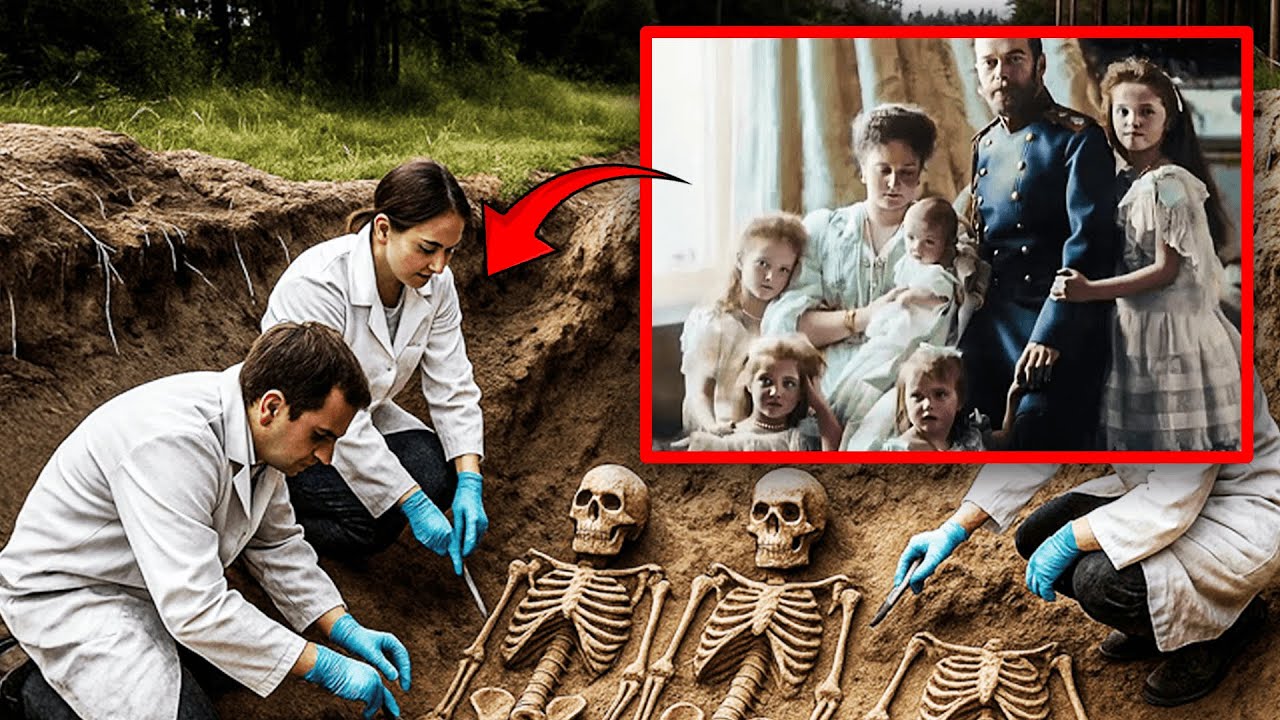

The fate of the Romanov royal family has lingered in global memory for more than a century, surrounded by mystery, speculation, and an extraordinary blend of documented history and enduring legend. For decades, the exact details of the final hours of Russia’s last imperial family remained uncertain. Then, in a quiet forest near Yekaterinburg, an excavation changed everything. When archaeologists finally opened the grave believed to contain the Romanovs, they encountered a discovery so historically significant that it shook even the most seasoned experts.
This was not simply an academic milestone. It was a rare moment when history, science, emotion, and national identity collided in a single site—one that had been hidden for generations.
A Discovery That Reopened a Century-Old Question

The Romanovs had ruled Russia for more than three hundred years, shaping the cultural, political, and spiritual identity of the empire. Their fall in 1917 and the events that followed left deep marks on history. After their execution in 1918, official accounts remained vague or intentionally concealed, giving rise to stories that the family may have escaped or that one or more children had survived.
When archaeologists reached the burial site decades later, they did so knowing they were confronting one of the great historical mysteries of the twentieth century. The grave, hidden under forest soil and decades of silence, contained nine skeletons. Early assessments suggested these remains could belong to Nicholas II, his wife Alexandra, and several of their children.
But science, not speculation, would determine what happened next.
DNA Evidence Confirms What Eyewitness Accounts Only Hinted
Through a rigorous series of DNA tests involving both mitochondrial and nuclear analysis, scientists confirmed the identities of the remains. The grave indeed contained Nicholas II, Alexandra, and three of their daughters. Their identities were matched with living relatives, including descendants of the Romanov line and the extended European royal families.
This confirmation was a breakthrough that answered questions which had fueled countless books, films, and theories. Yet the discovery also revealed something unexpected: the gravesite contained only nine bodies, not eleven. Missing were the remains of Alexei, the heir to the throne, and one of his sisters (either Maria or Anastasia, depending on the interpretation of the evidence).
Their absence reignited public curiosity and reminded researchers that even with scientific progress, history sometimes offers incomplete solutions.
The Emotional Weight of the Excavation
For the archaeologists and historians present, the moment carried emotional weight beyond scientific significance. They were not simply uncovering a burial; they were encountering the final chapter of a family whose story had shaped the trajectory of an entire nation.
Archaeologists described a sense of silence falling over the team as the remains were uncovered—a quiet recognition that they were standing at the intersection of personal tragedy and historical transformation. The Romanovs had once lived in palaces and commanded the largest empire on Earth. Now, their story was reduced to fragments, bones, and remnants of personal belongings buried anonymously in the forest.
This contrast between imperial grandeur and the modest, hidden grave left many researchers deeply moved. It highlighted how history does not always preserve power, but it often preserves lessons.
From Empire to Revolution: A Story Carved Into National Memory
The Romanovs’ downfall had been swift and dramatic. Their lavish lifestyle stood in stark contrast to the hardships experienced by many Russians at the time, contributing to growing resentment and eventually revolution. After Nicholas II abdicated, the family was placed under house arrest, moved repeatedly, and ultimately transported to Yekaterinburg.
Their final months were marked by uncertainty, but few anticipated that their last chapter would remain concealed for generations. Even as the gravesite brought clarity, it also forced Russia to re-examine this turbulent period.
The discovery allowed historians to piece together more accurate accounts of what happened, resolving inconsistencies and discarding myths that persisted for almost a century.
The Question That Wouldn’t Go Away: What Happened to Alexei and His Sister?
The absence of Alexei and one of his sisters rekindled a narrative that had captured global imagination. Over the years, rumors of surviving Romanov children grew into legends—stories of escape, hidden identities, and secret descendants. The most famous example was the claim that Anastasia had survived, a theory dramatized in films and novels.
Subsequent discoveries, including additional remains found in 2007 near the original gravesite, provided further evidence that the entire family had been accounted for. However, debates occasionally resurface, fueled not by lack of scientific evidence but by the emotional resonance of the Romanov story.
The excavation did not settle every question, but it shifted the conversation from speculation to documented history, creating a foundation for future research.
How Russia Responded to the Discovery
The opening of the grave had cultural and political implications for Russia. The Romanovs remain deeply symbolic figures—representing dynasty, faith, tragedy, and the uncertainties of national identity.
The Russian Orthodox Church canonized Nicholas II and his family as martyrs, recognizing them as symbols of endurance in the face of hardship. Their story became interwoven not only with history textbooks but with spiritual teachings and public discourse.
The excavation, therefore, was not just a scientific moment. It was a moment of national reflection. It forced Russia to confront a chapter of its past that had long been avoided or minimized. The burial site became a bridge between the imperial era, the Soviet period, and the modern nation seeking to understand how its history shapes its present.
What Archaeologists Learned from the Site
Beyond the emotional significance, the excavation provided valuable insights into:
- Burial practices used in hurried or improvised conditions
- The challenges of identifying remains after decades of exposure
- The importance of multidisciplinary collaboration between historians, archaeologists, and geneticists
- How political events can alter the historical record
The Romanov site became a case study in how science can illuminate history, especially when documents, testimonies, and rumors provide only partial truths.
The research also highlighted the importance of preserving historical memory. Without careful documentation and protection of excavation sites, important pieces of the past can easily be lost.
Why This Discovery Still Resonates Today
More than a century after the Romanovs’ final days, their story continues to attract global attention. It contains all the elements that capture public imagination—power, downfall, family bonds, mystery, and the human cost of political upheaval.
The opening of the Romanov grave was a reminder of how closely linked history is to identity. It showed how a single discovery can clarify debates, correct misunderstandings, and influence cultural memory.
For archaeologists, it reaffirmed the importance of their work. Excavations are not just about uncovering physical remains—they are about reconnecting stories, families, and nations with pieces of their past.
A Story That Will Continue to Evolve
The excavation did not mark the end of the Romanov narrative. Instead, it opened a new chapter—one grounded in evidence rather than speculation. As more research continues and as new generations study the Romanovs’ place in history, their story remains a powerful reminder of the complexities of human experience during times of political transformation.
The Romanov grave, once hidden for decades, now stands as a testament to the enduring impact of history. Its opening revealed not only the final chapter of a royal family but also the ongoing importance of seeking truth, honoring memory, and learning from the past.
The echoes of that forest excavation still resonate, inviting reflection on power, legacy, and the fragile threads that connect the present to the past.
