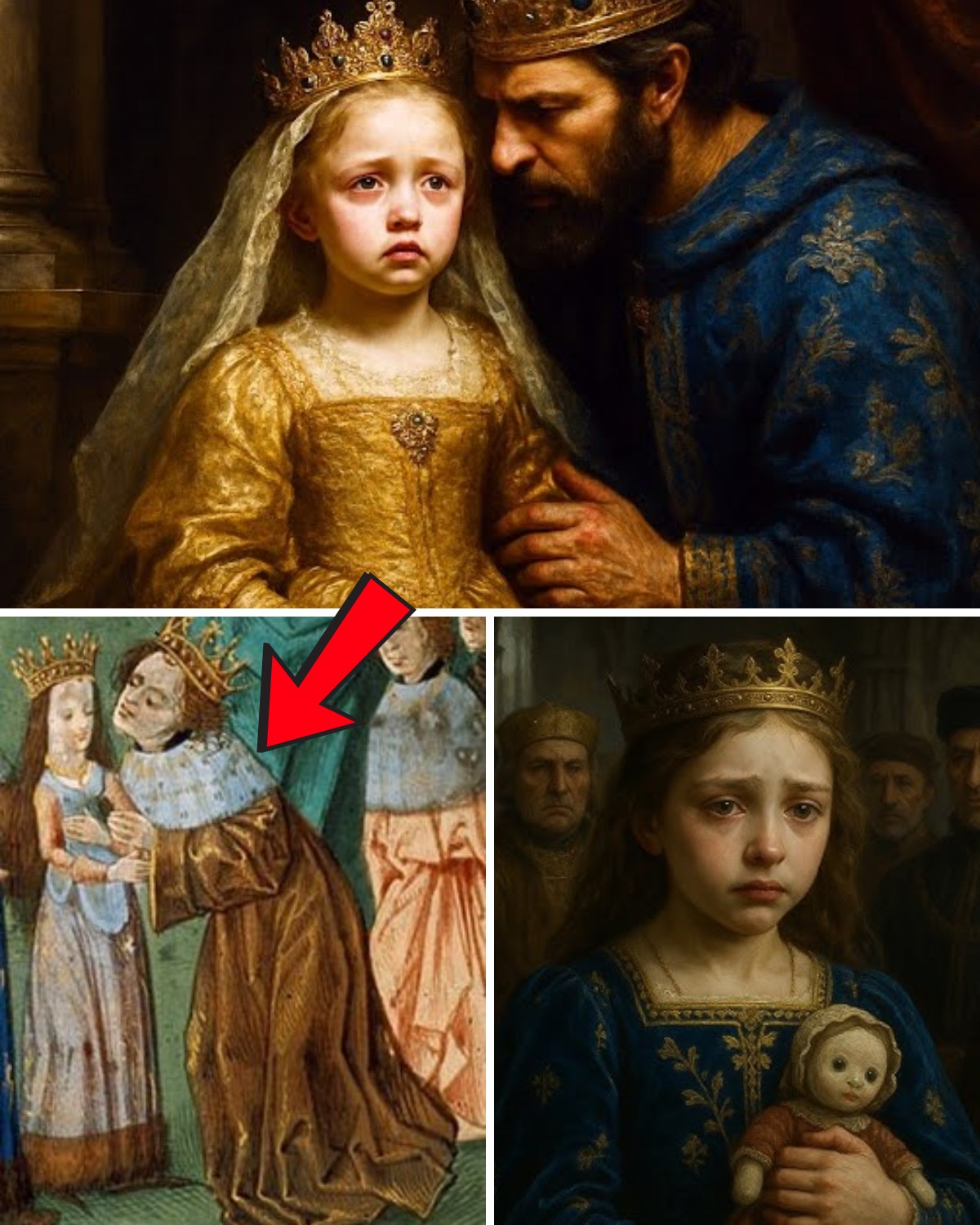

Isabella of Valois: The Childhood Princess Who Became England’s Youngest Queen
History often remembers monarchs for their power, victories, or scandals. Yet some figures are remembered for reasons far more complex—and far more revealing about the times in which they lived. Isabella of Valois, a young French princess who became Queen of England at the age of six, is one of these figures. Her story reflects not personal choice or ambition, but the political realities of medieval Europe, where royal marriages served as diplomatic tools rather than personal unions.
Though her childhood was marked by pageantry, alliances, and royal titles, Isabella’s life was shaped primarily by the shifting political landscape of the late 14th century. Her marriage to King Richard II has often been misinterpreted through a modern lens, but understanding it requires examining the customs, diplomatic strategies, and expectations of medieval monarchies.
While the marriage symbolized peace between two long-warring kingdoms, Isabella herself remained a child whose role was largely ceremonial. Her story offers a window into the political structures of her time, showing how royal families used marriage alliances as instruments of diplomacy and stability.
A Princess Born Into Turbulence

Isabella of Valois was born in 1389 as the daughter of King Charles VI of France and Queen Isabeau of Bavaria. Her early years coincided with a challenging period in French history. Her father suffered from recurring episodes of mental illness, and his condition affected the functioning of the French court. Political factions struggled for influence, and the kingdom’s stability often depended on careful negotiation among nobles and advisors.
Despite the uncertainty surrounding her father’s reign, Isabella’s position as a princess made her a valuable diplomatic figure. Royal children frequently played symbolic roles in treaties, and their marriages were arranged to bind kingdoms together. From an early age, Isabella lived within these political expectations.
By the mid-1390s, tensions between England and France—long-standing rivals—were easing. Leaders on both sides recognized the need for a lasting truce, given the strain of the ongoing Hundred Years’ War. A marriage alliance was considered one of the most effective paths toward peace.
A Marriage With Diplomatic Purpose

In 1396, when Isabella was just six years old, a formal marriage arrangement was completed between her and King Richard II of England, who was twenty-nine at the time. Modern observers may find this age difference surprising, but in medieval Europe such diplomatic marriages were not uncommon. Crucially, the union was entirely symbolic at the time of the wedding, and it was publicly understood that the marriage would not be consummated until Isabella reached maturity.
The ceremony took place near Calais with considerable grandeur. Chroniclers described the occasion as one steeped in royal tradition, featuring representatives from both kingdoms and an atmosphere of cautious optimism. For England, the marriage offered the hope of long-term peace with France; for France, it provided a strategic alliance that could temper conflict and ease political tensions.
After the ceremony, Isabella traveled to England, where she was welcomed with respect and treated according to the customs reserved for queens consort. Richard II, aware of her young age, ensured that she lived separately in an environment suited to a child, under the supervision of governesses and attendants.
Life as a Child Queen

Isabella’s life in England was not one of political power or adult responsibility. She was educated in languages, etiquette, and religious instruction, and she lived under the protection of Richard’s household. Contemporary accounts frequently describe her as gentle, intelligent, and well cared for.
Richard II regarded the marriage primarily as a diplomatic agreement and appears to have treated Isabella with consideration. He provided her with gifts, clothing, and a well-staffed household. She also participated in ceremonial functions appropriate for her age, symbolizing the peace between England and France.
However, the stability surrounding her life was short-lived. England’s political climate shifted rapidly, and Richard’s authority began to weaken. Discontent among the nobility—particularly Richard’s cousin, Henry Bolingbroke—created tension within the royal court.
A Kingdom in Crisis
In 1399, while Richard II was away in Ireland, Henry Bolingbroke returned to England and gained significant support among influential nobles. Within months, Richard was deposed, and Bolingbroke was crowned King Henry IV.
Isabella, still a child of just ten years old, found herself in a vulnerable position. As the widow of a deposed king, her status was politically sensitive. She was taken into custody and moved to various royal residences, including the Tower of London, not as a prisoner in the modern sense but as a figure whose presence required careful management.
Henry IV attempted to negotiate a new marriage for Isabella, hoping to maintain peaceful relations with France. The French royal family, however, preferred her return to her homeland, emphasizing her young age and the need to reunite her with her relatives.
Return to France and a New Beginning

In 1401, negotiations concluded and Isabella returned to France. Her journey across the Channel marked both an end and a beginning: she left behind a country where she had been queen in name but rarely in position, and rejoined her family as a member of the French court.
Her later life continued to reflect the political roles expected of royal women. At the age of sixteen, she married Charles, Duke of Orléans, in a union that strengthened internal French alliances. This marriage, unlike her earlier one, was age-appropriate and rooted in shared upbringing and cultural context.
Tragically, Isabella’s life remained short. She passed away in 1409 at the age of nineteen, likely due to complications following childbirth. Though she did not live long, her life had intersected with some of the most significant political events of the late medieval period.
Understanding Her Legacy
Isabella of Valois is often described as a “forgotten” or overlooked queen, yet her story tells us much about medieval diplomacy. Royal marriages were instruments of strategy rather than personal relationships, and children born into ruling families often carried responsibilities that reflected geopolitical needs rather than individual choice.
Her life also underscores the unique position of royal women, whose roles were shaped by alliance-building and ceremonial representation. Though she did not rule, Isabella’s presence influenced negotiations between two powerful kingdoms and helped maintain a period of stability between England and France.
Modern historians emphasize that interpreting her story requires sensitivity to historical context. What appears unusual today must be understood within the customs and norms of 14th-century Europe, where monarchs often engaged in symbolic marriages to secure peace and prevent war.
Isabella of Valois remains an important figure precisely because her life illustrates these dynamics. Through her, we gain insight into the complexities of the Hundred Years’ War, the relationships between European kingdoms, and the lived experiences of royal children whose futures were shaped by political necessity.
Sources
-
Isabella of Valois: Queen Consort of England – Encyclopaedia Britannica
-
The Life and Reign of Richard II – Royal Historical Society
-
Medieval Marriage Alliances in Europe – Oxford University Press
-
Charles VI of France and the Valois Court – Cambridge University Press
