
Humanity has known about conjoined twins for thousands of years. One of the earliest depictions dates back to around 4000–2200 BC: a white marble figure from Anatolia showing two women joined at the hip.
This 5,000-year-old statue was found in a Neolithic shrine and is considered the oldest known representation of conjoined twins. Despite how rare the condition is, it has fascinated both medical professionals and the public for millennia.
Today, doctors estimate that conjoined twins occur in roughly one out of every 50,000–60,000 births. For most of history, survival was extremely unlikely—both during pregnancy and after birth, especially if surgical separation was attempted.
Even now, the odds are daunting: around 60% of conjoined twin pregnancies result in stillbirth, and the condition appears more often in girls, with about three out of every four surviving sets being female.
Because the condition is so rare and many cases may never be documented, experts still don’t fully understand how these twins become physically connected in the womb.
According to Children’s Hospital Colorado, the most widely accepted explanation is that a single fertilized egg destined to form identical twins splits later than usual, and the division stops before fully completing, leaving the babies joined. Another possibility is that two initially separate embryos fuse together in very early development. For now, the underlying trigger for either process remains unknown.
Yet, despite these odds, some conjoined twins have not only survived but reached adulthood, set world records, and changed medical understanding. Here are some of their remarkable stories.
Chang and Eng
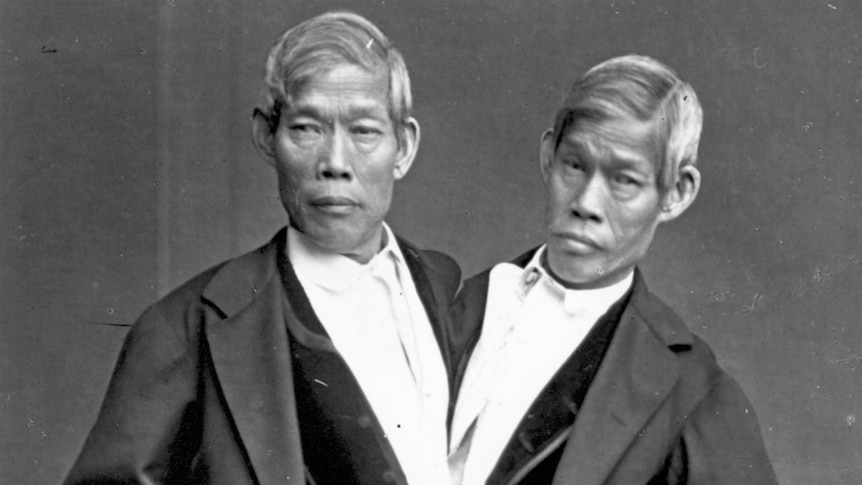
Perhaps the most famous conjoined twins in history are Chang and Eng Bunker, whose lives gave rise to the outdated phrase “Siamese twins.”
Born on 11 May 1811 in Meklong, in what was then Siam (now Thailand), Chang and Eng were the children of Chinese parents. They were joined at the chest by a band of tissue and shared a liver. Today, this type of connection might be operable, but in the early 19th century, separation was not considered possible.
In 1824, a Scottish trader named Robert Hunter saw them and quickly recognized that people would pay to see such a rarity. He arranged for the twins to travel to the United States in 1829, when they were 17. Initially they were exhibited while performing athletic tricks like somersaults. Over time, they learned English, took control of their own bookings, and shifted to a more formal lecture-style format where audiences could ask questions.
They eventually settled in North Carolina, became American citizens, and married two sisters, Adelaide and Sarah Yates. The brothers built two homes and lived on a three-day rotation, spending half the week with one household and half with the other.
Their story, however, is complicated by their participation in slavery. The Bunkers owned enslaved people and supported the Confederacy during the American Civil War—an aspect of their lives that casts a long shadow over their fame.
Together with their wives, the twins had 21 children: Chang and Adelaide had 10, while Eng and Sarah had 11. This set a record for the most children born to conjoined twins who were never separated.
Twin researcher Dr Nancy Segal has pointed out that their families were genetically unusual: since Chang and Eng were identical, the children of both couples were not just cousins but genetic half-siblings, because they effectively shared the same paternal genes.
Chang and Eng died on 17 January 1874 at the age of 62, after Chang passed away in his sleep and Eng died soon afterward. They have more than 1,500 descendants alive today, many of whom still gather in North Carolina. For years, the Bunkers held the record for the oldest male conjoined twins, until that title passed to Ronnie and Donnie Galyon.
Ronnie and Donnie

Ronnie and Donnie Galyon, born 25 October 1951 in Dayton, Ohio, spent their first two years in a hospital while doctors assessed whether separation was possible. The twins were joined at the abdomen and pelvis but had separate hearts, stomachs, livers, lungs, kidneys, and limbs.
As adults, they lived in their own home near their younger brother Jim and his wife Mary. They shared many of the same daily routines—cooking, cleaning, watching television, and playing with toy cars. They moved with the help of a custom-made double wheelchair and were well-known in their local community.
Despite being physically joined, their personalities differed. Like many siblings, they argued, sometimes staying upset with each other for days before reconciling—Jim recalled that Ronnie was usually the one to make peace first.
The idea of separation was never appealing to them. Donnie once explained that they believed they were born this way for a reason and were content with their lives together.
On their 63rd birthday, the Galyons became the oldest conjoined twins ever, surpassing Chang and Eng’s record. They were proud to be recognized in the Guinness World Records. Both brothers died on 4 July 2020 at the age of 68 years and 253 days, reportedly from heart-related complications.
Lori and George
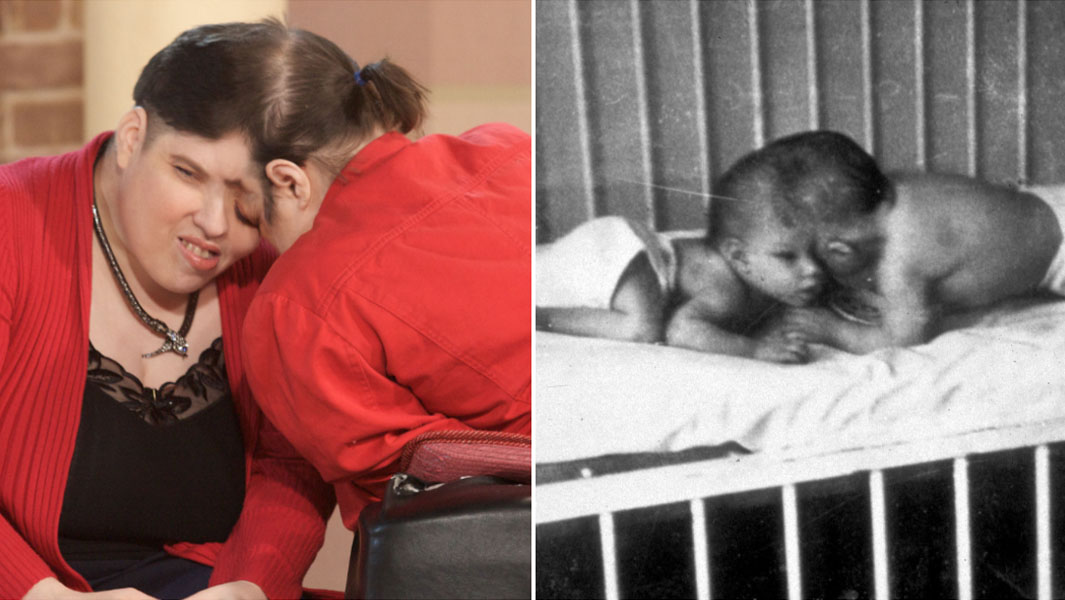
One of the rarest forms of the condition involves craniopagus twins, where two individuals are joined at the skull. This type accounts for only about 5% of all conjoined twin cases.
Among the most notable craniopagus twins were Lori Lynn and George (born Dori) Schappell, who lived an exceptionally long life for their condition. Born on 18 September 1961 in Reading, Pennsylvania, they became the oldest female conjoined twins ever recorded, dying at 62 years and 202 days old on 7 April 2024.
Lori and George shared partially fused skulls, several key blood vessels, and around 30% of their brain tissue (including parts of the frontal and parietal lobes). Despite this, they had different levels of mobility and distinct personalities. Lori was fully mobile, while George had spina bifida and used a wheelchair that Lori pushed when they travelled.
Each sibling developed their own career and interests: George became a country music performer, while Lori excelled as a ten-pin bowler and worked at a hospital laundry when not traveling with George for performances.
In 2007, George publicly came out as transgender and began living as a man, making the pair the first known case of same-sex conjoined twins to live as different genders. He changed his name from Reba to George, expressing a desire for more independent identity and a dislike of the rhyming names they had been given at birth.
The twins aimed for as much independence as possible within their situation. They shared a two-bedroom apartment, alternating which room they used, and maintained separate hobbies and daily routines. They even organized their bathroom time so that one twin would stand behind the shower curtain while the other washed.
Doctors had once predicted they would not live past 30, but Lori and George more than doubled that expectation. They died in 2024 at the Hospital of the University of Pennsylvania from undisclosed causes. They are survived by their father, six siblings, nieces, nephews, and many friends.
Masha and Dasha

The rarest conjoined twins documented so far are Masha and Dasha Krivoshlyapova from Russia, born on 3 January 1950 in the former USSR and passing away on 17 April 2003, within 17 hours of one another.
The sisters were dicephalus tetrabrachius dipus twins: they had two heads, four arms, and two legs, with a shared lower body. They shared one reproductive system, bladder, and colon, but had separate spines, small intestines, hearts, and lungs.
Writer Juliet Butler spent over a decade studying their lives for her book The Less You Know the Sounder You Sleep, which examines their childhood, personalities, and the difficult history of medical experimentation they endured in Soviet institutions.
Butler has explained that the twins were, for a long time, astonishingly unaware of their full medical history and even of the term “conjoined twins.” Despite their physical connection, they saw themselves as very different individuals. Masha once remarked that nothing about them felt identical and that she believed they “must have become joined somehow,” reflecting their lack of early information about their condition.
Three years after their deaths, Butler began writing their biography, hoping to honor Dasha’s desire for a society more accepting of visible disabilities. She has said she hopes sharing their story will help move the world closer to that goal.
What their stories teach us
From ancient carvings to modern medical records, conjoined twins have challenged our understanding of human development, individuality, and connection.
Their lives highlight both advances in medicine and ongoing ethical questions—about separation surgery, autonomy, identity, and how society treats people whose bodies do not fit conventional expectations.
Every time these stories are told—whether it’s Chang and Eng’s complicated legacy, Ronnie and Donnie’s determination to live on their own terms, Lori and George’s groundbreaking gender identities, or Masha and Dasha’s struggle for dignity—awareness grows.
With greater awareness can come better research, more compassionate healthcare, and a more inclusive culture for people with disabilities and rare conditions.
